
48V Rack-Mounted LiFePO4 Battery Guide (2026)

Table of Contents
- Introduction: Why 48V Rack-Mounted LiFePO4?
- What Is a 48V Rack-Mounted LiFePO4 Battery?
- Key Specifications & Parameters
- 6 Reasons to Choose 48V Rack-Mounted Systems
- 48V vs 24V vs 12V: Which Voltage for Rack Storage?
- Key Applications & Typical Setups
- How to Size a 48V Rack Battery System (Step-by-Step)
- Rack-Mounted vs Wall-Mounted vs Stackable
- Installation & Inverter Integration Best Practices
- B2B Procurement Checklist (15 Points)
- Related Resources
- Frequently Asked Questions
- Summary
48V Rack-Mounted LiFePO4 Battery: 100Ah/200Ah Specs, Sizing & Procurement Guide (2026)
Last updated: September 2026 | Written by the Enerbe Engineering Team
Introduction: Why 48V Rack-Mounted LiFePO4?
Quick Answer: This 48v rack mounted lithium battery guide covers everything project buyers need to know—from module specifications and rack compatibility to sizing calculations, inverter integration, certifications, and procurement best practices.A 48V rack-mounted LiFePO4 battery is a modular 51.2V (16S) lithium iron phosphate battery pack designed to slide into standard 19-inch server racks, offering 2.5-5.12 kWh per module (50-100Ah), 4,000+ cycle life, CAN bus/RS485 communication, and hot-swappable maintenance. It is the standard form factor for data center UPS, telecom base stations, and commercial energy storage. For project buyers, the key selection criteria are: rack compatibility (3U-6U), capacity per module, communication protocol (CAN/RS485), certifications (UL 1973, IEC 62619, UN38.3), BMS quality, and inverter compatibility. A typical 4-module rack provides ~20 kWh of usable storage, sufficient for most small commercial and data center rack applications.
This 48V rack-mounted lithium battery guide covers everything project buyers, system integrators, data center operators, and telecom engineers need to know about sourcing and selecting rack-mounted LiFePO4 batteries. From key specifications and rack compatibility to sizing calculations, inverter integration, certifications, and a 15-point procurement checklist—this guide helps you make informed decisions and avoid costly procurement mistakes.
For a complete overview of LiFePO4 battery technology, see our What Is a LiFePO4 Battery guide. For broader sourcing across all applications, see our B2B Sourcing Guide.
What Is a 48V Rack-Mounted LiFePO4 Battery?
A 48V rack-mounted LiFePO4 battery (also called a rack battery, server rack battery, or 19-inch rack battery) is a modular energy storage unit designed to slide into standard 19-inch server racks or dedicated battery cabinets. Each module contains 16 LiFePO4 cells in series (16S), producing a nominal voltage of 51.2V (marketed as "48V"), with capacities ranging from 50Ah to 100Ah (2.56 kWh to 5.12 kWh per module).
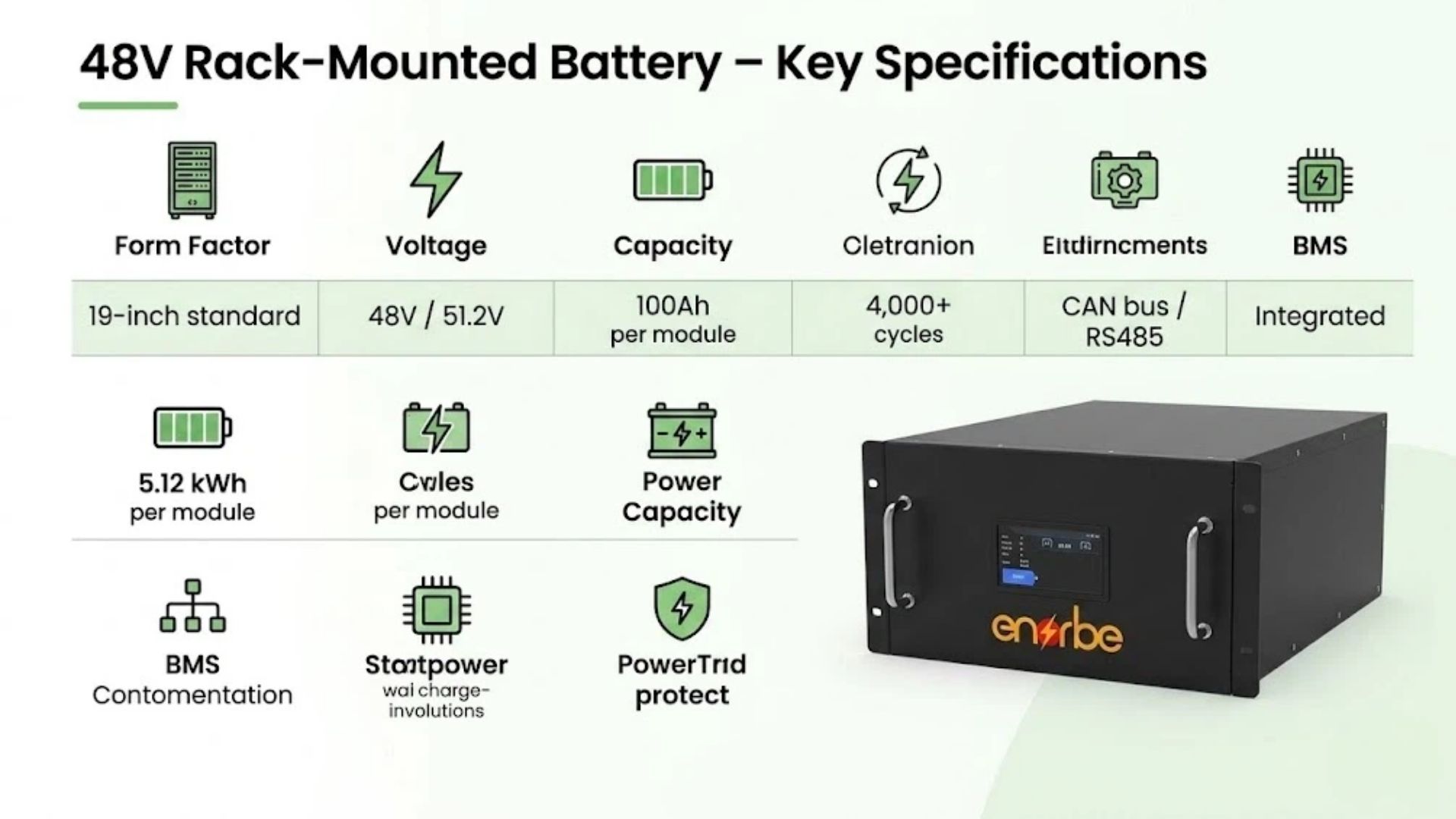
Key components of a rack-mounted battery module:
-
16S LiFePO4 cell pack — 16 lithium iron phosphate cells in series, 51.2V nominal
-
Integrated BMS — Battery Management System with per-cell voltage monitoring, temperature sensing, current measurement, cell balancing, and full protection (over-voltage, under-voltage, over-current, short-circuit, over-temperature)
-
19-inch rack enclosure — Standard 19-inch width, 3U-6U height (1U = 44.45mm), with rack mounting ears and slide rails
-
Communication ports — CAN bus and/or RS485 for integration with inverters, PCS, and monitoring systems
-
Power terminals — M6/M8 copper terminals for DC input/output, typically on the front or rear panel
-
Display / LEDs — LCD screen or LED indicators showing SOC, voltage, current, temperature, and fault status
-
Parallel expansion port — Allows multiple modules to be connected in parallel for capacity expansion (up to 15+ modules per rack)
How rack systems scale: Multiple modules are connected in parallel (same voltage, increased capacity) and mounted in a standard 19-inch rack. A typical 42U rack can hold 7-14 modules (depending on module height), providing 17.5-71.7 kWh of energy storage per rack. For larger systems, multiple racks are connected in parallel through a battery cabinet or PCS (Power Conversion System).
Key Specifications & Parameters
| Specification | Typical Value | Notes |
|---|---|---|
| Nominal Voltage | 51.2V (16S) | Marketed as "48V"; 16 LiFePO4 cells in series (3.2V × 16 = 51.2V) |
| Full Charge Voltage | 58.4V | 3.65V per cell × 16 |
| Cut-off Voltage | 40.0V (BMS) | 2.5V per cell × 16; inverter low-voltage cutoff typically set at 44-46V |
| Capacity per Module | 50Ah – 100Ah | 100Ah = 5.12 kWh; 50Ah = 2.56 kWh |
| Energy per Module | 2.56 – 5.12 kWh | Usable energy ~80-90% of nominal (4.1-4.6 kWh for 100Ah) |
| Form Factor | 19-inch standard, 3U–6U height | 1U = 44.45mm; 3U = 133mm, 6U = 267mm |
| Module Dimensions (typical) | 482 × 133 × 450mm (3U 100Ah) | Width × Height × Depth; depth varies 400-500mm |
| Module Weight | 25-35 kg (100Ah) | Verify rack load capacity; a full rack of 10 modules = 250-350 kg |
| Rack Capacity | 4–15 modules per rack | Depends on module height and rack height (42U standard) |
| Continuous Discharge | 0.5C-1C (50-100A for 100Ah) | BMS limits continuous current; peak 2C for 5-10 seconds |
| Max Charge Current | 0.5C (50A for 100Ah) | Faster charging reduces cycle life; 0.2C-0.5C recommended |
| Communication | CAN bus / RS485 | CAN for inverter integration; RS485 for monitoring/industrial |
| BMS Protection | OVP, UVP, OCP, SCP, OTP, UTP | Over/under voltage, over current, short circuit, over/under temperature |
| Cell Balancing | Passive, 50-100mA per cell | Active balancing available on high-end models |
| Cycle Life | 4,000+ cycles at 80% DoD | To 80% capacity retention; 6,000+ at 50% DoD |
| Round-Trip Efficiency | 94-97% | DC-to-DC; system-level (with inverter) 88-92% |
| Operating Temperature | Discharge: -20°C to 60°C; Charge: 0°C to 45°C | Heating option available for cold climate charging |
| Cooling | Natural convection / forced air | Rack-mounted units benefit from rack airflow; high-density racks may need active cooling |
| Certifications | UL 1973, IEC 62619, UN38.3, CE, RoHS | UL 9540/9540A for system-level; verify model-specific certificates |
| Warranty | 5-10 years | Typically 5 years standard, 10 years extended for commercial projects |
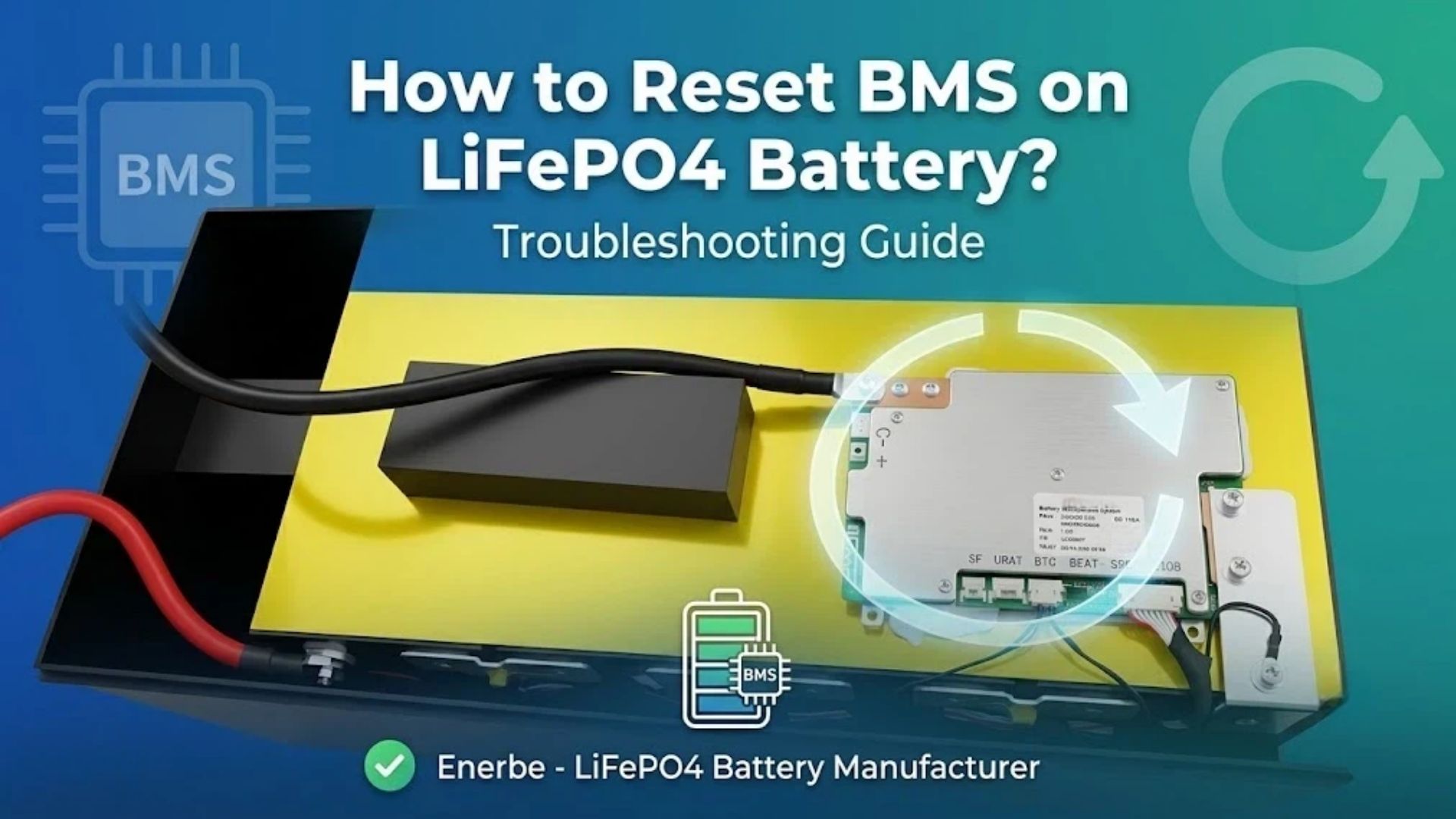
The integrated Battery Management System (BMS) provides comprehensive protection and enables remote monitoring through CAN bus or RS485 communication. For more on BMS operation and troubleshooting, see our How to Reset BMS on LiFePO4 Battery guide.
6 Reasons to Choose 48V Rack-Mounted Systems
1. Standardized 19-Inch Form Factor
The 19-inch rack format is the global industry standard for data centers, telecom facilities, and server rooms. Rack-mounted batteries integrate seamlessly with existing server racks, requiring no custom enclosures, no dedicated battery room, and minimal floor space. This standardization also means you can mix and match components from different vendors (batteries, inverters, switches) in the same rack.
2. Modular Scalability
Start with 1-2 modules (5-10 kWh) and expand to 15+ modules (75+ kWh) per rack as load grows. Each module is a complete battery with its own BMS, allowing capacity expansion without system redesign or replacing existing equipment. For larger projects, add more racks—there is no practical upper limit for parallel expansion.
3. Hot-Swappable Maintenance
Slide-out modules can be replaced without powering down the entire system—critical for data centers, telecom operations, and critical infrastructure where downtime costs thousands of dollars per minute. If one module fails, simply slide it out and replace it with a spare; the remaining modules continue operating. This also means you don't need a certified battery technician on-site for module replacement.
4. 48V Platform Efficiency
The 48V (51.2V) platform offers significant advantages over 12V and 24V for higher-power applications: lower current for the same power (P = V × I), meaning thinner cables, less voltage drop, higher system efficiency, and reduced heat. For a 5kW load, 48V draws ~100A vs 12V drawing ~417A—requiring much heavier and more expensive cables. 48V is also the telecom industry standard voltage, making integration straightforward.
5. Active Cooling & High-Density Installation
Rack-mounted batteries are designed to work with rack cooling systems (front-to-back airflow), maintaining optimal operating temperatures even in high-density installations where multiple racks are placed side by side. This is essential for data centers and commercial installations where heat management is critical. Many modules also include temperature sensors that trigger derating or shutdown if temperatures exceed safe limits.
6. Communication & Remote Monitoring
CAN bus and RS485 communication enable integration with existing monitoring systems (BMS, SCADA, cloud platforms), providing real-time visibility into battery health, state of charge, cell voltages, temperatures, and system status. For system integrators, this means you can monitor and manage battery fleets remotely, receive alerts for faults or anomalies, and perform predictive maintenance—reducing on-site service costs and minimizing downtime.
48V vs 24V vs 12V: Which Voltage for Rack Storage?
Choosing the right voltage platform is one of the most important decisions in designing a rack energy storage system. Here is a comparison of the three common voltages:
| Parameter | 12V (4S) | 24V (8S) | 48V (16S) |
|---|---|---|---|
| Nominal voltage | 12.8V | 25.6V | 51.2V |
| Current at 5kW load | ~390A | ~195A | ~98A |
| Cable gauge (5kW) | 2/0 AWG (heavy) | 2 AWG | 6 AWG (light) |
| Cable cost (5kW, 3m) | High ($150-250) | Medium ($60-120) | Low ($20-50) |
| System efficiency | Lower (higher I²R loss) | Medium | Higher (lower current) |
| Max practical power | 1-3 kW | 3-8 kW | 8-30+ kW |
| Typical applications | RV, marine, small solar | Trolling motor, marine house bank | Data center, telecom, commercial ESS |
| Rack-mount common? | Rare | Occasional | Standard |
Rule of thumb: For systems above 3kW, 48V is the practical choice. For rack-mounted applications specifically, 48V is the industry standard—almost all rack battery modules, inverters, and PCS systems are designed for 48V. For more on 24V systems, see our 24V LiFePO4 battery complete guide.
Key Applications & Typical Setups
1. Data Center UPS Backup
48V rack-mounted batteries provide reliable backup power for server racks, ensuring uninterrupted operation during grid outages. The 48V platform matches the legacy telecom voltage used in many data center UPS systems, and the rack form factor allows batteries to be colocated with servers in the same rack.
Typical setup: 1-3 racks per data center aisle, each with 4-8 modules (20-40 kWh per rack), paired with a 48V DC UPS or inverter/charger. Runtime: 15-60 minutes at full rack load, sufficient for graceful shutdown or generator transfer.
2. Telecom Base Stations
The 48V platform is the global telecom industry standard (specified in ITU-T and ETSI standards). Rack-mounted batteries are ideal for cell towers, central offices, and communication facilities, offering reliable backup in a compact form factor that fits standard telecom racks.
Typical setup: 2-4 modules per base station (10-20 kWh), paired with a 48V rectifier system. Runtime: 4-8 hours at typical base station load (1-3 kW). Many telecom operators are replacing lead-acid battery banks with LiFePO4 rack modules to reduce maintenance and extend service life.
3. Commercial Energy Storage (C&I)
Rack-mounted batteries are increasingly used in commercial buildings for peak shaving, demand charge reduction, time-of-use arbitrage, and backup power. The modular design allows systems to be sized precisely for the building's load profile, and the rack form factor fits in mechanical rooms or dedicated battery closets.
Typical setup: 1-5 racks per commercial installation (20-250 kWh), paired with a 30-100kW hybrid inverter or PCS. Applications: peak shaving (reduce demand charges), backup power (critical loads), solar self-consumption (store excess solar for evening use).
4. Server Room & Edge Computing
Small to mid-size server rooms and edge computing facilities benefit from rack-mounted batteries for UPS protection without dedicated battery rooms. The batteries mount directly in the server rack, saving floor space and simplifying cable runs.
Typical setup: 1 rack with 2-4 modules (10-20 kWh), paired with a rack-mount inverter/charger. Runtime: 20-60 minutes at typical server room load (3-5 kW).
5. Solar + Storage for Small Businesses
For small businesses (retail, offices, workshops) with rooftop solar, rack-mounted 48V batteries provide a compact, scalable storage solution that fits in a closet or mechanical room. Pair with a hybrid inverter for solar charging, grid backup, and load management.
Typical setup: 1 rack with 2-6 modules (10-30 kWh), paired with a 5-15kW hybrid inverter. Solar array: 5-20kWp. Applications: solar self-consumption, peak shaving, backup power.
How to Size a 48V Rack Battery System (Step-by-Step)
Step 1: Calculate Your Load
Determine the total power (kW) and energy (kWh) your system needs to support:
-
Continuous power (kW): Sum the wattage of all loads that will run simultaneously. For UPS backup, this is the critical load only.
-
Daily energy (kWh): Multiply each load's power by its daily runtime, then sum. For solar self-consumption, this is the excess solar energy you want to store.
-
Required runtime (hours): How long the battery should power the load during an outage (UPS) or through the evening (solar storage).
Step 2: Calculate Required Battery Capacity
Formula:
Required kWh = (Load kW × Runtime hours) ÷ (Depth of Discharge × Inverter Efficiency × Temperature Derating)
Typical values: DoD = 0.8 (80%), Inverter efficiency = 0.92 (92%), Temperature derating = 0.95 (at 25°C)
Example: A small commercial building needs 5kW backup for 4 hours.
-
Required kWh = (5kW × 4h) ÷ (0.8 × 0.92 × 0.95) = 20 ÷ 0.699 = 28.6 kWh
-
Round up to 30 kWh → 6 modules × 5.12 kWh = 30.7 kWh nominal, ~24.6 kWh usable at 80% DoD
-
Wait, that's not enough. Recalculate: need 28.6 kWh usable → 28.6 ÷ 0.8 = 35.8 kWh nominal → 7 modules × 5.12 = 35.8 kWh → 7 modules
Step 3: Verify Inverter/PCS Compatibility
| Check | Requirement |
|---|---|
| Voltage range | Inverter must accept 40-58.4V DC (48V LiFePO4 range) |
| Max charge current | Inverter charge current ≤ 0.5C per module (50A for 100Ah) |
| Max discharge current | Inverter continuous output ≤ module continuous current × number of modules |
| Communication protocol | Inverter must support CAN bus or RS485 BMS communication (verify specific protocol: PYLONTECH, DEYE, SOLARAXE, etc.) |
| Parallel support | Inverter must support the number of parallel modules you plan to use (typically 8-15 max) |
Step 4: Quick Sizing Reference Table
| Application | Typical Load | Runtime | Modules (100Ah) | Nominal kWh |
|---|---|---|---|---|
| Small server room | 2-3 kW | 30 min | 1-2 | 5-10 kWh |
| Data center rack | 5-10 kW | 15-30 min | 2-4 | 10-20 kWh |
| Telecom base station | 1-3 kW | 4-8 hours | 2-4 | 10-20 kWh |
| Small business solar+storage | 3-5 kW | 4-6 hours | 4-6 | 20-30 kWh |
| Commercial ESS (peak shaving) | 10-30 kW | 2-4 hours | 8-15 (1-2 racks) | 40-75 kWh |
Rack-Mounted vs Wall-Mounted vs Stackable
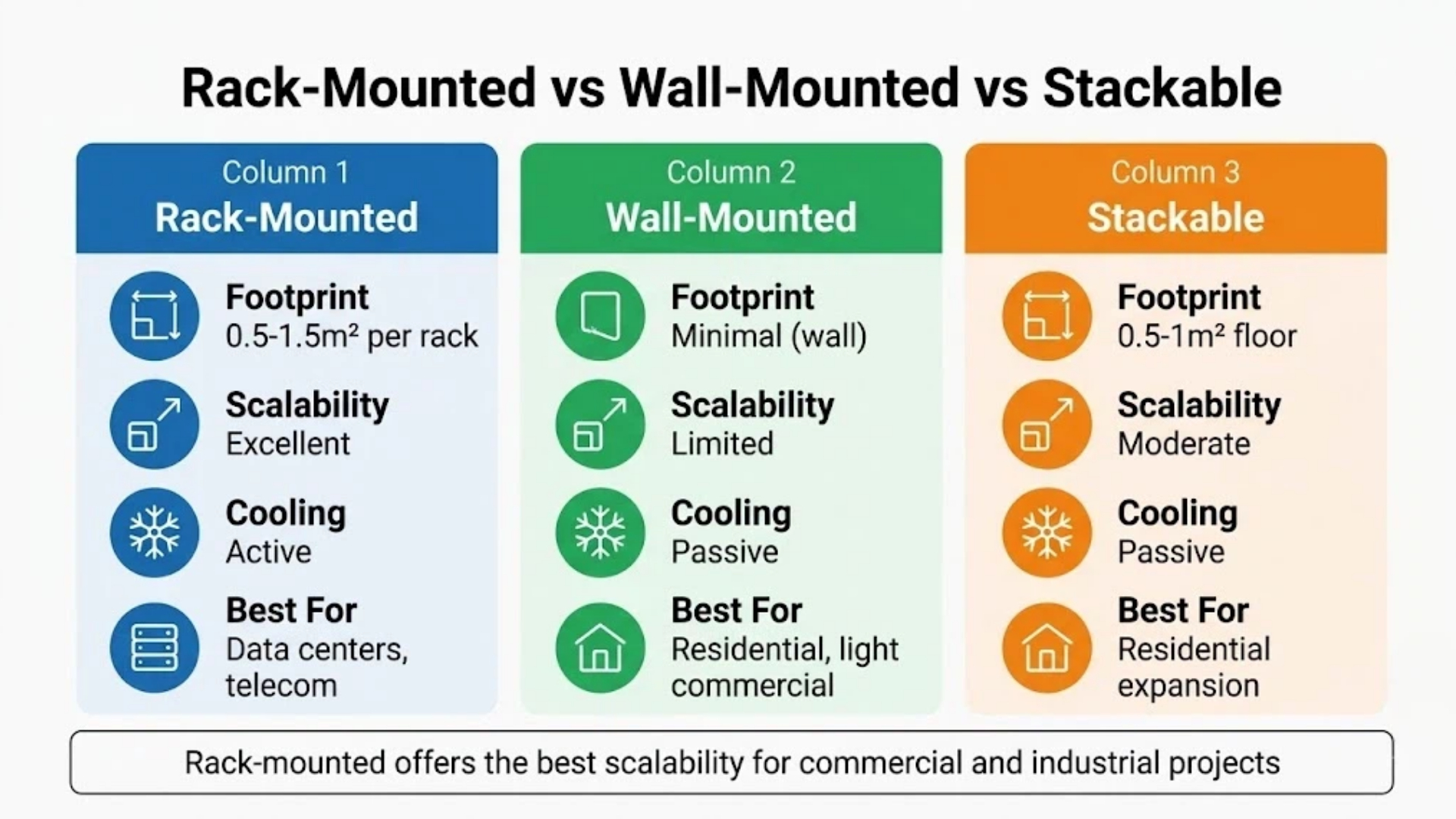
| Feature | Rack-Mounted | Wall-Mounted | Stackable |
|---|---|---|---|
| Footprint | 0.5-1.5m² per rack | Minimal (wall) | 0.5-1m² floor |
| Scalability | Excellent (10+ racks, no practical limit) | Limited (2-3 units per wall) | Moderate (2-10 modules per stack) |
| Cooling | Active (rack airflow, front-to-back) | Passive (natural convection) | Passive + optional active |
| Maintenance | Slide-out (hot-swappable, no shutdown) | Fixed (must remove from wall) | Stack access (remove upper modules first) |
| Standardization | 19-inch EIA/ECA standard | Proprietary (varies by brand) | Proprietary (varies by brand) |
| Cost per kWh | Lower (high volume, standard form factor) | Higher (enclosure, mounting hardware) | Medium |
| Best For | Data centers, telecom, commercial ESS, server rooms | Residential, light commercial, floor space limited | Residential expansion, small commercial |
For project buyers, rack-mounted systems offer the best scalability, maintenance accessibility, and standardization—critical for commercial and industrial installations where uptime and future expansion are priorities.
Installation & Inverter Integration Best Practices
Rack Installation
-
Rack selection: Use a standard 19-inch server rack with sufficient depth (≥600mm for most modules) and load rating (≥500kg for a full rack of 100Ah modules). Open-frame racks are preferred for airflow; enclosed racks need active cooling.
-
Module placement: Install heavier modules lower in the rack for stability. Leave 1U (44mm) of space between modules for airflow if the rack does not have forced-air cooling. Ensure modules are securely mounted with rack screws or slide rails.
-
Grounding: Ground the rack and all battery modules to a common grounding busbar per local electrical codes (NEC, IEC, etc.). Use appropriate gauge grounding wire (typically 6 AWG or larger).
-
Cable management: Use cable trays or routing channels for DC power cables and communication wires. Keep power cables and communication cables separated (≥150mm) to avoid electromagnetic interference. Label all cables at both ends.
Parallel Connection of Multiple Modules
-
Match modules: Only parallel modules from the same manufacturer, same model, same capacity, and similar age/SOC. Mixing different modules can cause unequal current sharing and premature failure.
-
Pre-charge modules to same voltage: Before connecting in parallel, charge or discharge all modules to within ±0.5V of each other. Large voltage differences cause high inrush current that can damage BMS or weld contacts.
-
Use parallel busbars: Connect all module positives to a common positive busbar and all negatives to a common negative busbar. Use equal-length cables from each module to the busbar to ensure equal current sharing.
-
Fuse each module: Install a fuse or circuit breaker on the positive output of each module, rated at the module's maximum continuous discharge current. This protects against a single module failure causing a cascade.
-
BMS communication: Connect modules in parallel via the BMS communication port (daisy-chain CAN or RS485). The master BMS (or first module) communicates with the inverter; slave modules report their status to the master.
Inverter/PCS Integration
-
Verify communication protocol: Confirm the inverter supports the battery's BMS communication protocol (e.g., PYLONTECH CAN, DEYE CAN, SOLARAXE, RS485 Modbus). Many inverters have a "battery type" setting—select "LiFePO4" or the specific brand protocol.
-
Set charge parameters: Configure the inverter's charge voltage to 58.4V (56.4V recommended for longer life), charge current to ≤0.5C, and low-voltage cutoff to 44-46V (above the BMS hard cutoff of 40V to protect the battery).
-
Set discharge parameters: Configure discharge cutoff voltage to 44-46V, and maximum discharge current to the inverter's rating (not exceeding the battery's continuous current rating).
-
Test communication: After connection, verify the inverter can read battery SOC, voltage, current, and temperature from the BMS. Test charge and discharge to confirm current limits are respected.
⚠️ Important
Always follow the manufacturer's installation manual and local electrical codes. Lithium battery installations may require permits, inspections, and dedicated fire suppression depending on system size and jurisdiction. For commercial installations, engage a licensed electrician and verify compliance with NEC Article 480 (Storage Batteries), NFPA 855 (Energy Storage Systems), and local fire codes.
B2B Procurement Checklist (15 Points)
When sourcing 48V rack-mounted lithium batteries for commercial projects, verify each of these 15 points before issuing a purchase order:
-
Form factor — 19-inch rack compatibility (EIA-310 standard), verify exact width, height (U), and depth fit your rack
-
Module height — 3U-6U, calculate how many modules fit your rack height (account for 1U spacing if no forced cooling)
-
Capacity — 50Ah-100Ah per module (2.56-5.12 kWh), verify usable capacity at 80% DoD, not just nominal
-
Cell manufacturer & grade — Ask for cell brand (CATL, BYD, EVE, CALB, etc.) and confirm Grade A cells with test reports
-
BMS manufacturer & features — BMS brand, per-cell monitoring, balancing current (passive/active), protection thresholds, firmware update capability
-
Communication protocol — CAN bus / RS485, verify specific protocol compatibility with your inverter/PCS (PYLONTECH, DEYE, SOLARAXE, Modbus, etc.)
-
Parallel expansion — Maximum number of modules in parallel, master/slave configuration, parallel busbar included or optional
-
Certifications — UL 1973 (model-specific), IEC 62619, UN38.3, CE, RoHS; for system-level: UL 9540, UL 9540A. Verify certificates directly with issuing body
-
Cycle life test data — Request independent cycle life test data showing 80% capacity retention after claimed cycles (not just marketing claims)
-
Continuous/peak current — Verify continuous discharge current (0.5C-1C) and peak current (2C for 5-10s) match your load requirements
-
Cooling & temperature range — Operating temperature range, charging temperature range (0-45°C), heating option for cold climates, cooling method (natural/forced)
-
Warranty terms — 5-10 years standard, what is covered (defects, capacity degradation threshold), claim process, replacement lead time
-
Hot-swappable design — Can modules be replaced without system shutdown? Are slide rails included? Is there a maintenance bypass?
-
Shipping & packaging — UN38.3 certified packaging, shipping dimensions and weight per module, pallet quantity, damage replacement policy
-
Technical support & after-sales — Response time (24h?), engineering support for integration, firmware updates, spare parts availability (BMS, sensors, connectors), local service partner
For a comprehensive supplier evaluation framework, see our reliable BESS supplier vs risky supplier guide with a 17-point audit checklist.
Related Resources
-
What Is a LiFePO4 Battery? — chemistry, specs, advantages vs NMC and lead-acid
-
LiFePO4 Battery Safety Guide — thermal runaway, fire risk, certifications, emergency response
-
How to Reset BMS on LiFePO4 Battery — BMS protection mode, reset procedures, troubleshooting
-
Reliable BESS Supplier vs Risky Supplier — 17-point audit checklist for supplier evaluation
-
24V LiFePO4 Battery Complete Guide — for lower-voltage applications (marine, trolling motor, RV)
-
LiFePO4 Battery Products — 12V, 24V, 48V rack-mounted and standalone batteries
Frequently Asked Questions
What is a 48V rack-mounted battery?
A 48V rack-mounted battery is a modular 51.2V (16S) lithium iron phosphate (LiFePO4) battery pack designed to slide into standard 19-inch server racks. Each module typically provides 50-100Ah (2.56-5.12 kWh), with an integrated BMS, CAN bus/RS485 communication, and hot-swappable design. Multiple modules connect in parallel to scale capacity from 5 kWh to 75+ kWh per rack, making them ideal for data center UPS, telecom backup, and commercial energy storage.
Why is 48V used instead of 12V or 24V for rack storage?
48V (51.2V) is preferred for rack storage and higher-power applications because higher voltage means lower current for the same power (P = V × I), resulting in: thinner and cheaper cables, less voltage drop over distance, higher system efficiency (less I²R heat loss), and reduced connector and switch ratings. For a 5kW load, 48V draws ~98A (6 AWG cable) vs 12V drawing ~390A (2/0 AWG cable). 48V is also the global telecom standard voltage, and almost all rack battery modules, inverters, and PCS systems are designed for 48V. For systems above 3kW, 48V is the practical choice.
How many 48V rack battery modules do I need?
Calculate required capacity using: Required kWh = (Load kW × Runtime hours) ÷ (DoD × Inverter Efficiency × Temperature Derating). Use DoD = 0.8, inverter efficiency = 0.92, temperature derating = 0.95. Then divide by 5.12 kWh (per 100Ah module) and round up. Quick reference: 1-2 modules (5-10 kWh) for small server room UPS (2-3kW, 30min); 2-4 modules (10-20 kWh) for data center rack or telecom base station; 4-6 modules (20-30 kWh) for small business solar+storage; 8-15 modules (40-75 kWh) for commercial ESS peak shaving. Always verify your inverter supports the number of parallel modules you plan to use.
Can I mix different brands of 48V rack batteries in parallel?
No, you should not mix different brands, models, capacities, or ages of battery modules in parallel. Different BMS units have different protection thresholds, charge curves, and communication protocols, which can cause unequal current sharing, overcharging of weaker modules, and premature failure. For parallel operation, use identical modules from the same manufacturer, same model, same capacity, and similar age (within ±6 months). Before connecting in parallel, ensure all modules are within ±0.5V of each other to avoid high inrush current. If you need to expand an existing system, contact the manufacturer for guidance—some brands support adding new modules to an existing bank after a voltage matching procedure.
What certifications should a 48V rack battery have?
Key certifications for 48V rack-mounted LiFePO4 batteries: UL 1973 (stationary battery safety, required for US installations and insurance), IEC 62619 (international industrial battery safety), UN38.3 (transport safety, mandatory for shipping), CE (EU conformity), RoHS (environmental compliance). For system-level BESS installations, also verify UL 9540 (complete energy storage system safety) and UL 9540A (thermal runaway fire propagation testing at cell, module, unit, and installation levels). For grid-tied systems, verify IEEE 1547 compliance. Always verify certificates directly with the issuing body (UL, IEC, TÜV) — never rely solely on the supplier's marketing materials, as certificates can be expired, revoked, or not model-specific.
How long do 48V rack-mounted LiFePO4 batteries last?
48V rack-mounted LiFePO4 batteries typically last 4,000-6,000+ charge-discharge cycles before reaching 80% capacity retention, depending on depth of discharge (DoD). At 80% DoD, 4,000-5,000 cycles is standard; at 50% DoD, 6,000+ cycles. In calendar terms, this translates to 10-15+ years of service life for most commercial applications (at 1 cycle/day). Factors that affect lifespan: depth of discharge (shallower = longer), charge rate (0.2C-0.5C recommended, faster = shorter), operating temperature (15-25°C ideal, above 40°C or below 0°C accelerates degradation), and BMS/cell quality. Most manufacturers offer 5-10 year warranties, with extended warranties available for commercial projects.
What inverter brands are compatible with 48V rack batteries?
Most major hybrid inverter and PCS brands support 48V LiFePO4 rack batteries with CAN bus or RS485 BMS communication. Common compatible brands include: Victron (MultiPlus/Quattro, uses VE.Bus or CAN), Deye/SunSynk (hybrid inverters, supports PYLONTECH CAN protocol), Growatt (SPF series, supports CAN/RS485), Sol-Ark (hybrid inverters, supports multiple BMS protocols), SMA (Sunny Island, supports CAN), Schneider (Conext XW+, supports CAN), and many PCS brands for commercial systems (Sungrow, Huawei, GoodWe, etc.). Always verify specific model compatibility with the battery manufacturer before purchasing—some inverters require a specific BMS protocol or firmware version. The battery manufacturer should provide a compatibility list and integration guide.
Are 48V rack batteries safe for data center and commercial installations?
Yes, 48V rack-mounted LiFePO4 batteries are safe for data center and commercial installations when properly selected, installed, and maintained. LiFePO4 chemistry has a thermal runaway threshold of ~270°C (vs ~150°C for NMC), does not release oxygen during decomposition, and has lower fire probability than other lithium chemistries. Key safety measures: choose batteries with UL 1973 and IEC 62619 certification, ensure the BMS provides full protection (over/under voltage, over current, short circuit, temperature), install in a properly ventilated rack or battery room, follow manufacturer spacing and cooling requirements, install fuses on each module, and comply with local fire codes (NFPA 855 for energy storage systems, NEC Article 480 for storage batteries). For large installations (>20 kWh), consider dedicated fire suppression and thermal monitoring. For a detailed safety analysis, see our LiFePO4 battery safety guide.
Summary
A 48V rack-mounted LiFePO4 battery is the standard form factor for data center UPS, telecom backup, and commercial energy storage. Key takeaways for project buyers:
-
Specs: 51.2V nominal (16S), 50-100Ah per module (2.56-5.12 kWh), 19-inch rack form factor (3U-6U), 4,000+ cycle life, CAN bus/RS485 communication
-
Why 48V: Lower current = thinner cables, less voltage drop, higher efficiency; 48V is the telecom and data center standard; practical for systems above 3kW
-
6 advantages: standardized form factor, modular scalability, hot-swappable maintenance, 48V efficiency, active cooling compatibility, remote monitoring
-
Sizing: Required kWh = (Load kW × Runtime) ÷ (0.8 × 0.92 × 0.95); verify inverter voltage range, charge/discharge current, communication protocol, and parallel support
-
Applications: data center UPS, telecom base stations, commercial ESS (peak shaving), server rooms, small business solar+storage
-
Procurement: Verify 15 points — form factor, capacity, cell grade, BMS quality, communication protocol, certifications (UL 1973, IEC 62619, UN38.3), cycle life test data, current ratings, warranty, hot-swap design, shipping, and technical support
-
Safety: LiFePO4 is the safest lithium chemistry; choose certified products, follow installation codes (NFPA 855, NEC 480), use proper fusing and ventilation
Enerbe provides 48V rack-mounted LiFePO4 batteries with Grade A cells, quality BMS, full certifications (UL 1973, IEC 62619, UN38.3, CE, RoHS), CAN bus/RS485 communication, and 5-10 year warranties. We serve data centers, telecom operators, system integrators, and commercial ESS projects worldwide with standard stock units and custom ODM/OEM builds. For wholesale pricing, custom configurations, or technical specifications, contact our engineering team.
Get In Touch
Ready to source 48V rack-mounted LiFePO4 batteries for your project? Contact Enerbe today.
📄 Request Rack Battery Datasheet & Certifications
Contact Us →📞 Speak with Our Engineering Team
Get In Touch →🔗 Browse 48V Rack-Mounted Battery Products
View Products →Dongguan A&S Power Technology Co., Limited.
Building 1, No. 2, Keji 9th Road,
Songshan Lake, Dongguan, Guangdong, China
📞 +86 137 1383 1631
✉ info@aspowerbattery.com
Stay Charged. Stay Connected.



LiFePO4 Battery Lifespan: How Long Do They Last? (2026)
What Is a LiFePO4 Battery? Complete Guide for B2B Buyers (2026)
Related Article



Get In Touch
Have questions about custom lithium batteries, energy storage solutions, or lead-to-lithium conversion? Our team is ready to help. Send us a message and we’ll respond within 24 hours.

Building 1, No. 2, Keji 9th Road, Songshan Lake, Dongguan, Guangdong, China
Office Address

info@aspowerbattery.com
Email Us

+86 137 1383 1631
Call Us

Sun - Fri (08AM - 10PM)
Office Open
