
The Complete B2B Sourcing Guide for LiFePO4 Batteries: Energy Storage, Golf Carts, Marine, RV & More (2026)
Table of Contents
- Introduction: The B2B Lithium Battery Sourcing Landscape
- LiFePO4 vs. Other Lithium Chemistries: Why B2B Buyers Choose LFP
- How to Evaluate a LiFePO4 Battery Supplier: A 5-Dimension Framework
- Why Enerbe?
- What Is an Energy Storage System (ESS)?
- B2B Applications for Energy Storage Systems
- Utility-Scale
- Residential (Installer Channel)
- Enerbe Product Portfolio & Sourcing Guides
- Frequently Asked Questions
Introduction: The B2B Lithium Battery Sourcing Landscape
LiFePO4 vs. Other Lithium Chemistries: Why B2B Buyers Choose LFP
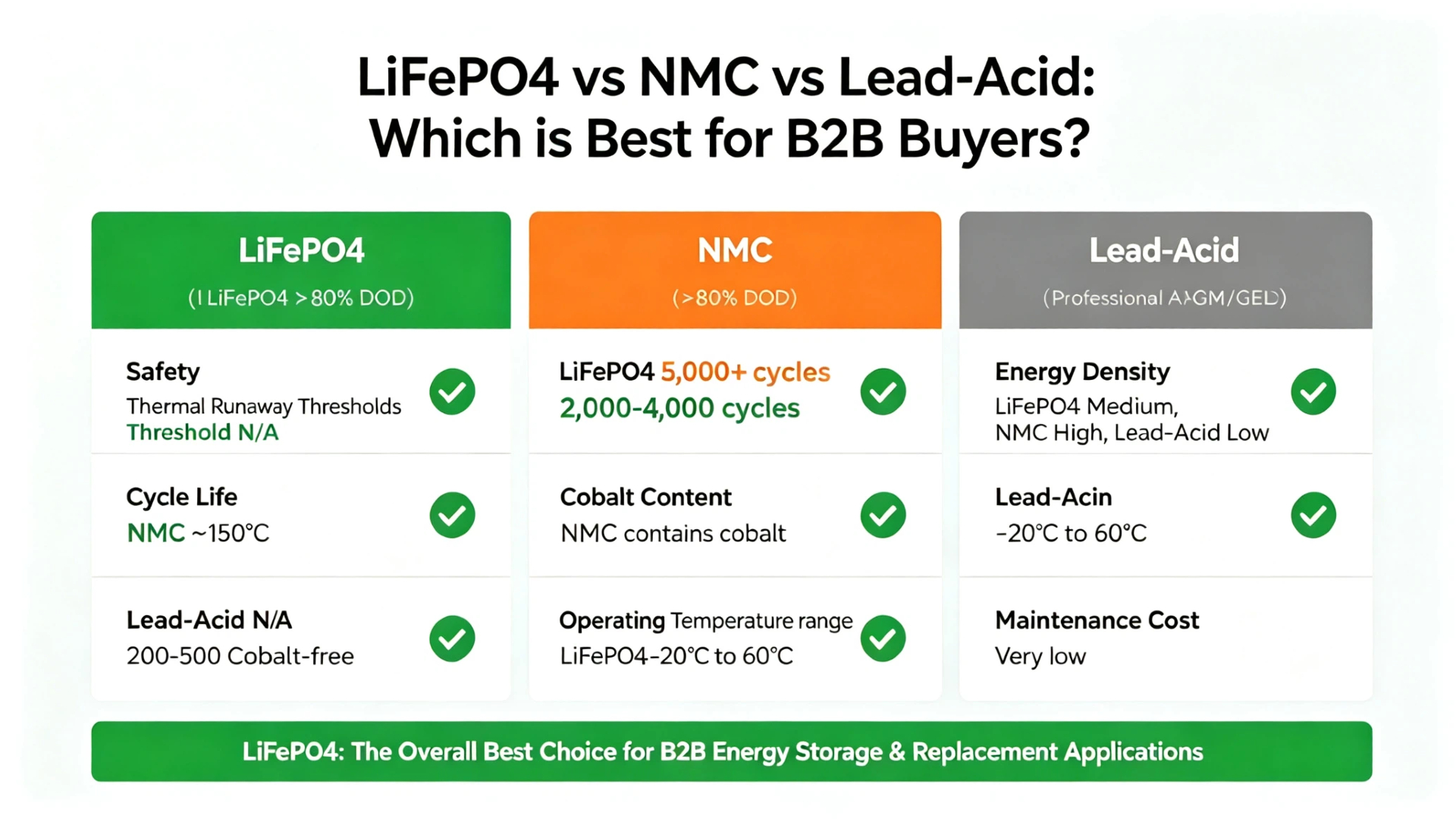
For B2B applications spanning energy storage, golf carts, marine, RV, and automotive, LiFePO4 has become the standard choice. Here's why procurement teams consistently select LFP over NMC and lead-acid:
Safety and Thermal Stability: LiFePO4 has a higher thermal runaway temperature (270°C+) than NMC (150-200°C) and releases less oxygen during thermal events, making it significantly less prone to fire. For stationary storage installed in buildings and mobile applications in vehicles and boats, this safety margin is not a marketing feature — it's a risk management decision that affects insurance premiums, fire code compliance, and liability exposure.
Long Cycle Life: High-quality LiFePO4 batteries deliver 5,000+ cycles at 80% Depth of Discharge (DoD), translating to 10+ years of daily cycling. At partial discharges (50-60% DoD), cycle life extends to 7,000-10,000+ cycles. Compare this to NMC (2,000-4,000 cycles) and lead-acid (200-500 cycles), and the lifespan advantage is decisive for any application with regular cycling.
ESG and Regulatory Compliance: LiFePO4 is cobalt-free — cobalt mining is associated with human rights concerns in the DRC, and corporate ESG mandates increasingly require cobalt-free supply chains. LiFePO4 is also easier to recycle (the iron, phosphate, copper, and aluminum are all valuable and recyclable), aligning with upcoming EU Battery Regulation requirements for recycled content and battery passports.
Total Cost of Ownership: While LiFePO4 has higher upfront cost than lead-acid, the full lifecycle math — including replacement frequency, maintenance labor, downtime, and usable capacity (80-90% for LFP vs 50% for lead-acid) — makes LiFePO4 the lowest-cost option over 5+ years for any regularly cycled application. We've run these calculations for golf cart fleets, RV fleets, and commercial solar storage, and the crossover point where LiFePO4 becomes cheaper than lead-acid is almost always within the first 3 years.
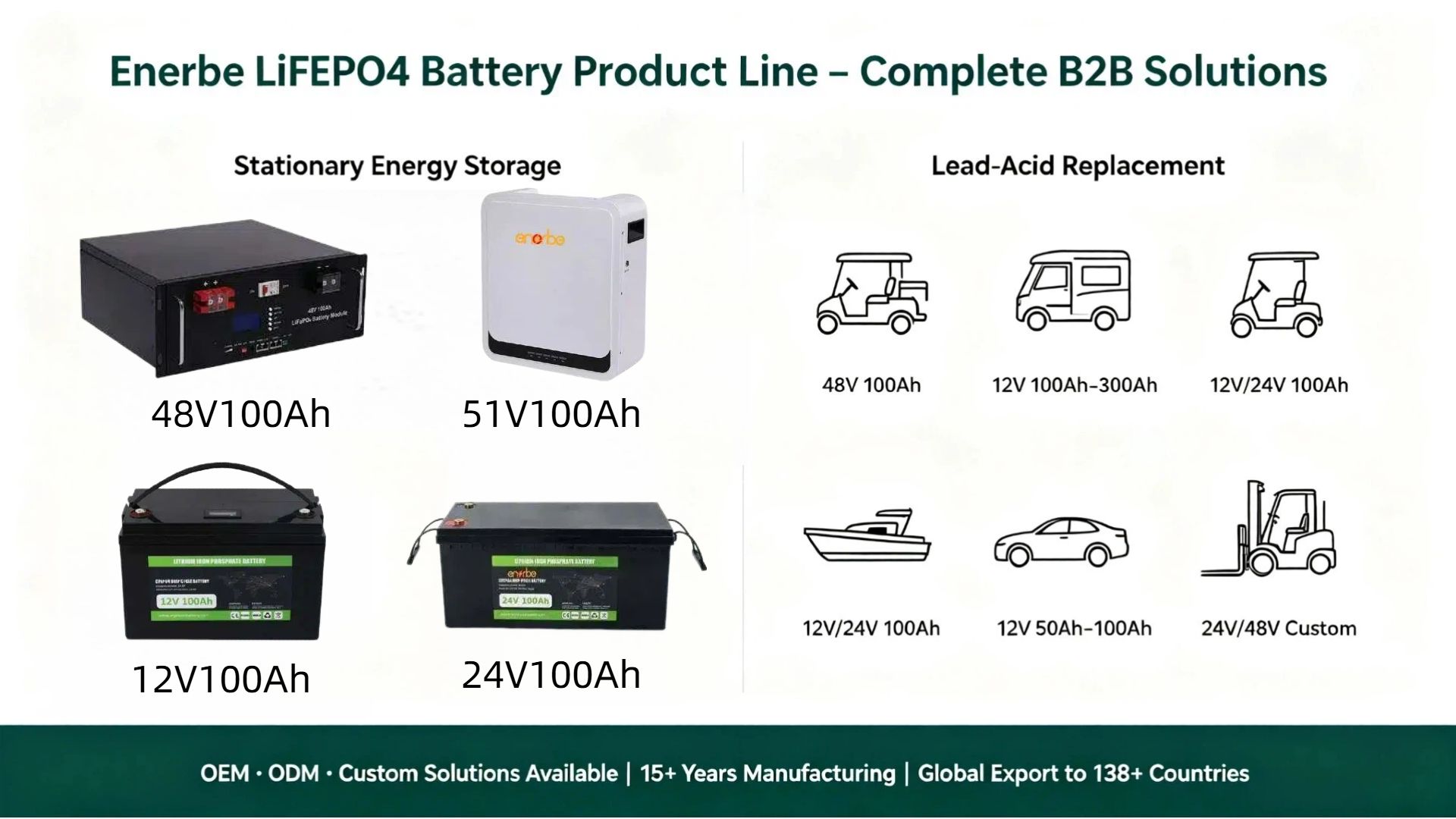


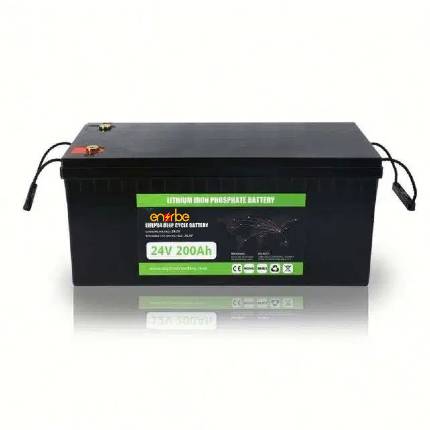


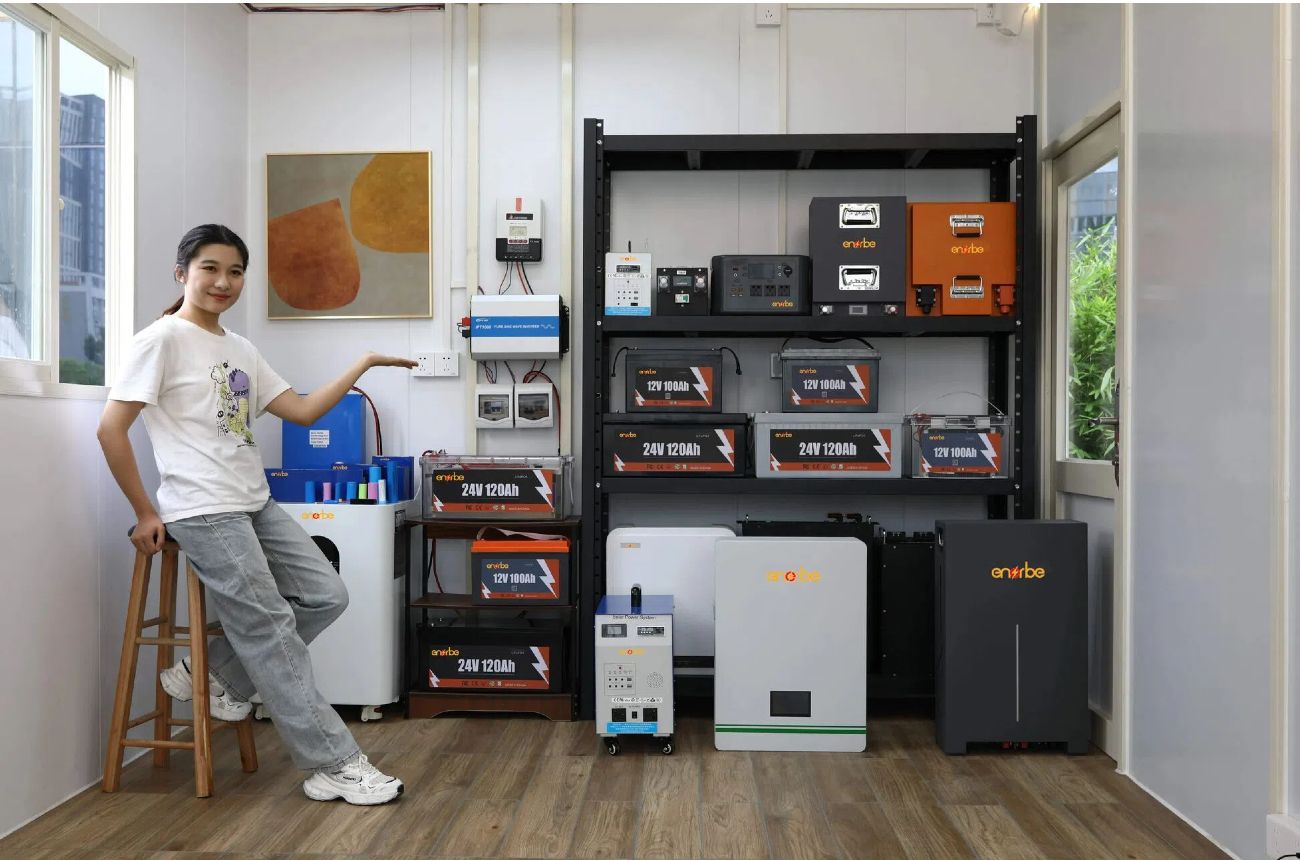
Enerbe, backed by Dongguan A&S Power Technology Co., Limited — a manufacturer with over 15 years of experience in battery design, development, and manufacturing — offers a comprehensive range of LiFePO4 solutions across multiple B2B applications:
Stationary Energy Storage
| Configuration | Key Specifications | Best For |
|---|---|---|
| Wall-Mounted | 48V 100Ah, 48V 200Ah, 51.2V 100Ah | Residential solar storage, light commercial backup |
| Rack-Mounted | 48V 100Ah, 48V 200Ah, stackable to MWh scale | Data centers, telecom, industrial UPS, C&I storage |
| Portable Power Systems | 15kWh (51.2V 300Ah) with wheels and handle | Off-grid worksites, emergency response, events |
| Stackable/Modular Systems | Modular 5kWh–MWh scale, CAN bus parallel expansion | Scalable C&I projects, microgrids, utility front-of-meter |
Lead-Acid Replacement (Drop-In Solutions)
| Application | Recommended Voltage/Capacity | Key Feature |
|---|---|---|
| Golf Carts | 48V 50Ah, 48V 100Ah | More power, extended range, 10x longer life than lead-acid |
| RVs & Campervans | 12V 100Ah–300Ah, 24V 100Ah–200Ah | Lightweight (50-70% lighter), deep-cycle, zero maintenance |
| Marine & Trolling Motors | 12V 100Ah, 24V 100Ah, IP65 options | Corrosion-resistant, waterproof, no fumes or acid spill risk |
| Automotive Starting | 12V 50Ah–100Ah, high CCA models | High cranking amps, cold-weather performance, 3x lighter than lead-acid |
| Forklifts & Industrial | 24V/48V custom configurations, 200Ah–1000Ah | Heavy-duty, long runtime, opportunity charging compatible |
How to Evaluate a LiFePO4 Battery Supplier: A 5-Dimension Framework
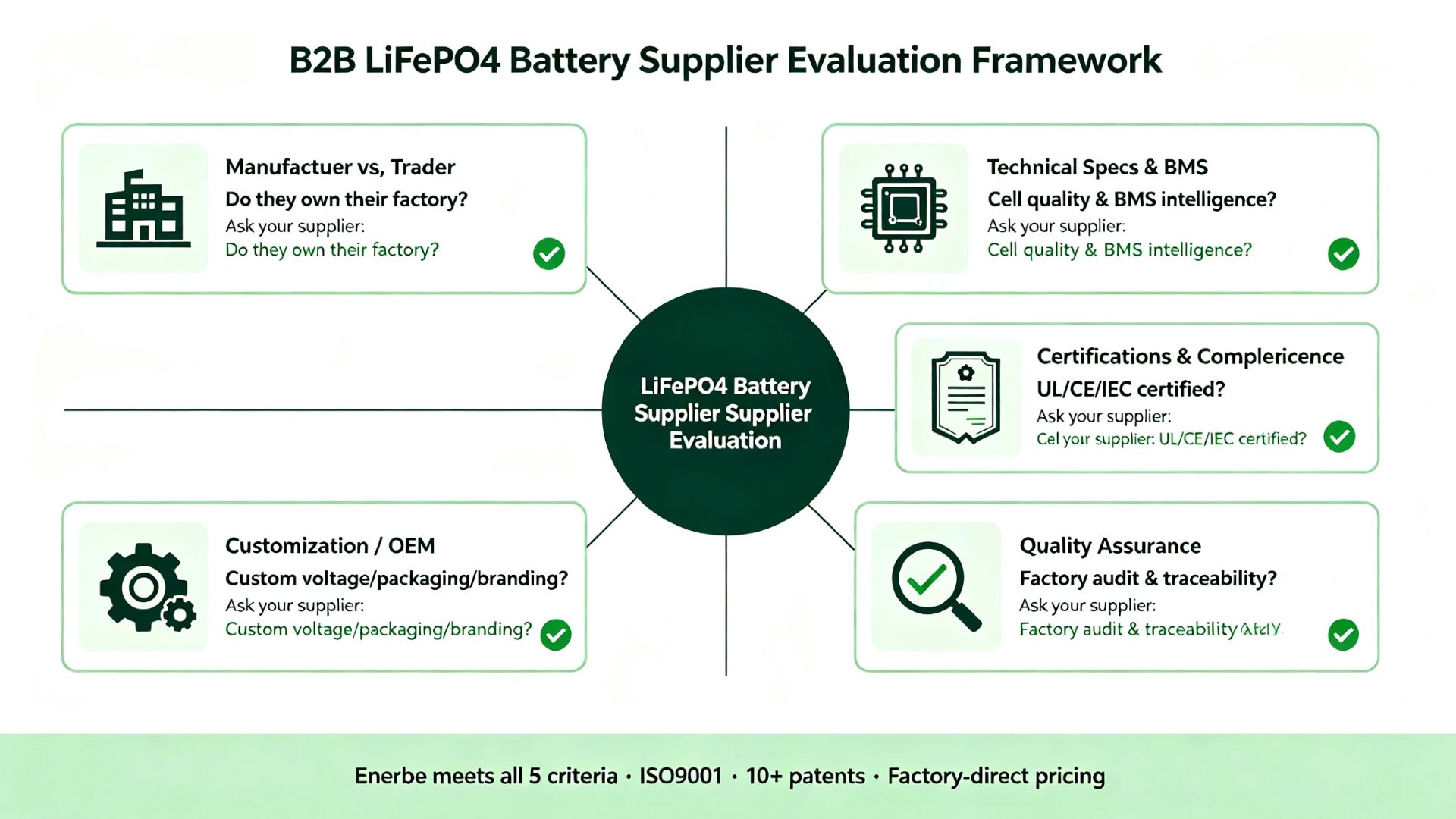
When sourcing LiFePO4 batteries for B2B applications, the supplier you choose matters more than the spec sheet. Two batteries with identical numbers on paper can perform very differently in the field depending on cell quality, BMS firmware, and manufacturing consistency. Evaluate suppliers across these five core dimensions:
1. Manufacturer vs. Trader
This is the first and most important filter. Direct manufacturers own their production lines, which means better pricing (no middleman markup), direct quality control, faster customization, and real technical support. Trading companies buy from factories and resell — they may offer lower prices on standard products, but they can't modify BMS firmware, guarantee consistent cell lots, or support custom engineering. To tell the difference: ask for the factory address and verify it on Google Maps (a trader will list an office, not a factory), ask if you can visit the factory (manufacturers welcome visits; traders make excuses), and ask for production line photos or videos. When in doubt, a third-party factory audit ($500-$1,500) is the most reliable verification. Enerbe operates its own ISO9001-certified manufacturing facility in Songshan Lake, Dongguan, and welcomes factory visits and third-party audits.
2. Technical Specifications and BMS Capability
Don't just look at the headline numbers (voltage, capacity). Dig into the details that determine real-world performance:
-
Cell source and grade: Are the cells A-grade from a known manufacturer (CATL, EVE, BYD, REPT)? Or are they B-grade or unknown cells? A-grade cells have tighter tolerances and longer cycle life. Ask for the cell manufacturer name and model number — refusal to disclose is a red flag.
-
Cycle life rating and test conditions: "5,000 cycles" at what DoD? At what temperature? At what charge/discharge rate? Cycle life at 100% DoD is very different from cycle life at 50% DoD. Reputable suppliers specify the test conditions.
-
BMS features: Over-voltage, under-voltage, over-current, short-circuit, and temperature protection are basics. Look for active cell balancing (not just passive), low-temperature charging protection, and communication protocols (CAN bus, RS485, Modbus) for system integration. Enerbe's intelligent BMS includes voltage collection, active current balance, overcharge/discharge protection, temperature monitoring, Coulomb meter, Bluetooth, and GPS remote capabilities.
-
Round-trip efficiency: What percentage of energy you put in comes back out. LiFePO4 typically achieves 95%+; anything below 90% suggests poor BMS design or low-quality cells.
3. Certifications and Regulatory Compliance
| Market | Required Certification |
|---|---|
| North America | UL 1973 (battery safety), UL 9540A (fire propagation for ESS) |
| Europe | CE Mark (LVD, EMC, RoHS), IEC 62619 (battery safety) |
| Australia | CEC Listed (for solar-connected storage) |
| International Shipping | UN38.3 (transport safety), MSDS/SDS (safety data sheet) |
Always verify that certifications are current (not expired), model-specific (covering the exact model you're buying, not a similar one), and issued by accredited third-party bodies (not self-declared). Request the full test report, not just the certificate — the report shows what was actually tested. For a deep dive on BESS certification, see our BESS Certification & Compliance Guide.
4. Quality Assurance and Traceability
A supplier's quality assurance processes determine whether the battery you receive matches the battery you tested. Look for: ISO 9001 quality management certification, incoming cell inspection (every cell lot tested for capacity, internal resistance, and voltage matching), end-of-line testing (every finished battery undergoes charge/discharge testing before shipping), full traceability (can they trace a finished battery back to specific cell lots and production dates?), and support for factory visits and third-party inspections. Enerbe welcomes factory audits and provides comprehensive quality documentation including cell lot traceability and end-of-line test reports.
5. Customization and OEM/ODM Capabilities
Many B2B buyers require customized solutions — specific voltage, capacity, form factor, connector type, BMS firmware parameters, or private-label branding. A manufacturer with in-house engineering can deliver these customizations; a trading company typically cannot. Ask about: OEM (private label with your branding) and ODM (custom design based on your specifications) services, minimum order quantities for custom configurations, tooling costs and lead times for custom enclosures, BMS firmware customization (custom voltage thresholds, communication protocols, charge profiles), and enclosure customization (dimensions, mounting, IP rating, color, labeling). Enerbe offers comprehensive OEM/ODM services for custom lithium battery solutions, with in-house engineering and tooling capabilities.
Why Enerbe?
-
Factory-Direct Pricing: As a manufacturer, not a trader, Enerbe offers competitive wholesale pricing with no middleman markup. For volume orders, our per-unit cost decreases significantly — ask about our tiered pricing for 100+, 500+, and 1000+ unit orders.
-
15+ Years of Expertise: Our parent company, Dongguan A&S Power Technology Co., Limited, has over 15 years of experience in battery design and manufacturing, serving global brands including LEGO, Philips, and Best Buy. This track record means proven quality systems and reliable delivery.
-
Customization Capabilities: In-house engineering team supports OEM/ODM services for custom voltage, capacity, form factor, BMS firmware, and branding. Whether you need a custom enclosure for a specific application or modified BMS parameters for a unique system, we can deliver.
-
Global Export Experience: We serve B2B clients across North America, Europe, Australia, the Middle East, and Southeast Asia. We understand the certification requirements for each market and provide full shipping documentation (UN38.3, MSDS, commercial invoice, packing list) to ensure smooth customs clearance.
-
Quality Certifications: ISO9001-certified manufacturing, with UL 1973, UL 9540, IEC 62619, CE Mark, and UN38.3 certified products. All certifications are current, model-specific, and verifiable against issuing body databases.
-
Comprehensive Product Range: One-stop solution from battery cells to complete energy storage systems. We offer 12V, 24V, 48V, and 51.2V configurations from 50Ah to 1000Ah+, in wall-mounted, rack-mounted, portable, and stackable form factors. This means you can source all your battery needs from one supplier, simplifying procurement and support.
What Is an Energy Storage System (ESS)?
An energy storage system (ESS) captures energy produced at one time for use at a later time. In the context of B2B applications, a battery energy storage system (BESS) typically uses lithium-ion batteries — with LiFePO4 emerging as the industry standard — to store electrical energy for commercial, industrial, and utility-scale applications. The core value of an ESS is that it decouples energy production from energy consumption, allowing you to store cheap solar energy for use during expensive peak hours, or to provide backup power when the grid goes down.
Core Components of a BESS:
-
Battery Pack: The energy storage medium, consisting of LiFePO4 cells configured in series/parallel to achieve the desired voltage and capacity.
-
Battery Management System (BMS): The "brain" of the battery — monitors cell voltage, temperature, and current; ensures safe operation by preventing overcharge, over-discharge, over-current, and over-temperature; maintains cell balance; and communicates with the inverter/EMS.
-
Power Conversion System (PCS): The inverter that converts DC battery power to AC for use in buildings or grid injection, and converts AC to DC when charging the battery from the grid or solar.
-
Energy Management System (EMS): The control software that decides when to charge and discharge based on demand, electricity pricing, grid signals, or user-defined priorities. For commercial systems, the EMS typically handles peak shaving, solar self-consumption optimization, and backup power management.
For a complete technical deep-dive on BESS systems, components, and sourcing, see our BESS Complete Sourcing Guide. For procurement-specific guidance, see our BESS Procurement Guide.
B2B Applications for Energy Storage Systems
Commercial and Industrial (C&I):
-
Peak shaving: Reducing demand charges by discharging batteries during peak utility rate periods. For many commercial customers, demand charges make up 30-50% of their electricity bill, and a properly sized BESS can reduce these charges by 20-40%.
-
Solar self-consumption: Storing excess PV generation for use during evening or cloudy periods, increasing the self-consumption ratio from 30-40% (without storage) to 70-90% (with storage).
-
Emergency backup: Protecting critical operations from grid outages. For data centers, hospitals, manufacturing facilities, and cold storage, even a short outage can cost tens of thousands of dollars.
-
Time-of-use arbitrage: Charging during low-rate off-peak hours and discharging during high-rate peak hours, directly reducing electricity costs.
Utility-Scale
-
Grid stabilization: Frequency regulation (responding to grid frequency deviations in milliseconds) and voltage support (injecting or absorbing reactive power). These are fast-response services that batteries are uniquely suited for, as they can respond in milliseconds vs minutes for traditional generators.
-
Renewable integration: Smoothing intermittent solar and wind generation by storing excess output and releasing it when generation drops. This allows higher penetrations of renewables on the grid without sacrificing stability.
-
Transmission deferral: Delaying costly grid infrastructure upgrades (new transmission lines, substations) by locating storage at constrained points on the grid. In many cases, a BESS installation is 30-50% cheaper than a transmission upgrade and can be deployed in months vs years.
-
Capacity markets: Providing reliable capacity to grid operators during peak demand periods, earning capacity payments in markets that have capacity markets (PJM, ISO-NE, NYISO, etc.).
Residential (Installer Channel)
-
Solar plus storage for homeowners seeking energy independence: Storing solar generation for evening use and backup power during outages. For installers, residential storage is a high-margin add-on to solar installations, with typical system sizes of 10-30 kWh.
-
Backup power during grid outages: Providing whole-home or critical-load backup during power outages. With increasing frequency of extreme weather events and grid outages, residential backup storage is one of the fastest-growing segments of the energy storage market.
-
Time-of-use bill management: In regions with time-of-use electricity rates, storing cheap off-peak energy for use during peak hours reduces the homeowner's electricity bill.
For system integrators and EPC contractors, sourcing a BESS requires evaluating battery chemistry (LiFePO4 vs NMC), BMS capabilities, inverter compatibility, and certification compliance (UL 1973, UL 9540A, IEC 62619). For supplier evaluation specifically, see our How to Choose a Reliable BESS Supplier guide.
Enerbe offers complete BESS solutions including wall-mounted, rack-mounted, and stackable configurations for commercial, industrial, and residential installer projects. All our BESS products use A-grade LiFePO4 cells, feature advanced BMS with CAN bus/RS485 communication, and are certified to UL 1973, IEC 62619, CE, and UN38.3 standards.
Enerbe Product Portfolio & Sourcing Guides
- Golf Cart Fleet LiFePO4 Conversion – A detailed guide for golf course operators and fleet managers
- BESS Procurement Guide – A complete 7-phase procurement framework for system integrators
- How to Charge LiFePO4 Batteries – Complete guide to voltage, current, and charging best practices
- LiFePO4 Battery Lifespan – How long do they last? Cycles, years, and tips to maximize life
- Lithium Ion vs Deep Cycle Battery – Complete comparison guide for B2B buyers
Frequently Asked Questions
Q1: What should I look for in a LiFePO4 battery supplier?
Evaluate suppliers across five dimensions: (1) Manufacturer vs trader — direct manufacturers offer better pricing, quality control, and customization. (2) Technical specifications and BMS capability — verify cycle life (5,000+ at 80% DoD), BMS features (over/under voltage, over-current, temperature protection, cell balancing). (3) Certifications — UL 1973, IEC 62619, CE, UN38.3 for your target market. (4) Quality assurance — factory audits, third-party inspections, supply chain traceability. (5) Customization — OEM/ODM capability for voltage, capacity, form factor, and branding.
Q2: Is LiFePO4 better than NMC for B2B applications?
For most B2B applications — energy storage, golf carts, marine, RV, and lead-acid replacement — LiFePO4 is the better choice. It offers 5,000+ cycles (vs 2,000-4,000 for NMC), superior thermal stability and safety (lower fire risk), is cobalt-free (better ESG compliance), and has lower total cost of ownership. NMC has higher energy density (smaller, lighter), which matters for EVs and portable electronics, but for stationary storage and lead-acid replacement where size is less critical, LiFePO4 wins on lifespan, safety, and cost.
Q3: What certifications do I need for LiFePO4 battery sourcing?
Required certifications depend on your target market: North America requires UL 1973 (battery safety) and UL 9540A (fire propagation) for energy storage systems. Europe requires CE Mark (LVD, EMC, RoHS) and IEC 62619. Australia requires CEC listing for solar-connected storage. For international shipping, UN38.3 and MSDS are mandatory for every lithium battery shipment. Always verify that certifications are current, model-specific, and issued by accredited third-party bodies — not self-declared.
Q4: How do I tell a manufacturer from a trading company?
Ask these questions: (1) Do you own your factory? Request the factory address and verify it on Google Maps — a trading company will list an office address, not a factory. (2) Can I visit the factory? Manufacturers welcome visits; traders will make excuses or offer to take you to "their partner's factory." (3) Do you provide OEM/ODM with custom BMS firmware? Traders typically can't modify firmware. (4) What is your production capacity? Request production line photos or videos. (5) Can you provide factory audit reports (ISO 9001, etc.)? A legitimate manufacturer will have these. When in doubt, a third-party factory audit ($500-$1,500) is the most reliable way to verify.
Q5: What voltage should I choose for my LiFePO4 battery project?
Voltage selection depends on the application: 12V is standard for RV house batteries, marine trolling motors, and small off-grid systems — it's the most common drop-in replacement for lead-acid. 24V is used for larger RVs, marine systems, forklifts, and medium off-grid systems — it reduces current (and cable thickness) for the same power. 48V is the standard for residential and light commercial solar storage, golf carts, and telecom backup — it's the most efficient for systems above 5kWh. 51.2V (16 cells in series) is increasingly common for wall-mounted residential storage. For utility-scale and large C&I, systems range from 400V to 1500V DC. Match the voltage to your existing equipment or inverter specifications.
Q6: How do I calculate the right battery capacity for my project?
Calculate your daily energy consumption in watt-hours (Wh), then divide by the system voltage to get amp-hours (Ah). For example, if you need 5kWh per day at 48V, that's 5,000Wh ÷ 48V = 104Ah — so a 48V 100Ah or 200Ah battery depending on your depth of discharge. For LiFePO4, you can safely use 80-90% of rated capacity, so you don't need to oversize as much as with lead-acid (where you're limited to 50% DoD). Also factor in days of autonomy (how many days of backup you need) and system efficiency (inverter and battery round-trip losses, typically 85-90%). For critical systems, add 20-30% buffer.
Q7: What is the typical lead time for bulk LiFePO4 battery orders?
For standard configurations (12V 100Ah, 24V 100Ah, 48V 100Ah rack-mounted), lead time is typically 15-30 days for production plus 15-30 days for sea freight, or 5-7 days for air freight (much more expensive). For custom configurations (custom voltage, capacity, enclosure, BMS firmware, branding), add 10-20 days for tooling and prototyping. For large orders (container load or more), confirm production capacity with the supplier — some manufacturers have 60-90 day backlogs during peak season (Q4). Always build a 2-week buffer into your project schedule for customs clearance and unexpected delays. Request a firm delivery date with delay penalties in the contract.
Q8: Can LiFePO4 batteries directly replace lead-acid batteries?
In most cases, yes — LiFePO4 batteries are designed as drop-in replacements for lead-acid in the same voltage class (12V, 24V, 48V). They have the same terminal positions and similar dimensions for standard sizes. However, there are important considerations: (1) Charging profile — LiFePO4 requires a different charging voltage (14.2-14.6V for 12V) than lead-acid (13.8-14.4V for float). Many modern chargers and inverters have a LiFePO4 setting — select it. (2) Alternator charging — for vehicles and boats, a DC-DC charger is recommended to protect the alternator and properly charge the LiFePO4 battery. (3) BMS cutoff — the BMS may disconnect under heavy load, which can confuse some older chargers. (4) Low-temperature charging — LiFePO4 should not be charged below 0°C; some batteries have low-temp protection that disables charging. For most solar storage and backup applications with a compatible inverter, the swap is straightforward.
Get In Touch
Ready to source LiFePO4 batteries for your project? Contact Enerbe today.
📄 Request a Technical Datasheet
Contact Us →📞 Speak with Our Engineering Team
Get In Touch →🔗 Browse Our Custom Battery Solutions
View Products →Dongguan A&S Power Technology Co., Limited.
Building 1, No. 2, Keji 9th Road,
Songshan Lake, Dongguan, Guangdong, China
📞 +86 137 1383 1631
✉ info@aspowerbattery.com
Stay Charged. Stay Connected.



Commercial & Residential Energy Storage Systems: Sourcing Wall-Mounted, Rack-Mounted & Portable LiFePO4 Batteries
Customized LiFePO4 24V 50Ah/100Ah/200Ah Batteries for RVs & Golf Carts: Stop Pushing Your Cart Up Hills
Related Article


Get In Touch
Have questions about custom lithium batteries, energy storage solutions, or lead-to-lithium conversion? Our team is ready to help. Send us a message and we’ll respond within 24 hours.

Building 1, No. 2, Keji 9th Road, Songshan Lake, Dongguan, Guangdong, China
Office Address

info@aspowerbattery.com
Email Us

+86 137 1383 1631
Call Us

Sun - Fri (08AM - 10PM)
Office Open
