
12V vs 24V vs 48V LiFePO4 Batteries: A Simple Guide to Choosing the Right Voltage for Your Project
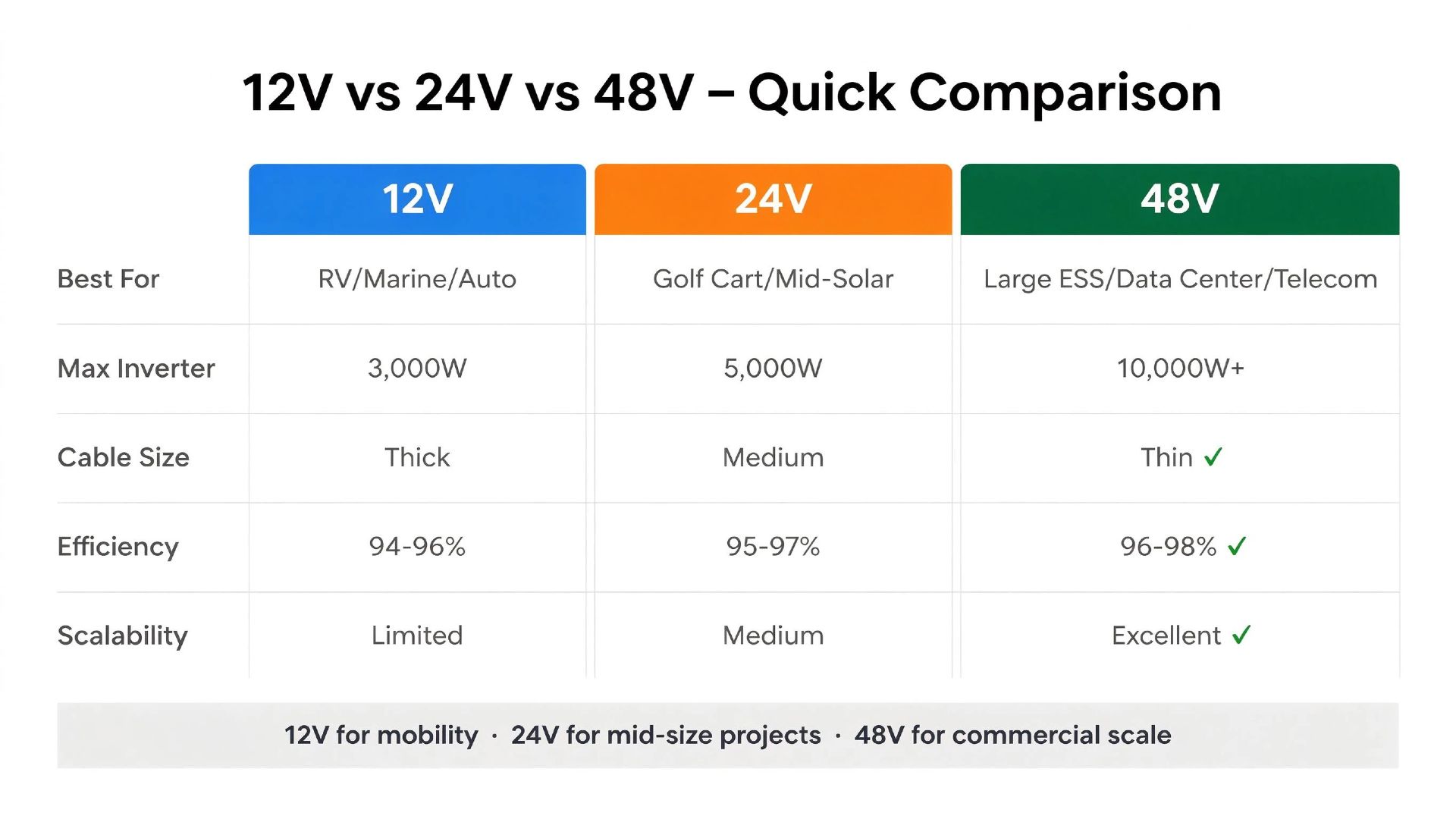
Table of Contents
Introduction: The Voltage Question
One of the most common questions B2B buyers ask when sourcing LiFePO4 batteries is: "What voltage do I need—12V, 24V, or 48V?"
The answer depends on your application, power requirements, and existing infrastructure. Choose the wrong voltage and you could end up with undersized cables, inefficient operation, or compatibility issues with your inverter and other equipment.
This guide provides a simple, practical framework for choosing the right voltage for your project—whether you're powering an RV, a golf cart fleet, a solar storage system, or a commercial facility.
The Three Voltage Options at a Glance
| Voltage | Nominal Voltage | Cells in Series | Typical Capacity Range | Best For |
|---|---|---|---|---|
| 12V | 12.8V | 4S | 50–300Ah | RVs, small boats, automotive, small solar |
| 24V | 25.6V | 8S | 50–200Ah | Golf carts, mid-size solar, commercial vehicles |
| 48V | 51.2V | 16S | 100–300Ah | Large ESS, data centers, telecom, C&I projects |
12V Systems: The Versatile Standard
What Is It?
A 12V LiFePO4 battery consists of 4 cells in series (4S), delivering a nominal voltage of 12.8V. This is the most common voltage platform globally, used in virtually every car, RV, boat, and small solar system.
Best Applications
| Application | Why 12V |
|---|---|
| RVs & Campervans | Standard 12V appliances and lighting |
| Small Boats & Trolling Motors | Industry standard for marine electronics |
| Automotive Starting | 12V is the global automotive standard |
| Small Solar Systems | Entry-level off-grid systems (under 3,000W) |
| Motorcycles & ATVs | Compact footprint |
Key Advantages
-
Widest component availability — inverters, chargers, and accessories are everywhere
-
Easiest integration — drop-in replacement for existing lead-acid systems
-
Lowest entry cost — most affordable voltage platform
-
Simple parallel expansion — connect multiple batteries in parallel for more capacity
Key Limitations
-
Higher current — requires thicker cables for the same power output
-
Limited scalability — max inverter size around 3,000W
-
More energy loss — I²R losses over long cable runs
Enerbe 12V Solutions
-
12V 100Ah — lightweight, deep-cycle, ideal for RVs and small boats
-
12V 200Ah — extended capacity for larger RVs and marine applications
-
12V 300Ah — maximum capacity with self-heating for cold climates
24V Systems: The Balanced Mid-Range
What Is It?
A 24V LiFePO4 battery consists of 8 cells in series (8S), delivering a nominal voltage of 25.6V. This configuration offers a middle ground between 12V accessibility and 48V efficiency.
Best Applications
| Application | Why 24V |
|---|---|
| Mid-Size Solar Systems | 3,000W–5,000W inverter capacity |
| Golf Carts | Common 24V/48V configurations |
| Commercial Vehicles | Trucks, buses, heavy equipment |
| Marine (Larger Boats) | 24V trolling motors and electronics |
| Telecom & Industrial | Industrial control systems |
Key Advantages
-
Lower current than 12V — smaller cables, less heat, better efficiency
-
Better long-distance performance — reduced voltage drop
-
More scalable — supports 3,000W–5,000W inverters
-
Good balance — sweet spot for many applications
Key Limitations
-
Fewer accessory options than 12V
-
Requires step-down converter for 12V loads
-
Higher upfront cost than 12V systems
Enerbe 24V Solutions
-
24V/200Ah LiFePO4 Battery — high-capacity for solar and commercial use
-
24V Lithium Battery Pack with 150Ah — solar-optimized
-
Custom 24V configurations (50Ah–200Ah) for golf carts and RVs
48V Systems: The High-Performance Choice
What Is It?
A 48V LiFePO4 battery consists of 16 cells in series (16S), delivering a nominal voltage of 51.2V. This is the industry standard for commercial energy storage, telecom, and large-scale solar projects.
Best Applications
| Application | Why 48V |
|---|---|
| Large Solar/ESS Projects | Standard for grid-tied and hybrid systems |
| Commercial & Industrial | Peak shaving, demand charge reduction |
| Data Centers & Telecom | 48V is the telecom industry standard |
| Large Golf Cart Fleets | Higher efficiency for fleet operations |
Key Advantages
-
Highest efficiency — lowest current for the same power
-
Best scalability — parallel up to 15+ racks for MWh-scale
-
Industry standard — wide inverter compatibility
-
Smallest cable sizes — lowest cable material cost
-
Less heat — reduced cooling requirements
Key Limitations
-
Higher upfront cost — components are more expensive
-
Not compatible with 12V/24V systems
-
Requires professional installation
Enerbe 48V Solutions
-
48V 100Ah Wall-Mounted Battery System — residential and light commercial
-
48V 200Ah Powerwall (51.2V 200Ah) — commercial projects
-
15kWh Portable Power System (51.2V 300Ah) — off-grid and emergency
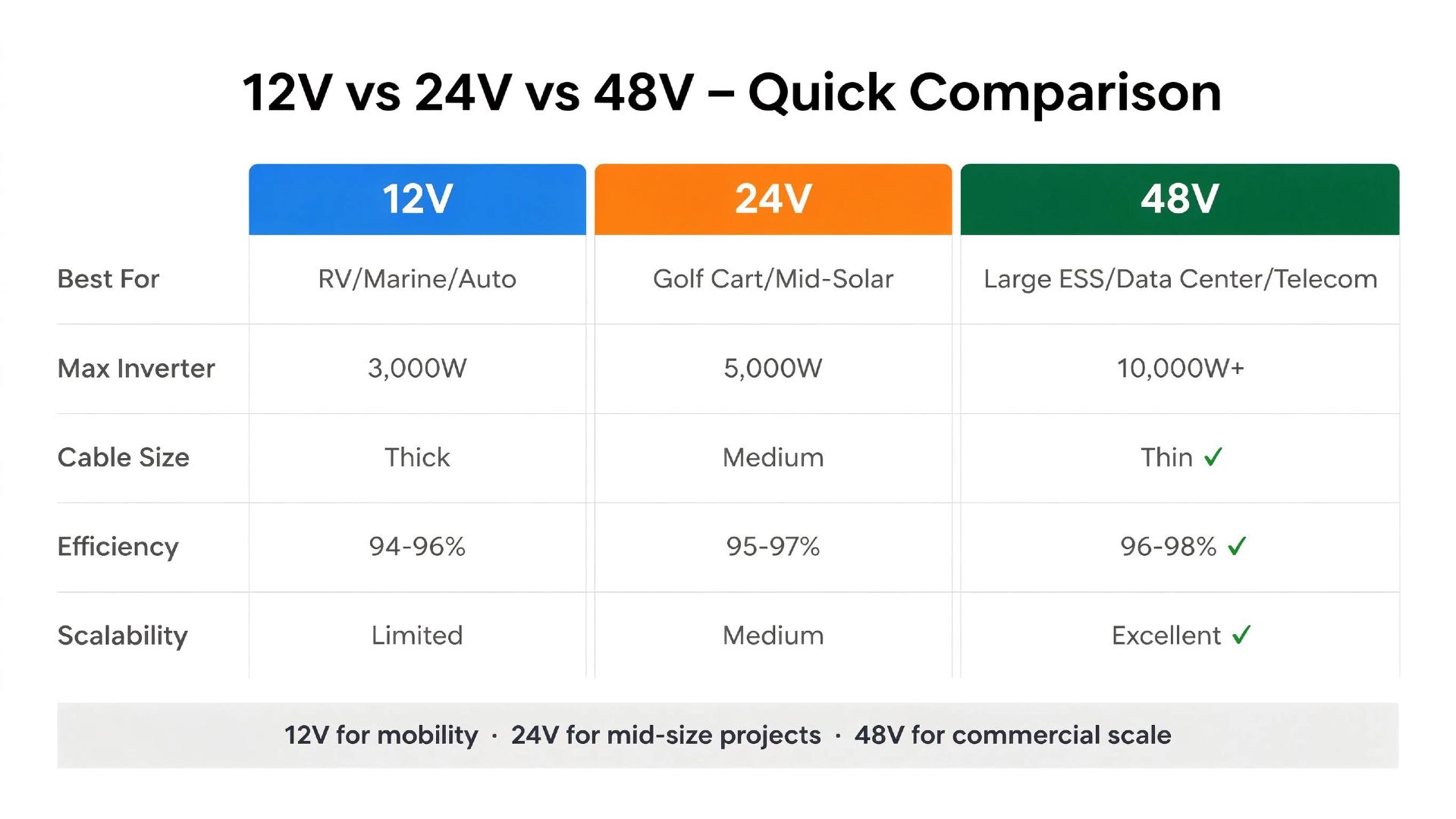
Quick Comparison Table
| Feature | 12V System | 24V System | 48V System |
|---|---|---|---|
| Nominal Voltage | 12.8V | 25.6V | 51.2V |
| Cells in Series | 4 | 8 | 16 |
| Typical Capacity | 50–300Ah | 50–200Ah | 100–300Ah |
| Max Inverter | 3,000W | 5,000W | 10,000W+ |
| Cable Size | Thick | Medium | Thin ✓ |
| Efficiency | 94–96% | 95–97% | 96–98% ✓ |
| Scalability | Limited | Moderate | Excellent ✓ |
| Best Application | RV, Marine, Auto | Golf Cart, Mid-Solar | ESS, Telecom, C&I |
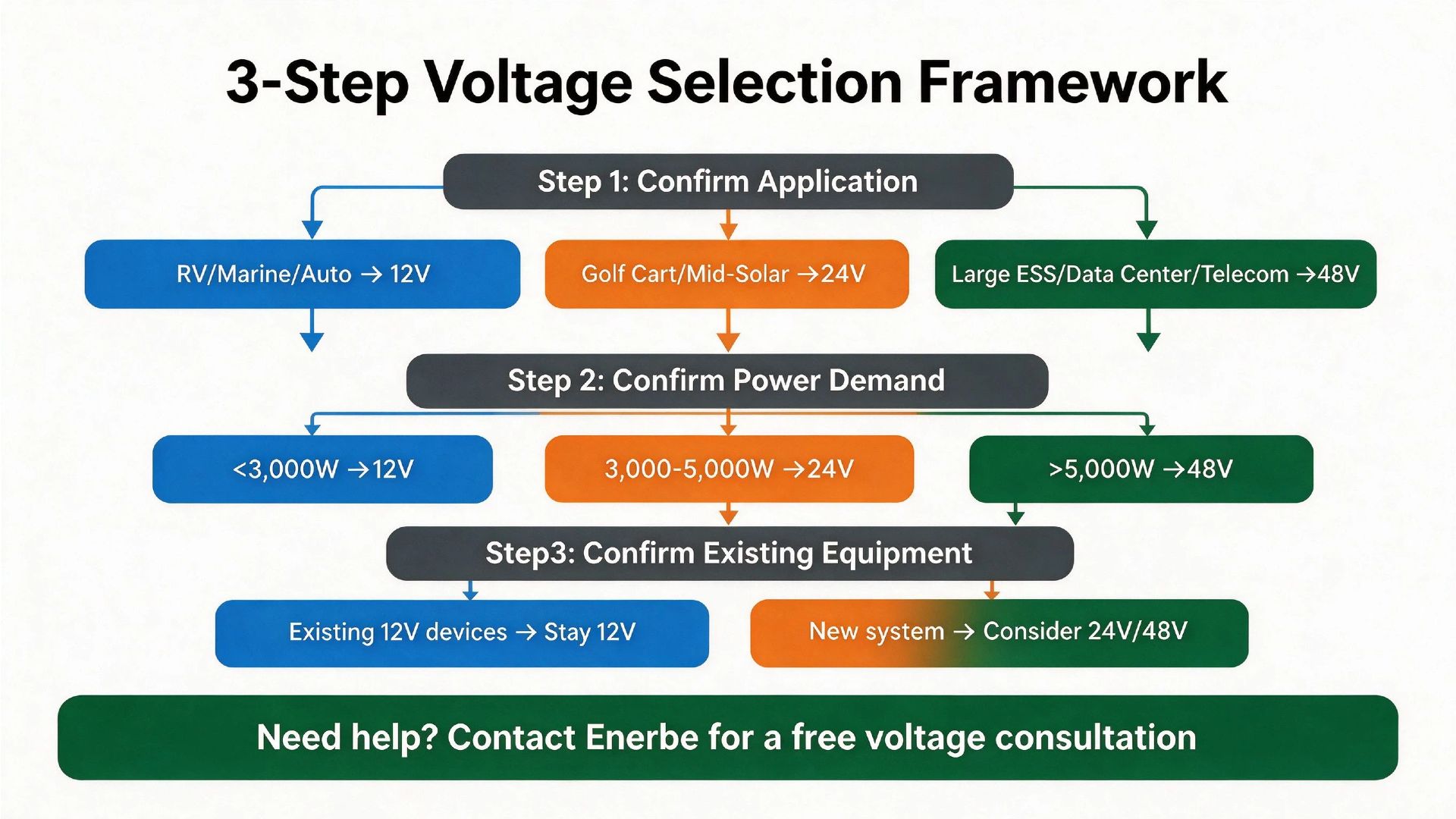
3-Step Decision Framework
Step 1: Identify Your Application
| Application | Recommended |
|---|---|
| RV / Campervan / Small Boat / Automotive | 12V |
| Golf Cart / Mid-Size Solar / Commercial Vehicle | 24V |
| Large ESS / Data Center / Telecom / Fleet Golf Carts | 48V |
Step 2: Check Your Power Requirements
| Inverter Size | Recommended |
|---|---|
| Under 3,000W | 12V |
| 3,000W–5,000W | 24V |
| Over 5,000W | 48V |
Step 3: Consider Your Existing Equipment
| Situation | Recommendation |
|---|---|
| Existing 12V components | Stick with 12V |
| Building from scratch | Consider 24V or 48V for future-proofing |
| Long cable runs (>5m) | 48V minimizes voltage drop |
Common Mistakes to Avoid
| Mistake | Why It's a Problem |
|---|---|
| Choosing 12V for large loads | Requires extremely thick cables, high heat, poor efficiency |
| Choosing 48V for RV | Incompatible with standard 12V appliances without step-down converter |
| Mixing voltages in same system | Requires separate converters, increases complexity and failure points |
| Not checking inverter compatibility | Some inverters only support one voltage—check before ordering |
Why Enerbe for All Voltages?
Enerbe offers comprehensive 12V, 24V, and 48V LiFePO4 solutions from a single supplier:
-
Factory-direct pricing — no middleman markups on any voltage
-
Custom configurations — OEM/ODM for custom voltage, capacity, and branding
-
Smart BMS — CAN bus/RS485 for all configurations
-
5,000+ cycle life — across all voltages, all models
-
Full certifications — UL, CE, IEC 62619, UN38.3
-
Global shipping — US, Europe, Australia, Middle East
📞 Speak with Our Engineering Team – Get In Touch
🔗 Browse Our Custom Battery Solutions – View Products
Building 1, No. 2, Keji 9th Road, Songshan Lake, Dongguan, Guangdong, China
📞 +86 137 1383 1631 | ✉ info@aspowerbattery.com



China LiFePO4 & Energy Storage Market H1 2026 – Key Trends for B2B Buyers
Wall-Mounted vs Stackable vs Rack-Mounted Energy Storage: Which Configuration Fits Your Project?
Related Article


Get In Touch
Have questions about custom lithium batteries, energy storage solutions, or lead-to-lithium conversion? Our team is ready to help. Send us a message and we’ll respond within 24 hours.

Building 1, No. 2, Keji 9th Road, Songshan Lake, Dongguan, Guangdong, China
Office Address

info@aspowerbattery.com
Email Us

+86 137 1383 1631
Call Us

Sun - Fri (08AM - 10PM)
Office Open
