
LiFePO4 Batteries for AGVs and AMRs: A 24V/48V Custom Pack Guide for Warehouse Robots (2026)

Table of Contents
- Introduction: The Battery Is Now the Bottleneck
- What Are AGV and Forklift LiFePO4 Batteries?
- Which Vehicle, Which Battery: Trucks and Voltage
- Why LiFePO4 Is Replacing Lead-Acid in Material Handling
- Charging AGVs and Forklifts: Opportunity, Fast, Automatic, Swap
- Matching the Battery to Shift Patterns
- Sizing and Specifying an Industrial Vehicle Battery
- AGV and AMR Battery Systems for OEMs
- Cold Storage and Tough Environments
- Certification and Safety
- Mistakes Buyers Make
- Related Resources
- Frequently Asked Questions
- Summary
LiFePO4 Batteries for AGVs and Electric Forklifts: A Warehouse Material Handling Guide (2026)
Last updated: October 2026 | Written by the Enerbe Engineering Team
Introduction: The Battery Is Now the Bottleneck
In a warehouse that runs two or three shifts, the battery decides how much work actually gets done. A lead-acid forklift takes eight hours to charge and another eight to cool, so a three-shift operation needs two or three batteries per truck and a dedicated charging room, with a crew swapping heavy packs in and out. When the fleet moves toward AGVs and AMRs, the problem gets stricter: those robots recharge themselves, on a schedule, with no operator to change a pack, and they need a battery that accepts frequent short top-ups without wearing out.
This is the gap LiFePO4 batteries were built for. A lithium iron phosphate pack charges fast, accepts opportunity charging during the natural pauses of a shift, runs for thousands of cycles, needs no watering or acid room, and reports its state of charge over CAN to the vehicle controller. This guide covers the two groups that buy these batteries together: AGV and AMR manufacturers designing a new machine, and warehouse or fleet managers replacing lead-acid on electric forklifts, pallet jacks, and reach trucks. It explains which truck uses which voltage, how charging actually works, how the lead-acid cost comparison breaks down, how to size and specify a pack, and what to demand from a supplier.
Quick Answer: Small AGVs, AMRs, and pallet jacks usually run 24V or 48V LiFePO4 packs; counterbalance and reach trucks use 48V, 80V, or 96V. LiFePO4 beats lead-acid on the points that matter in a warehouse: it charges in one to two hours instead of eight, handles repeated opportunity charging, delivers 3,000-6,000 cycles against roughly 1,000-1,500 for lead-acid, and removes the spare battery, charging room, and watering labor. Buy on the pack's voltage, capacity, charge rate, CAN interface, and certified safety, not on its headline kWh price.
What Are AGV and Forklift LiFePO4 Batteries?
An AGV is an automated guided vehicle that follows a fixed route or markers; an AMR is an autonomous mobile robot that plans its own path around obstacles. Both are part of the shift toward automated warehouses. Electric forklifts are the rider trucks that move and lift pallets, from walkie pallet jacks up to heavy counterbalance machines. All of them run on a traction battery, and the work that battery does is the same: deliver high current for driving and lifting, then recharge during breaks.
That traction battery is increasingly lithium iron phosphate; most new AGV batteries and forklift packs specified today use LiFePO4. It is the chemistry of choice for industrial vehicles because it is thermally stable, tolerates the shallow charge and discharge cycles that opportunity charging creates, and carries a long service life. NMC cells are common in consumer and passenger EVs but are less dominant in forklifts, where safety and cycle life outweigh the extra energy density. The underlying chemistry and why it matters for industrial use are covered in the 24V LiFePO4 battery guide.
An industrial lithium pack is not a loose collection of cells. It pairs LiFePO4 cell modules with a battery management system, a current-carrying connector, thermal management, and a communication port that lets the vehicle read the pack's state. That full assembly is what an AGV maker buys as a battery system, and what a forklift fleet buys as a drop-in replacement.
Which Vehicle, Which Battery: Trucks and Voltage
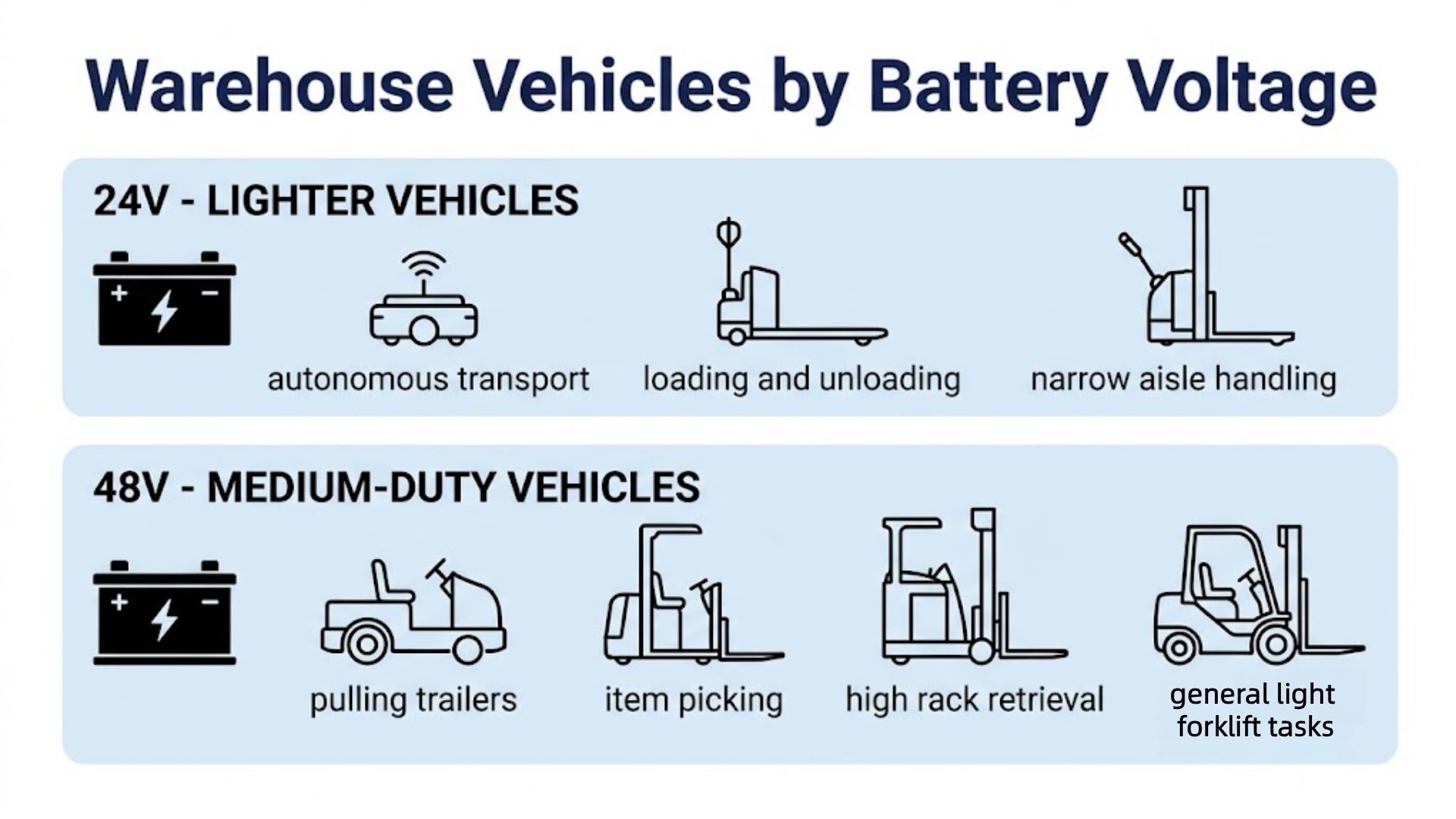
The voltage platform is set by the truck's size and power demand, and matching it is the first decision. Smaller, low-to-the-ground machines use 24V; heavier rider trucks move up to 48V and 80V. The figures below are typical and vary by manufacturer, but they are the starting point for a specification.
| Vehicle | Typical voltage | Typical capacity | Duty |
|---|---|---|---|
| Small AGV / AMR | 24V / 48V | 30-200 Ah | Continuous duty, automatic charging |
| Pallet jack / stacker | 24V | 200-300 Ah | Walkie, light to medium duty |
| Reach truck | 48V / 80V | 300-600 Ah | Rider, high reach and lifting |
| Counterbalance forklift | 48V / 80V / 96V | 400-800 Ah | Heaviest loads, high peak current |
| Tow tractor / heavy AGV | 48V / 80V | 400-900 Ah | Towing, long shifts |
Voltage is not interchangeable: the motors, controller, and charger are built for a specific nominal voltage, and a lithium replacement must match the truck's original lead-acid pack. Four-wheel electric forklifts are a particularly common replacement target because their packs are large and their daily energy use high. Where the machine uses 48V, the 48V LiFePO4 specification guide details the module blocks these packs are assembled from.
Why LiFePO4 Is Replacing Lead-Acid in Material Handling
The lead-acid versus lithium decision in a forklift is not a spec-sheet choice, it is a labor and uptime decision. Lead-acid is cheaper at the point of purchase, but almost everything else in a multi-shift operation costs more. The comparison is also set out in the deep-cycle vs lithium-ion guide, and it is sharpest in industrial trucks.
| Factor | Lead-acid | LiFePO4 |
|---|---|---|
| Full charge | ~8 hours, plus ~8 hours cooling | 1-2 hours fast, opportunity charging |
| Cycle life | ~1,000-1,500 cycles | ~3,000-6,000 cycles at 80% DoD |
| Usable capacity | Roughly 50-80% before life suffers | Up to ~90% without shortening life |
| Maintenance | Watering, equalizing, acid cleaning | None beyond BMS monitoring |
| Multi-shift need | 2-3 batteries + charging room | One battery, opportunity charging |
| Round-trip efficiency | ~70-80% | ~90-95% |
The practical effect is on the whole fleet. A lead-acid truck on three shifts needs spare packs that sit idle while charging, plus the floor space and handling equipment to swap them. A lithium truck runs one pack and tops it up at break and shift change, so the capital is spent on working trucks instead of idle batteries. The mechanism behind the longer life is the cycle-count and depth-of-discharge relationship, explained in the LiFePO4 cycle-life guide.
Charging AGVs and Forklifts: Opportunity, Fast, Automatic, Swap
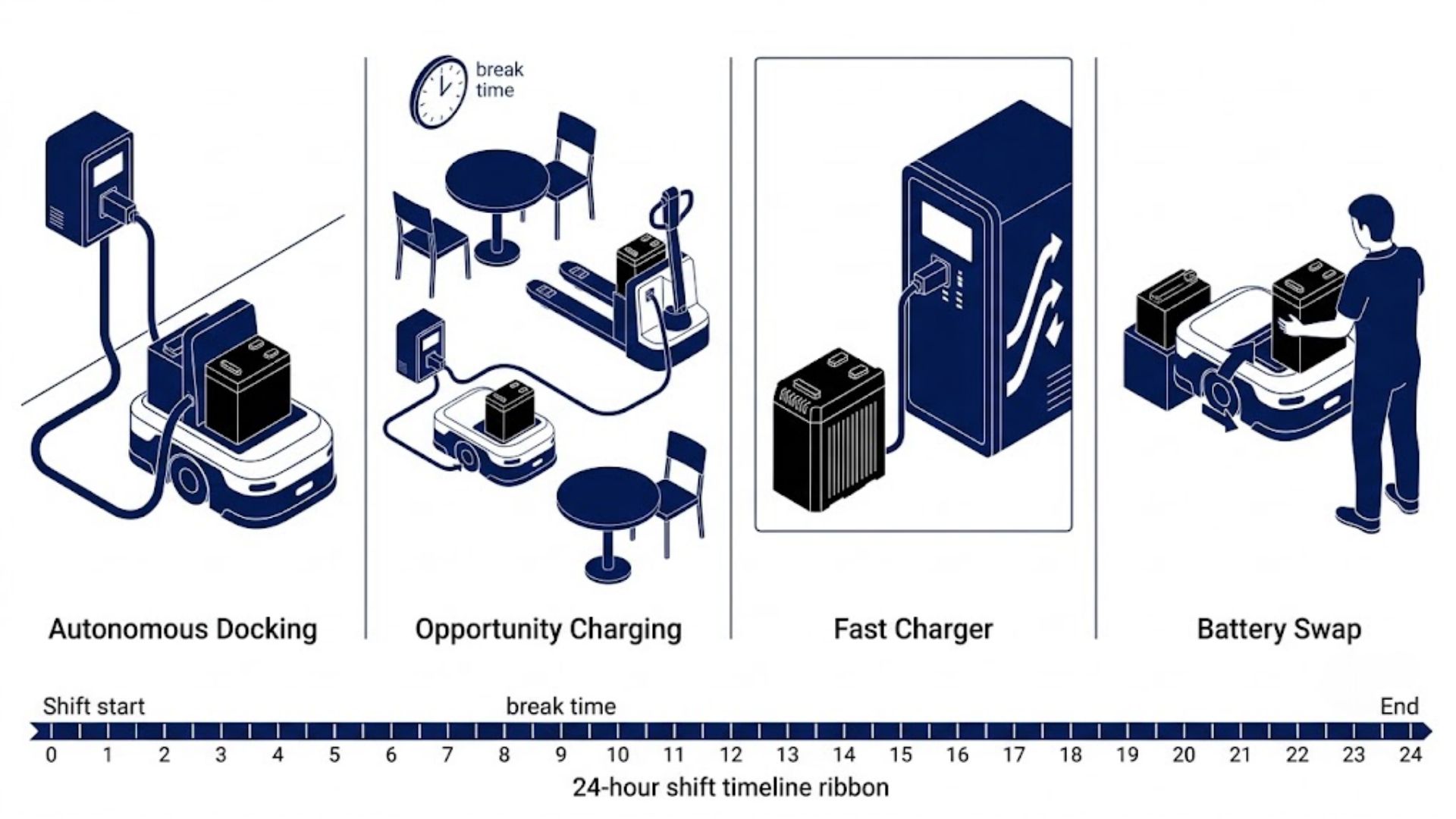
How the machine recharges is where AGV and forklift systems differ most, and it is the single most searched topic in this category. There are four patterns, often combined on one site.
Opportunity charging
The pack is topped up during the natural gaps in work: break times, shift change, while an operator loads a trailer. A lithium pack accepts these short, frequent charges without damage; a lead-acid pack does not, because it needs a full charge and cooling cycle to avoid sulfation. This is how one lithium battery replaces two or three lead-acid packs.
Fast charging
A high-power charger can return most of a lithium pack in one to two hours, and some packs are built for a one-hour rate. Fast charging requires both a pack and BMS rated for the current and adequate thermal management. A battery specified at a slow charge rate cannot be pushed fast without overheating and losing life.
Automatic charging for AGVs and AMRs
This is the AGV-specific method. The robot routes itself to a charging station when its state of charge drops, docks with a contact charging head or charging contacts, and resumes work without an operator. Some heavy AGVs use inductive pads at fixed stops. The charger, pack, and vehicle software must be matched, and the system typically holds the pack in a healthy middle band rather than full cycling, which suits LiFePO4 well. The pack's CAN bus tells the fleet software when to charge and how much capacity remains.
Battery swap
Common with lead-acid fleets, where a pack is changed out in a few minutes using a changer and the empty one goes to the room. Lithium reduces the need for swapping because it charges fast, but a small number of facilities retain a swap model for continuous operation. The voltage and charging rules for the pack are laid out in the LiFePO4 charging guide.
Engineering note: never charge a lithium forklift pack with a lead-acid charger, and do not mix lithium and lead-acid batteries on the same vehicle. The charge profiles and termination logic differ, and the wrong charger either fails to charge the pack fully or stresses the cells. The charger and the battery should be specified as a matched pair.
Matching the Battery to Shift Patterns
The number of shifts and the length of the charging windows set the battery strategy. This is the cleanest way to decide whether a single lithium pack is enough.
-
Single shift: the battery charges overnight, so either chemistry can work. Lithium wins on maintenance and life, but the payback is slower because there is no spare battery to eliminate.
-
Two shifts: lithium with opportunity charging at shift change usually runs on one pack. Lead-acid needs two packs. This is where lithium payback begins.
-
Three shifts: lithium with fast or opportunity charging keeps one pack in service, with a second optional pack as reserve. Lead-acid requires two to three packs per truck, a charging room, and swap labor, which is where lithium is hardest to argue against.
AGVs and AMRs are a special case: because charging is automatic and scheduled by the fleet software, the pack is usually kept cycling in a healthy band rather than run down, so capacity is chosen to cover the longest gap between charging points rather than a full shift.
Sizing and Specifying an Industrial Vehicle Battery
For a forklift replacement, the voltage is fixed by the truck and the pack must physically occupy the original battery compartment, so the dimensions and weight are as important as the kilowatt-hours. A genuine drop-in replacement uses the same footprint and connector, and where lead-acid provided useful counterweight, the lighter lithium pack may need added ballast to keep the truck's rated capacity. For an AGV built from scratch, the pack is designed around the available volume, the duty cycle, and the charging points.
The parameters to write into the specification are:
-
Nominal voltage and capacity (V / Ah), and total energy (kWh), matching the truck.
-
Continuous and peak discharge current for driving and lifting; forklifts pull a short high-current peak on lift.
-
Charge rate and time, from the slowest overnight charge to the rated fast-charge rate, and whether the pack supports it.
-
Depth of discharge and cycle life at the rated DoD, with the warranty's cycle count and throughput in writing.
-
Communication interface, typically CAN or CANopen, so the truck or fleet software can read SOC and faults.
-
Dimensions, weight, connector, and ingress protection for the compartment and environment.
-
Operating temperature range, especially for cold storage.
Where multiple modules are combined to reach the required voltage or capacity, the series and parallel rules in the LiFePO4 series vs parallel guide apply, and the BMS must cover the full module count.
AGV and AMR Battery Systems for OEMs
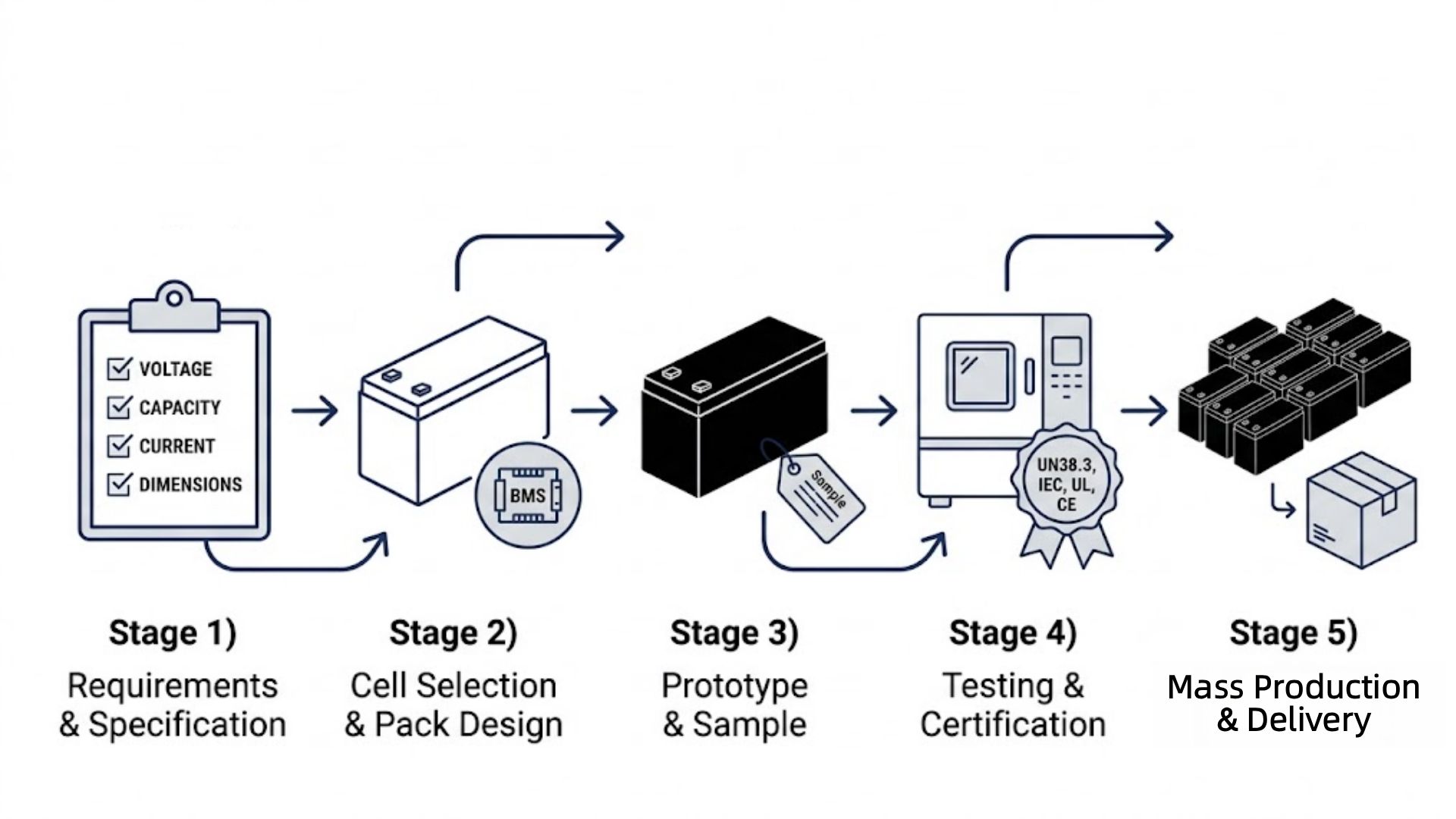
AGV and AMR manufacturers usually buy a battery system rather than a single block, and the system is the highest-volume search in this cluster. A production AGV pack integrates several elements, and quoting only cells leaves the OEM to engineer the rest.
-
LiFePO4 cell modules sized to the chassis and duty cycle.
-
An integrated BMS that balances cells, protects the pack, and reports over CAN.
-
Thermal management, from passive cooling to active heating for cold sites.
-
Charging contacts or a docking interface matched to the automatic station.
-
Mechanical enclosure and connector with the right ingress rating and vibration tolerance.
Because AGV fleets order a custom pack for each machine model, the conversation is an OEM/custom-battery project rather than a catalog purchase. The compliance and documentation path for a custom pack is covered in the custom lithium battery compliance case study, and the supplier qualification process is the same one used for any project-scale battery purchase in the LiFePO4 supplier selection guide.
Cold Storage and Tough Environments
Cold storage is one of the most demanding forklift applications. Lithium capacity and charging performance drop below freezing, and charging a cold cell can damage it. A pack intended for a freezer or cold room needs built-in heating that brings the cells above a safe charging threshold before charging begins, and the charger and BMS must coordinate that. On the positive side, lithium packs produce no acid fumes and need no charging room ventilation, which removes an actual lead-acid problem in enclosed facilities. Outside cold storage, dust, moisture, and wash-down areas dictate the ingress rating, and outdoor yards need a rated operating temperature range. Specifying an ambient-temperature pack into a cold warehouse is a common and avoidable failure.
Certification and Safety
Industrial trucks are sold to fleets and insurers that expect certified batteries, and lithium packs are no exception. LiFePO4 is the safer chemistry, but it still needs a certified pack and a correctly matched charger. The standards that matter for this segment are:
-
UL 2271 for light electric vehicle batteries, commonly cited for industrial trucks and mobile machinery.
-
UL 1973 for battery packs used in motive and stationary applications, and IEC 62619 for industrial battery safety.
-
UN 38.3 for transport of the cells and packs, with CE and forklift-relevant safety requirements such as EN 1175 in the EU.
-
In the U.S., forklift operation and battery handling fall under the workplace truck safety rules, which require trained handling and a compliant battery and charger.
The exact set depends on the market, and the fire and thermal-runaway behavior of the chemistry is explained in the LiFePO4 battery safety guide. China-market projects also need the GB 38031-2025 safety standard. Ask the supplier for the certificates for the exact pack model, not a generic cell certificate.
Mistakes Buyers Make
-
Using a lead-acid charger on lithium. Different charge profile and termination; always pair the pack and charger.
-
Ignoring the compartment and weight. A pack that does not fit the battery box, or is too light without ballast, will not work as a drop-in.
-
Assuming a pack can fast-charge. Fast charging needs a BMS, cells, and thermal design rated for it; a slow-rate pack cannot be pushed.
-
Buying an ambient pack for cold storage. Without heating, the pack will not charge and will lose capacity in a freezer.
-
Buying on kWh price alone. Compare cycles, throughput warranty, charge rate, and communication, not the sticker price.
-
Ordering AGV packs without CAN compatibility. If the BMS cannot talk to the fleet controller, automatic charging and SOC reporting do not work.
-
Accepting a cell certificate instead of a pack certificate. The finished pack, not just the cell inside it, has to carry the certification.
Related Resources
-
24V LiFePO4 Battery Complete Guide: the platform for small AGVs and pallet jacks
-
48V LiFePO4 Battery Guide: blocks for reach trucks and mid-size AGVs
-
48V Golf Cart Battery Guide: the same low-voltage chemistry in other electric vehicles
-
How to Charge LiFePO4 Correctly: charge profiles and matched chargers
-
How Long LiFePO4 Batteries Last: cycles, DoD, and throughput
-
Deep Cycle vs Lithium Ion: the lead-acid comparison and 10-year TCO
-
LiFePO4 Series vs Parallel: building the voltage and capacity a truck needs
-
Custom Lithium Battery Compliance Case Study: documentation for an OEM AGV pack
-
LiFePO4 Safety Guide: thermal runaway and pack safety
-
Enerbe Industrial Battery Products: 24V, 48V, 80V traction and AGV packs
Frequently Asked Questions
What battery does an AGV use?
Most AGVs and AMRs use 24V or 48V LiFePO4 packs with a BMS and a CAN communication port, paired with automatic docking chargers. The pack is sized to cover the gap between charging points and is kept in a healthy state-of-charge band by the fleet software rather than fully discharged. Larger heavy-load AGVs move up to 48V or 80V.
What voltage battery does an electric forklift use?
Pallet jacks and stackers typically use 24V, reach trucks use 48V or 80V, and counterbalance forklifts use 48V, 80V, or 96V for heavier models. A lithium replacement must match the voltage of the original lead-acid pack because the truck's motors and charger are built for that voltage.
Can lithium forklift batteries be opportunity charged?
Yes, which is one of their main advantages. LiFePO4 accepts short top-ups during breaks and shift change without losing life, unlike lead-acid which needs a full charge and cooling. This lets one lithium pack cover two or three shifts where lead-acid would need two or three packs.
How long does it take to charge a lithium forklift battery?
A slow overnight charge takes a few hours, while a fast-charge-capable pack and charger can return most of the capacity in one to two hours. The actual time depends on the charger power and the pack's rated charge rate, which must be specified up front.
How does an AGV charge itself?
An AGV routes to a charging station when its state of charge drops, docks with contact charging pins or a charging head, and resumes work automatically. Some heavy AGVs use inductive pads at fixed stops. The charger, pack, and vehicle fleet software are matched, and the BMS reports charge level over CAN.
Can I replace a lead-acid forklift battery with lithium?
Yes, as a drop-in replacement, but the pack must match the voltage, fit the battery compartment, and use a compatible connector. Because lithium is lighter, added ballast may be needed to retain the truck's rated lifting capacity, and the charger must be changed to a lithium charger. You cannot mix lithium and lead-acid or use the same charger.
How many batteries do I need for a three-shift forklift?
With lead-acid, a three-shift truck usually needs two or three batteries because each takes eight hours to charge and eight to cool. With LiFePO4 and fast or opportunity charging, one battery typically stays in service, with an optional second as reserve, which removes the spare packs, charging room, and swap labor.
What is the lifespan of a lithium forklift battery?
Quality LiFePO4 industrial packs are rated for roughly 3,000-6,000 cycles at 80% depth of discharge, which covers several years of single or multi-shift use, well beyond the 1,000-1,500 cycles typical of lead-acid. Actual life depends on depth of discharge, charge rate, and temperature.
Can a lithium forklift battery work in cold storage?
Yes, if it has integrated heating. Charging a cold lithium cell below freezing damages it, so a cold-room pack heats the cells above a safe threshold before charging. An ambient-temperature pack without heating will lose capacity and should not be charged in a freezer.
What is an AGV battery management system (BMS) for?
The BMS balances the cells, protects against over and under voltage, current, and temperature, and reports state of charge and faults to the vehicle or fleet controller over CAN. Without a compatible BMS, the AGV cannot manage automatic charging or report its battery status, so the communication interface is part of the specification.
What certifications should an AGV or forklift battery have?
Common requirements are UL 2271 for electric vehicle batteries, UL 1973 and IEC 62619 for pack safety, UN 38.3 for transport, and CE with forklift-relevant standards such as EN 1175 in the EU. The finished pack itself, not just the cells inside, should carry the certification, and the U.S. market requires compliant forklift handling.
Is LiFePO4 cheaper than lead-acid for forklifts?
The lithium pack costs more up front, but on multi-shift sites it removes spare batteries, the charging room, watering and swap labor, and the energy losses of lead-acid, and it lasts several times as many cycles. On a single-shift truck with only overnight charging, the payback is slower; the strongest case is two or three shifts or an automated AGV fleet.
Summary
| Decision | Guideline |
|---|---|
| Voltage | 24V for small AGVs and pallet jacks; 48V/80V/96V for reach and counterbalance trucks |
| Chemistry | LiFePO4 for safety, cycle life, and opportunity charging |
| Charging | Automatic and opportunity for AGVs; fast/opportunity for forklifts; matched charger |
| Replacement | Match voltage, compartment, connector; add ballast if needed; replace the charger |
| Best fit | Two or three shifts, automated AGV fleets, cold storage with heating |
The battery choice in a modern warehouse is set by the vehicle, the shift pattern, and the charging gaps, not by the upfront price. Small AGVs and pallet jacks run 24V and 48V; reach and counterbalance trucks run 48V, 80V, and 96V. LiFePO4 earns its premium on multi-shift and automated sites where fast and opportunity charging remove spare batteries, the charging room, and the swap crew, and where a CAN-connected BMS lets the fleet manage itself. Specify voltage, capacity, charge rate, communication, temperature, and a certified pack, and source the battery and charger as a matched pair. Enerbe supplies LiFePO4 traction and AGV battery systems across 24V, 48V, and 80V, with integrated BMS, CAN communication, and the industrial and transport certifications fleets and OEMs require.
Get In Touch
Designing an AGV or replacing a forklift fleet? Send the truck model, voltage, capacity, and shift pattern and Enerbe will size the pack and charger.
📄 Request a Technical Datasheet
Contact Us →📞 Speak with Our Engineering Team
Get In Touch →🔗 Browse Industrial Battery Solutions
View Products →Dongguan A&S Power Technology Co., Limited.
Building 1, No. 2, Keji 9th Road,
Songshan Lake, Dongguan, Guangdong, China
📞 +86 137 1383 1631
✉ info@aspowerbattery.com
Stay Charged. Stay Connected.



Commercial and Industrial Energy Storage: A Buyer's Guide to C&I LiFePO4 Battery Systems (2026)
Related Article


Get In Touch
Have questions about custom lithium batteries, energy storage solutions, or lead-to-lithium conversion? Our team is ready to help. Send us a message and we’ll respond within 24 hours.

Building 1, No. 2, Keji 9th Road, Songshan Lake, Dongguan, Guangdong, China
Office Address

info@aspowerbattery.com
Email Us

+86 137 1383 1631
Call Us

Sun - Fri (08AM - 10PM)
Office Open
