
How to Connect LiFePO4 Batteries in Series vs Parallel: Voltage, Capacity & Safe Wiring (2026)

Table of Contents
- Introduction: How to Connect LiFePO4 Batteries to Get More Voltage or More Capacity
- Series vs Parallel at a Glance
- Connecting Batteries in Series: Voltage Adds, Capacity Stays
- Connecting Batteries in Parallel: Capacity Adds, Voltage Stays
- Series-Parallel Banks: Higher Voltage AND Higher Capacity
- The Golden Rules for Matching LiFePO4 Batteries
- Can You Mix Different Ah, Brands, or Ages?
- BMS, Charging & Wiring for Series-Parallel Banks
- Common Mistakes & Safety
- Related Resources
- Frequently Asked Questions
- Summary
How to Connect LiFePO4 Batteries in Series vs Parallel: Voltage, Capacity & Safe Wiring (2026)
Last updated: October 2026 | Written by the Enerbe Engineering Team
Introduction: How to Connect LiFePO4 Batteries to Get More Voltage or More Capacity
When a single 12V 100Ah LiFePO4 battery isn't enough, the answer is almost always to connect more than one. But there are only two legal ways to do it — in series or in parallel — and they do completely different things. Connect batteries in series and the voltages add up; connect them in parallel and the amp-hours add up. Get the wiring right and you can build a 24V, 48V, or higher-capacity bank from identical 12V modules. Get it wrong and you can trip the BMS, overheat the cables, or permanently damage the cells.
This is the practical wiring guide for installers, dealers, and project buyers. It explains how to connect LiFePO4 batteries in series and in parallel, shows exactly how to turn two 12V batteries into 24V or four 12V batteries into 48V, gives the rules for which batteries can safely be combined, and covers the BMS, charging, and cable requirements for the finished bank. It is the companion to the voltage-selection guide (which decides whether to use 12V, 24V, or 48V) and the wire-gauge guide (which decides how thick the cables should be).
Quick Answer: Connect batteries in series (positive to negative) to raise voltage — two 12V 100Ah batteries in series make a 24V 100Ah bank. Connect batteries in parallel (positive to positive, negative to negative) to raise capacity — two 12V 100Ah batteries in parallel make a 12V 200Ah bank. Always combine matched LiFePO4 batteries of the same voltage, capacity, age, and brand, and use a BMS rated for the final bank.
Series vs Parallel at a Glance
Before touching any cables, it helps to lock in the one rule that matters: series adds voltage, parallel adds capacity. The table below shows what happens when two identical 12V 100Ah LiFePO4 batteries are joined each way.
| Result for 2 × 12V 100Ah | In Series | In Parallel |
|---|---|---|
| Wiring | Positive of one → negative of the next | Positive → positive; negative → negative |
| Final voltage | 24V (12V + 12V) | 12V (unchanged) |
| Final capacity | 100Ah (unchanged) | 200Ah (100Ah + 100Ah) |
| Energy | 2.4 kWh | 2.4 kWh |
| Same current flows through | Every cell — use a series BMS | Splits across branches — parallel BMS or matched modules |
| Common use | Reaching 24V / 48V for inverters, carts, racks | Extending runtime at 12V for RVs, marine, solar |
Notice that total energy (kWh) is the same in both examples — both arrangements store 2.4 kWh. What changes is the shape of that energy: series gives you a higher voltage (and lower current for the same power), while parallel gives you more stored amp-hours at the same voltage. To decide which voltage you actually need in the first place, see 12V vs 24V vs 48V LiFePO4: Choosing the Right Voltage.
Connecting Batteries in Series: Voltage Adds, Capacity Stays
In a series connection, you join the positive terminal of one battery to the negative terminal of the next, forming a single chain. The free negative at one end and the free positive at the other become the bank's terminals. The voltages of every battery in the chain add together, while the capacity (Ah) stays equal to that of one battery.
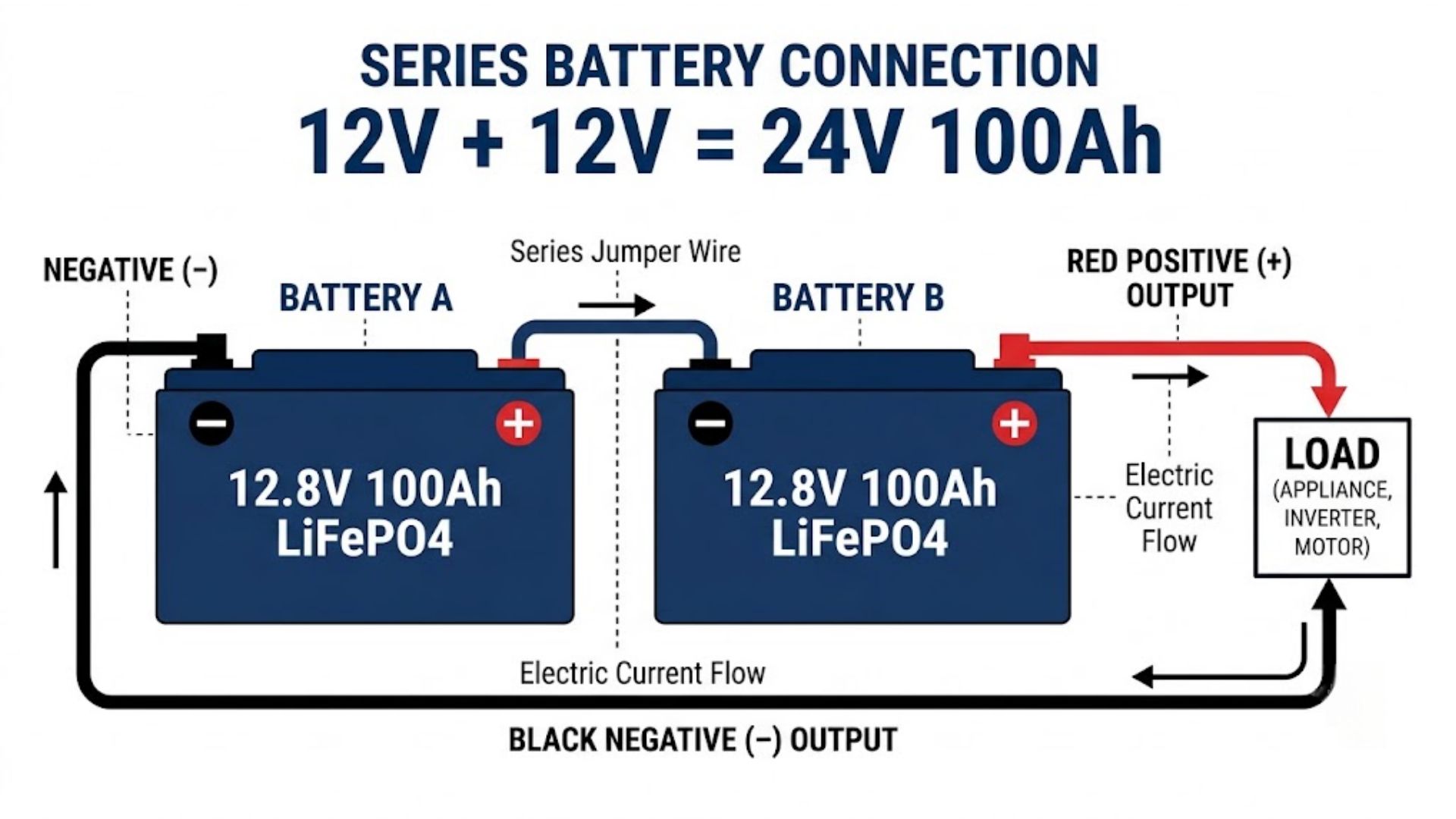
Series math (voltage adds, capacity stays):
-
2 × 12V 100Ah in series → 24V 100Ah
-
4 × 12V 100Ah in series → 48V 100Ah
-
8 × 12V 100Ah in series → 96V 100Ah
How to connect two 12V LiFePO4 batteries in series (step by step):
-
1. Match and prepare. Confirm both batteries are identical 12V 12.8V LiFePO4 units with the same capacity and charge level. Fully charge each one separately, then disconnect loads and chargers.
-
2. Make the series link. Connect the positive (+) terminal of battery A to the negative (−) terminal of battery B with a single series cable.
-
3. Identify the bank terminals. The remaining negative (−) of battery A is the bank negative; the remaining positive (+) of battery B is the bank positive.
-
4. Verify the voltage. Measure across the two free terminals — you should read roughly 25.6V (two full 12.8V batteries) before connecting the load.
-
5. Connect the load and charger. Attach them only to the two outer bank terminals — never to a middle point — using a 24V-rated BMS and a 24V LiFePO4 charger.
Series tip: in a series string the same current passes through every battery, so the weakest, oldest, or lowest-capacity unit limits the entire chain and can be over-discharged. This is why matched batteries and a per-cell BMS are non-negotiable — see the matching rules below.
Connecting Batteries in Parallel: Capacity Adds, Voltage Stays
In a parallel connection, you join all positive terminals together and all negative terminals together. The voltage stays the same as one battery, but the available capacity (Ah) and the maximum current the bank can deliver both add up. This is how you extend runtime without changing the system voltage.
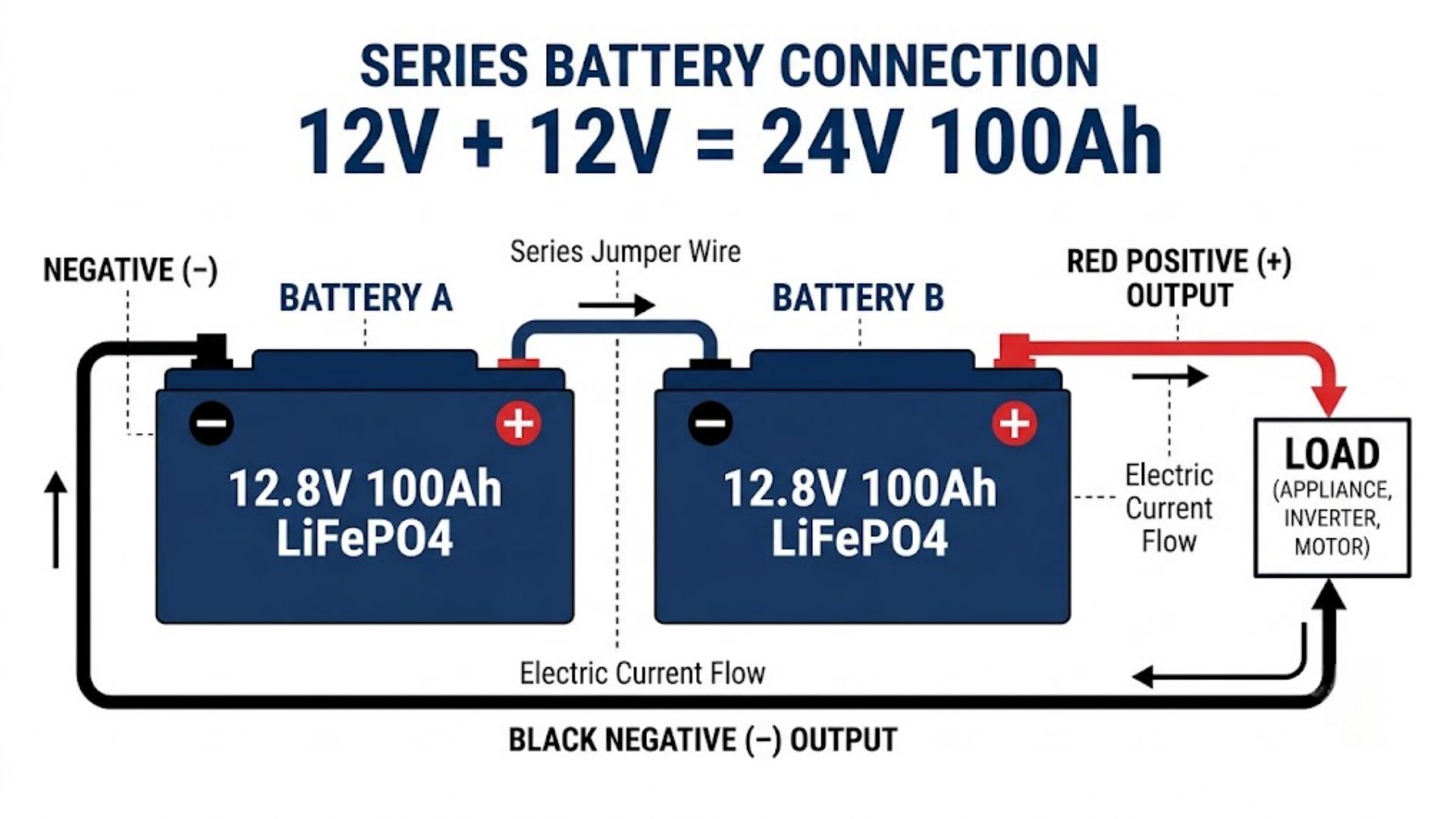
Parallel math (capacity adds, voltage stays):
-
2 × 12V 100Ah in parallel → 12V 200Ah
-
3 × 12V 100Ah in parallel → 12V 300Ah
-
4 × 12V 100Ah in parallel → 12V 400Ah
How to connect two 12V LiFePO4 batteries in parallel (step by step):
-
1. Match and prepare. Use identical batteries and bring them to the same voltage (within a few hundredths of a volt) by charging each separately first.
-
2. Link the positives. Connect the positive (+) of battery A to the positive (+) of battery B.
-
3. Link the negatives. Connect the negative (−) of battery A to the negative (−) of battery B.
-
4. Verify. The common positive and common negative points are the bank terminals; the voltage should read about 12.8V.
-
5. Use matched, equal-length cables. Each parallel branch should see the same resistance so current shares evenly. Keep each module's BMS, or use a parallel-rated shared BMS.
Parallel tip: connecting batteries in parallel increases amp-hours (and runtime), but a bank with unequal branches will circulate current between batteries until they equalize, which stresses the cells. Pre-charge batteries to the same voltage before paralleling and use identical, equal-length cables.
Series-Parallel Banks: Higher Voltage AND Higher Capacity
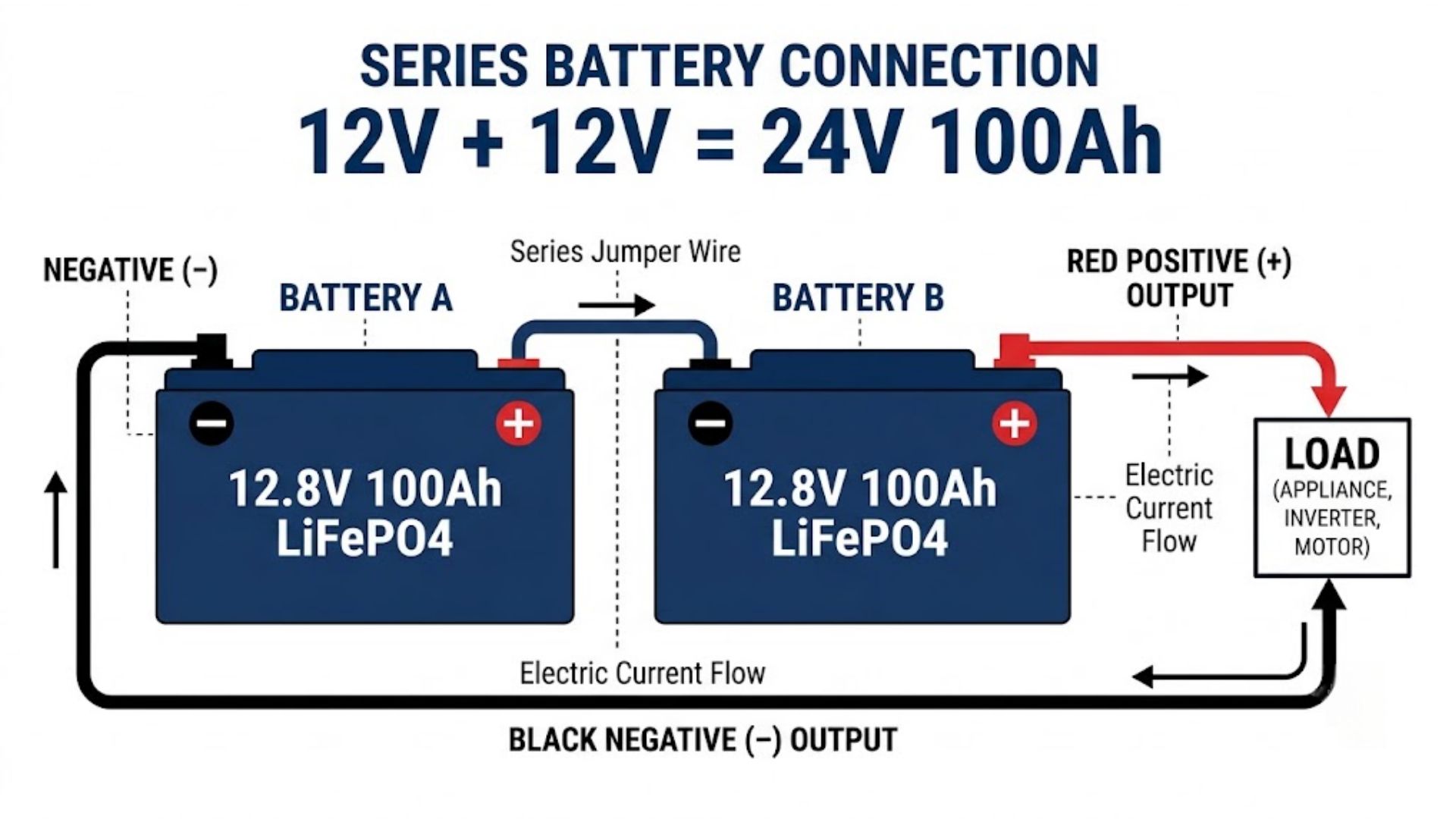
When you need both a higher voltage and more capacity than a single string provides, you combine the two methods into a series-parallel bank (written as, for example, 4S2P — four in series, two in parallel). You first build identical series strings, then connect the strings in parallel. Each battery must be identical, and each series string must produce the same voltage.
| Configuration (all cells 12V 100Ah) | Result | Typical application |
|---|---|---|
| 4S1P (4 in series) | 48V 100Ah (5.12 kWh) | Small 48V solar / rack |
| 4S2P (2 strings × 4) | 48V 200Ah (10.24 kWh) | Home / small commercial ESS |
| 4S4P (4 strings × 4) | 48V 400Ah (20.48 kWh) | Commercial rack / backup |
| 2S2P (2 strings × 2) | 24V 200Ah (5.12 kWh) | Golf carts, mid-size solar |
Building a series-parallel bank correctly: assemble each series string completely and confirm each string reads the same voltage; connect the strings in parallel only after they are matched. Professional 48V rack systems (for example, 48V 100Ah modules that stack in parallel) are already built as matched modules with compatible BMS communication, which removes most of this wiring risk — see our 48V Rack-Mounted Battery Guide.
The Golden Rules for Matching LiFePO4 Batteries
LiFePO4 is forgiving, but it is not magic. The batteries in a series or parallel bank must behave like one big battery, which is only safe when the individual units match. Follow these rules.
| Parameter | Requirement for a safe bank |
|---|---|
| Chemistry | All LiFePO4 — never mix with lead-acid, AGM, gel, or NMC |
| Nominal voltage | Identical (all 12V, all 24V, etc.) |
| Capacity (Ah) | Identical rating for parallel branches; the smallest unit limits the series string |
| Brand / model | Same manufacturer and model — same internal resistance and BMS |
| Age / cycle history | Match age and wear; don't pair new batteries with worn ones |
| Starting voltage | Pre-charge all units to within ~0.05V before connecting |
| BMS | One BMS rated for the final bank voltage/current, or compatible module BMS |
If cells drift apart after assembly, the fix is balancing — see How to Balance LiFePO4 Batteries. For a bank that seems dead after a wiring error, the recovery procedure is in How to Wake Up a LiFePO4 Battery.
Can You Mix Different Ah, Brands, or Ages?
This is the single most common question in battery bank building, and the short answer is not recommended for parallel, and never for a series string. The table below gives the safe answer for each situation.
| Mixing scenario | Allowed? | Why / condition |
|---|---|---|
| Different amp-hours in parallel | Not recommended | Current splits by resistance, not Ah; the small branch is overloaded |
| Different amp-hours in series | No | The lowest-capacity unit is over-charged/discharged every cycle |
| Different brands, same specs | Avoid | Different internal resistance and BMS curves cause imbalance |
| New + old (same model) | Avoid | The aged unit drags the bank down and ages faster |
| Different chemistries | Never | Different voltage curves and charge voltages — damage and fire risk |
| Same model, same batch, matched | Yes | The correct way to build a bank |
Buying tip: if a project may need more capacity later, buy a matched set up front rather than adding a random battery months later. LiFePO4 batteries from the same production batch are pre-matched for internal resistance and capacity, which is what a long-lasting parallel bank depends on.
BMS, Charging & Wiring for Series-Parallel Banks
BMS sizing. A series string needs a BMS that handles the full series voltage (for example, a 4S 12V BMS for 12V, a 16S BMS for 51.2V) and the bank's continuous and peak current. Most drop-in LiFePO4 modules contain an internal BMS that can be paralleled within the manufacturer's limit; building a high-voltage series string from modules that are not designed for it can void the warranty — use modules engineered for series or a dedicated rack system.
Charging voltage. The charger must match the final bank voltage and use the LiFePO4 charge profile. A 24V series bank charges to about 28.8V; a 48V (51.2V) bank to about 57.6V (14.4V / 28.8V / 57.6V per 12V / 24V / 48V block, with a 13.5V / 27.0V / 54.0V float). Parallel banks at 12V use a standard 12V LiFePO4 charger. Full parameters are in How to Charge LiFePO4 Batteries.
Cables and wire gauge. Higher-voltage series banks run lower current for the same power, but the cables must still carry the full current with acceptable voltage drop. Parallel branches must use identical-length, identical-gauge cables so current shares evenly. Wire sizing is covered in detail in What Gauge Wire to Connect 12V Batteries to Make 24V.
Connection order. Always connect battery-to-battery links first, verify the bank voltage with a multimeter, and only then connect the charger and load. When disconnecting, reverse the order — remove the load/charger first, then the bank links. This avoids sparking and BMS lockout. If the BMS trips or the bank reads 0V, follow How to Reset the BMS on a LiFePO4 Battery.
Common Mistakes & Safety
-
Shorting a battery by touching the wrong terminals. Always use insulated tools, remove jewelry, and connect the load last.
-
Crossing a series and parallel link (creating a short loop). Double-check the wiring against the diagram before energizing; a mistaken parallel cable across a series string can cause a short and fire.
-
Mixing unmatched batteries. This is the leading cause of imbalance, BMS trips, and premature failure — match chemistry, voltage, capacity, brand, and age.
-
Using an undersized or wrong-voltage BMS. The BMS must cover every cell in a series string and the bank's peak current.
-
Using a lead-acid charger. Lead-acid charge profiles overcharge LiFePO4; use a LiFePO4-specific charger.
-
Unequal parallel cable lengths. Different branch resistances cause unequal current sharing and hot cables.
-
Forgetting to torque and re-check terminals. Loose connections heat up under load; torque to the manufacturer's spec and re-check after the first few cycles.
For safe mounting, ventilation, and enclosure placement, see How to Install a LiFePO4 Battery.
Related Resources
-
12V vs 24V vs 48V LiFePO4: Choosing the Right Voltage — decide which voltage your project needs before wiring the bank
-
What Gauge Wire to Connect 12V Batteries to Make 24V — cable size and voltage-drop calculations
-
How to Charge LiFePO4 Batteries — charge voltages for 12V, 24V, and 48V banks
-
How to Balance LiFePO4 Batteries — matching cells and correcting drift in a bank
-
How to Install a LiFePO4 Battery — mounting, ventilation, and commissioning
-
48V Rack-Mounted Battery Guide — pre-matched 48V modules that parallel safely
-
What Size LiFePO4 Battery Do I Need? — sizing the bank before you connect it
-
Enerbe LiFePO4 Battery Products — matched 12V, 24V, and 48V batteries and rack systems
Frequently Asked Questions
What is the difference between connecting batteries in series and parallel?
Series connects positive to negative and adds the voltages while keeping capacity the same — two 12V 100Ah batteries make 24V 100Ah. Parallel connects positive to positive and negative to negative, adding capacity while keeping voltage the same — two 12V 100Ah batteries make 12V 200Ah. Both store the same total energy; they shape it differently.
Does connecting batteries in series increase voltage?
Yes. In a series string, the voltage of each battery adds. Two 12V 100Ah LiFePO4 batteries in series make 24V 100Ah, and four make 48V 100Ah. The capacity in amp-hours stays the same as a single battery, and the same current flows through every battery in the chain.
Does connecting batteries in parallel increase amp-hours?
Yes. Parallel connections add the amp-hours (and runtime) of every branch while the voltage stays the same. Two 12V 100Ah batteries in parallel make a 12V 200Ah bank, and four make a 12V 400Ah bank. The maximum current the bank can deliver also increases.
Can you connect LiFePO4 batteries in parallel?
Yes, and it is the standard way to extend runtime at 12V. Use identical batteries, pre-charge them to the same voltage, connect positive to positive and negative to negative with equal-length cables, and keep each module's BMS or use a parallel-rated shared BMS. Respect the manufacturer's maximum parallel count.
Can you connect batteries in parallel with different amp-hours?
It is not recommended. In parallel, current splits according to each branch's resistance rather than the Ah rating, so a smaller or mismatched battery can be overloaded and charged/discharged at a different rate. For a reliable, long-lasting bank, use batteries of the same capacity, brand, age, and chemistry. If you must add capacity, add an identical, matched string.
How do I connect two 12V batteries to make 24V?
Connect them in series: join the positive of battery A to the negative of battery B. The remaining negative of A and positive of B are the 24V bank terminals. Measure them — you should read about 25.6V when full — then connect a 24V LiFePO4 BMS, charger, and load only to the two outer terminals.
How do I connect four 12V batteries to make 48V?
Connect all four in series (4S): link A+ to B−, B+ to C−, and C+ to D−. The free A− and D+ are the 48V terminals. Four 12V 100Ah batteries in series make a 48V 100Ah bank. Use a 48V BMS (16S for 3.2V cells) and a 48V LiFePO4 charger. For more runtime at 48V, build two identical 4S strings and parallel them (4S2P).
How do I connect batteries in both series and parallel?
Build complete series strings first, verify each string reads the same voltage, then connect the strings in parallel (positive to positive, negative to negative). For example, a 4S2P bank uses two strings of four 12V batteries in parallel, giving 48V 200Ah. Never mix series and parallel links until the strings are matched.
Can I mix different battery brands, ages, or chemistries?
Not in the same bank. Different brands have different internal resistance and BMS curves, aged batteries hold less capacity, and different chemistries (LiFePO4 with lead-acid or NMC) use incompatible voltage ranges. Any of these cause imbalance, BMS trips, and a real risk of overheating or failure. Use matched batteries from the same batch.
Do I need a special BMS for a series or parallel bank?
Yes, the BMS must be rated for the final configuration. A series string needs a BMS handling the full series voltage and current; parallel drop-in modules usually keep their internal BMS and must be within the maker's parallel limit. When in doubt, use matched rack modules that are designed and certified to parallel with each other, rather than building a high-voltage string from unrated modules.
Should I charge the batteries before connecting them?
Yes. Fully charge each battery separately so they are at the same voltage (within about 0.05V) before connecting them, especially in parallel. Connecting units at very different states of charge causes large equalizing currents that can trip the BMS or stress the cells. After assembly, run a full charge to let the bank settle.
Summary
| Goal | Connection | Example (12V 100Ah units) |
|---|---|---|
| Raise voltage | Series (+ to −) | 2 units → 24V 100Ah; 4 units → 48V 100Ah |
| Raise capacity / runtime | Parallel (+ to +, − to −) | 2 units → 12V 200Ah; 4 units → 12V 400Ah |
| Raise both | Series-parallel (matched strings) | 4S2P → 48V 200Ah |
Series adds voltage, parallel adds capacity, and both store the same total energy. Whichever you choose, the rules are the same: match the chemistry, voltage, capacity, brand, and age of every battery; pre-charge units to the same voltage; size the BMS and charger to the final bank; use identical cables; and verify with a multimeter before connecting the load. For project-scale banks, matched pre-certified 48V rack modules are the safest and fastest way to scale. Enerbe supplies matched LiFePO4 batteries and rack systems with compatible BMS and communication, plus full shipping certifications.
Get In Touch
Building a matched series or parallel LiFePO4 battery bank? Contact Enerbe for pre-matched modules and rack systems.
📄 Request a Technical Datasheet
Contact Us →📞 Speak with Our Engineering Team
Get In Touch →🔗 Browse Our Custom Battery Solutions
View Products →Dongguan A&S Power Technology Co., Limited.
Building 1, No. 2, Keji 9th Road,
Songshan Lake, Dongguan, Guangdong, China
📞 +86 137 1383 1631
✉ info@aspowerbattery.com
Stay Charged. Stay Connected.



Deep Cycle Battery vs Lithium Ion: 100Ah Specs, 10-Year TCO & When to Choose (2026)
Related Article



Get In Touch
Have questions about custom lithium batteries, energy storage solutions, or lead-to-lithium conversion? Our team is ready to help. Send us a message and we’ll respond within 24 hours.

Building 1, No. 2, Keji 9th Road, Songshan Lake, Dongguan, Guangdong, China
Office Address

info@aspowerbattery.com
Email Us

+86 137 1383 1631
Call Us

Sun - Fri (08AM - 10PM)
Office Open
