
How to Balance LiFePO4 Batteries Guide
Table of Contents
- Introduction: What Is Battery Balancing?
- Why Do LiFePO4 Cells Become Unbalanced?
- How Does Cell Balancing Work?
- Passive Balancing vs Active Balancing
- When Should You Balance LiFePO4 Batteries?
- Signs Your LiFePO4 Battery Needs Balancing
- How to Check Cell Balance
- B2B Buyer's Checklist for Battery Balancing
- Frequently Asked Questions
- Related Resources
- Summary
How to Balance LiFePO4 Batteries: Complete BMS Cell Balancing Guide
Last updated: September 2026 | Written by the Enerbe Engineering Team
Introduction: What Is Battery Balancing?
Quick Answer: LiFePO4 battery balancing is the process of equalizing voltage across all cells in a series-connected pack. The BMS handles this automatically—passive balancing (50-100mA/cell, burns excess as heat) is standard for batteries under 50kWh; active balancing (transfers energy between cells) is for large ESS. You rarely need to balance manually. If cell voltage spread exceeds 50mV, runtime drops and the weakest cell limits the whole pack. The key is buying a battery with a reliable BMS that reports per-cell voltage via CAN/RS485/Bluetooth.
LiFePO4 batteries are made of multiple cells connected in series. A 12V pack has 4 cells (4S), a 24V pack has 8 cells (8S), and a 48V pack has 16 cells (16S). Over time, these cells can become unbalanced—meaning some cells have higher voltage than others.
Unbalanced cells reduce your battery's usable capacity and can shorten its lifespan. The worst cell determines the whole battery's performance: if one cell reaches 3.65V during charging, the BMS stops charging the entire pack—even if other cells are only at 3.30V. Similarly, if one cell drops to 2.5V during discharge, the BMS cuts output—even if other cells still have charge.
Battery balancing is the process of equalizing voltage across all cells to maximize performance and longevity. Proper LiFePO4 battery maintenance includes regular monitoring of cell balance to ensure optimal performance and extend cycle life.
For a complete overview of LiFePO4 battery technology, see our What Is a LiFePO4 Battery Guide. For sourcing across all applications, see our B2B Sourcing Guide.
Why Do LiFePO4 Cells Become Unbalanced?
Understanding LiFePO4 cell balancing starts with knowing why cells drift apart in the first place. Even Grade A cells from the same production batch have tiny differences that compound over thousands of cycles.
| Cause | Explanation | Typical Impact |
|---|---|---|
| Manufacturing variations | Small differences in internal resistance, capacity, and self-discharge rate between cells | 5-20mV initial spread |
| Temperature differences | Cells at different temperatures charge/discharge at different rates; hot spots accelerate degradation | 10-50mV spread per 10°C difference |
| Ageing | Cells degrade at slightly different rates; internal resistance increases unevenly over time | Gradual spread increase over cycles |
| Deep discharges | Pushing batteries below 20% SOC increases imbalance risk; weakest cell hits LVD first | 20-100mV spread after deep cycle |
| High charge/discharge rates | Faster rates amplify small cell differences; higher IR cells heat more and degrade faster | Proportional to current squared |
| Self-discharge differences | Each cell self-discharges at a slightly different rate during storage | 1-3% per month, varies by cell |
For B2B buyers, the most preventable cause is poor thermal management. Ensuring even temperature distribution across the pack (within ±5°C) is the single most effective way to minimize cell imbalance over time.
How Does Cell Balancing Work?
BMS cell balancing is the process of equalizing voltage across all cells in a battery pack. Cell balancing is performed by the Battery Management System (BMS)—your battery's brain.
The BMS monitors each cell's voltage (typically every 1-10 seconds) and redistributes energy between cells to ensure they are all at the same voltage level. This maximizes total usable capacity and prevents any single cell from being overcharged or over-discharged.
The Balancing Process Step by Step
-
Monitoring: The BMS continuously measures each cell's voltage using precision analog-to-digital converters (ADCs), typically with ±5mV accuracy.
-
Detection: When the voltage spread between the highest and lowest cell exceeds the balancing threshold (typically 20-50mV), the BMS activates balancing.
-
Action: For passive balancing, the BMS switches on a resistor across the highest-voltage cell(s), discharging them at 50-100mA until they match the lowest cell. For active balancing, the BMS uses a DC-DC converter to transfer energy from high cells to low cells.
-
Verification: The BMS continues monitoring and adjusts balancing current until all cells are within the target spread (typically <10mV).
-
Completion: Balancing typically occurs during the final stage of charging (CV phase) when cells are near full, as this is when voltage differences are most visible.
Key Point: Balancing is most effective during charging, not discharging. During discharge, the BMS can only monitor and protect—it cannot transfer energy between cells. This is why a full charge cycle (including the CV phase) is important for maintaining cell balance.
Passive Balancing vs Active Balancing

When evaluating BMS options for your project, the choice between passive vs active balancing is a key consideration.
| Feature | Passive Balancing | Active Balancing |
|---|---|---|
| Method | Burns excess energy as heat through resistors | Transfers energy from high-voltage cells to low-voltage cells via DC-DC converter |
| Typical Balancing Current | 50-100mA per cell | 1-10A per cell |
| Cost | Lower ($5-20 per BMS) | Higher ($50-200+ per BMS) |
| Efficiency | Lower (wastes energy as heat) | Higher (85-95% energy reuse) |
| Speed | Slower (minutes to hours for 50mV spread) | Faster (seconds to minutes) |
| Heat Generation | Yes (resistors get warm) | Minimal |
| Complexity | Simple (resistors + MOSFETs) | Complex (inductors/capacitors + controllers) |
| Best For | Batteries under 50kWh, cost-sensitive applications, golf carts, RVs, marine | Large ESS (>50kWh), high-performance applications, grid-scale storage |
Which One Should You Choose?
For most commercial and industrial applications under 50kWh, passive balancing is sufficient and cost-effective. The energy wasted as heat is negligible (typically <0.1% of total capacity per cycle), and the lower BMS cost more than compensates.
For large-scale energy storage systems (ESS) where efficiency is critical and packs exceed 50kWh, active balancing provides better long-term performance. The higher balancing current (1-10A vs 50-100mA) means large packs can balance in minutes rather than hours.
B2B Buying Tip: The BMS quality matters more than the balancing method. A reliable BMS with passive balancing (from reputable manufacturers like Daly, JBD, or ANT) often outperforms a poorly designed BMS with active balancing from an unknown supplier. Always verify the BMS can report per-cell voltage via CAN bus, RS485, or Bluetooth—you cannot manage what you cannot measure.
When Should You Balance LiFePO4 Batteries?
For systems with balancing LiFePO4 batteries in series, the BMS should monitor each cell group individually. Balancing is not something you schedule—it happens automatically when the BMS detects imbalance.
| Scenario | Balancing Action | Expected Duration |
|---|---|---|
| New battery installation | BMS automatically balances during first 3-5 full charge cycles | 1-3 hours per cycle |
| After deep discharge (<20% SOC) | Let BMS balance during recharge; perform a full charge to 100% | 2-4 hours |
| Performance drop detected | Check cell voltages; if spread >50mV, run a full charge + CV phase | 3-6 hours |
| Multiple batteries in series/parallel | Regular balancing is essential; ensure each pack's BMS is functioning | Continuous during charge |
| After long storage (>3 months) | Balance before putting back into service; perform 2-3 full charge/discharge cycles | 2-3 cycles |
| After BMS reset or wake-up | BMS may need to relearn cell parameters; perform a full charge cycle | 1-2 hours |
Most BMS units handle balancing automatically—you don't need to do anything manually. The only time you need to intervene is if the BMS fails to balance (e.g., balancing current too low for the degree of imbalance) or if you're using a basic BMS without balancing capability.
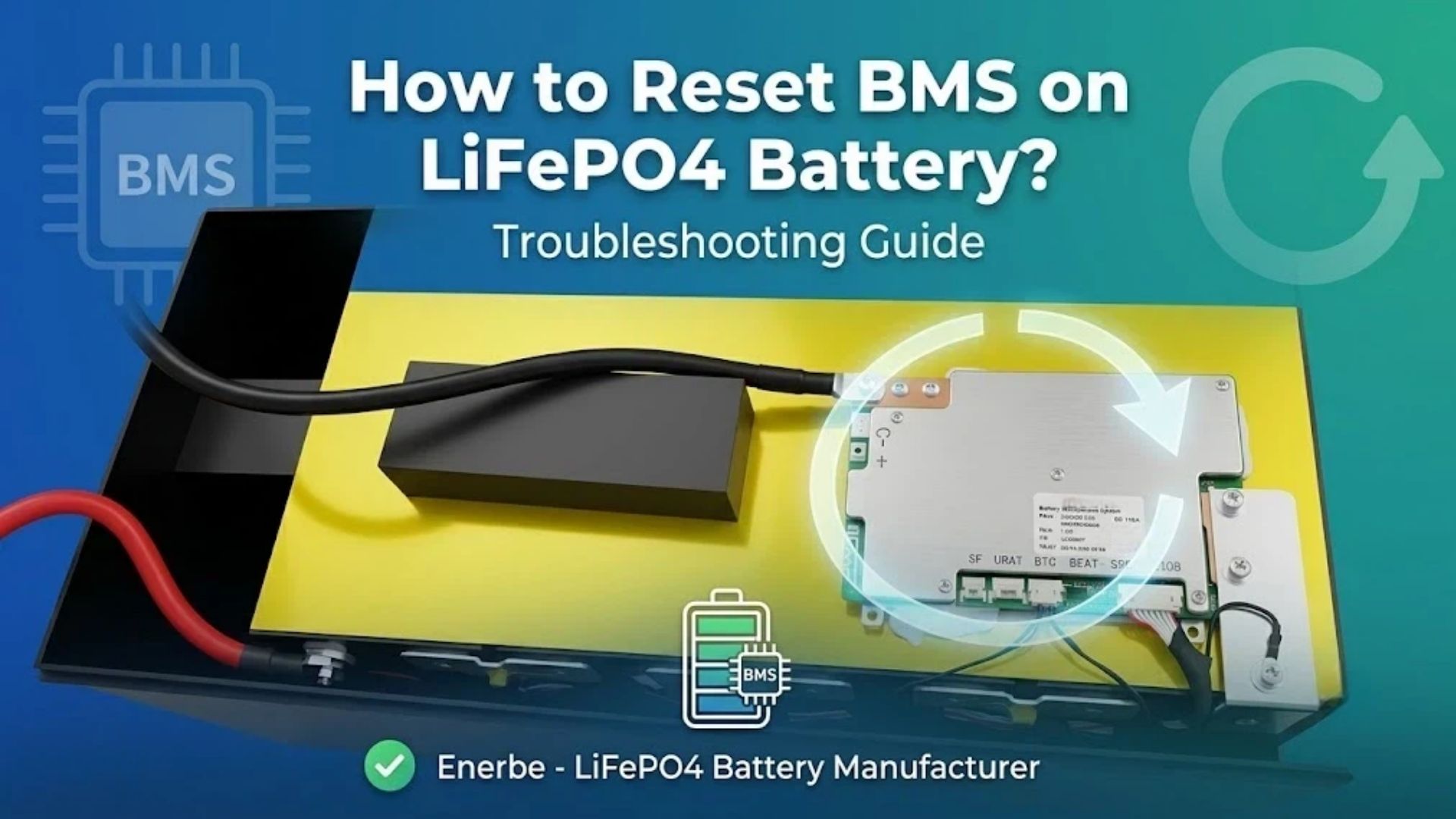
For BMS reset procedures, see our How to Reset BMS on LiFePO4 Battery. For waking a sleeping BMS, see our How to Wake Up a LiFePO4 Battery.
Signs Your LiFePO4 Battery Needs Balancing
| Sign | What It Means | Typical Cell Voltage Spread |
|---|---|---|
| Reduced runtime | Battery doesn't last as long as it used to; weakest cell limits discharge | >50mV |
| BMS error codes | Some BMS units flag cell imbalance (e.g., "CELL_IMBALANCE" or error code 0x08) | >100mV |
| Voltage fluctuation | Inconsistent voltage under load; pack voltage drops suddenly when weakest cell hits LVD | >80mV |
| Charging stops early | BMS stops charging because one cell reached 3.65V OVP, even if other cells are only at 3.30V | >100mV at top of charge |
| Discharging stops early | BMS stops discharging because one cell reached 2.5V UVP, even if other cells still have charge | >100mV at bottom of discharge |
| SOC jumps or inaccurate | BMS state of charge reading jumps erratically; Coulomb counting is thrown off by imbalance | Varies |
How to Check Cell Balance
Checking cell balance requires access to per-cell voltage data. There are three methods, depending on your BMS capabilities:
Method 1: BMS App / Bluetooth (Easiest)
Most modern BMS units (JBD, Daly, ANT, Overkill Solar) have Bluetooth connectivity. Simply:
-
Download the BMS manufacturer's app (e.g., "JBD BMS", "Daly BMS", "ANT BMS")
-
Connect to the BMS via Bluetooth
-
Navigate to the "Cell Info" or "Cell Voltage" screen
-
Record each cell's voltage and calculate the spread (max - min)
Healthy spread: <20mV at rest, <50mV under load. Needs attention: >50mV at rest, >100mV under load.
Method 2: CAN Bus / RS485 (For Fleet/Industrial)
For commercial systems, per-cell data is available via CAN bus or RS485. Use the BMS manufacturer's protocol documentation to read cell voltage registers. This is the method used by fleet management systems and SCADA integration.
Method 3: Multimeter (Manual, Last Resort)
If your BMS does not report per-cell voltage, you can measure directly at the BMS cell sense wires:
-
Set multimeter to DC voltage (20V range)
-
Measure between each adjacent pair of cell sense wires (B0-B1 = cell 1, B1-B2 = cell 2, etc.)
-
Record each cell voltage and calculate spread
Safety Warning: Only measure at the BMS sense wires, not directly at the cell terminals—accidental short across cell terminals can cause severe arcing. Use insulated probes and work in a dry area.
B2B Buyer's Checklist for Battery Balancing
When sourcing LiFePO4 batteries for commercial projects, verify the BMS balancing capabilities:
-
BMS has balancing capability — passive (standard) or active (for large ESS)
-
Balancing is automatic — no manual intervention required under normal operation
-
Balancing current rating — 50-100mA passive is standard; 1-10A active for large packs
-
BMS can report per-cell voltage — via CAN bus, RS485, or Bluetooth for monitoring and diagnostics
-
Communication protocol supported — CAN bus (standard for ESS), RS485 (industrial), Bluetooth (consumer)
-
Balancing threshold — typically 20-50mV; lower threshold = tighter balance = more capacity
-
Cell voltage measurement accuracy — ±5mV or better; poor accuracy means poor balancing
-
Temperature sensing per cell group — at least 2-3 NTC thermistors per pack for thermal monitoring
-
BMS manufacturer reputation — Daly, JBD, ANT, Overkill Solar are reputable; avoid unknown no-name BMS
-
Firmware updatable — ability to update BMS firmware for bug fixes and feature improvements
Frequently Asked Questions
How often should I balance my LiFePO4 batteries?
Modern BMS units balance cells automatically during every charge cycle—you don't need to schedule balancing. No manual balancing is required under normal operation. The BMS activates balancing whenever the cell voltage spread exceeds its threshold (typically 20-50mV). If you notice performance issues (reduced runtime, early charge/discharge cutoff), check cell voltages and run a full charge cycle (including the CV phase) to allow the BMS to balance. For batteries in storage, perform a full charge every 3-6 months to maintain balance.
Is passive balancing good enough?
For most commercial applications under 50kWh, yes. Passive balancing is reliable, cost-effective, and sufficient for batteries under 50kWh. The energy wasted as heat is negligible (typically <0.1% of total capacity per cycle). For larger systems (>50kWh) or high-performance applications where every watt-hour counts, active balancing provides better efficiency and faster balancing. The key factor is not passive vs active—it's BMS quality. A well-designed passive BMS from a reputable manufacturer will outperform a poorly designed active BMS from an unknown supplier.
Can I balance LiFePO4 batteries manually?
Some battery management systems allow manual balancing via their app or software (you can select which cells to discharge). However, for safety and reliability, automatic BMS balancing is the standard approach for commercial projects. Manual balancing is only recommended if: (1) the BMS has failed and you need a temporary fix, (2) you're using a basic BMS without balancing, or (3) you need to top-balance cells before initial assembly. Never attempt to manually charge/discharge individual cells without proper equipment—LiFePO4 cells can deliver very high short-circuit currents. If you must manually balance, use a dedicated cell balancer (e.g., HobbyKing, ISDT) with proper safety features.
How long does cell balancing take?
Balancing time depends on three factors: (1) BMS balancing current, (2) number of cells, and (3) degree of imbalance. For passive balancing (50-100mA): a 50mV spread in a 100Ah pack takes approximately 2-4 hours; a 100mV spread takes 4-8 hours; a 200mV spread may take 12-24 hours or more. For active balancing (1-10A): the same spreads take minutes to 1 hour. Balancing is most effective during the CV (constant voltage) phase of charging when cells are near full—this is when voltage differences are most visible and the BMS has time to balance. If balancing takes longer than 24 hours, the balancing current may be too low for the pack size, or there may be a faulty cell.
What is a normal cell voltage spread for LiFePO4?
A healthy LiFePO4 pack should have a cell voltage spread of <20mV at rest and <50mV under load. At the top of charge (100% SOC), cells should be within 10-30mV of each other. At the bottom of discharge (0% SOC), spread may increase to 30-50mV as the weakest cell approaches LVD. If the spread exceeds 100mV at rest, the pack needs balancing. If the spread exceeds 200mV and balancing doesn't reduce it, you may have a faulty cell that needs replacement. Note that LiFePO4 has a very flat voltage curve (3.20-3.35V for most of the SOC range), so small voltage differences correspond to significant SOC differences—this is why precise balancing is important.
Do I need to balance new LiFePO4 batteries?
New batteries from reputable manufacturers are typically pre-balanced at the factory (cells are matched within ±5-10mV). However, during shipping and storage (which can take weeks to months), cells may self-discharge at slightly different rates, causing minor imbalance. The BMS will automatically balance during the first 3-5 full charge cycles. We recommend performing 2-3 full charge/discharge cycles (charge to 100%, discharge to 20%, repeat) when first installing a new battery to allow the BMS to calibrate and balance. After this initial break-in period, the BMS will maintain balance automatically. If you're assembling your own pack from individual cells, you must top-balance the cells before assembly using a dedicated cell balancer.
Can cell imbalance cause safety issues?
Mild cell imbalance (50-100mV) is not a safety hazard—it primarily reduces usable capacity and shortens cycle life. However, severe imbalance (>200mV) can lead to safety issues: (1) a single cell may be overcharged beyond 3.65V if the BMS only monitors pack voltage (not per-cell), causing lithium plating and potential thermal runaway; (2) a single cell may be over-discharged below 2.0V, causing copper dissolution from the anode and permanent damage; (3) a severely degraded cell may have increased internal resistance, causing it to overheat under load. This is why per-cell monitoring and protection are essential—any reputable BMS will cut charge/discharge if any single cell exceeds safe limits, regardless of pack voltage. For more on safety, see our LiFePO4 Battery Safety Guide.
What's the difference between top-balancing and bottom-balancing?
Top-balancing means all cells are fully charged to the same voltage (3.65V) at the top of the charge curve. This is the standard method for LiFePO4 and is what BMS passive balancing does—during the CV phase, high cells are discharged down to match the lowest cell, ensuring all cells reach full charge together. Bottom-balancing means all cells are discharged to the same voltage (2.5V) at the bottom of the discharge curve. This is less common for LiFePO4 because the flat voltage curve makes it hard to determine when cells are truly empty. For DIY pack builders, top-balancing is strongly recommended for LiFePO4. In commercial packs, the BMS handles top-balancing automatically during every charge cycle.
Related Resources
-
What Is a LiFePO4 Battery? Complete Guide — chemistry, voltage, capacity, and BMS basics
-
How to Reset BMS on LiFePO4 Battery — BMS reset procedures for common brands
-
How to Wake Up a LiFePO4 Battery — reviving a sleeping BMS after deep discharge
-
How to Charge LiFePO4 Batteries Guide — correct charge voltage, current, and CV phase for balancing
-
How to Install a LiFePO4 Battery — step-by-step installation, series/parallel wiring
-
LiFePO4 Battery Safety Guide — thermal runaway risk, fire safety, and safe handling
-
LiFePO4 Battery Lifespan Guide — how balancing affects cycle life and longevity
Summary
Balancing LiFePO4 batteries ensures cells operate at the same voltage level, maintaining maximum capacity and prolonging battery life.
-
Why it matters: Unbalanced cells reduce usable capacity and shorten lifespan; the weakest cell limits the whole pack
-
How it works: The BMS monitors per-cell voltage (±5mV accuracy) and balances automatically during charging (CV phase)
-
Passive vs Active: Passive (50-100mA, burns as heat) is standard for <50kWh; active (1-10A, transfers energy) for large ESS
-
Healthy spread: <20mV at rest, <50mV under load; >100mV needs attention
-
BMS quality matters: A reliable BMS with per-cell reporting (CAN/RS485/Bluetooth) is essential—you cannot manage what you cannot measure
-
Manual balancing rarely needed: Modern BMS handles it automatically; only intervene if BMS fails or you're assembling a DIY pack
The most common B2B procurement mistake is buying batteries with a basic BMS that cannot report per-cell voltage. Without per-cell data, you cannot diagnose imbalance, cannot verify balancing is working, and cannot detect a failing cell before it causes a safety issue. Always insist on per-cell voltage reporting via CAN bus, RS485, or Bluetooth.
Enerbe provides LiFePO4 batteries with advanced BMS that includes automatic passive balancing, per-cell voltage monitoring, and CAN/RS485/Bluetooth communication, ensuring consistent performance and extended cycle life. For wholesale pricing or custom configurations, contact our team.
Get In Touch
Need a quote or custom BMS configuration for LiFePO4 batteries? Contact Enerbe today.
📄 Request Safety Certifications & Datasheet
Contact Us →📞 Speak with Our Engineering Team
Get In Touch →🔗 Browse Certified LiFePO4 Battery Products
View Products →Dongguan A&S Power Technology Co., Limited.
Building 1, No. 2, Keji 9th Road,
Songshan Lake, Dongguan, Guangdong, China
📞 +86 137 1383 1631
✉ info@aspowerbattery.com
Stay Charged. Stay Safe.



Marine LiFePO4 Battery: Complete Guide for Boat Builders, Dealers & B2B Buyers (2026)
BESS Supplier Selection: 7 Key Criteria & Capability Assessment
Related Article



Get In Touch
Have questions about custom lithium batteries, energy storage solutions, or lead-to-lithium conversion? Our team is ready to help. Send us a message and we’ll respond within 24 hours.

Building 1, No. 2, Keji 9th Road, Songshan Lake, Dongguan, Guangdong, China
Office Address

info@aspowerbattery.com
Email Us

+86 137 1383 1631
Call Us

Sun - Fri (08AM - 10PM)
Office Open
