
LiFePO4 Battery Lifespan: How Long Do They Last? (2026)

Table of Contents
- Introduction
- How Long Do LiFePO4 Batteries Last? (Short Answer)
- Cycle Life vs Calendar Life: What's the Difference?
- LiFePO4 Cycle Life: 3000, 4000, 6000+ Cycles Explained
- 6 Factors That Affect LiFePO4 Battery Lifespan
- LiFePO4 vs Lead-Acid vs NMC: Lifespan Comparison
- How to Calculate kWh from Voltage and Ah (51.2V 300Ah to kWh)
- How to Extend LiFePO4 Battery Lifespan: 10 Expert Tips
- When to Replace Your LiFePO4 Battery
- Frequently Asked Questions
- Why Enerbe for Long-Lasting LiFePO4 Batteries?
LiFePO4 Battery Lifespan: How Long Do They Last? (Cycles, Years & Tips 2026)
Last updated: August 2026 | Written by the Enerbe Engineering Team
Introduction
How long do LiFePO4 batteries last? This is one of the most important questions for B2B buyers evaluating lithium iron phosphate batteries for solar energy storage, UPS systems, telecom backup, and commercial applications. Unlike lead-acid batteries that need replacement every 3–5 years, LiFePO4 batteries offer dramatically longer lifespan—but the actual number depends on how you use and maintain them.
This complete LiFePO4 battery lifespan guide covers everything B2B buyers need to know: cycle life vs calendar life, what 3000/4000/6000+ cycles really mean, the 6 key factors that affect lifespan, a detailed comparison with lead-acid and NMC chemistries, how to calculate kWh from voltage and Ah (including the common 51.2V 300Ah to kWh calculation), 10 expert tips to extend battery life, and clear signs that it's time to replace your battery.
For guidance on correct charging parameters that maximize lifespan, see our complete guide to charging LiFePO4 batteries.
How Long Do LiFePO4 Batteries Last? (Short Answer)
LiFePO4 batteries typically last 4,000–6,000+ cycles at 80% depth of discharge (DoD), which translates to 10–15+ years of typical use. High-quality LiFePO4 batteries with robust BMS protection can reach 6,000–10,000 cycles under optimal conditions. This is 4–10 times longer than lead-acid batteries (500–1,000 cycles at 50% DoD) and 2–3 times longer than NMC lithium batteries (1,000–2,000 cycles).
✅ Key Takeaway
For most commercial solar + storage applications using 20–80% daily cycles, a quality LiFePO4 battery will last 12–15 years. The upfront cost is higher than lead-acid, but the cost per cycle is 3–5 times lower, making LiFePO4 the most economical choice over the system's lifetime.
Cycle Life vs Calendar Life: What's the Difference?
Battery lifespan is measured in two ways: cycle life and calendar life. Understanding the difference helps you accurately predict how long your battery will last in your specific application.
Cycle Life
Cycle life is the number of complete charge-discharge cycles a battery can perform before its capacity drops to 80% of its original rated capacity. One cycle = discharging from 100% to 0% and recharging back to 100%. Partial cycles (e.g., 100% to 50% and back) count as half a cycle.
Cycle life is always specified at a particular depth of discharge (DoD). A battery rated for "4,000 cycles at 80% DoD" means you can regularly discharge it to 20% remaining (80% used) and recharge 4,000 times before capacity drops below 80% of original.
Calendar Life
Calendar life is the total number of years a battery remains functional, regardless of how many cycles it has performed. Even a battery that is never used will degrade over time due to chemical aging (passivation layer growth, electrolyte degradation, internal resistance increase).
LiFePO4 has excellent calendar life—typically 15–20 years when stored properly at 50% SOC and room temperature. In active use, calendar life is usually 10–15 years, at which point the battery may still function but with reduced capacity (70–80% of original).
Which One Matters More?
For most commercial applications, cycle life is the limiting factor. A solar + storage battery cycled daily will reach its cycle life limit (4,000–6,000 cycles = ~11–16 years) before its calendar life limit (15–20 years). For standby/UPS applications with infrequent cycling, calendar life may be the limiting factor, and LiFePO4 can last 15+ years on standby.
LiFePO4 Cycle Life: 3000, 4000, 6000+ Cycles Explained
You'll see LiFePO4 batteries advertised with different cycle life ratings—3,000 cycles, 4,000 cycles, 6,000 cycles, even 10,000+ cycles. What do these numbers mean, and why do they vary so much?
The Fine Print: Depth of Discharge Matters
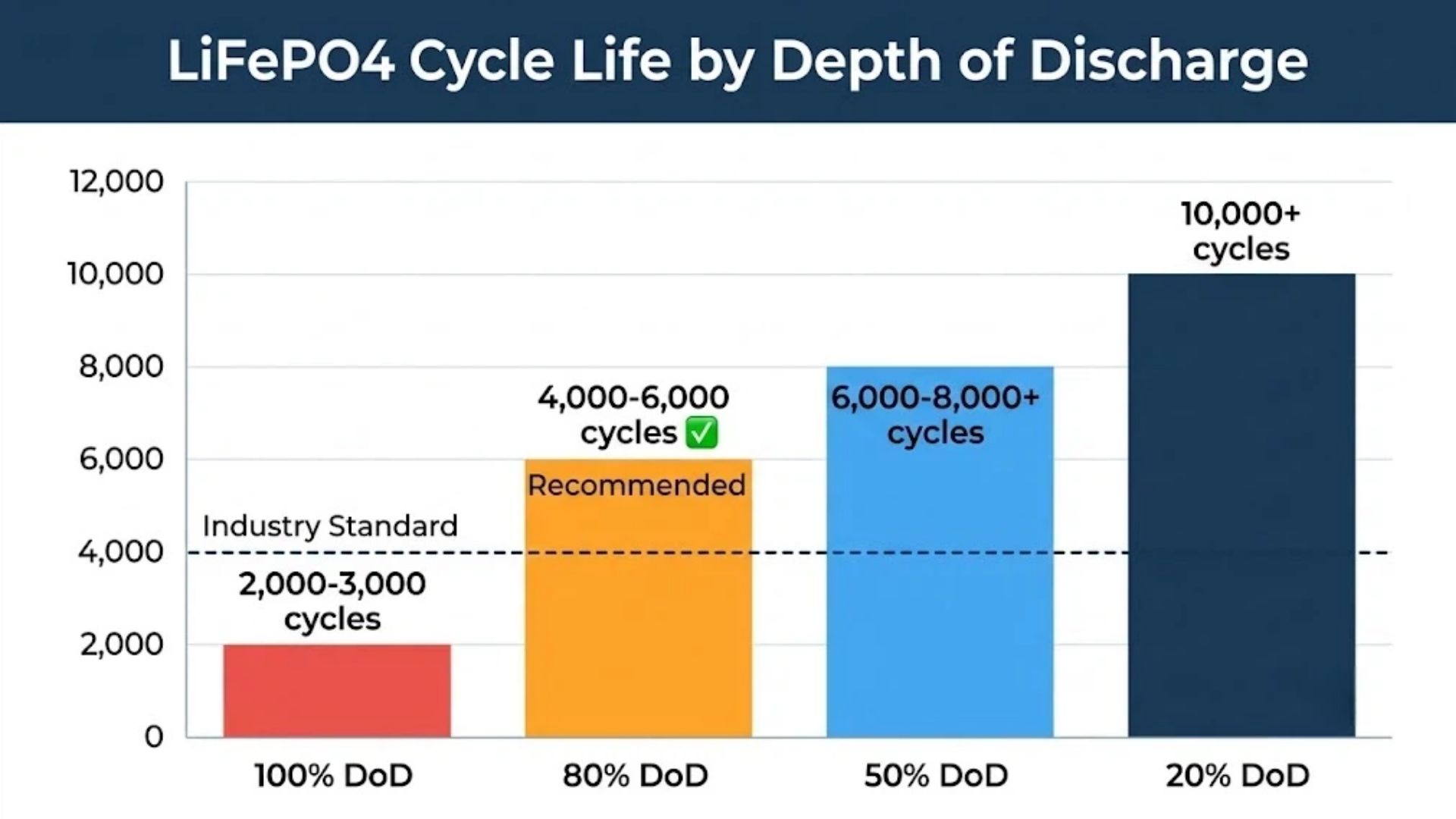
Cycle life ratings are only meaningful when you know the depth of discharge (DoD) they were tested at. A battery advertised as "6,000 cycles" might be tested at 50% DoD (only using half the capacity), while the same battery at 100% DoD might only last 2,000–3,000 cycles. Always check the DoD in the specification.
| Depth of Discharge (DoD) | Typical Cycle Life (Quality LiFePO4) | Equivalent Years (1 cycle/day) |
|---|---|---|
| 100% DoD (full discharge) | 2,000–3,000 cycles | ~5.5–8 years |
| 80% DoD (recommended max) | 4,000–6,000 cycles ✅ | ~11–16 years |
| 50% DoD (shallow cycle) | 6,000–8,000+ cycles | ~16–22 years |
| 20% DoD (very shallow) | 10,000+ cycles | ~27+ years (calendar life limits) |
B2B Tip: For commercial solar + storage, design your system for 20–80% daily cycles (60% DoD) to maximize lifespan. This means sizing the battery 30–50% larger than your average daily usage. The extra upfront cost is offset by 30–50% longer battery life.
What Does "End of Life" Mean?
A battery is considered at end of life when its capacity drops to 80% of its original rated capacity. This is the industry standard definition (also used by battery warranties). At 80% capacity, the battery still works but provides less runtime, and the degradation rate may accelerate. Many commercial batteries continue operating at 60–70% capacity for several more years before replacement is necessary.
6 Factors That Affect LiFePO4 Battery Lifespan
Two identical LiFePO4 batteries can have very different lifespans depending on how they are used. These are the 6 most important factors:
1. Depth of Discharge (DoD)
The single biggest factor. Regularly discharging to 100% (0% remaining) can halve the cycle life compared to discharging to only 80% (20% remaining). For maximum life, set your inverter low-voltage cutoff to keep 20% reserve (80% max DoD). Avoid regularly going below 20% state of charge.
2. Charge Rate (C-Rate)
Higher charge rates generate more heat and internal stress, reducing cycle life. Charging at 0.2C–0.5C is ideal for long life. While LiFePO4 can handle 1C fast charging, doing it daily can reduce cycle life by 10–20%. For solar systems, the natural charge rate from solar panels is usually 0.2C–0.5C, which is optimal.
3. Temperature
LiFePO4 batteries perform best at 15–25°C (59–77°F). Operating outside this range accelerates degradation:
-
High temperatures (>30°C / 86°F): Accelerates chemical aging and increases internal resistance. Every 10°C above 25°C roughly doubles the degradation rate. Ensure proper ventilation and cooling in battery rooms.
-
Low temperatures (<0°C / 32°F): Charging below 0°C causes lithium plating (irreversible damage). Discharging at low temperatures is okay but reduces available capacity temporarily. Use battery heating for cold climate installations.
4. State of Charge During Storage
Storing a LiFePO4 battery at 100% or 0% for extended periods accelerates degradation. The ideal storage state is 50–60% SOC (~3.3V per cell). If a battery will be idle for more than 2 weeks, discharge or charge to 50% first. Recharge to 50% every 3–6 months during long-term storage.
5. Cell Quality & Manufacturing
Not all LiFePO4 cells are equal. High-quality cells from reputable manufacturers (CATL, BYD, EVE, CALB) use consistent materials and strict quality control, delivering the rated cycle life. Cheap, low-quality cells may have inconsistent performance, higher internal resistance, and shorter actual cycle life—sometimes half the rated value. For B2B applications, always verify the cell manufacturer and quality control processes.
6. BMS Quality & Cell Balancing
A quality BMS protects the battery from overcharge, over-discharge, over-current, and temperature extremes—all of which would otherwise drastically reduce lifespan. Active cell balancing ensures all cells age evenly, preventing one weak cell from limiting the entire battery's life. A battery with a poor or basic BMS may experience accelerated cell imbalance and premature failure, even with quality cells.
LiFePO4 vs Lead-Acid vs NMC: Lifespan Comparison
How does LiFePO4 lifespan compare to other battery chemistries commonly used in commercial applications?
| Characteristic | LiFePO4 (LFP) | Lead-Acid (Flooded/AGM/Gel) | NMC (Lithium Nickel Manganese Cobalt) |
|---|---|---|---|
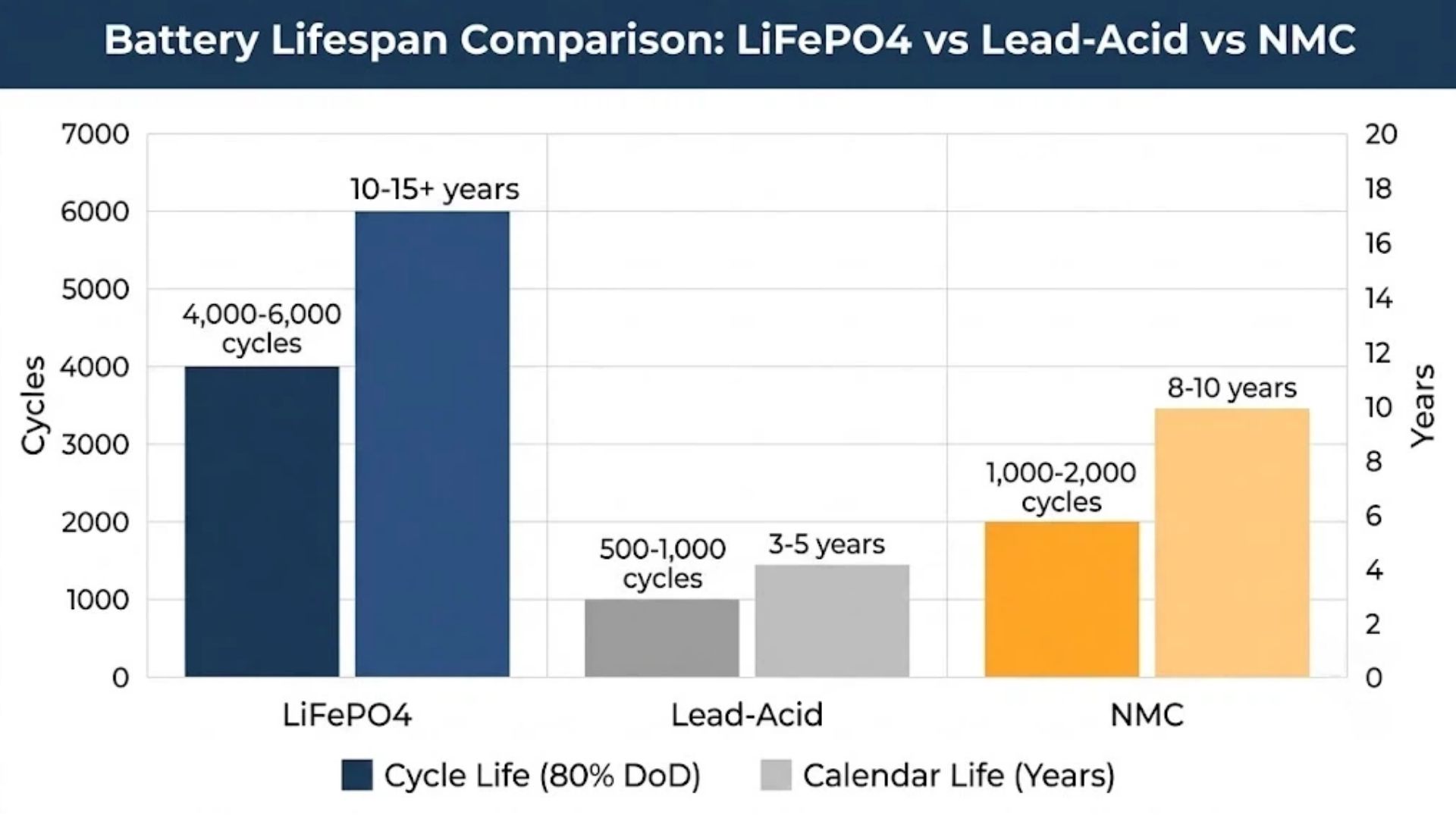
| Cycle Life (80% DoD) | 4,000–6,000+ ✅ | 500–1,000 (at 50% DoD) | 1,000–2,000 |
| Calendar Life | 10–15+ years ✅ | 3–5 years | 8–10 years |
| Recommended Max DoD | 80–90% ✅ | 50% (deeper = much shorter life) | 80% |
| Energy Density | 90–120 Wh/kg | 30–50 Wh/kg | 150–220 Wh/kg ✅ |
| Maintenance Required | None (sealed) ✅ | Flooded: regular watering; AGM/Gel: none | None (sealed) ✅ |
| Cost per Cycle (approx.) | $0.02–$0.04 ✅ | $0.08–$0.15 | $0.05–$0.08 |
Bottom line: While LiFePO4 has a higher upfront cost than lead-acid, its 4–10x longer cycle life and zero maintenance make it significantly cheaper over the system's lifetime. For commercial installations where downtime and replacement costs are high, LiFePO4 is the clear economic choice.
How to Calculate kWh from Voltage and Ah (51.2V 300Ah to kWh)
Battery capacity is often specified in Ah (amp-hours), but for energy storage system sizing and comparison, you need to know the kWh (kilowatt-hours) capacity. The calculation is simple:
kWh = Voltage (V) × Amp-Hours (Ah) ÷ 1000
Or: Wh = V × Ah, then kWh = Wh ÷ 1000
Example: 51.2V 300Ah to kWh
A common question is "51V 300Ah to kWh" (or more precisely, 51.2V 300Ah). Here's the calculation:
-
Voltage: 51.2V (nominal for a 16S LiFePO4 battery, commonly called "48V")
-
Capacity: 300Ah
-
Calculation: 51.2V × 300Ah = 15,360 Wh = 15.36 kWh
So a 51.2V 300Ah LiFePO4 battery provides approximately 15.36 kWh of nominal energy storage. At 80% usable DoD, that's about 12.3 kWh of usable capacity per cycle.
Common Capacity Reference Table
| Battery Specification | Nominal kWh | Usable kWh (80% DoD) |
|---|---|---|
| 12.8V 100Ah (12V) | 1.28 kWh | 1.02 kWh |
| 25.6V 100Ah (24V) | 2.56 kWh | 2.05 kWh |
| 51.2V 100Ah (48V) | 5.12 kWh | 4.10 kWh |
| 51.2V 200Ah (48V) | 10.24 kWh | 8.19 kWh |
| 51.2V 300Ah (48V) | 15.36 kWh | 12.29 kWh |
| 51.2V 400Ah (48V) | 20.48 kWh | 16.38 kWh |
How to Extend LiFePO4 Battery Lifespan: 10 Expert Tips
Follow these 10 tips to maximize the lifespan of your LiFePO4 battery investment:
1. Limit Depth of Discharge to 80%
Set your inverter's low-voltage cutoff to keep at least 20% state of charge remaining. Regularly discharging below 20% (80%+ DoD) significantly reduces cycle life. For critical applications, use an even more conservative 70% max DoD (30% reserve).
2. Charge at Moderate Rates (0.2C–0.5C)
Use a charger or inverter that charges at 0.2C–0.5C of battery capacity. For a 100Ah battery, that's 20A–50A. Avoid regular fast charging above 0.5C unless necessary. Solar systems naturally charge at moderate rates, which is ideal.
3. Maintain Optimal Operating Temperature
Keep the battery in an environment between 15–25°C (59–77°F) whenever possible. Ensure proper ventilation in battery rooms. For outdoor installations in hot climates, use shaded or insulated enclosures. For cold climates, install battery heating systems and ensure the BMS has low-temperature charging protection.
4. Store at 50–60% SOC for Long Periods
If the battery will be idle for more than 2 weeks, charge or discharge to 50–60% SOC (~3.3V per cell). Never store at 100% or 0% for extended periods. Recharge to 50% every 3–6 months during storage.
5. Use the Correct Charger Voltage
Always use a LiFePO4-specific charger with the correct voltage setting (14.6V for 12V, 29.2V for 24V, 54.6V for 48V/51.2V). Never use a lead-acid charger—its float mode and higher voltage will overcharge the battery and shorten life. For detailed charging guidance, see our LiFePO4 charging guide.
6. Perform Periodic Full Charges for Cell Balancing
Even if you normally use partial cycles (20–80%), perform a full charge to 100% every 2–4 weeks. This allows the BMS to balance all cells to the same voltage, preventing cell imbalance that reduces usable capacity and accelerates aging. Leave the charger connected during the CV stage until current tapers fully.
7. Keep Terminals Clean and Tight
Loose or corroded terminals cause voltage drops, overheating, and inconsistent charging—all of which stress the battery and reduce lifespan. Inspect terminals monthly, clean with a wire brush if corroded, apply dielectric grease to prevent corrosion, and torque to manufacturer specifications.
8. Avoid Physical Damage and Vibration
Physical damage (puncture, crushing, impact) can cause internal short circuits and immediate failure. Excessive vibration can loosen internal connections over time. Mount batteries securely, use vibration-damping pads for mobile applications, and protect from impact hazards.
9. Monitor Battery Health Regularly
For commercial systems, use the BMS monitoring system (via CAN bus/RS485 or app) to track key health metrics: capacity degradation, internal resistance trends, cell voltage spread, and cycle count. Monthly checks allow early detection of issues before they cause permanent damage. For critical systems, consider quarterly capacity testing.
10. Buy Quality Batteries from Reputable Suppliers
The single most important factor for long lifespan is buying a quality battery with genuine cells and a robust BMS. Cheap batteries with unknown cells and basic BMS may last only 1,000–2,000 cycles despite being rated for 4,000+. Always verify cell manufacturer, BMS capabilities, certifications, and supplier track record. For guidance on evaluating suppliers, see our reliable BESS supplier guide.
When to Replace Your LiFePO4 Battery
LiFePO4 batteries give clear warning signs before complete failure. Watch for these indicators:
1. Capacity Drops Below 80% of Rated
This is the official "end of life" threshold. If your 100Ah battery now only delivers 75–80Ah (or your runtime has dropped by 20%+ compared to when new), the battery is at end of life. It may still work for less critical applications, but plan for replacement.
2. Increased Internal Resistance
As batteries age, internal resistance increases. Signs include: voltage drops more than expected under load, battery gets warmer than usual during charging/discharging, and charge/discharge efficiency decreases. BMS monitoring systems can track internal resistance trends.
3. Frequent BMS Protection Triggers
If the battery frequently triggers over-voltage, under-voltage, or over-temperature protection during normal operation (that didn't trigger when new), this indicates degraded cells or increased internal resistance. The BMS is working harder to protect aging cells.
4. Severe Cell Imbalance
If cell voltage spread exceeds 0.1V–0.2V even after a full balance cycle, and the imbalance keeps returning, one or more cells are degrading faster than others. This will progressively reduce usable capacity and may cause premature low-voltage cutoff.
5. Physical Damage or Swelling
Any sign of swelling (puffed cells), casing cracks, leaking electrolyte, or burn marks on terminals means the battery should be replaced immediately. Do not continue using a physically damaged battery—disconnect it, move to a safe location, and contact the manufacturer for disposal guidance.
⚠️ Replacement Planning Tip
For commercial systems, plan battery replacement at the 80% capacity mark rather than waiting for complete failure. This avoids unexpected downtime and allows budget planning. Most quality LiFePO4 batteries reach 80% capacity at 10–15 years in typical solar + storage use.
Frequently Asked Questions
How long does a LiFePO4 solar battery last?
A quality LiFePO4 solar battery typically lasts 10–15 years in typical solar + storage applications (daily 20–80% cycles). In cycle terms, that's 4,000–6,000+ cycles at 80% depth of discharge. The exact lifespan depends on depth of discharge, charge rate, temperature, and battery quality. With shallow cycling (50% DoD) and optimal conditions, LiFePO4 solar batteries can last 15–20 years. This is 3–5 times longer than lead-acid solar batteries (3–5 years).
How many cycles does a LiFePO4 battery have?
LiFePO4 batteries typically have 3,000–6,000+ cycles at 80% depth of discharge, depending on quality. High-quality cells with robust BMS can reach 6,000–10,000 cycles under optimal conditions. However, cycle life depends heavily on depth of discharge: at 100% DoD, expect 2,000–3,000 cycles; at 50% DoD, expect 6,000–8,000+ cycles. Always check the DoD specification when comparing cycle life ratings between batteries.
What is 51.2V 300Ah in kWh?
A 51.2V 300Ah LiFePO4 battery has a nominal capacity of 15.36 kWh. Calculation: 51.2V × 300Ah = 15,360 Wh = 15.36 kWh. At 80% usable depth of discharge, that provides approximately 12.3 kWh of usable energy per cycle. The 51.2V is the nominal voltage of a 16-cell (16S) LiFePO4 battery, commonly referred to as a "48V" battery in the industry.
Do LiFePO4 batteries degrade if not used?
Yes, LiFePO4 batteries do degrade over time even if not used, due to chemical aging (calendar aging). However, LiFePO4 has excellent calendar life—typically 15–20 years when stored properly at 50–60% SOC and room temperature (15–25°C). The key is to never store at 100% or 0% for extended periods, and to recharge to 50% every 3–6 months during long-term storage. A battery stored at 100% in a hot environment will degrade much faster than one stored at 50% in a cool, dry place.
What is the lifespan of a 48V LiFePO4 battery?
A 48V (51.2V nominal) LiFePO4 battery typically lasts 10–15 years or 4,000–6,000+ cycles at 80% DoD, regardless of voltage. The voltage (12V, 24V, 48V) does not fundamentally change the cycle life—it's determined by cell chemistry and quality, BMS quality, and usage patterns. A 48V 100Ah rack-mounted LiFePO4 battery used in a commercial solar + storage system with daily 20–80% cycles will typically last 12–15 years. Higher capacity 48V batteries (200Ah, 300Ah) use the same cells and have similar cycle life ratings.
How can I tell if my LiFePO4 battery is healthy?
You can assess LiFePO4 battery health by checking these indicators: (1) Capacity test—does it still deliver near-rated Ah capacity? (below 80% = end of life); (2) Cell voltage balance—all cells should be within 0.05V–0.1V of each other at full charge (via BMS app or monitoring); (3) Internal resistance—compare to when new (significant increase = aging); (4) Temperature—does it run hotter than normal during use? (5) BMS fault history—frequent protection triggers indicate aging. For commercial systems, use the BMS monitoring system to track these metrics monthly.
Can a LiFePO4 battery last 20 years?
It's possible but requires optimal conditions. LiFePO4 batteries can theoretically last 20+ years in terms of calendar life, but in active daily use, the cycle life is usually the limiting factor. To reach 20 years, you would need: shallow cycling (20–50% DoD), moderate charge rates (0.2C), optimal temperature (15–25°C), high-quality cells with robust BMS, and proper maintenance. For standby/UPS applications with infrequent cycling, 15–20 years is achievable. For daily-cycled solar + storage, 10–15 years is more realistic, with 15+ years possible with conservative use.
Why Enerbe for Long-Lasting LiFePO4 Batteries?
Enerbe designs and manufactures LiFePO4 batteries optimized for long cycle life and reliable performance in commercial applications. Our batteries are built with quality cells and robust BMS technology to deliver the rated lifespan in real-world conditions.
Enerbe Lifespan Advantages:
-
Quality LiFePO4 cells: Sourced from reputable manufacturers with strict quality control, delivering consistent 4,000–6,000+ cycle performance at 80% DoD
-
Robust BMS with active balancing: Active cell balancing ensures even aging across all cells, preventing one weak cell from limiting battery life. Full protection against overcharge, over-discharge, over-current, short circuit, and temperature extremes
-
Thermal management design: Rack-mounted systems designed for active cooling compatibility, with proper cell spacing and heat dissipation to maintain optimal operating temperature
-
Wide capacity range: 50Ah, 100Ah, 150Ah, 200Ah, 300Ah, 400Ah options across 12V, 24V, and 48V configurations, allowing right-sizing for your application to optimize DoD and lifespan
-
Real-time monitoring: CAN bus / RS485 communication enables tracking of capacity, internal resistance, cell voltages, and cycle count for proactive maintenance
-
5–10 year warranty: Backed by a comprehensive warranty, giving you confidence in long-term performance
-
Technical support: Our engineering team provides system sizing guidance (to optimize DoD for maximum lifespan), installation support, and ongoing technical assistance for B2B customers
Explore our full range of long-lasting LiFePO4 battery products, including 12V, 24V, and 48V rack-mounted solutions for solar energy storage, UPS, telecom, and commercial applications.
Get In Touch
Need long-lasting LiFePO4 batteries for your commercial project? Contact Enerbe today for system sizing and lifespan optimization guidance.
📄 Request Lifespan Specifications & Datasheet
Contact Us →📞 Speak with Our Engineering Team
Get In Touch →🔗 Browse Our Long-Lasting LiFePO4 Solutions
View Products →Dongguan A&S Power Technology Co., Limited.
Building 1, No. 2, Keji 9th Road,
Songshan Lake, Dongguan, Guangdong, China
📞 +86 137 1383 1631
✉ info@aspowerbattery.com
Last Longer. Perform Better.



LiFePO4 Cycle Life Explained: DoD, SOH & Cycle Count (2026)
Related Article


Get In Touch
Have questions about custom lithium batteries, energy storage solutions, or lead-to-lithium conversion? Our team is ready to help. Send us a message and we’ll respond within 24 hours.

Building 1, No. 2, Keji 9th Road, Songshan Lake, Dongguan, Guangdong, China
Office Address

info@aspowerbattery.com
Email Us

+86 137 1383 1631
Call Us

Sun - Fri (08AM - 10PM)
Office Open
