
GB 38031-2025 Battery Safety Standard: Key Changes, Thermal Propagation & Compliance

Table of Contents
- Introduction: Why GB 38031-2025 Matters for Battery Sourcing
- What Is GB 38031-2025?
- GB 38031-2020 vs 2025: Key Changes
- Core Safety Test Requirements
- The Thermal Propagation Test: What You Need to Know
- Impact on BESS and Energy Storage Systems
- Why Global Buyers Should Care About a Chinese Standard
- How to Verify Supplier Compliance
- GB 38031 vs UL 1973 vs IEC 62619: Comparison
- Frequently Asked Questions
- Summary
Introduction: Why GB 38031-2025 Matters for Battery Sourcing
If you source lithium-ion batteries from China — whether for EVs, energy storage, golf carts, marine, or industrial applications — you've probably seen "GB 38031" referenced in supplier datasheets and compliance documents. But until the 2025 revision, many overseas buyers treated it as just another Chinese standard, something that only mattered if you were selling into the China market.
That's changing. GB 38031-2025 — the revised mandatory national safety standard for traction batteries — is one of the most rigorous battery safety standards in the world, particularly when it comes to thermal propagation testing. And because Chinese battery manufacturers dominate global production (over 75% of lithium-ion battery cells are made in China), the standards they design to become de facto global benchmarks whether you're buying in Shanghai, Sydney, or Stuttgart.
This guide breaks down what GB 38031-2025 is, what changed from the 2020 version, how the thermal propagation test works, why it matters for BESS and energy storage, how to verify supplier compliance, and how it compares to UL 1973 and IEC 62619. It's written for B2B procurement teams, system integrators, and EPC contractors who need to understand what this standard means for their sourcing decisions — not for regulatory lawyers who need clause-by-clause legal analysis.
For a complete overview of BESS certification requirements across all major markets, see our BESS Certification & Compliance Guide. For a practical framework on evaluating battery suppliers, see our How to Choose a Reliable BESS Supplier guide.
What Is GB 38031-2025?
GB 38031-2025 is China's mandatory national safety standard for traction batteries used in electric vehicles. The "GB" prefix stands for "Guobiao" (国家标准), meaning national standard. The "38031" is the standard number, and "2025" is the year of publication. It replaces the earlier GB 38031-2020 version, which was China's first comprehensive mandatory safety standard for EV lithium-ion batteries.
The standard is published by the Standardization Administration of China (SAC) and developed under the guidance of the Ministry of Industry and Information Technology (MIIT). It applies to all lithium-ion traction batteries sold or used in China for electric vehicles, including battery electric vehicles (BEVs), plug-in hybrid electric vehicles (PHEVs), and fuel cell electric vehicles with traction battery systems.
Key point: GB 38031 is a mandatory standard, not a voluntary one. In China, products that fall under its scope must comply — there's no "self-certification" option. Testing must be performed by accredited laboratories, and non-compliant products cannot be legally sold or used in China.
The standard covers a comprehensive range of safety tests and requirements, including:
-
Electrical safety: Overcharge, over-discharge, external short circuit, internal short circuit simulation
-
Mechanical safety: Crush, vibration, shock, drop, simulated collision
-
Environmental safety: Temperature cycling, thermal stability, salt spray, altitude simulation
-
Thermal propagation: Evaluation of whether thermal runaway in one cell spreads to the battery system and causes external hazards
-
BMS safety functions: Requirements for battery management system fault detection and protective actions
-
Construction and marking: Requirements for battery system construction, labeling, and documentation
For B2B buyers, the most important thing to understand is that GB 38031 compliance is not a marketing claim — it's a tested, verified requirement. A supplier that says "meets GB 38031" should be able to produce a test report from an accredited laboratory showing the specific tests performed and results.
GB 38031-2020 vs 2025: Key Changes
The 2025 revision incorporates five years of real-world EV safety data, incident investigations, and technological advancements since the 2020 version was published. While the exact clause-by-clause changes should be verified against the official standard text, the key updates fall into these categories:
| Area | GB 38031-2020 | GB 38031-2025 |
|---|---|---|
| Thermal Propagation | Required minimum time between cell thermal runaway and external hazard release | Tightened requirements based on real-world incident data; extended evacuation time requirements; updated test methodology |
| Overcharge Test | Standard overcharge conditions and pass/fail criteria | Updated test conditions, charge rates, and thresholds; additional requirements for BMS overcharge protection response |
| Short Circuit | External short circuit test with specified resistance | Updated short circuit conditions; additional requirements for internal short circuit simulation and BMS response time |
| BMS Safety | Basic requirements for BMS protective functions | Expanded requirements for BMS fault detection, diagnostic functions, communication, and fail-safe behavior; functional safety alignment |
| Scope & Application | EV traction batteries (BEV, PHEV) | Clarified scope; updated references to new battery technologies, cell chemistries, and system architectures |
| Mechanical Tests | Crush, vibration, shock, drop | Updated test parameters and conditions based on real-world collision data; additional simulated collision scenarios |
Important: The specific parameter values, test conditions, and clause numbers in the table above are general summaries based on publicly available information about the standard's direction. For procurement decisions, compliance verification, or legal purposes, always refer to the official GB 38031-2025 text published by SAC, or request a copy from your supplier or an accredited testing laboratory.
For B2B buyers, the practical implication is straightforward: if your supplier's test reports are dated 2020-2024 and reference GB 38031-2020, you should ask whether they have been retested to the 2025 version. During the transition period, 2020-compliant products may still be legally sold, but they may not meet the latest safety requirements — and for projects where safety is a top priority, 2025 compliance should be your baseline.
Core Safety Test Requirements
GB 38031-2025 defines a comprehensive set of safety tests that battery systems must pass. Here's what each test evaluates and why it matters for B2B sourcing:
Electrical Safety Tests
-
Overcharge: The battery is charged beyond its rated capacity to verify that the BMS and battery construction prevent thermal runaway or fire. This is one of the most common causes of lithium-ion battery incidents in real-world use — a faulty charger or BMS failure can lead to overcharge. The test verifies that the battery can withstand overcharge conditions without catching fire or exploding.
-
Over-discharge: The battery is discharged below its minimum voltage to verify that it can recover without internal damage or safety hazards. Over-discharge can cause internal short circuits and permanent capacity loss in lithium-ion batteries.
-
External short circuit: The battery terminals are short-circuited through a specified low resistance to verify that the BMS disconnects and the battery does not catch fire or explode. This simulates a wiring fault or accidental terminal short during installation or maintenance.
-
Internal short circuit simulation: The test evaluates the battery's response to an internal short circuit — one of the most dangerous failure modes because it cannot be prevented by external fuses or BMS protection. The test may use methods like nail penetration, crush, or temperature-induced short circuit.
Mechanical Safety Tests
-
Crush: The battery is subjected to a specified crushing force to verify that it does not catch fire or explode. This simulates a vehicle collision where the battery pack is crushed by vehicle structure or debris.
-
Vibration: The battery is subjected to specified vibration frequencies and amplitudes to verify that internal components do not loosen, short, or fail. This simulates the vibration environment of a moving vehicle over its lifetime.
-
Shock and drop: The battery is subjected to mechanical shock and drop tests to verify that it can withstand handling and transportation impacts without safety hazards.
-
Simulated collision: The battery may be subjected to simulated collision scenarios to evaluate its integrity in a vehicle crash.
Environmental Safety Tests
-
Temperature cycling: The battery is cycled between high and low temperatures to verify that thermal expansion and contraction do not cause internal damage or safety hazards. This simulates the temperature extremes that batteries experience in different climates and seasons.
-
Thermal stability: The battery is exposed to high ambient temperatures to verify that it does not enter thermal runaway spontaneously. This evaluates the battery's behavior in hot environments or during thermal events.
-
Salt spray and humidity: The battery is exposed to salt spray and high humidity to verify corrosion resistance and insulation integrity — particularly important for marine and coastal applications.
-
Altitude simulation: The battery is tested at reduced pressure to verify safe operation at high altitudes or during air transport.
For B2B buyers, the key takeaway is that GB 38031 testing is comprehensive — it covers electrical, mechanical, and environmental failure modes, not just one or two headline tests. When you review a supplier's GB 38031 test report, check that all applicable test items were performed and passed, not just the ones the supplier chooses to highlight. A report that only shows overcharge and short circuit results but omits thermal propagation and crush results is incomplete.
The Thermal Propagation Test: What You Need to Know
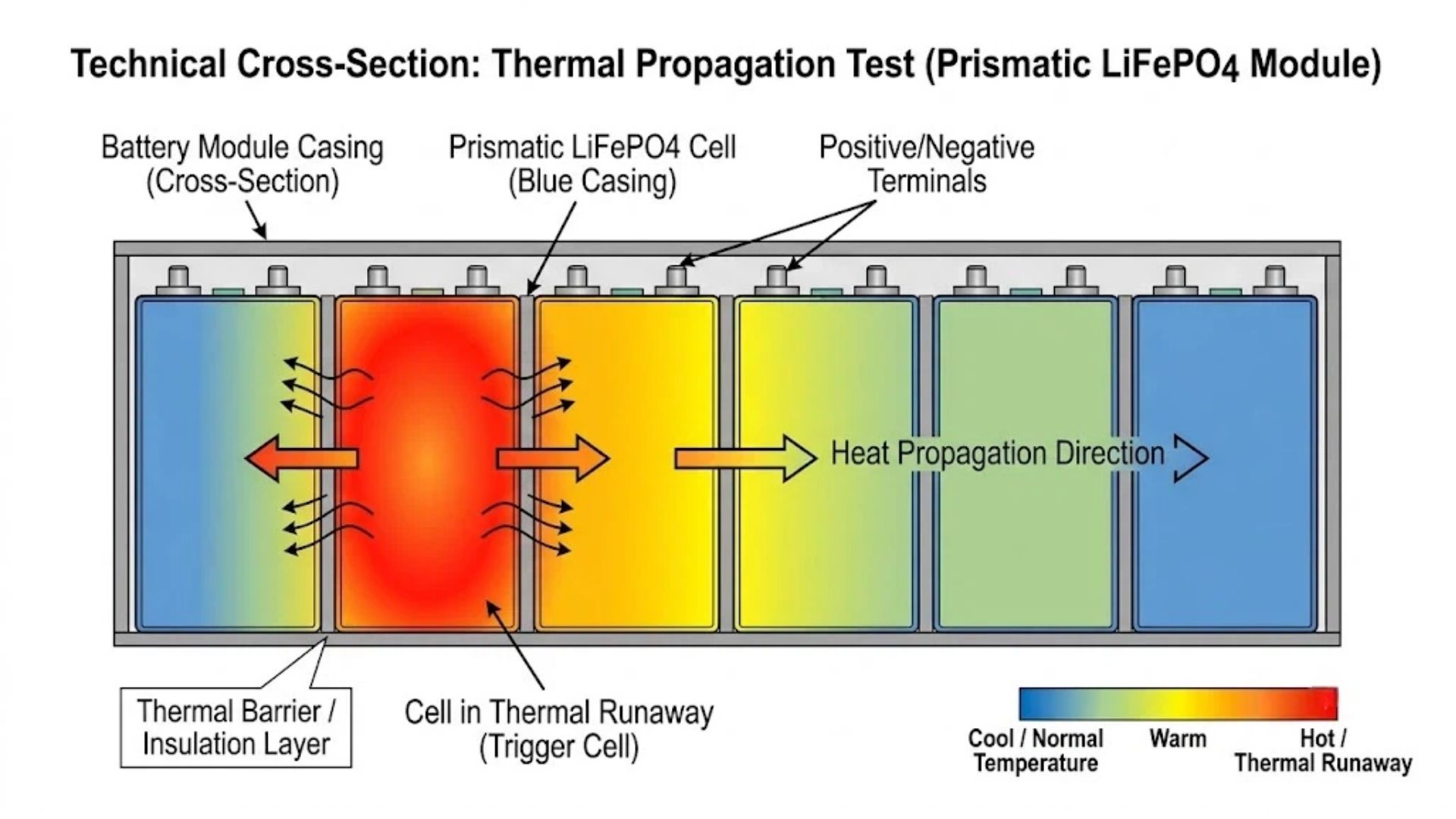
The thermal propagation test is the most distinctive and arguably most important test in GB 38031. It's also the test that gets the most attention from battery safety engineers and fire code officials — because thermal propagation is the mechanism by which a single cell failure becomes a battery system fire, and battery system fires are what cause the most serious EV and BESS incidents.
What the Test Does
The thermal propagation test evaluates whether a thermal runaway event in a single battery cell will spread (propagate) to adjacent cells and ultimately cause a hazardous condition — fire, explosion, or toxic gas release — outside the battery system. Here's how it works:
-
Trigger thermal runaway: A single cell within the battery pack is induced into thermal runaway using a controlled method — typically through localized heating (a heating element attached to the cell), overcharge, or mechanical puncture (nail penetration). The trigger method is specified in the standard.
-
Monitor propagation: The test monitors temperature, voltage, and gas emissions throughout the battery pack to track whether and how quickly the thermal event spreads from the triggered cell to adjacent cells, modules, and the full pack.
-
Measure evacuation time: The critical measurement is the time between the triggered cell entering thermal runaway and the battery system releasing fire, explosion, or hazardous gases to the outside environment (e.g., the passenger compartment in an EV). This time must meet or exceed the minimum required by the standard.
-
Pass/fail criterion: The battery passes if the time between single-cell thermal runaway and external hazard release is at least the minimum required by the standard — giving occupants sufficient time to evacuate the vehicle. The battery fails if fire or hazardous gases reach the outside environment before the minimum time, or if the battery explodes.
Why This Matters for BESS
While GB 38031 is technically an EV standard, the thermal propagation test is directly relevant to BESS and stationary energy storage. Here's why:
-
Same failure mechanism: Thermal propagation in a stationary storage battery rack works the same way as in an EV battery pack — one cell goes into thermal runaway, the heat spreads to adjacent cells, and if not contained, the whole rack catches fire. The test methodology and pass/fail logic are directly applicable.
-
BESS fire risk: BESS fires — particularly in residential and commercial installations — are a growing concern for fire departments, insurers, and building code officials. A battery that has passed GB 38031 thermal propagation testing has demonstrated that it can contain a single-cell thermal runaway event for a minimum period, which is valuable data for fire risk assessment.
-
UL 9540A connection: The North American equivalent of thermal propagation testing is UL 9540A, which evaluates thermal runaway fire propagation in energy storage systems at the cell, module, unit, and installation levels. While the test methodologies differ, both standards address the same fundamental safety question: can a single-cell failure be contained before it becomes a system fire? GB 38031 thermal propagation results can serve as a preliminary indicator of a battery's thermal containment capability, though UL 9540A testing is still required for North American BESS installations.
B2B buying tip: When evaluating BESS suppliers, ask for thermal propagation test data — whether GB 38031, UL 9540A, or both. A supplier that can provide detailed thermal propagation test results at the module and system level is demonstrating a higher level of safety engineering than one that only provides cell-level test data. For large BESS installations, fire departments and insurers may require UL 9540A test results specifically, but GB 38031 thermal propagation data is a useful supplementary indicator.
Impact on BESS and Energy Storage Systems
GB 38031-2025 is primarily an EV traction battery standard, but its impact extends to BESS and stationary energy storage for several reasons:
1. EV-Grade Cells in BESS
Many BESS products — particularly residential and light commercial systems — use EV-grade lithium-ion cells that are designed and tested to GB 38031. When a battery manufacturer says their BESS product uses "EV-grade cells," it typically means the cells have passed GB 38031 testing (or an equivalent standard like UL 1973). This is a positive indicator of cell quality and safety, because EV traction battery standards are generally more rigorous than standards for consumer electronics cells.
2. Repurposed EV Batteries (Second Life)
A growing segment of the BESS market uses repurposed EV batteries — batteries that have reached the end of their useful life in vehicles (typically 70-80% capacity remaining) but still have sufficient capacity for stationary storage applications. For these second-life BESS products, GB 38031 compliance of the original EV battery is relevant because it establishes the baseline safety design of the battery system. However, second-life BESS products should also be tested to stationary storage standards (such as UL 1973 or GB/T 36276) because the usage profile, installation environment, and system architecture differ from the original EV application.
3. China-Market BESS Projects
For BESS projects installed in China, GB 38031 may be referenced as a safety baseline, though China has separate standards specifically for stationary energy storage — most notably GB/T 36276 (Lithium-ion Batteries for Energy Storage) and various local fire code requirements for BESS installations. The relationship between GB 38031 and GB/T 36276 is that GB 38031 covers EV traction batteries while GB/T 36276 covers stationary storage batteries, but there is overlap in test methodology and safety requirements. For China-market BESS projects, verify which specific standards apply to your project type, size, and installation scenario with your local integrator or regulatory consultant.
4. Supply Chain Safety Baseline
Even for BESS projects outside China, GB 38031 compliance is a useful indicator of a Chinese battery supplier's safety engineering rigor. A supplier that invests in GB 38031 testing and compliance is demonstrating that they take battery safety seriously and have the engineering capability to design and test to rigorous standards. This doesn't replace UL 1973, IEC 62619, or other regional certifications for your target market, but it's a positive data point in supplier evaluation — particularly when comparing suppliers that have GB 38031 compliance against those that don't.
Why Global Buyers Should Care About a Chinese Standard
We've talked to procurement managers in Australia, Germany, and the United States who say: "GB 38031 is a Chinese standard — why should I care if I'm not selling into China?" It's a fair question. Here's why it matters even if your projects are entirely outside China:
1. Chinese Manufacturing Dominance
Over 75% of global lithium-ion battery cell production is in China. Whether you buy from CATL, BYD, EVE, or a smaller manufacturer, the cells are likely designed and tested to Chinese standards as their baseline. GB 38031 is the mandatory safety standard that these cells must meet for the China EV market — which means the cells you're buying for your Australian, German, or American project were probably tested to GB 38031 at some point in their development. Understanding the standard helps you evaluate what that testing actually covers.
2. Test Data Transferability
Many Chinese battery manufacturers use GB 38031 test results as a foundation for obtaining UL, IEC, and CE certifications. The test methodologies overlap significantly — overcharge, short circuit, crush, vibration, temperature cycling — so GB 38031 test data can often be used to support applications for other certifications. When you ask a supplier for UL 1973 test data and they say "we're in the process of obtaining it," their GB 38031 test report can give you a preliminary indication of their safety performance while you wait for the UL certification.
3. Thermal Propagation Is a Global Concern
Battery fires don't respect national borders. Whether your BESS installation is in California, Queensland, or Bavaria, the risk of thermal propagation is the same — and GB 38031's thermal propagation test is one of the most rigorous standardized evaluations of this risk in the world. A battery that has passed GB 38031 thermal propagation testing has demonstrated that it can contain a single-cell thermal runaway for a minimum period, which is directly relevant to fire risk assessment anywhere in the world.
4. Supply Chain Transparency
Understanding GB 38031 helps you ask better questions of your suppliers. Instead of a vague "are your batteries safe?" you can ask: "Have you tested this specific model to GB 38031-2025? Can I see the thermal propagation test report? What was the evacuation time result? Which laboratory performed the testing?" These specific questions separate suppliers that have real safety engineering capability from those that are just marketing "safe batteries" without data to back it up.
How to Verify Supplier Compliance
Any supplier can say "meets GB 38031-2025" in a datasheet. Here's how to verify that claim:
Step 1: Request the Full Test Report, Not Just a Certificate
A certificate is a one-page document that says "this product passed GB 38031 testing." A test report is a detailed document (often 50+ pages) that shows exactly which tests were performed, the test conditions, the equipment used, the raw data, and the pass/fail results for each test item. Always request the full test report. A supplier that refuses to provide the full report — citing "confidentiality" or "proprietary information" — is a red flag. Reputable suppliers will provide test reports under NDA if necessary.
Step 2: Verify Model Specificity
GB 38031 testing is model-specific. A test report for battery model ABC-100 does not apply to model XYZ-200, even if they use the same cells. Check that the test report covers the exact battery model or cell model you are purchasing. Pay attention to: model number, capacity, voltage configuration, cell manufacturer and model, BMS version, and enclosure/construction details. If any of these differ from what you're buying, the test report may not apply.
Step 3: Check the Testing Laboratory's Accreditation
GB 38031 testing must be performed by an accredited laboratory. In China, the primary accreditation body is CNAS (China National Accreditation Service for Conformity Assessment). Internationally, laboratories accredited by ILAC-MRA signatories (such as A2LA in the US, DAkkS in Germany, NATA in Australia) are also generally recognized. Verify that the laboratory that performed the testing is accredited and that the accreditation scope covers battery safety testing to GB 38031. You can usually verify laboratory accreditation on the accreditation body's website.
Step 4: Request the Supplier's Declaration of Conformity
A Declaration of Conformity (DoC) is a formal document issued by the manufacturer stating that the specified product complies with GB 38031-2025, referencing the specific test report(s) and clause numbers. The DoC should be signed by an authorized representative of the manufacturer and include: product model and identification, applicable standard and version, test report numbers, date of issue, and manufacturer contact information. The DoC is a legal document — if the product later fails to meet the standard, the DoC establishes the manufacturer's liability.
Step 5: Consider a Third-Party Factory Audit
For high-volume or critical projects, consider a third-party factory audit to verify that production quality control matches the tested sample. A test report shows that a sample passed testing — it doesn't guarantee that every unit coming off the production line will perform the same way. A factory audit evaluates the manufacturer's quality management system, incoming cell inspection, production process control, end-of-line testing, and traceability. Third-party audit companies (such as SGS, Bureau Veritas, TÜV, or Intertek) can perform these audits for a fee of typically $1,000-$3,000 depending on scope and location.
Red flags to watch for:
- Supplier says "meets GB 38031" but cannot produce a test report
- Test report is for a different model or cell than what you're buying
- Test report only covers a subset of test items (e.g., overcharge and short circuit but not thermal propagation)
- Testing laboratory is not accredited or cannot be verified
- Test report is dated before 2025 and references GB 38031-2020, but supplier claims 2025 compliance
- Supplier offers a "self-declaration" of compliance without third-party testing
GB 38031 vs UL 1973 vs IEC 62619: Comparison
For global B2B sourcing, it's important to understand how GB 38031-2025 fits into the global landscape of battery safety standards. Here's a comparison of the three most commonly referenced standards:
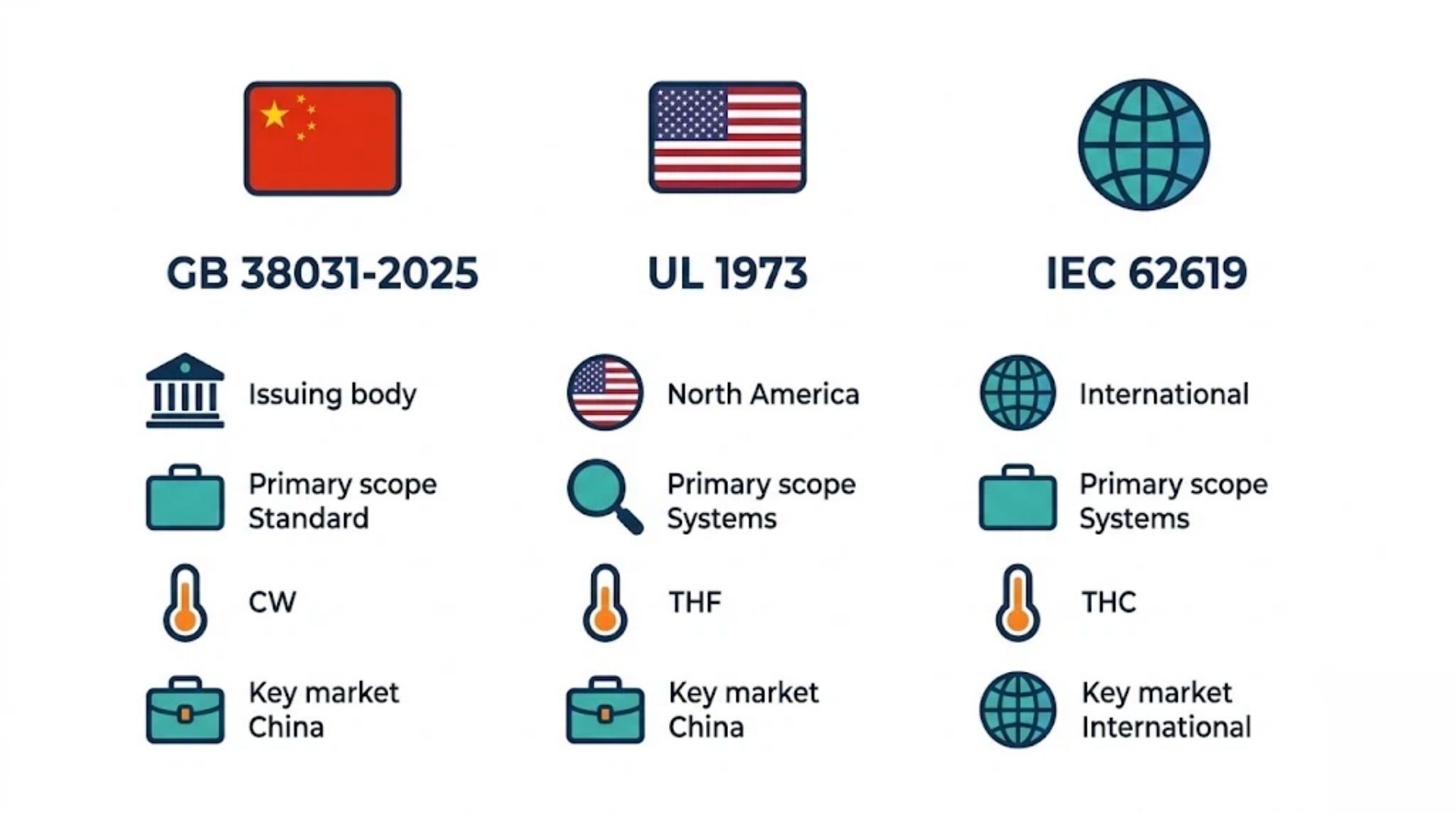
| Aspect | GB 38031-2025 | UL 1973 | IEC 62619 |
|---|---|---|---|
| Issuing Body | SAC (China), mandatory | UL (USA), nationally recognized | IEC (international), voluntary |
| Primary Scope | EV traction batteries | Stationary & motive auxiliary batteries | Industrial lithium-ion batteries (incl. stationary storage) |
| Thermal Propagation | Required, with specific evacuation time criteria | Referenced; UL 9540A covers propagation in detail | Required; thermal propagation test at cell and system level |
| Electrical Tests | Overcharge, over-discharge, short circuit | Overcharge, short circuit, abnormal operation | Overcharge, over-discharge, short circuit |
| Mechanical Tests | Crush, vibration, shock, drop, collision | Vibration, shock, drop, impact | Vibration, shock, drop |
| BMS/Functional Safety | BMS protective functions, fault detection (expanded in 2025) | BMS requirements, construction, marking | Functional safety of BMS (comprehensive) |
| Key Market | China (mandatory); global reference | North America (required for code compliance) | Europe, Asia, Australia (widely referenced) |
For global B2B sourcing, the practical approach is: identify which standards are required for your target market (UL 1973 for North America, IEC 62619 + CE for Europe, GB 38031 for China), and then use GB 38031 compliance as an additional indicator of supplier safety engineering capability. Many reputable manufacturers test to all three standards to serve global markets — and if your supplier can show compliance with all three, that's a strong positive signal.
For a detailed breakdown of BESS certification requirements by market, see our BESS Certification & Compliance Guide.
Frequently Asked Questions
Q1: What is GB 38031-2025?
GB 38031-2025 is China's mandatory national safety standard for traction batteries used in electric vehicles. It replaces the earlier GB 38031-2020 version and sets stricter requirements for battery safety testing, including thermal propagation, overcharge, external short circuit, crush, vibration, and temperature cycling. The standard is published by the Standardization Administration of China (SAC) and applies to all lithium-ion traction batteries sold or used in China, including those used in battery energy storage systems (BESS) that share traction battery technology.
Q2: What changed between GB 38031-2020 and GB 38031-2025?
The 2025 version tightens several key requirements based on five years of real-world EV safety data: (1) Stricter thermal propagation requirements — the time between a single cell entering thermal runaway and the battery system releasing hazardous gases or fire to the passenger compartment is extended, giving occupants more time to evacuate. (2) Updated test conditions and thresholds for overcharge, short circuit, and crush tests. (3) Additional requirements for battery management system (BMS) safety functions and fault detection. (4) Clarified scope and application to new battery technologies and system architectures. The exact clause numbers and parameter values should be verified against the official standard text published by SAC.
Q3: Does GB 38031-2025 apply to energy storage systems (BESS)?
GB 38031 is technically titled "Safety Requirements for Traction Batteries for Electric Vehicles," so its primary scope is EV traction batteries. However, many BESS products — especially those using EV-grade lithium-ion cells or repurposed EV batteries — are designed to meet GB 38031 as a baseline safety standard because the test methods (thermal propagation, overcharge, short circuit, crush) are directly applicable to stationary storage. Additionally, China has separate standards for stationary energy storage (such as GB/T 36276 for lithium-ion batteries for energy storage), but GB 38031 compliance is often referenced by BESS manufacturers as evidence of robust safety design. For BESS projects in China, verify which specific standards apply to your project type and installation scenario.
Q4: How does GB 38031-2025 compare to UL 1973 and IEC 62619?
All three standards address lithium-ion battery safety but with different scopes and test methodologies: GB 38031-2025 is China's mandatory standard for EV traction batteries, with a strong focus on thermal propagation and occupant evacuation time. UL 1973 is the North American standard for stationary and motive auxiliary batteries, covering electrical, mechanical, and environmental safety. IEC 62619 is the international standard for industrial lithium-ion batteries, including stationary energy storage. Key differences: GB 38031 has specific thermal propagation pass/fail criteria tied to passenger compartment safety; UL 1973 includes construction and marking requirements specific to North American installation codes; IEC 62619 covers functional safety of the BMS more comprehensively. For global B2B sourcing, many manufacturers test to all three standards to serve multiple markets.
Q5: How do I verify if a battery supplier complies with GB 38031-2025?
To verify GB 38031-2025 compliance: (1) Request the test report from an accredited testing laboratory — not just a certificate. The report should show the specific test items performed, test conditions, and results. (2) Verify that the test report covers the exact battery model or cell model you are purchasing — GB 38031 testing is model-specific, and a certificate for a similar model does not apply. (3) Check that the testing laboratory is accredited by China National Accreditation Service (CNAS) or an equivalent international body. (4) Request the supplier's declaration of conformity referencing the specific GB 38031-2025 clauses. (5) For high-volume or critical projects, consider a third-party factory audit to verify that production quality control matches the tested sample. Note: GB 38031 compliance does not replace UL, IEC, CE, or other regional certifications — it is one piece of the compliance puzzle.
Q6: Is GB 38031-2025 relevant for buyers outside China?
Yes, for several reasons: (1) If you source batteries from Chinese manufacturers, the batteries are likely designed and tested to GB 38031 as their baseline safety standard — understanding the standard helps you evaluate the safety rigor of your supplier. (2) Many Chinese battery manufacturers use GB 38031 test results as a foundation for obtaining UL, IEC, and CE certifications, so the test data is often available and transferable. (3) If your project involves China-market EVs or energy storage, GB 38031 compliance is mandatory. (4) Even for projects outside China, GB 38031's thermal propagation testing methodology is considered one of the most rigorous in the industry, and compliance indicates a higher baseline of safety engineering. For B2B buyers sourcing globally, GB 38031 compliance is a useful additional data point in supplier evaluation, alongside UL 1973, IEC 62619, and UN38.3.
Q7: What is the thermal propagation test in GB 38031?
The thermal propagation test is one of the most critical and distinctive tests in GB 38031. It evaluates whether a thermal runaway event in a single battery cell will spread to adjacent cells and ultimately cause a hazardous condition (fire, explosion, or toxic gas release) outside the battery system. The test involves triggering thermal runaway in a single cell (typically through overheating, overcharge, or mechanical puncture) and monitoring whether and how quickly the thermal event propagates through the battery pack. The pass/fail criterion is based on the time between the single cell entering thermal runaway and the battery system releasing fire or hazardous gases to the outside environment — this time must be sufficient for occupants to evacuate (the specific time requirement is defined in the standard). The 2025 version tightens these requirements based on real-world incident data. This test is particularly relevant for BESS because thermal propagation containment is a key factor in fire safety for stationary storage installations.
Q8: When did GB 38031-2025 take effect?
GB 38031-2025 was published by China's Standardization Administration (SAC) as a revision to GB 38031-2020. Mandatory national standards in China typically include a transition period between publication and full implementation, allowing manufacturers to update their products and testing. The exact effective date and transition timeline should be verified against the official announcement from SAC or the Ministry of Industry and Information Technology (MIIT). For B2B buyers, it's important to confirm whether your supplier's current products are certified to the 2020 or 2025 version, and whether they have a roadmap to achieve 2025 compliance if they haven't already. Products certified only to the 2020 version may still be legally sold during the transition period but may not meet the latest safety requirements.
Summary
GB 38031-2025 is China's revised mandatory national safety standard for EV traction batteries, and it matters for B2B battery buyers worldwide — even if you don't sell into China. Here's what you need to remember:
-
It's mandatory, not voluntary: GB 38031 compliance requires third-party testing by accredited laboratories. A supplier that says "meets GB 38031" should be able to produce a detailed test report — not just a marketing claim.
-
The 2025 version is stricter: Key changes include tightened thermal propagation requirements (longer evacuation time), updated test conditions for overcharge and short circuit, expanded BMS safety requirements, and clarified scope. If your supplier's test reports reference GB 38031-2020, ask about their 2025 compliance roadmap.
-
Thermal propagation is the key test: This test evaluates whether a single-cell thermal runaway spreads to the full battery system. It's directly relevant to BESS fire safety, and GB 38031's methodology is one of the most rigorous in the world. Always ask for thermal propagation test results.
-
It matters for BESS: Even though GB 38031 is technically an EV standard, many BESS products use EV-grade cells tested to GB 38031. The thermal propagation test methodology is directly applicable to stationary storage fire safety. For China-market BESS, also check GB/T 36276 and local fire code requirements.
-
Verify, don't assume: Request full test reports (not just certificates), verify model specificity, check laboratory accreditation, request a Declaration of Conformity, and consider third-party factory audits for high-volume projects. Watch for red flags like missing thermal propagation data, expired certificates, or model mismatches.
-
It complements, not replaces, other standards: GB 38031 is one piece of the compliance puzzle. For North America, you need UL 1973 (and UL 9540A for BESS). For Europe, IEC 62619 + CE Mark. For global shipping, UN38.3 + MSDS. GB 38031 compliance is a useful additional indicator of safety engineering rigor, particularly for Chinese-sourced batteries.
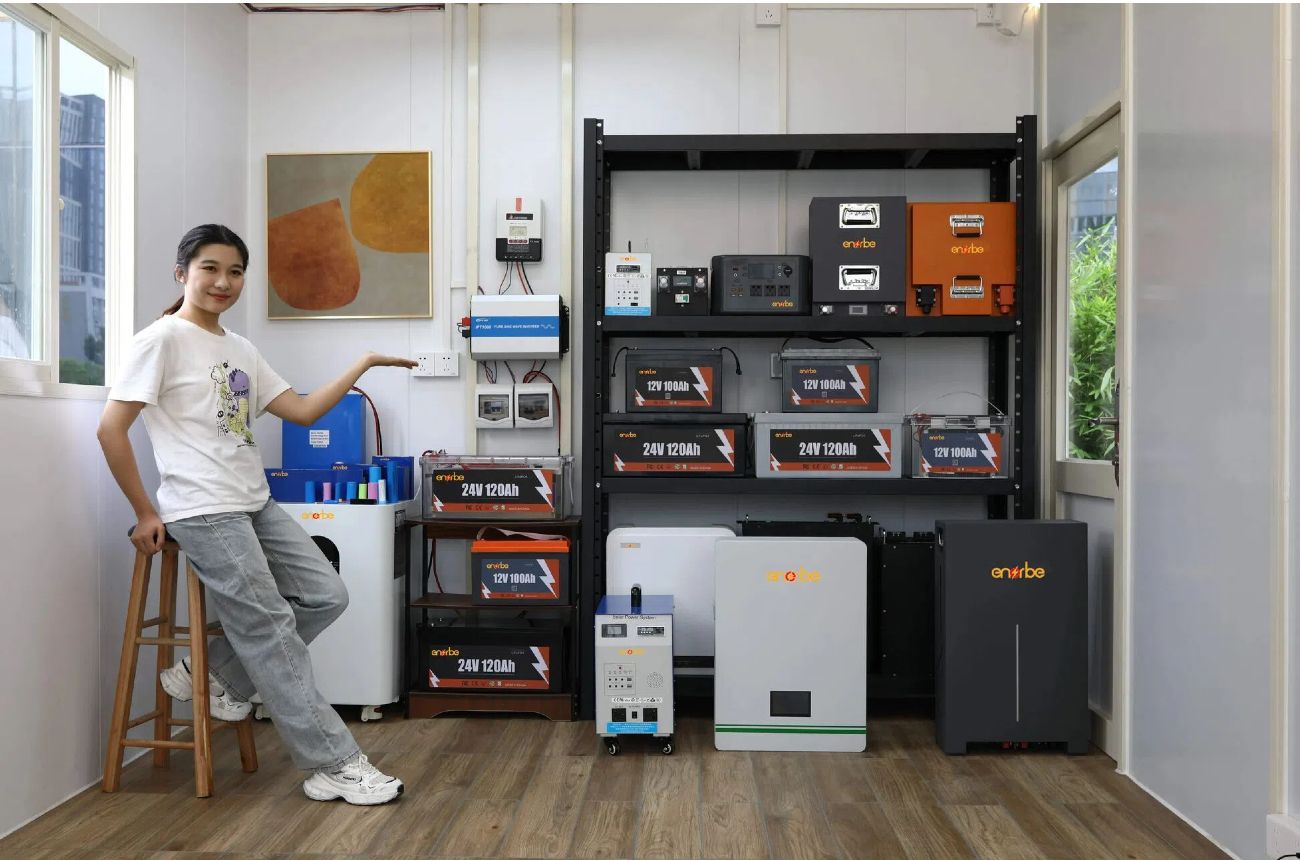
Enerbe designs and manufactures LiFePO4 battery systems with rigorous safety engineering, including thermal propagation containment design and full compliance with global safety standards (UL 1973, IEC 62619, CE, UN38.3). Our engineering team can provide detailed test reports, compliance documentation, and custom safety analysis for your specific project requirements. For wholesale pricing, custom configurations, or compliance support, contact our team.
Get In Touch
Ready to source LiFePO4 batteries for your project? Contact Enerbe today.
📄 Request a Technical Datasheet
Contact Us →📞 Speak with Our Engineering Team
Get In Touch →🔗 Browse Our Custom Battery Solutions
View Products →Dongguan A&S Power Technology Co., Limited.
Building 1, No. 2, Keji 9th Road,
Songshan Lake, Dongguan, Guangdong, China
📞 +86 137 1383 1631
✉ info@aspowerbattery.com
Stay Charged. Stay Connected.



LiFePO4 Motorcycle Battery: 12V 6Ah Lithium Upgrade Complete Guide
Where to Buy Lithium Batteries – B2B Sourcing Guide for Businesses | Enerbe
Related Article


Get In Touch
Have questions about custom lithium batteries, energy storage solutions, or lead-to-lithium conversion? Our team is ready to help. Send us a message and we’ll respond within 24 hours.

Building 1, No. 2, Keji 9th Road, Songshan Lake, Dongguan, Guangdong, China
Office Address

info@aspowerbattery.com
Email Us

+86 137 1383 1631
Call Us

Sun - Fri (08AM - 10PM)
Office Open
