
BESS Certification & Conformity Assessment Guide 2026: UL 1973, UL 9540, UL 9540A, IEC 62619 & GB 38031-2025

Table of Contents
- Introduction: Why Certification Isn't a Checkbox
- Core BESS Safety Standards: UL 1973 & IEC 62619
- Fire Safety: UL 9540, UL 9540A & UL 1974
- UL 9540 vs UL 1973: What's the Difference?
- GB 38031-2025: China's New Mandatory BESS Standard
- BESS Conformity Assessment: What It Really Means
- Factory Audit, Commissioning & Site Acceptance Testing (SAT)
- EU Battery Regulation 2023/1542: What BESS Buyers Need to Know
- Regional Certification Requirements
- Certification Checklist for B2B Buyers
- How to Verify BESS Supplier Certifications
- Red Flags: What to Watch Out For
- Why Enerbe for Certified BESS Solutions?
- Frequently Asked Questions
- Related Resources
BESS Certification & Conformity Assessment Guide 2026: UL 1973, UL 9540, UL 9540A, IEC 62619 & GB 38031-2025
Last updated: September 2026 | Written by the Enerbe Engineering Team
Introduction: Why Certification Isn't a Checkbox
Quick Answer: BESS certification is not optional—it's the difference between a project that gets permitted, insured, and grid-connected, and one that gets torn out after installation. North America requires UL 1973 (battery), UL 9540 (complete system), and UL 9540A (fire propagation test data). Europe requires CE Mark + IEC 62619, with EU Battery Regulation 2023/1542 phasing in through 2027-2028. China mandates GB 38031-2025. Beyond certificates, BESS conformity assessment verifies the system as installed actually meets requirements—through document review, design review, factory audit, commissioning, and site acceptance testing (SAT). Always request full test reports, not just certificates; verify model-specific coverage; confirm the certificate number in the issuing body's online database; and never confuse certificate verification with broader supplier qualification.
For B2B buyers sourcing battery energy storage systems, BESS certification is not a "nice-to-have" — it's the difference between a project that gets permitted, insured, and connected to the grid, and one that gets torn out after installation. We've seen it happen: a commercial customer bought an uncertified battery system at a steep discount, installed it, and then the local fire marshal ordered it removed because the battery wasn't on any approved list. The supplier had gone silent. The customer ate the entire cost.
Yet many procurement teams still struggle to navigate the BESS certification landscape. Different markets demand different standards. Some suppliers hold certificates for cells but not for complete systems. Others present certificates that are expired, self-issued, or for a different model than the one you're buying. And then there's the growing complexity of BESS conformity assessment — the process of verifying that a system actually meets all applicable requirements, not just that a piece of paper exists. Conformity doesn't end at the factory gate: a BESS factory audit, structured commissioning, and site acceptance testing confirm that the system delivered to your site is the same one that was certified.
This guide walks through the standards that matter, what they actually test, how to verify supplier claims, and what's changing with China's new GB 38031-2025 mandatory standard and the EU's Battery Regulation 2023/1542. It's built for procurement teams, project engineers, and EPC managers who need to make real decisions, not just collect certificates.
For a complete overview of LiFePO4 battery sourcing across all applications, see our B2B Sourcing Guide. For a detailed introduction to BESS systems, refer to our BESS Complete Guide. For supplier evaluation, see our Reliable BESS Supplier Guide.
If you are still evaluating whether LiFePO4 is the right chemistry for a home, RV, marine or small commercial system rather than specifying a full BESS, our Are LiFePO4 Batteries Safe? buyer Q&A compares fire and explosion risk across LFP, NMC and lead-acid in plain language.
Core BESS Safety Standards: UL 1973 & IEC 62619
Two standards form the foundation of BESS certification worldwide: UL 1973 (North America) and IEC 62619 (international). If a supplier can't produce current certificates for at least one of these — depending on your market — stop the conversation there.
UL 1973: The North American Battery Safety Standard
UL 1973 is the safety standard for batteries used in stationary energy storage systems, covering LiFePO4, NMC, and other battery chemistries. It's published by UL Solutions and recognized by OSHA, the Canadian Standards Association, and most US building codes.
What UL 1973 actually tests:
-
Electrical safety — overcharge, over-discharge, external short circuit, and abnormal operation
-
Mechanical safety — vibration, shock, crush, and drop testing
-
Environmental safety — temperature cycling, humidity, altitude simulation
-
Thermal runaway prevention and propagation at the cell and module level
-
Fire resistance and containment of the battery enclosure
-
BMS functional safety — fault detection, response times, and fail-safe behavior
Why it matters: UL 1973 is required for virtually all stationary storage projects in the US and Canada. Local building departments and fire marshals reference it. Insurance companies increasingly require it — many won't write a policy for an uncertified system. And it's the baseline for UL 9540 system certification, which we'll cover next.
Procurement tip: Request the UL 1973 test report, not just the certificate. The certificate is a one-page summary. The report shows specific test conditions, pass/fail results for each test, and any deviations or conditions granted. A certificate alone doesn't tell you if the battery passed the thermal propagation test or if it was granted an exception.
IEC 62619: The International Safety Standard
IEC 62619 is the international standard for safety requirements of secondary lithium cells and batteries used in industrial applications, including stationary energy storage. It's published by the International Electrotechnical Commission and recognized across Europe, Asia, Australia, the Middle East, and Africa.
What IEC 62619 covers:
-
Cell-level safety — overcharge, over-discharge, external short circuit, forced discharge
-
Battery system-level safety — thermal propagation, fire prevention, internal electrical isolation
-
Functional safety — BMS fault detection, response, and fail-safe behavior under fault conditions
-
Environmental testing — temperature, humidity, vibration, mechanical shock
-
Construction requirements — marking, documentation, and service access
Why it matters: IEC 62619 is the most widely recognized BESS safety standard globally. It's referenced in EU regulations, Australian standards, and many national procurement specifications. For suppliers selling into multiple markets, holding both UL 1973 and IEC 62619 demonstrates broader compliance. But here's the catch: some suppliers only certify the cells to IEC 62619, not the complete battery system. Cell-level certification does not equal system-level certification. Always verify which level the certificate covers.
Fire Safety: UL 9540, UL 9540A & UL 1974
Beyond basic electrical safety, fire safety is where BESS projects live or die — literally and figuratively. A battery fire in a commercial building or utility-scale installation can cause millions in damage, regulatory scrutiny, and reputational harm. The standards below address fire safety at the system level. For the underlying chemistry and how LiFePO4 resists thermal runaway, see our LiFePO4 Battery Safety Guide.
UL 9540: Energy Storage Systems and Equipment
UL 9540 certifies the complete energy storage system — not just the battery. It covers the integrated system including battery, BMS, inverter or power conversion system (PCS), enclosure, fire detection, and suppression integration.
What UL 9540 covers:
-
System-level electrical safety — interoperability of battery, inverter, and protection devices
-
Fire detection and suppression integration — does the system work with building fire systems?
-
Ventilation and thermal management — does the enclosure manage heat under normal and fault conditions?
-
Installation and maintenance requirements — clear labeling, disconnect access, service procedures
-
Marking and documentation — system ratings, limitations, and installation manual
UL 9540A: Thermal Runaway Fire Propagation Testing
UL 9540A is a test method — not a certification standard — specifically designed to evaluate thermal runaway fire propagation in battery energy storage systems. Alongside the UL 9540 fire safety requirements, it's arguably the most important fire safety document for BESS procurement today.
What UL 9540A tests at four levels:
-
Cell level — what triggers thermal runaway, how hot does it get, what gases are released
-
Module level — does thermal runaway propagate from one cell to adjacent cells?
-
Unit level — does fire propagate from one module to adjacent modules within the battery enclosure?
-
Installation level — does fire spread from the battery unit to other equipment, adjacent units, or the building structure?
It also measures gas emissions — what gases are released during thermal runaway, their concentration, and whether they're toxic or flammable. This data is critical for fire department response planning and ventilation system design.
Why it matters: UL 9540A test data is increasingly required by local fire codes, especially under NFPA 855 and the International Fire Code. For indoor installations in commercial occupancies, the threshold is often 20 kWh — above that, UL 9540A data may be mandatory. For utility-scale outdoor installations, requirements vary, but insurers and project financiers increasingly demand it regardless of code minimums.
Procurement tip: Ask for UL 9540A test results at all four levels. Many suppliers only test at cell or module level — that's the easy part. Unit-level and installation-level testing is far more rigorous and far more valuable for project approval. If a supplier only has cell-level data, ask when they plan to complete the higher-level tests — and don't accept "soon" as an answer for a project that needs permitting next quarter.
Beyond the certificate: UL 9540A tells you whether a design can contain and control a thermal event; it does not design the system for you. For how these test results translate into cell-to-cell propagation control, off-gas ventilation, fire spacing and suppression, see our LiFePO4 Thermal Runaway & BESS Fire-Protection Engineering Guide.
UL 1974: Battery Recycling & Second-Life Certification
UL 1974 is a relatively new standard that addresses the safety of recycled, re-manufactured, and second-life battery systems. As the first generation of BESS installations reaches end-of-life, and as EV batteries are repurposed for stationary storage, UL 1974 is becoming increasingly relevant.
What UL 1974 covers:
-
Safety evaluation of reclaimed cells — testing recycled cells to verify they meet performance and safety criteria
-
Re-manufacturing process requirements — quality control for disassembly, testing, sorting, and reassembly
-
Second-life battery system safety — ensuring repurposed batteries (e.g., EV batteries used for stationary storage) meet safety standards for their new application
-
Documentation and traceability — tracking battery history from original manufacture through recycling or second-life deployment
Why it matters for BESS buyers: If you're evaluating a supplier that uses second-life or recycled cells (which can be significantly cheaper), UL 1974 certification provides assurance that the reclaimed cells have been properly tested and the re-manufacturing process follows safety protocols. Without UL 1974, you're relying on the supplier's internal quality control — which may not be sufficient for utility-scale or commercial deployments. Even if you're buying new cells, UL 1974 matters because the EU Battery Regulation 2023/1542 will mandate recycled content minimums for industrial batteries starting in 2031 — suppliers that already have UL 1974 processes in place will be better positioned to comply.
UL 9540 vs UL 1973: What's the Difference?
This is one of the most common questions in BESS procurement — and one of the most common sources of confusion. Suppliers often present a UL 1973 certificate and imply it covers the complete system. It doesn't. Here's the side-by-side comparison:
| Aspect | UL 1973 | UL 9540 |
|---|---|---|
| What it certifies | The battery itself (cells, modules, BMS, enclosure) | The complete energy storage system (battery + PCS + enclosure + fire systems) |
| Scope | Battery component only | Integrated system including inverter/PCS |
| Fire safety | Battery enclosure fire resistance only | System-level fire detection, suppression, and ventilation integration |
| Interoperability | Not tested (battery alone) | Battery + inverter + protection devices tested as a system |
| Required for | All stationary storage batteries in US/Canada | Most commercial & utility-scale complete system installations |
| Can one substitute for the other? | ❌ No — UL 1973 does not cover system integration | ❌ No — UL 9540 requires UL 1973 as a prerequisite for the battery component |
| Typical cost | $20,000-$50,000 per model | $50,000-$150,000+ per system configuration |
Bottom line: For most commercial and utility-scale projects, you need both. UL 1973 certifies the battery is safe on its own. UL 9540 certifies that when you combine that battery with an inverter, enclosure, and fire systems, the complete system is still safe. A supplier that only has UL 1973 and claims it's "UL certified" is being misleading — ask specifically whether they have UL 9540 for the complete system configuration you're buying.
GB 38031-2025: China's New Mandatory BESS Standard
If you source batteries from China or sell into the Chinese market, you need to understand GB 38031-2025. This is the updated version of China's mandatory national standard for battery safety, replacing the 2020 version (GB 38031-2020). It's published by the Standardization Administration of China (SAC) and enforced by the Ministry of Industry and Information Technology (MIIT). We cover the clause-level details in our dedicated GB 38031-2025 Standard Guide.
What Changed from GB 38031-2020?
The 2025 version significantly strengthens safety requirements, driven by high-profile BESS fires in China in 2023-2024. Key changes include:
-
Stricter thermal runaway propagation: The 2020 version required that thermal runaway in one cell should not spread to the entire pack within 5 minutes. The 2025 version extends this requirement and adds more rigorous test methods for large-format energy storage systems (not just EV packs).
-
New large-format ESS test methods: The 2020 standard was primarily written for electric vehicle battery packs. The 2025 version adds specific test protocols for stationary energy storage systems, including rack-mounted and containerized BESS.
-
Tighter gas emission limits: Stricter limits on flammable and toxic gas emissions during thermal events, with new requirements for gas detection and ventilation system design.
-
Enhanced BMS requirements: More rigorous requirements for battery management system fault detection, response times, and fail-safe behavior under fault conditions.
-
Fire suppression integration: New requirements for integrated fire detection and suppression systems in BESS enclosures, including specific performance criteria.
-
Liquid immersion cooling safety: New sections addressing the safety of liquid-immersion-cooled battery systems, an increasingly common design in high-density BESS.
Who Needs to Comply?
GB 38031-2025 is mandatory for:
-
All lithium-ion batteries manufactured in or imported into China for electric vehicles and stationary energy storage
-
BESS system integrators assembling systems in China
-
Cell manufacturers supplying the Chinese market
Even for projects outside China, GB 38031-2025 matters because:
-
Most global BESS cell manufacturing is in China — cells produced for export are increasingly being built to GB 38031-2025 as the baseline, since manufacturers don't want separate production lines
-
Global insurers and financiers are starting to reference GB 38031-2025 as an additional safety benchmark, alongside UL and IEC standards
-
If you're sourcing from a Chinese supplier, asking about GB 38031-2025 compliance is a quick way to gauge whether they're current on the latest safety requirements. For a fuller sourcing process, see our China LiFePO4 Manufacturer Sourcing Guide.
Timeline note: GB 38031-2025 was published in 2025 with a transition period. Products already certified to GB 38031-2020 may have a grace period, but new certifications and new product launches must meet the 2025 version. If you're evaluating suppliers in 2026, ask specifically whether their products are certified to the 2025 version or still on the 2020 version — and when they plan to transition.
BESS Conformity Assessment: What It Really Means
You'll increasingly see the term BESS conformity assessment in procurement specifications, insurance requirements, and regulatory documents. It's more than just "does the battery have certificates?" — it's a systematic process of verifying that the complete system, as installed and operated, meets all applicable requirements. In practice it combines BESS verification, quality assurance (QA/QC), and documented evidence at every stage from factory to site.
What Conformity Assessment Includes
A proper BESS conformity assessment covers five stages:
-
Document review: Verifying that all certificates are current, model-specific, and issued by accredited third-party bodies. Reviewing test reports for actual test results, not just pass/fail summaries.
-
Design review: Confirming that the system design (battery + PCS + enclosure + fire suppression) matches the certified configuration. Substituting a different inverter or modifying the enclosure can invalidate the system certification.
-
Factory inspection (factory audit): For high-value or high-risk projects, a third-party inspector visits the manufacturing facility to verify that the product being built matches the certified product — same cells, same BMS, same enclosure, same quality control processes. See the dedicated factory audit section below.
-
Site acceptance testing (commissioning/SAT): After installation, testing the system to verify it performs as specified — charge/discharge rates, response times, BMS functionality, fire detection and suppression activation, grid-code protection, and communication with building management systems. A full SAT checklist is provided in the next section.
-
Ongoing compliance: Verifying that maintenance procedures, software updates, and component replacements don't inadvertently take the system out of compliance. A firmware update to the BMS, for example, could change system behavior in ways that affect certification. This stage also tracks warranty conditions, performance guarantees, cybersecurity patches, and long-term O&M support obligations.
Why Conformity Assessment Matters More Than Certificates Alone
Here's the problem with just collecting certificates: a battery can be UL 1973 certified, the inverter can be UL 1741 certified, and the complete system can still fail to meet safety requirements because the integration wasn't tested. The fire suppression system might not interface correctly with the BMS. The ventilation might be inadequate for the actual heat output. The enclosure might not provide the required fire separation distance. This is exactly the gap that battery procurement verification and manufacturer quality verification are designed to close.
BESS conformity assessment closes these gaps. For utility-scale projects, commercial buildings, and any installation where a fire would be catastrophic, conformity assessment is not optional — it's what stands between you and a denied insurance claim or a regulatory shutdown.
If you're a B2B buyer, ask your supplier whether they can support conformity assessment — not just whether they have certificates. A supplier that can provide test reports, factory inspection support, and site acceptance test procedures is one that takes compliance seriously. One that just hands you a PDF certificate and walks away is a risk.
Factory Audit, Commissioning & Site Acceptance Testing (SAT)
Certificates prove that a representative model passed tests in a laboratory. They do not prove that the specific units delivered to your project were built to the same standard, integrated correctly on site, or perform as specified. That assurance comes from three field activities: the BESS factory audit (before or during production), factory acceptance testing (before shipment), and commissioning with site acceptance testing (after installation). Together they are the operational core of BESS conformity assessment.
BESS Factory Audit: What Gets Checked
A BESS factory audit (also called a factory capability assessment or factory due diligence) is an on-site inspection of the supplier's manufacturing facility. It can be conducted by your own engineering team or an independent third party, and it answers one question: can this factory consistently build the certified product at the volume and quality my project needs?
| Audit Area | What the Auditor Verifies |
|---|---|
| Cell sourcing & incoming inspection | Cells come from the certified Grade A source; capacity/IR/OCV sorting and incoming QC records exist |
| Production line & equipment | Laser welding, compression stacking, automated BMS programming, and torque control actually exist and run |
| End-of-line (EOL) testing | 100% hi-pot, insulation resistance, internal resistance, capacity grading, and BMS communication tests per unit |
| Traceability | Each finished battery traces to specific cell lots, BMS firmware version, and test records (serialized) |
| Calibration & QA/QC system | Test equipment is calibrated; ISO 9001 procedures, non-conformance handling, and aging/burn-in rooms operate |
| Certification consistency | Units in production match the certified model — same cells, BMS, enclosure, and rated configuration |
A factory audit typically costs $2,000-$5,000 depending on location and scope — trivial insurance for a project worth hundreds of thousands or millions. The full supplier-evaluation methodology, including financial and reference checks, is covered in our Reliable BESS Supplier Guide and the 7 BESS Supplier Selection Criteria.
BESS Commissioning & Site Acceptance Testing (SAT) Checklist
Commissioning is the controlled process of bringing a newly installed BESS online for the first time; site acceptance testing (SAT) is the documented test sequence that proves the as-built system meets the contract and the certified design. A BESS delivery and commissioning checklist protects both buyer and supplier by creating a signed record before the system is accepted.
| Stage | SAT / Commissioning Check |
|---|---|
| 1. Visual & mechanical | No shipping damage; correct model/serial numbers; rack torque, clearances, ventilation gaps, and labeling match design |
| 2. Pre-energization | Insulation resistance (hi-pot), grounding/bonding continuity, polarity, DC cable torque, and disconnect operation verified |
| 3. BMS & communications | Per-cell voltage reporting, temperature sensors, CAN/RS485/Modbus links, alarms, and SOC calibration confirmed |
| 4. Fire & safety systems | Smoke/heat/gas detectors, suppression release, emergency stop, and ventilation interlocks tested end-to-end |
| 5. Grid-code / protection | UL 1741 / IEEE 1547 anti-islanding, over/under voltage & frequency trip, reconnect timing, and grid-support functions verified |
| 6. Performance test | Witnessed charge/discharge confirms rated capacity (kWh), power (kW), round-trip efficiency, and thermal behavior |
| 7. Handover pack | As-built drawings, SAT report, certificates, O&M manual, warranty terms, firmware versions, and training records signed off |
Key point: Certification is model-level; commissioning and SAT are project-level. A UL 9540-certified system still needs on-site grid-code and fire-system testing, because every site's integration, wiring, and utility interconnection are different. Never make final payment or accept handover until the SAT report is signed and all punch-list items are closed.
EU Battery Regulation 2023/1542: What BESS Buyers Need to Know
The EU's Battery Regulation (EU) 2023/1542 is the most significant change to battery regulation in decades. It replaces the older Battery Directive (2006/66/EC) and introduces sweeping new requirements for all batteries placed on the EU market, including industrial and stationary energy storage batteries. For BESS buyers sourcing from or selling into Europe, this regulation will affect procurement decisions starting in 2025-2026 and ramping up through 2031.
Key Requirements Affecting BESS
| Requirement | What It Means | Effective Date |
|---|---|---|
| Carbon footprint declaration | Manufacturers must declare the carbon footprint of each battery model, measured in kg CO2e per kWh. Verified by third-party auditors. | February 2027 (industrial batteries) |
| Carbon footprint performance classes | Batteries will be assigned performance classes based on carbon footprint. Maximum thresholds will be set — batteries exceeding the threshold cannot be placed on the EU market. | August 2028 (thresholds set), February 2029 (enforcement) |
| Recycled content minimums | Industrial batteries must contain minimum percentages of recycled cobalt (16% by 2031, 26% by 2036), lead (85% by 2031), lithium (6% by 2031, 12% by 2036), and nickel (6% by 2031, 15% by 2036). | August 2031 (first phase) |
| Battery passport | Each industrial battery >2 kWh must have a digital passport (QR code) containing: chemistry, capacity, carbon footprint, recycled content, repair/recycling information, and full supply chain traceability. | February 2027 |
| Due diligence requirements | Manufacturers and importers must conduct supply chain due diligence for raw materials (cobalt, lithium, nickel, graphite) to verify no conflict minerals, child labor, or environmental harm. | August 2025 |
| Repairability & recyclability | Batteries must be designed for disassembly, repair, and recycling. Manufacturers must provide spare parts and repair instructions for 5-10 years after the last unit is sold. | February 2027 |
What BESS Buyers Should Do Now
Even though many requirements don't take effect until 2027-2031, smart buyers are starting to evaluate suppliers against EU 2023/1542 now because:
-
Certification takes time: Carbon footprint verification, battery passport systems, and due diligence processes can take 12-18 months to implement. Suppliers that haven't started will be scrambling in 2026-2027.
-
Procurement cycles are long: A BESS project you specify today may not be installed until 2027-2028. If the battery you buy today doesn't meet the carbon footprint threshold that takes effect in 2029, you may be stuck with a system that can't be expanded or replaced with compliant parts.
-
It's becoming a global benchmark: Even for projects outside the EU, the EU Battery Regulation is becoming the de facto global standard for battery sustainability. Large corporate buyers, insurers, and financiers worldwide are starting to require EU 2023/1542 compliance as a condition of purchase or financing.
Questions to ask your supplier about EU 2023/1542:
-
Have you conducted a carbon footprint assessment for your battery models? When will you have verified carbon footprint declarations?
-
Do you have a battery passport system in development? When will it be available?
-
What is your recycled content strategy? Are you working with UL 1974-certified recyclers?
-
Have you completed supply chain due diligence for cobalt, lithium, nickel, and graphite?
-
Are your batteries designed for disassembly and repair? Do you provide spare parts and repair documentation?
Regional Certification Requirements

North America (US & Canada)
| Certification | What It Covers | When It's Required |
|---|---|---|
| UL 1973 | Battery safety (cells, modules, BMS, enclosure) | All stationary storage batteries in US & Canada |
| UL 9540 | Complete system safety (battery + PCS + enclosure) | Most commercial & utility-scale installations |
| UL 9540A | Thermal runaway fire propagation test data | Required by many local fire codes, especially >20 kWh indoor |
| UL 1741 / IEEE 1547 | Inverter/PCS safety and grid interconnection | All grid-connected systems (verified again during SAT) |
| FCC | Electromagnetic compatibility | All electronic components |
Key regulatory references: NFPA 855 (Standard for the Installation of Stationary Energy Storage Systems) is referenced in US building codes. The International Fire Code (IFC) requires UL 9540A testing for ESS exceeding certain energy capacities. CSA C22.2 No. 340 is the Canadian equivalent to UL 1973. Grid-code compliance under UL 1741 / IEEE 1547 must be re-verified during commissioning, because it depends on the as-installed inverter settings and utility interconnection.
Europe
| Certification | What It Covers | When It's Required |
|---|---|---|
| CE Mark | EU market access (LVD, EMC, RoHS directives) | All electrical equipment sold in the EU/EEA |
| IEC 62619 | Battery safety (cell and system level) | Industrial lithium batteries, referenced in national regulations |
| IEC 62477 | Power conversion equipment safety | Inverters and PCS |
| EMC Directive | Electromagnetic compatibility | All electronic equipment |
| RoHS / REACH | Hazardous substance restrictions | All electrical and electronic equipment |
| EU 2023/1542 | Battery Regulation: carbon footprint, recycled content, battery passport, due diligence | Phasing in 2025-2031 (see dedicated section above) |
Australia
| Certification | What It Covers | When It's Required |
|---|---|---|
| CEC Listed | Approved battery list for solar+storage | All batteries connected to solar systems; required for rebates |
| AS/NZS 5139 | Battery system installation safety | Electrical installation safety standard |
| IEC 62619 | Battery safety | Referenced in Australian regulations |
The Clean Energy Council (CEC) maintains the approved battery list. Only CEC-listed batteries are eligible for government rebates and grid connection approvals in most Australian states. Getting on the CEC list requires IEC 62619 certification plus additional Australian-specific testing.
China
| Certification | What It Covers | When It's Required |
|---|---|---|
| GB 38031-2025 | Mandatory battery safety (EV + stationary ESS) | All lithium batteries manufactured in or imported into China |
| CQC Certification | China Quality Certification Centre product certification | Required for many government and utility procurement projects |
| GB/T 36276 | Performance standards for lithium-ion ESS batteries | Performance specification, often referenced in procurement |
International Shipping
| Certification | What It Covers | When It's Required |
|---|---|---|
| UN38.3 | Transport safety (air, sea, road, rail) | All lithium battery shipments — mandatory, no exceptions |
| MSDS / SDS | Safety data sheet | Required for all chemical products, including batteries |
UN38.3 is the one certification that applies to every single lithium battery shipment, regardless of destination. Without it, freight forwarders will not accept your cargo, and customs will reject your shipment at the port of entry. We've seen shipments held in customs for weeks because the UN38.3 certificate was for a different model or had expired. Verify that the UN38.3 certificate is current and covers the exact model number you're shipping — not a similar model, not a previous revision. Our LiFePO4 Battery Shipping Certifications Guide walks through the full documentation pack, and a real-world example is documented in our custom battery compliance case study.
Certification Checklist for B2B Buyers
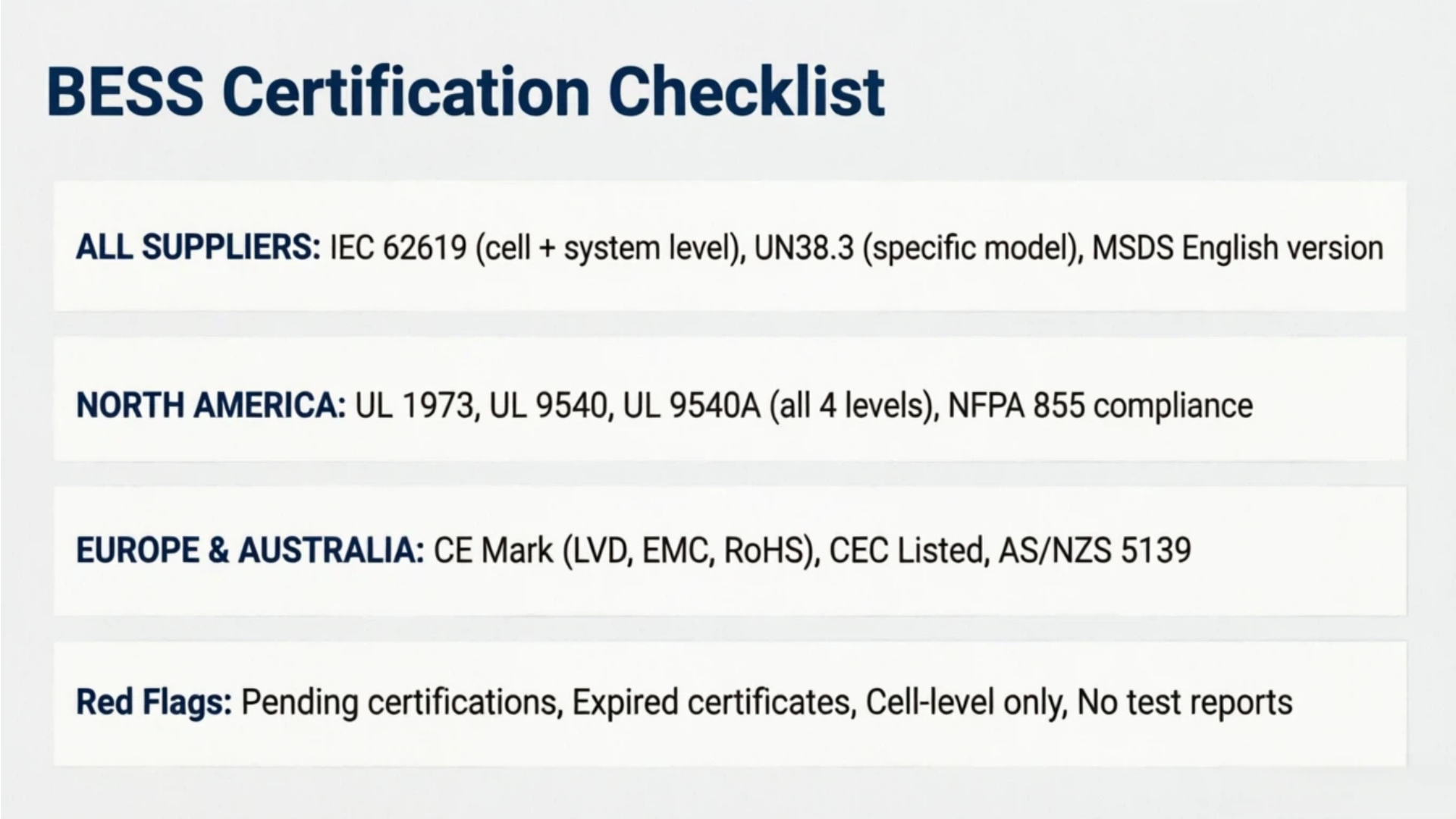
Before finalizing any BESS procurement, work through this checklist with your supplier. If they can't provide a clear, documented answer for any item, that's a finding — not a reason to move on quietly.
For All Projects (Regardless of Market)
-
☐ IEC 62619 — current, covering both cell level and battery system level (not just cells)
-
☐ UN38.3 — current, covering the exact battery model being shipped
-
☐ MSDS / SDS — available in English for your target market, current version
-
☐ BMS functional safety documentation — fault detection, response times, fail-safe behavior
-
☐ Test reports — not just certificates, but full test reports showing actual test conditions and results
-
☐ Factory audit / FAT — scheduled, with cell sourcing, EOL testing, and traceability evidence
-
☐ Commissioning & SAT plan — agreed before delivery, including grid-code and fire-system tests
For North American Projects
-
☐ UL 1973 — current, covering the specific battery model
-
☐ UL 9540 — current, covering the complete system (battery + PCS + enclosure)
-
☐ UL 9540A — test data at cell, module, unit, and installation levels (not just cell level)
-
☐ UL 1741 / IEEE 1547 — for inverter/PCS, if grid-connected
-
☐ NFPA 855 compliance — installation design meets fire code requirements
-
☐ Local fire marshal approval — confirm with the AHJ (Authority Having Jurisdiction) early
For European Projects
-
☐ CE Mark — covering all applicable directives (LVD, EMC, RoHS)
-
☐ IEC 62619 — current, covering the specific battery model
-
☐ IEC 62477 — for inverters and PCS, if supplied
-
☐ EU 2023/1542 readiness — supplier's plan for carbon footprint, battery passport, and recycled content requirements
For Australian Projects
-
☐ CEC Listed — on the current approved battery list (verify on CEC website)
-
☐ AS/NZS 5139 — installation design meets Australian safety standards
-
☐ IEC 62619 — current, as required for CEC listing
For Chinese Market or Chinese-Sourced Products
-
☐ GB 38031-2025 — current compliance, not just the 2020 version
-
☐ CQC Certification — if required for the specific project type
-
☐ GB/T 36276 — performance specification compliance, if referenced in procurement
How to Verify BESS Supplier Certifications
Anyone can print a certificate. Here's how to actually verify that a supplier's BESS certification claims are valid — and what to do when they're not.
Certification Verification vs Supplier Qualification: Don't Confuse the Two
Buyers often use "verify the supplier" to mean two different things, and mixing them up causes gaps. Certification verification (the focus of this guide) confirms that documents are genuine, current, and cover the exact model. Supplier qualification / prequalification is a broader commercial and technical assessment of the company behind the certificate — its finances, references, delivery capacity, warranties, performance guarantees, cybersecurity, and long-term O&M support. You need both, but they answer different questions:
| Dimension | Certification Verification | Supplier Qualification |
|---|---|---|
| Core question | Is this certificate real and does it cover this model? | Is this company a viable, low-risk long-term partner? |
| Evidence | Certificates, full test reports, online database lookup | Audited accounts, project references, factory audit, warranty terms, SLAs |
| Commercial factors | Not covered | Delivery track record, financial health, cybersecurity, performance guarantees, O&M |
| Where to go deeper | This guide | 7 supplier criteria · procurement guide · supplier guidance |
Step 1: Check the Certificate Against the Issuing Body's Database
Most reputable certification bodies maintain online databases where you can look up certificate numbers:
-
UL: UL Product iQ database (productiq.ul.com) — search by certificate number, company name, or product category
-
TUV Rheinland: Certipedia database — search by certificate number or company
-
TUV SUD: Certificate database — search by certificate number
-
Intertek: Listed product database — search by company or product
-
SGS: SGS Certified directory — search by certificate number
If the certificate number doesn't appear in the database, or the details don't match what the supplier gave you, that's a red flag. Ask the supplier to explain — and don't accept "the database hasn't been updated yet" for a certificate that's more than a few months old.
Step 2: Verify Model-Specific Coverage
This is the most common gap we see. A supplier presents a UL 1973 certificate, but when you check the fine print, it's for a different model — a smaller capacity, a different BMS version, or a previous generation. Each battery model needs its own certification. A certificate for Model ABC-100 does not cover Model ABC-200, even if they look similar.
Check:
-
Does the certificate list the exact model number you're buying?
-
Does it cover the exact capacity and configuration (voltage, capacity, number of modules in parallel/series)?
-
Does it cover the current BMS firmware version? (A firmware update can require recertification)
-
Is the certificate for the complete battery system, or just the cells?
Step 3: Request the Full Test Report
The certificate is a one-page summary. The test report is where the real information lives. A proper test report shows:
-
Specific test conditions (temperature, voltage, current, duration)
-
Actual measured results for each test (not just "pass")
-
Any deviations, exceptions, or conditions granted
-
Photographs of the test setup and test samples
-
Signature and stamp of the testing engineer and lab accreditation
If a supplier refuses to provide the full test report — claiming it's "confidential" or "proprietary" — that's a significant red flag. Reputable suppliers provide test reports to serious buyers under NDA if necessary. A refusal usually means either the report doesn't exist, or it contains results the supplier doesn't want you to see.
Step 4: For High-Stakes Projects, Consider a Third-Party Factory Audit
For utility-scale projects, commercial installations, or any deployment where a failure would be catastrophic, a third-party factory audit is worth the cost. An auditor visits the manufacturing facility and verifies the product, processes, and traceability described in the factory audit section above. A factory audit typically costs $2,000-$5,000 depending on location and scope. For a project worth hundreds of thousands or millions of dollars, that's a trivial insurance premium. Our BESS supplier evaluation guide covers the full audit process →
Red Flags: What to Watch Out For
When evaluating BESS suppliers, these are warning signs that certifications may not be valid or that the supplier doesn't take compliance seriously:
| Red Flag | Why It's a Problem | What to Do |
|---|---|---|
| "Pending" certifications | Pending is not certified. A certificate in process doesn't help your project get permitted today. | Don't accept promises. Require current certificates before PO. |
| Expired certificates | Certificates have expiration dates (usually 3-5 years). An expired certificate is invalid. | Check expiration dates. Require current certificates. |
| Certificates for similar products | Each battery model needs its own certification. Similar doesn't mean certified. | Verify exact model number match on the certificate. |
| Cell-level only (not system-level) | UL 1973 and IEC 62619 should cover both cell and battery system levels. Cells alone don't guarantee system safety. | Ask which level the certificate covers. Require system-level. |
| "Self-certified" claims | Only third-party certification by accredited bodies is acceptable for BESS. Self-declaration doesn't meet regulatory requirements. | Verify the issuing body is accredited (ILAC-MRA or equivalent). |
| Unable to provide test reports | Certificates without test reports are meaningless. The report shows what was actually tested. | Request full test reports. Refusal is a major red flag. |
| No UN38.3 for shipping | Your shipment may be rejected at customs or by the freight forwarder. Can cause costly delays. | Verify UN38.3 is current and model-specific before shipping. |
| UL 9540A only at cell level | Cell-level data doesn't tell you if fire propagates at the unit or installation level — which is what matters for your project. | Require UL 9540A data at all four levels if possible. |
| Refuses factory audit or SAT | A supplier that won't allow a factory visit or support commissioning/SAT is hiding either capability or consistency gaps. | Make audit and SAT support a contractual condition, with payment milestones tied to SAT sign-off. |
| Vague on GB 38031-2025 | If sourcing from China, a supplier that can't clearly state their GB 38031-2025 compliance status may be using outdated designs. | Ask specifically about 2025 version compliance and transition timeline. |
| No EU 2023/1542 plan | For European projects, a supplier with no carbon footprint or battery passport plan will be non-compliant by 2027-2028. | Ask for their EU 2023/1542 compliance roadmap and timelines. |
Why Enerbe for Certified BESS Solutions?
Enerbe's LiFePO4 energy storage systems are built with certification as a foundation, not an afterthought. We work with B2B buyers worldwide who need systems that pass inspection, get insured, and stay connected to the grid.
| Certification | Status | Coverage |
|---|---|---|
| UL 1973 | ✅ Current and verifiable | Model-specific, battery system level |
| UL 9540 | ✅ Current and verifiable | Complete system (battery + PCS + enclosure) |
| IEC 62619 | ✅ Current | Cell and battery system level |
| CE Mark | ✅ Current | LVD, EMC, RoHS directives |
| UN38.3 | ✅ Current | Model-specific for air and sea transport |
| MSDS / SDS | ✅ Available | English, current version |
| GB 38031-2025 | ✅ Compliant | Current 2025 version, not just 2020 |
| EU 2023/1542 readiness | ✅ In progress | Carbon footprint assessment, battery passport, due diligence |
What sets Enerbe apart on certification:
-
Full traceability: All certifications are model-specific, not generic. We can tell you exactly which certificate covers which product configuration.
-
Test reports available: We provide full test reports, not just certificate summaries. Request UL 9540A test results at all available levels.
-
Audit & SAT support: We welcome third-party factory audits and provide commissioning documentation, FAT/SAT procedures, and engineering support on site.
-
Global compliance support: We support projects in US, Europe, Australia, and international markets with the right documentation for each jurisdiction.
-
Conformity assessment support: We support document review, design review, factory inspection, site acceptance testing, and ongoing compliance documentation.
-
Continuous certification maintenance: We track expiration dates and renew certifications proactively — you won't discover an expired certificate at shipment time.
Enerbe is the energy storage brand of Dongguan A&S Power Technology Co., Limited, a battery manufacturer with over 15 years of experience serving global brands. Our manufacturing facility in Songshan Lake, Dongguan, produces LiFePO4 battery systems for residential, commercial, and utility-scale energy storage applications.
Frequently Asked Questions
What certifications do I need for a BESS project?
It depends on your market. For North America, you need UL 1973 (battery safety), UL 9540 (system safety), and UL 9540A (fire propagation testing). For Europe, you need CE Mark (LVD, EMC, RoHS) and IEC 62619, with EU Battery Regulation 2023/1542 phasing in through 2027-2031. For Australia, you need CEC listing and AS/NZS 5139. For China, GB 38031-2025 is mandatory. For international shipping, UN38.3 and MSDS are required for every shipment. Always confirm with your local building department, fire marshal, and insurance provider — requirements can vary significantly by jurisdiction.
What is BESS conformity assessment?
BESS conformity assessment is the process of verifying that a battery energy storage system meets all applicable standards, regulations, and technical specifications for a given market. It goes beyond just having certificates — it includes five stages: (1) document review — verifying certificates are current, model-specific, and from accredited bodies; (2) design review — confirming the system design matches the certified configuration; (3) factory inspection (factory audit) — third-party verification that the product being built matches the certified product; (4) site acceptance testing (commissioning/SAT) — testing the installed system performs as specified, including grid-code and fire-system tests; and (5) ongoing compliance — verifying maintenance, software updates, and component replacements don't take the system out of compliance. For utility-scale and commercial projects, conformity assessment is often required by insurers, regulators, and project financiers.
What is a BESS factory audit and when is it required?
A BESS factory audit is an on-site inspection of the supplier's manufacturing facility (also called a factory capability assessment or factory due diligence). An auditor verifies cell sourcing and incoming inspection, the production line and equipment, 100% end-of-line testing (hi-pot, insulation, capacity grading, BMS communication), serialized traceability from cell lot to finished unit, calibrated test equipment, and that units in production match the certified model. It typically costs $2,000-$5,000. It's strongly recommended for utility-scale and high-value commercial projects, for first-time suppliers, or whenever certificates alone can't establish production consistency. It can be combined with factory acceptance testing (FAT) before shipment.
What is included in BESS commissioning and site acceptance testing (SAT)?
Commissioning brings a newly installed BESS online under controlled procedures; site acceptance testing (SAT) is the documented test sequence proving the as-built system meets contract and certified design. A typical SAT covers seven stages: (1) visual and mechanical inspection; (2) pre-energization tests (insulation/hi-pot, grounding continuity, polarity, torque); (3) BMS and communications checks (per-cell voltage, temperature, CAN/RS485, alarms, SOC); (4) fire and safety system tests (detection, suppression, e-stop, ventilation interlocks); (5) grid-code/protection tests (UL 1741/IEEE 1547 anti-islanding, voltage/frequency trip, grid-support functions); (6) a witnessed performance test confirming rated kWh, kW, and round-trip efficiency; and (7) a signed handover pack with as-built drawings, SAT report, certificates, warranty, firmware versions, and training records. Final payment should be tied to signed SAT sign-off.
What is the difference between BESS certification verification and supplier qualification?
Certification verification confirms that a specific certificate is genuine, current, and covers the exact model you're buying — checked through the issuing body's online database, model-specific coverage review, and the full test report. Supplier qualification (or prequalification) is a broader assessment of the company: financial stability, project references, delivery capacity and track record, warranties and performance guarantees, cybersecurity, and long-term O&M support. A valid certificate does not prove a supplier can deliver at volume or honor a 10-year warranty, and a healthy company can still ship a mis-certified model. You need both; this guide covers certification verification, while our supplier selection and procurement guides cover the commercial qualification process.
How do I verify a BESS manufacturer's quality and grid-code compliance?
Verify manufacturing quality through a factory audit plus end-of-line and traceability records, and by requesting full test reports rather than certificates alone. Verify grid-code compliance by confirming the inverter/PCS is certified to UL 1741 / IEEE 1547 (North America) or the applicable local grid code, and then re-verifying the protection settings on site during commissioning/SAT — because anti-islanding, voltage/frequency trip points, and reconnect timing depend on the as-installed configuration and utility interconnection, not just a lab certificate. Ask for witnessed performance and protection test results as part of the SAT handover pack.
What is GB 38031-2025 and why does it matter?
GB 38031-2025 is China's updated mandatory national standard for electric vehicle and stationary energy storage battery safety, replacing the 2020 version. It strengthens thermal runaway propagation requirements, adds new test methods for large-format energy storage systems (not just EV packs), imposes stricter gas emission limits, enhances BMS requirements, adds fire suppression integration requirements, and addresses liquid immersion cooling safety. For BESS manufacturers selling into China or sourcing cells from Chinese suppliers, compliance is mandatory. Even for projects outside China, it's increasingly referenced as a safety benchmark by global buyers and insurers because most BESS cell manufacturing is in China.
What is the difference between UL 1973 and UL 9540?
UL 1973 certifies the battery itself — the cells, modules, battery management system, and battery enclosure. UL 9540 certifies the complete energy storage system — battery plus inverter/PCS plus enclosure plus fire detection and suppression integration. You can have a UL 1973-certified battery that is NOT part of a UL 9540-certified system, and that's a problem for many commercial installations. For most projects, you need both — UL 1973 for the battery and UL 9540 for the complete system. A supplier that only has UL 1973 and claims it's "UL certified" is being misleading — ask specifically whether they have UL 9540 for the complete system configuration you're buying. See the dedicated comparison table in this guide for a full side-by-side breakdown.
What is UL 1974 and do I need it?
UL 1974 is a standard for the safety of recycled, re-manufactured, and second-life battery systems. It covers: safety evaluation of reclaimed cells (testing recycled cells to verify they meet performance and safety criteria), re-manufacturing process requirements (quality control for disassembly, testing, sorting, and reassembly), second-life battery system safety (ensuring repurposed batteries — e.g., EV batteries used for stationary storage — meet safety standards for their new application), and documentation and traceability. You need UL 1974 if: (1) you're buying a system that uses second-life or recycled cells — it provides assurance the reclaimed cells have been properly tested; or (2) you're planning for future compliance — the EU Battery Regulation 2023/1542 mandates recycled content minimums for industrial batteries starting in 2031 (16% cobalt, 6% lithium, 6% nickel), so suppliers with UL 1974 processes already in place will be better positioned. If you're buying brand-new cells only, UL 1974 is not immediately required but is worth asking about for future-proofing.
What is EU Battery Regulation 2023/1542?
EU Battery Regulation (EU) 2023/1542 is the most significant change to battery regulation in decades, replacing the older Battery Directive (2006/66/EC). It introduces sweeping new requirements for all batteries placed on the EU market, including industrial and stationary energy storage batteries. Key requirements affecting BESS buyers: (1) carbon footprint declaration — manufacturers must declare kg CO2e per kWh, verified by third-party auditors, effective February 2027; (2) carbon footprint performance classes — maximum thresholds will be set, batteries exceeding the threshold cannot be sold in the EU, enforcement from February 2029; (3) recycled content minimums — 16% cobalt, 85% lead, 6% lithium, 6% nickel by August 2031, increasing by 2036; (4) battery passport — each industrial battery >2 kWh must have a digital QR code passport with chemistry, capacity, carbon footprint, recycled content, and supply chain traceability, effective February 2027; (5) supply chain due diligence for raw materials — effective August 2025; and (6) repairability and recyclability design requirements — effective February 2027. Even for projects outside the EU, this is becoming the de facto global standard for battery sustainability.
How do I verify if a BESS supplier's certifications are valid?
Don't just take a certificate at face value. Follow these four steps: (1) Check the certificate number against the issuing body's online database — UL has Product iQ (productiq.ul.com), TUV Rheinland has Certipedia, Intertek and SGS have similar tools. If the number doesn't appear, that's a red flag. (2) Verify the certificate covers the exact model number you're buying — not a similar model, not a previous generation, not just the cells. Check capacity, configuration, and BMS firmware version. (3) Request the full test report, not just the certificate — the report shows actual test conditions, measured results, any deviations or exceptions, and photographs of the test setup. A supplier that refuses to provide test reports is a significant risk. (4) For high-stakes projects, consider a third-party factory audit ($2,000-$5,000) to verify the product being manufactured actually matches the certified product.
Is UL 9540A required for all BESS installations?
Not universally, but it's increasingly required. UL 9540A is a test method for thermal runaway fire propagation, not a certification standard per se. However, many local fire codes (especially under NFPA 855 and the International Fire Code) require UL 9540A test data for installations exceeding certain energy thresholds — typically 20 kWh for indoor installations in commercial occupancies. For utility-scale outdoor installations, requirements vary by jurisdiction, but insurers and financiers increasingly demand UL 9540A data regardless of code minimums. Always check with the local fire marshal and your insurance provider early in the project — don't wait until installation to discover you need test data that the supplier doesn't have.
What happens if my BESS project lacks proper certifications?
The consequences can be severe and costly. First, your local building department or fire marshal can deny the permit or order the system removed — we've seen projects torn out after installation because the battery wasn't on the approved list. Second, your insurer can refuse coverage or void an existing policy, leaving you fully liable for any fire or damage claim. Third, grid connection can be denied by the utility. Fourth, in regulated markets, you can face regulatory fines. Fifth, if a fire occurs and the system was uncertified, you may have no legal recourse against the supplier. Certification isn't a checkbox — it's your legal and financial protection.
Related Resources
-
How to Choose a Reliable BESS Supplier — supplier evaluation, factory audit process, and due diligence checklist
-
BESS Supplier Selection: 7 Key Criteria — qualifications, references, warranties, cybersecurity, and delivery capability
-
BESS Procurement Guide for System Integrators — procurement strategy, risk assessment, and vendor selection
-
Battery System Guidance for Suppliers — specifying and evaluating battery system vendors
-
BESS Complete Sourcing Guide — complete overview of battery energy storage systems, technologies, and applications
-
What Is a Battery Energy Storage System? — BESS fundamentals, components, and use cases
-
GB 38031-2025 Battery Safety Standard Guide — deep dive into China's mandatory battery safety standard
-
LiFePO4 Battery Safety Guide — thermal runaway risk, UL 9540A context, and safe handling of LiFePO4 batteries
-
LiFePO4 Battery Shipping Certifications Guide — UN38.3, MSDS, and the full export documentation pack
-
Custom Lithium Battery Compliance Case Study — how certification documentation was delivered for a real project
-
China LiFePO4 Battery Manufacturer Sourcing Guide — sourcing and auditing Chinese battery factories
-
What Is a LiFePO4 Battery? Complete Guide — chemistry, voltage, capacity, and BMS basics
-
B2B Sourcing Guide for LiFePO4 Batteries — complete overview across all applications
Get In Touch
Ready to source certified BESS solutions for your project? Contact Enerbe today.
📄 Request Safety Certifications & Datasheet
Contact Us →📞 Speak with Our Engineering Team
Get In Touch →🔗 Browse Certified LiFePO4 Battery Products
View Products →Dongguan A&S Power Technology Co., Limited.
Building 1, No. 2, Keji 9th Road,
Songshan Lake, Dongguan, Guangdong, China
📞 +86 137 1383 1631
✉ info@aspowerbattery.com
Stay Charged. Stay Safe.



LiFePO4 Battery Installation Guide
How to Balance LiFePO4 Batteries Guide
Related Article


Get In Touch
Have questions about custom lithium batteries, energy storage solutions, or lead-to-lithium conversion? Our team is ready to help. Send us a message and we’ll respond within 24 hours.

Building 1, No. 2, Keji 9th Road, Songshan Lake, Dongguan, Guangdong, China
Office Address

info@aspowerbattery.com
Email Us

+86 137 1383 1631
Call Us

Sun - Fri (08AM - 10PM)
Office Open
