
BESS Sourcing & Procurement Guide: The Complete Battery Energy Storage System Overview for B2B Buyers (2026)
Table of Contents
- Introduction & BESS Buyer's Resource Hub
- What Is a Battery Energy Storage System (BESS)?
- Core Components of a BESS
- Key Technical Parameters Every B2B Buyer Must Verify
- BESS Applications: Commercial, Industrial & Utility
- BESS vs Other Energy Storage Technologies
- Essential Certifications for BESS Sourcing
- BESS Procurement Checklist
- Supplier Evaluation Framework
- Why Enerbe for BESS?
- Frequently Asked Questions
- Related Resources
BESS Sourcing & Procurement Guide: The Complete Battery Energy Storage System Overview for B2B Buyers (2026)
Last updated: October 2026 | Written by the Enerbe Engineering Team
Introduction & BESS Buyer's Resource Hub
Quick Answer: A battery energy storage system (BESS) is an integrated, rechargeable LiFePO4-based system made of a battery pack, BMS, PCS and EMS that stores electricity for later use. Sourcing one as a B2B buyer means evaluating four components, verifying a fixed set of technical parameters (voltage, usable kWh, cycle life, RTE, IP rating, scalability), confirming the certifications for your market, and qualifying a direct manufacturer rather than a trader. This page is the overview hub for our entire BESS buying series; use the resource hub below to jump to the in-depth guide for each decision, from definition and the 7-phase procurement process to supplier selection, factory audit, certification and rack specifications.
The global battery energy storage system (BESS) market is experiencing unprecedented growth. In 2025, global battery storage installations exceeded 100 GW for the first time, with commercial and industrial (C&I) projects accounting for over 30% of new capacity. By 2030 the market is projected to exceed 500 GWh of annual installations.
For system integrators, EPC contractors, project developers, independent power producers (IPPs) and distributors, this is a major opportunity — but also a complex purchase. BESS sourcing and procurement involves evaluating battery chemistry, BMS capability, inverter compatibility, certification compliance and supply chain reliability. Getting it wrong causes project delays, cost overruns, compliance failures and damaged client relationships. This overview gives you the complete map, from core components to supplier evaluation; each decision area then links to its own detailed guide.
BESS Buyer's Resource Hub — Start Here
This is the overview (pillar) page of our BESS buying series. Open the in-depth guide for each step:
| What you need to decide | In-depth guide |
|---|---|
| What a BESS is, the types, and how it works | What Is a Battery Energy Storage System |
| The end-to-end buying process (RFP/RFQ → contract) | 7-Phase BESS Procurement Guide |
| Choosing and scoring the right supplier | BESS Supplier Selection: 7 Key Criteria |
| Verifying capability on the factory floor | How to Choose a Reliable BESS Supplier (Factory Audit) |
| Certification & conformity by market | BESS Certification Guide |
| Specifying a low-voltage rack system | 48V Rack-Mounted LiFePO4 Guide |
| This page — the full overview | Components, parameters, applications, technology comparison, checklist, supplier framework |
What Is a Battery Energy Storage System (BESS)?
A battery energy storage system (BESS) captures electrical energy produced at one time — typically from the grid during off-peak hours or from solar panels during the day — and stores it for use later, when electricity is more expensive, the grid is down, or demand exceeds supply. In B2B applications it stores energy in rechargeable LiFePO4 batteries for commercial, industrial and utility-scale use.
A BESS is more than a stack of batteries: it is an integrated system with intelligent management that decides when to charge, when to discharge and how to operate safely, built from a battery pack, a BMS, a PCS and an EMS. Across B2B projects it delivers peak shaving, solar self-consumption, emergency backup, grid stabilization and renewable-energy firming.
This page focuses on sourcing and procurement — the components, parameters, applications, comparison and supplier decisions below. For the full definition, the different system types, how a BESS works step by step and common misconceptions, read our dedicated guide: What Is a Battery Energy Storage System? (BESS Explained).
Why BESS Matters for B2B Buyers
| Application | Benefit |
|---|---|
| Peak shaving | Discharge during peak tariff periods to cut demand charges (15–40% of bills) |
| Solar self-consumption | Store excess PV for evening or cloudy periods |
| Emergency backup | Protect critical operations from grid outages |
| Grid stabilization | Frequency regulation and voltage support for utility projects |
| Renewable integration | Smooth intermittent solar and wind generation |
Core Components of a BESS
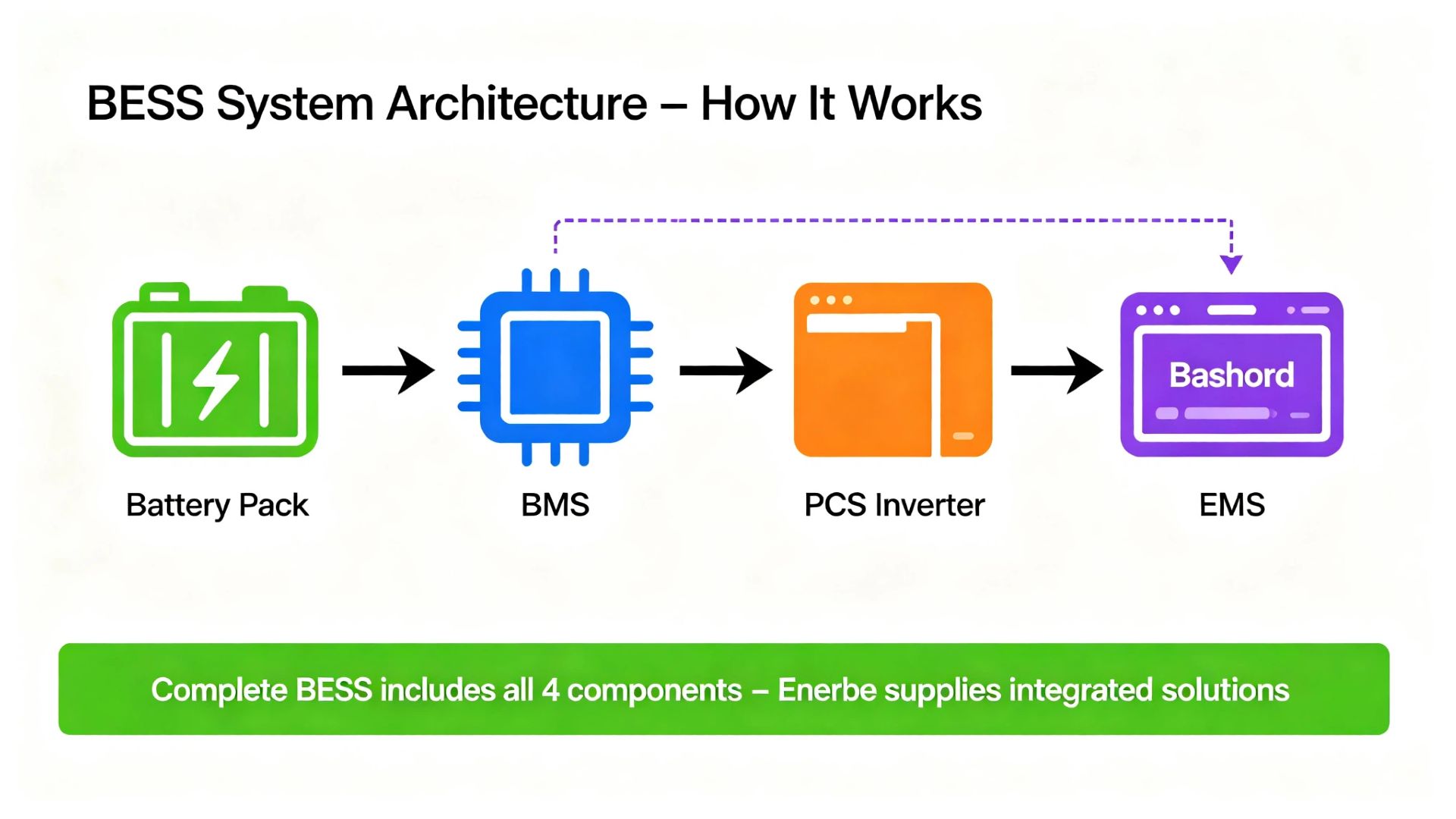
A complete battery energy storage system includes four core components. Understanding each is essential for informed sourcing decisions. The diagrams below summarize how they fit; for the step-by-step operating principle see how a BESS works.
1. Battery Pack (Energy Storage Medium)
The battery pack is the core of any BESS. For commercial and industrial applications, LiFePO4 (lithium iron phosphate) is the dominant chemistry for its safety, long cycle life and ESG compliance.
| Feature | LiFePO4 Advantage |
|---|---|
| Safety | Thermal-runaway threshold above 500°C, inherently stable chemistry |
| Cycle life | 5,000+ cycles at 80% DoD (10+ year service life) |
| ESG | Cobalt-free, fully recyclable, lower environmental impact |
| Temperature | −20°C to 60°C discharge, 0–55°C charge |
2. Battery Management System (BMS)
The BMS is the "brain" of the system. It monitors cell voltage, temperature and current, calculates SoC and SoH, balances cells, and communicates with the inverter via CAN bus or RS485.
B2B buying tip: confirm the BMS supports the protocol your target inverter needs (Victron, SMA, Sungrow, GoodWe, Growatt, Deye, etc.). Incompatible BMS–inverter communication is the #1 cause of BESS installation failures. For troubleshooting an existing pack, see the BMS reset guide.
3. Power Conversion System (PCS)
The PCS (inverter or bi-directional converter) converts DC from the battery to AC for loads or the grid, and back again for charging. Verify rated power (kW), peak efficiency (95%+), surge capacity, grid compliance (IEEE 1547, VDE-AR-N 4110, G99) and waveform quality (THD below 3%).
4. Energy Management System (EMS)
The EMS controls when the battery charges and discharges based on user strategy, tariffs and grid signals — the software layer that determines project ROI. Common strategies are time-of-use arbitrage, solar self-consumption, backup reserve and demand response.
Key Technical Parameters Every B2B Buyer Must Verify
When evaluating BESS suppliers, request specific datasheet values for these parameters. Never accept vague claims like "long life" or "high efficiency" — demand numbers.
| Parameter | What to Look For | Why It Matters |
|---|---|---|
| Nominal voltage | 48V for standard C&I; 150–1500V for utility scale | Inverter compatibility, cable sizing, safety |
| Usable capacity | kWh at a defined DoD (80–90% for LFP), not just Ah | Actual energy available |
| Cycle life | 5,000+ cycles at 80% DoD with 70–80% retention | 10+ year life and total cost of ownership |
| Round-trip efficiency | 95%+ AC-AC including PCS losses | Minimizes energy loss, maximizes ROI |
| Operating temperature | Charge 0–55°C / discharge −20–60°C | Site suitability |
| IP rating | IP65 outdoor; IP20/IP30 indoor climate-controlled | Weather and dust protection |
| Scalability | Parallel connection; max units per system | Expand without replacing the system |
| Discharge rate | 0.5C standard to 1C+ high power, in Amps or C-rate | Match load and PCS rating |
BESS Applications: Commercial, Industrial & Utility

Commercial & Industrial (30kWh to 10MWh+)
Factories, offices, retail, hotels and data centers use BESS for peak shaving (15–40% bill savings under demand charges), solar self-consumption, backup power, EV charging support without grid upgrades, and power-quality services such as voltage regulation and harmonic mitigation.
Utility-Scale (10MWh+)
Grid operators, utilities and IPPs use large BESS for sub-second frequency regulation, renewable firming, transmission deferral, energy arbitrage and capacity markets.
Residential (5–20kWh, installer channel)
Homeowners use solar-plus-storage for self-consumption (70–90% with storage vs 30–50% without), backup and TOU arbitrage. For B2B buyers this is an installer and distributor channel.
BESS vs Other Energy Storage Technologies
LiFePO4 BESS is not the only storage technology. Comparing alternatives helps you select the right one for the application.
| Technology | Key Advantage | Key Limitation | Best For |
|---|---|---|---|
| LiFePO4 BESS | Safe, 5,000+ cycles, ESG, fast response | Higher upfront cost than lead-acid | C&I, utility, residential — most uses |
| NMC BESS | Higher energy density, lighter | Lower safety (~200°C runaway), cobalt, shorter life | Mobile, weight-constrained |
| Lead-acid | Low upfront cost, well understood | 300–500 cycles, high maintenance, 50% DoD | Short-term backup, budget |
| Vanadium flow | 4–12h+ duration, non-flammable | Low density, costly, large footprint | Long-duration utility |
| Pumped hydro | Very low cost/kWh, 50+ year life | Needs geography, long build | Utility-scale, suitable terrain |
Bottom line: for about 90% of B2B needs (1–4 hour duration, C&I to utility scale), LiFePO4 is optimal. Flow batteries only make sense for long-duration (4h+) utility applications where footprint is not constrained.
Essential Certifications for BESS Sourcing
Depending on your target market, the supplier must hold specific certifications. Sourcing uncertified equipment can lead to denied permits, insurance refusals and regulatory shutdowns. This is a quick reference; the full interpretation, verification and conformity-assessment process is in the BESS certification guide.
| Market | Required Certification | Covers |
|---|---|---|
| North America | UL 1973, UL 9540, UL 9540A | Battery and system safety, fire data, permitting |
| Europe | CE (LVD/EMC/RoHS), IEC 62619, IEC 62477 | EU access, battery and PCS safety |
| Australia | CEC Listed | Rebates and grid connection |
| China | GB 38031-2025, CQC | Mandatory battery safety |
| Shipping | UN 38.3, MSDS/SDS | Mandatory for all lithium shipments |
B2B buying tip: request current, verifiable, model-specific certificates — not expired or pending ones — and check each number against the issuing body's online database (UL Product iQ, TÜV Certipedia). For packing and freight-forwarder requirements, see the shipping certifications guide.
BESS Procurement Checklist
Use this checklist when sourcing a BESS to cover the critical requirements before issuing a purchase order. This is the short version; the full end-to-end procedure, including the RFP/RFQ, TCO comparison, contract terms and FAT/SAT, is in the 7-phase BESS procurement guide.
Technical
-
Chemistry specified (LiFePO4 for most applications); voltage matches the inverter/PCS (48V standard for C&I).
-
Usable capacity in kWh at a defined DoD; cycle life with a capacity-retention guarantee; RTE 95%+.
-
Continuous discharge rate matches load and PCS; BMS protocol compatible with the inverter (CAN/RS485).
-
IP rating for the environment (IP65 outdoor / IP20–30 indoor); scalability and max parallel units confirmed.
Certification & Compliance
-
All required certifications current and model-specific; UN 38.3 and MSDS available for shipping.
-
Certificates verified against the issuing-body database; grid-code compliance (IEEE 1547, VDE-AR-N 4110, G99) confirmed.
Commercial Terms
-
Transparent pricing with no hidden costs; delivery timeline with liquidated damages.
-
Warranty terms defined (period, capacity retention, claims process, SLA); spare parts for 10+ years.
-
Payments aligned to milestones, not 100% upfront; technical support and local service confirmed.
Supplier Evaluation Framework
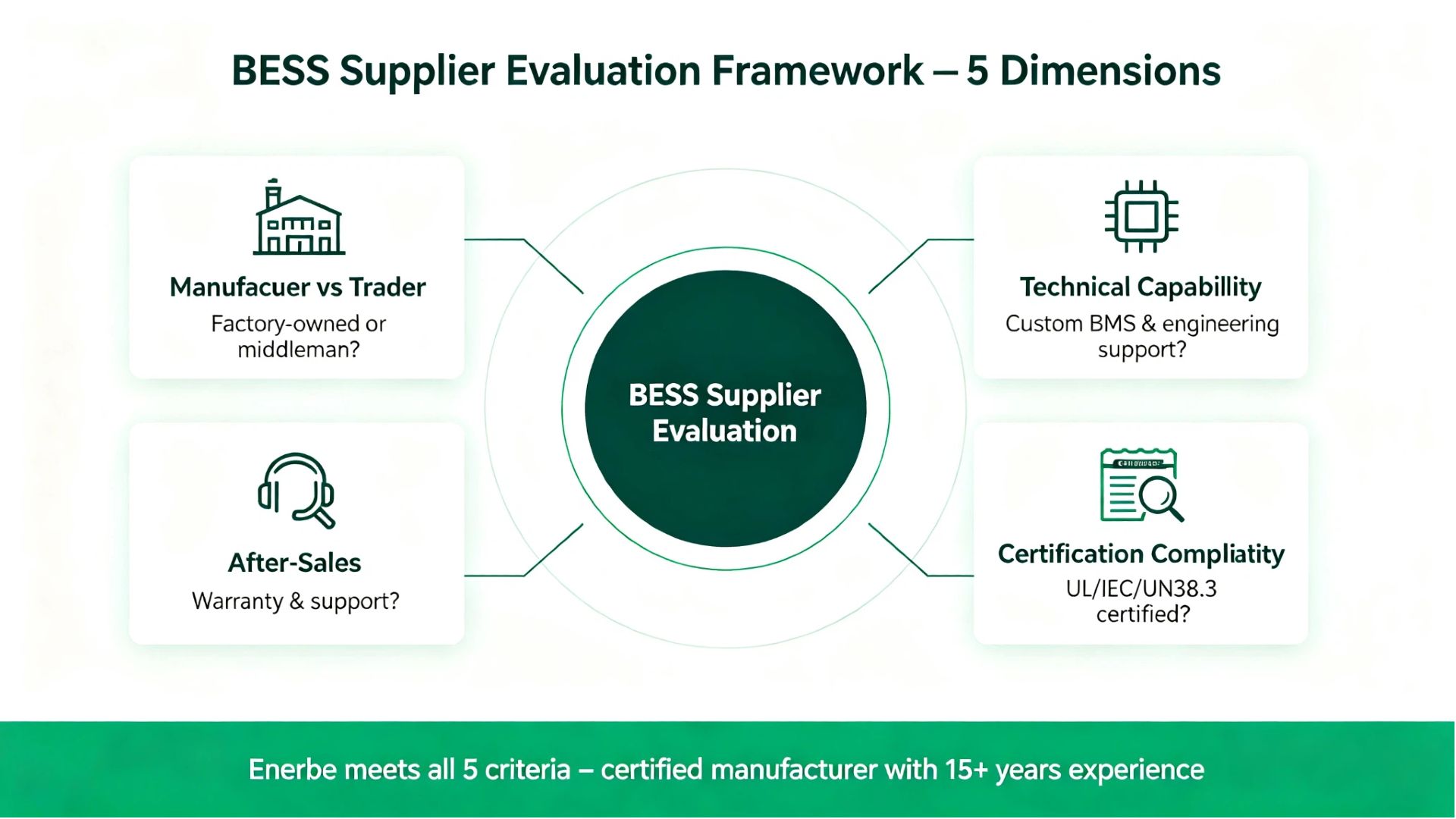
When sourcing a BESS, evaluate suppliers across five dimensions to distinguish direct manufacturers from traders and identify those that can deliver on their promises.
-
Manufacturer vs trader: direct manufacturers offer better pricing, quality control and customization. Ask whether they own the factory, whether you can visit, and their annual GWh capacity; request factory photos, production-line layout and ISO 9001.
-
Technical capability: engineering team size, BMS expertise, ability to customize voltage/capacity/BMS parameters, and the patent portfolio.
-
Certification compliance: certificates must be current and specific to the quoted model, verifiable in the issuing-body database.
-
Quality assurance: ISO 9001, traceability, incoming cell inspection, percentage of final-tested product, field failure-rate data, and support for factory visits and third-party inspection.
-
After-sales support: warranty period and capacity guarantee, claims process, response SLA, 10+ year spare parts, and local service partners.
For the complete weighted scoring matrix, capability verification, due diligence and factory-audit checklists, see BESS Supplier Selection: 7 Key Criteria and the reliable-supplier factory audit guide.
Why Enerbe for BESS?
Enerbe is the energy storage brand of A&S Power Technology Co., Ltd., a direct manufacturer (not a trader) with over 15 years of experience serving global brands. We offer factory-direct pricing, full quality control and extensive customization.
| Configuration | Key Specs | Best For |
|---|---|---|
| Wall-mounted | 48V 100Ah / 200Ah (5 / 10 kWh) | Residential, light commercial |
| Rack-mounted | 48V 100/200Ah, stackable up to 15 units | Data centers, telecom, C&I, server rooms |
| Stackable/modular | 5kWh modules, expandable to 50kWh+ | Scalable residential & commercial |
| Custom/OEM | 1S–20S, custom capacity and BMS programming | OEM partners, specialized uses |
Our ISO 9001 facilities in Dongguan provide UL 1973, UL 9540A, CE, IEC 62619 and UN 38.3 documentation across 200+ certified products, A-grade LiFePO4 cells with 100% incoming and final testing, and full traceability. We serve B2B clients in the US, Europe, Australia and the Middle East with logistics and customs support, and capacity of 10,000 pcs/day. For wholesale pricing or custom configurations, contact our team or view the full product lineup.
Frequently Asked Questions
Q1: What is battery energy storage procurement?
Battery energy storage procurement is the process of sourcing and purchasing BESS for commercial, industrial or utility-scale applications. It involves evaluating chemistry, technical parameters, certifications, supplier capability and commercial terms. A structured process ensures you select the right system at the best total cost of ownership over the 10–20 year lifecycle.
Q2: What are the core components of a BESS?
A complete BESS includes a battery pack (typically LiFePO4), a BMS that monitors and balances cells and communicates with the inverter, a PCS that converts DC to AC and back at 95%+ efficiency, and an EMS that controls charge/discharge for TOU, self-consumption, backup and demand response. All four must be compatible and integrated.
Q3: What technical parameters should I verify when procuring a BESS?
Nominal voltage (48V for C&I), usable capacity in kWh at a defined DoD, cycle life (5,000+ at 80% DoD with retention guarantee), RTE (95%+ AC-AC), operating temperature (charge 0–55°C / discharge −20–60°C), IP rating (IP65 outdoor), scalability and continuous discharge rate. Always request specific datasheet values.
Q4: What certifications are required for BESS procurement?
North America: UL 1973, UL 9540 and UL 9540A. Europe: CE, IEC 62619 and IEC 62477. Australia: CEC Listed. China: GB 38031-2025. Shipping: UN 38.3 and MSDS. Certificates must be current, model-specific and verifiable online. See the BESS certification guide for full detail.
Q5: How do I evaluate BESS suppliers for procurement?
Across five dimensions: manufacturer vs trader, technical capability, certification compliance, quality assurance and after-sales support. For projects over 1MWh, conduct a factory audit and reference calls. The 7-criteria selection guide and factory audit guide provide the complete framework.
Q6: LiFePO4 vs NMC vs lead-acid: which is best for BESS procurement?
For about 90% of B2B needs, LiFePO4: thermal-runaway above 500°C, 5,000+ cycles, cobalt-free and −20 to 60°C. NMC is denser but less safe and shorter-lived; lead-acid is cheap upfront but lasts only 300–500 cycles and is limited to 50% DoD. Over 10–20 years LiFePO4 has the lowest TCO.
Q7: What is the difference between BESS sourcing and BESS procurement?
Sourcing is the strategic activity of identifying, evaluating and qualifying suppliers and products through market research and relationship building. Procurement is the tactical process of buying specific systems for a specific project (RFQ/RFP, quotes, negotiation, PO, delivery). The terms are often used interchangeably, but strong sourcing makes each procurement faster and safer.
Related Resources
-
What Is a Battery Energy Storage System — definition, types, how it works and misconceptions.
-
7-Phase BESS Procurement Guide — RFP/RFQ, TCO, contract and FAT/SAT.
-
BESS Supplier Selection: 7 Key Criteria — capability verification, due diligence and scoring.
-
How to Choose a Reliable BESS Supplier — reliable vs risky and factory audit.
-
BESS Certification Guide — UL 1973, UL 9540/9540A, IEC, CE, UN 38.3, GB 38031.
-
48V Rack-Mounted LiFePO4 Guide — rack modules for data centers and C&I.
-
B2B Sourcing Guide for LiFePO4 Batteries — across all applications.
Get In Touch
Ready to source certified BESS solutions for your project? Contact Enerbe today.
📄 Request Safety Certifications & Datasheet
Contact Us →📞 Speak With Our Engineering Team
Get In Touch →🔗 Browse Certified LiFePO4 Products
View Products →Dongguan A&S Power Technology Co., Limited.
Building 1, No. 2, Keji 9th Road,
Songshan Lake, Dongguan, Guangdong, China
📞 +86 137 1383 1631
✉ info@aspowerbattery.com
Stay Charged. Stay Safe.



What Is an LFP Battery? LiFePO4 Full Form, Chemistry, Materials, Structure & Key Characteristics (2026)
BESS Equipment Procurement Guide: The 7-Phase ESS Procurement Process for System Integrators & IPPs (2026)
Related Article


Get In Touch
Have questions about custom lithium batteries, energy storage solutions, or lead-to-lithium conversion? Our team is ready to help. Send us a message and we’ll respond within 24 hours.

Building 1, No. 2, Keji 9th Road, Songshan Lake, Dongguan, Guangdong, China
Office Address

info@aspowerbattery.com
Email Us

+86 137 1383 1631
Call Us

Sun - Fri (08AM - 10PM)
Office Open
