
Deep Cycle Battery vs Lithium Ion – Which is Better for Your Application?

Table of Contents
- Introduction
- What Is a Deep Cycle Battery?
- What Is a Lithium Ion Deep Cycle Battery?
- Direct Comparison: Deep Cycle Battery vs Lithium Ion
- When to Choose Lead-Acid Deep Cycle
- When to Choose Lithium Ion Deep Cycle
- Total Cost of Ownership (TCO) Comparison
- Key Applications Comparison
- Frequently Asked Questions
- Summary
Introduction
If you're sourcing batteries for solar storage, RVs, marine applications, or off-grid systems, you've likely faced the question: deep cycle battery vs lithium ion – which is better?
The answer depends on your application, budget, and long-term goals. Deep cycle lead-acid batteries have been the traditional choice for decades, but lithium ion (specifically LiFePO4) batteries are rapidly gaining ground.
In 2026, the gap between these two technologies has widened significantly. Lithium ion offers 10x longer cycle life, 2x usable capacity, and 50-70% less weight – but at a higher upfront cost.
This guide provides a complete comparison of deep cycle battery vs lithium ion to help B2B buyers make informed procurement decisions.
For a complete overview of LiFePO4 battery sourcing across all applications, see our B2B Sourcing Guide.
What Is a Deep Cycle Battery?
A deep cycle battery is designed to provide steady power over a long period. Unlike starter batteries that deliver short, high-current bursts, deep cycle batteries are built to be discharged and recharged repeatedly.
Common deep cycle battery types:
-
Flooded lead-acid – Traditional, requires maintenance
-
AGM (Absorbent Glass Mat) – Sealed, low maintenance
-
Gel – Sealed, spill-proof
-
Lithium ion (LiFePO4) – Advanced, zero maintenance
For this comparison, we focus on traditional lead-acid deep cycle batteries (flooded, AGM, and gel) versus lithium ion deep cycle batteries (LiFePO4).
Typical applications: Solar storage, RVs, marine vessels, golf carts, UPS systems, and off-grid power.
For more detailed information on LiFePO4 battery technology, see our What Is a LiFePO4 Battery Guide.
What Is a Lithium Ion Deep Cycle Battery?
A lithium ion deep cycle battery uses advanced lithium-based chemistry – specifically LiFePO4 (Lithium Iron Phosphate) – to store and deliver energy.
Key characteristics of LiFePO4 deep cycle batteries:
-
80-100% usable capacity – nearly double lead-acid
-
3,000-5,000+ cycles – 10x longer than lead-acid
-
~50% lighter than lead-acid equivalents
-
Zero maintenance – no watering, no cleaning
-
Faster charging – 2-4 hours vs 8-10 hours
-
BMS protection – integrated battery management system
For more information on BMS and battery safety, see our BESS Certification & Compliance Guide.
Direct Comparison: Deep Cycle Battery vs Lithium Ion

| Comparison | Lead-Acid Deep Cycle | Lithium Ion (LiFePO4) | Winner |
|---|---|---|---|
| Cycle Life | 300-500 cycles | 3,000-5,000+ cycles | ✅ Lithium: 10x longer |
| Usable Capacity | ~50% DoD max | 80-100% DoD | ✅ Lithium: nearly 2x |
| Weight (100Ah) | ~25-30 kg | ~11-13 kg | ✅ Lithium: 60% lighter |
| Charging Time | 8-10 hours | 2-4 hours | ✅ Lithium: 3x faster |
| Maintenance | Monthly watering & cleaning | Zero | ✅ Lithium: zero maintenance |
| Efficiency | 70-85% | 95%+ | ✅ Lithium: higher efficiency |
| Upfront Cost | ~$150 for 100Ah | Higher | ✅ Lead-Acid: lower upfront |
| 10-Year TCO | Higher (3-4 replacements) | Lower (1 purchase) | ✅ Lithium: lower TCO |
Key takeaway: Lithium ion deep cycle batteries have significantly higher upfront cost but offer 10x longer life, 2x usable capacity, and lower total cost of ownership over a 10-year period.
For a detailed comparison of LiFePO4 and lead-acid, see our Lead-Acid to LiFePO4 Conversion Guide.
When to Choose Lead-Acid Deep Cycle
Lead-acid deep cycle batteries still make sense in specific scenarios:
| Scenario | Why Lead-Acid Works |
|---|---|
| Extreme budget constraints | Lowest upfront cost – ~$150 for 100Ah |
| Short-term projects (<2 years) | Battery won't outlast a single lead-acid unit |
| Low-cycle applications | Fewer than 100 cycles per year – lead-acid degrades slower with light use |
| Simple systems | No BMS or communication required |
| Cold climates (moderate) | AGM/Gel perform better than some lithium in extreme cold (without heating) |
B2B Buying Tip: If your project has a 2-3 year lifespan and budget is the primary constraint, lead-acid may be acceptable. However, for any application with daily cycling or a 5+ year timeline, lithium ion delivers better ROI.
For more information on lead-acid replacement, see our Lead-Acid to LiFePO4 Conversion Guide.
When to Choose Lithium Ion Deep Cycle
Lithium ion is the better choice for most B2B applications in 2026:
| Scenario | Why Lithium Wins |
|---|---|
| Daily cycling | 3,000-5,000+ cycles vs 300-500 – 10x longer life |
| Long-term projects (5-10+ years) | One battery lasts 10+ years – replaces 3-4 lead-acid units |
| Weight-sensitive applications | 50-70% lighter – better fuel efficiency, payload, handling |
| Low maintenance requirements | Zero maintenance – no watering, cleaning, or equalization |
| Remote or hard-to-access sites | 10+ year service life – fewer site visits |
| Solar and renewable energy | 95%+ efficiency vs 70-85% – more usable energy |
| Commercial fleets | Faster charging (2-4 hours) reduces downtime |
| Marine applications | Lighter weight improves boat performance and fuel efficiency |
B2B Buying Tip: For commercial projects with a 5+ year timeline, lithium ion consistently delivers lower total cost of ownership despite higher upfront cost.
For more information on lithium deep cycle advantages, see our 100Ah Deep Cycle Lithium Battery Guide.
Total Cost of Ownership (TCO) Comparison
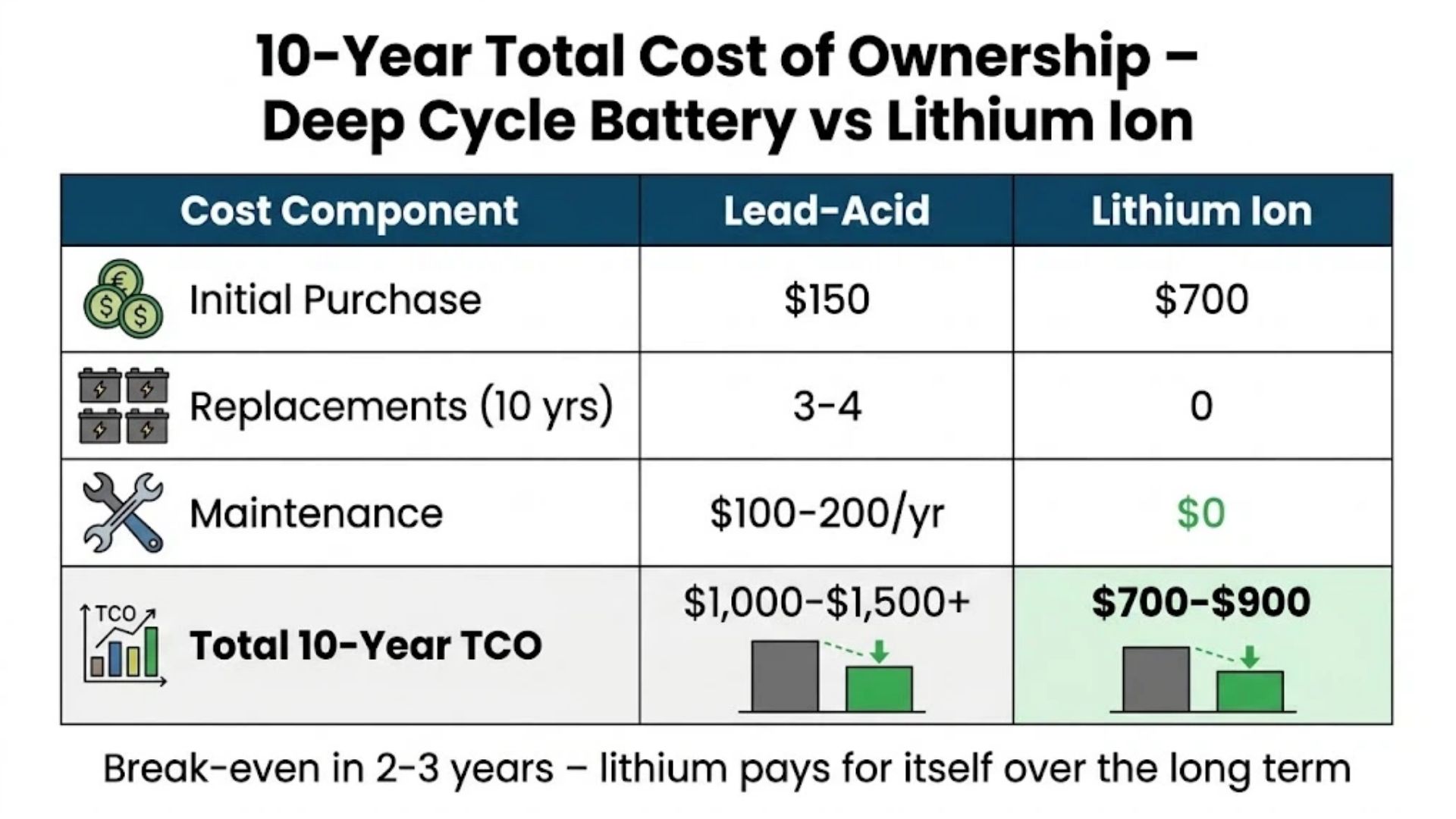
10-Year Cost Projection (100Ah Battery)
| Cost Component | Lead-Acid | Lithium Ion (LiFePO4) |
|---|---|---|
| Initial Purchase | ~$150 | ~$700 |
| Replacements (10 years) | 3-4 replacements | 0 replacements |
| Total Battery Cost (10 years) | $450-$600 | $700 |
| Maintenance Labor | $100-$200/year | $0 |
| Water/Cleaners | $50/year | $0 |
| Efficiency Loss (10 years) | Higher (70-85% efficiency) | Lower (95%+ efficiency) |
| Downtime Cost | Higher (longer charging, more failures) | Lower (fast charging, reliable) |
| Total 10-Year TCO | $1,000-$1,500+ | ~$700-$900 |
Break-even point: Lithium ion typically pays for itself within 2-3 years in applications with daily cycling.
The bottom line: One lithium ion battery replaces 3-4 lead-acid batteries over a 10-year period, with zero maintenance and significantly lower total cost of ownership.
Key Applications Comparison
| Application | Lead-Acid | Lithium Ion | Recommendation |
|---|---|---|---|
| Solar Storage | Limited (50% DoD) | Excellent (80-100% DoD) | ✅ Lithium |
| RVs & Campers | Heavy, limited cycles | Lightweight, 10+ years | ✅ Lithium |
| Marine | Heavy, corrosion risk | Lighter, maintenance-free | ✅ Lithium |
| Golf Carts | Short range, heavy | Extended range, lighter | ✅ Lithium |
| UPS/Backup | Acceptable (low-cycle) | Excellent (long standby, long life) | ✅ Lithium (for critical systems) |
| Short-term budget projects | Acceptable | Overkill | ✅ Lead-Acid |
Frequently Asked Questions
Q1: What is the difference between a deep cycle battery and a lithium ion battery?
Deep cycle refers to a battery's discharge/recharge design – it's built to be discharged and recharged repeatedly. Lithium ion refers to the battery's chemistry. The best deep cycle lithium ion batteries combine both: deep cycle design with lithium chemistry.
Q2: How many cycles does a lithium deep cycle battery last?
Lithium deep cycle batteries deliver 3,000-5,000+ cycles, compared to 300-500 cycles for lead-acid.
Q3: Is lithium ion better than lead-acid for deep cycle applications?
For most applications, yes. Lithium offers 10x longer cycle life, 2x usable capacity, 50-70% weight reduction, zero maintenance, faster charging, and lower total cost of ownership over a 10-year period.
Q4: What is the usable capacity difference between deep cycle and lithium?
Lead-acid deep cycle batteries can only be discharged to ~50% without damaging the battery. Lithium deep cycle batteries can be safely discharged to 80-100% – providing nearly double the usable energy.
Q5: How long does a lithium deep cycle battery last?
Lithium deep cycle batteries typically last 8-15 years with 3,000-5,000+ cycles. Lead-acid deep cycle batteries last only 2-4 years with 300-500 cycles.
Q6: Is a lithium deep cycle battery worth the higher cost?
Yes. Although lithium has higher upfront cost, the total cost of ownership over 10 years is significantly lower due to longer lifespan, zero maintenance, and higher efficiency. Break-even is typically 2-3 years.
Q7: Which is better for solar storage – deep cycle or lithium?
Lithium ion is better for solar storage. With 80-100% usable capacity, 95%+ efficiency, and 3,000-5,000+ cycles, lithium delivers far better ROI than lead-acid for daily cycling applications.
Summary
The choice between deep cycle battery vs lithium ion comes down to your application:
| Factor | Lead-Acid Deep Cycle | Lithium Ion Deep Cycle |
|---|---|---|
| Best For | Short-term, budget-limited projects | Long-term, daily cycling applications |
| Cycle Life | 300-500 cycles | 3,000-5,000+ cycles |
| Usable Capacity | ~50% | 80-100% |
| Weight | Heavy (25-30kg for 100Ah) | Lightweight (11-13kg for 100Ah) |
| Maintenance | Monthly watering | Zero |
| 10-Year TCO | Higher | Lower |
| Upfront Cost | Lower (~$150) | Higher (~$700) |
For most B2B applications in 2026 – solar storage, RVs, marine, golf carts, and commercial fleets – lithium ion (LiFePO4) is the superior choice. Despite higher upfront cost, it delivers 10x longer life, 2x usable capacity, and lower total cost of ownership over 10 years.
Enerbe provides LiFePO4 deep cycle batteries with integrated BMS, full shipping certifications, and customizable configurations. For wholesale pricing, custom configurations, or technical support, contact our team.
View the full product specifications on the product page:
👉 View LiFePO4 Deep Cycle Battery Product Page
Get In Touch
Ready to source LiFePO4 batteries for your project? Contact Enerbe today.
📄 Request a Technical Datasheet
Contact Us →📞 Speak with Our Engineering Team
Get In Touch →🔗 Browse Our Custom Battery Solutions
View Products →Where to Buy Lithium Batteries – B2B Sourcing Guide for Businesses | Enerbe
48V Rack-Mounted Lithium Battery Guide for Project Buyers (2026)
Related Article


Get In Touch
Have questions about custom lithium batteries, energy storage solutions, or lead-to-lithium conversion? Our team is ready to help. Send us a message and we’ll respond within 24 hours.

Building 1, No. 2, Keji 9th Road, Songshan Lake, Dongguan, Guangdong, China
Office Address

info@aspowerbattery.com
Email Us

+86 137 1383 1631
Call Us

Sun - Fri (08AM - 10PM)
Office Open
