
LiFePO4 vs Deep-Cycle Battery: Full Comparison Guide

Table of Contents
- Introduction: Lithium vs Deep Cycle — What's the Real Difference?
- What Is a Deep Cycle Battery?
- What Is a Lithium Ion Battery (LiFePO4)?
- Lithium Ion vs Deep Cycle: The Key Distinction
- Direct Comparison: Lithium Ion Deep Cycle vs Lead-Acid
- Lithium Ion Deep Cycle Battery Advantages
- The Role of BMS in Lithium Ion Deep Cycle Batteries
- Temperature Performance & Cold Weather Charging
- Safety Considerations
- Total Cost of Ownership (TCO)
- Applications: Marine, RV, Solar, Off-Grid, Golf Carts
- Can You Replace Lead-Acid Deep Cycle with Lithium Directly?
- Common Mistakes to Avoid
- B2B Procurement Checklist
- Related Resources
- Frequently Asked Questions
- Summary
Lithium Ion vs Deep Cycle Battery: Complete Comparison Guide for B2B Buyers (2026)
Last updated: September 2026 | Written by the Enerbe Engineering Team
Introduction: Lithium vs Deep Cycle — What's the Real Difference?
Most people asking about a lithium battery vs deep cycle battery — or the reverse, deep cycle battery vs lithium — are confused because the terms aren't actually opposites. If you're sourcing batteries for marine, RV, solar, or trolling motor applications, you've likely encountered this exact question: What's the difference between a lithium ion battery and a deep cycle battery? Are they the same thing? Do you need one or the other?
Quick Answer: "Deep cycle" describes how a battery is used (repeated deep discharge and recharge), while "lithium ion" describes the chemistry inside. A LiFePO4 lithium battery IS a deep cycle battery — just 3-5x better than lead-acid: 3,000-6,000 cycles at 80% DoD, 80-90% usable capacity, 50-70% lighter, zero maintenance, and lower total cost of ownership over 10 years. The only tradeoffs are higher upfront cost and no charging below 0°C without heating.
"Deep cycle" describes how a battery is used, drained repeatedly and recharged. "Lithium ion" describes the chemistry inside. A lithium ion battery, specifically the LiFePO4 kind used for storage, is a deep cycle battery. It's just a dramatically better one than the lead-acid deep cycle batteries everyone has been using for the last 100 years.
So what's the actual difference between deep cycle and lithium battery technologies? We build lithium battery systems for a living at Enerbe, and we talk to customers every week who are trying to figure out whether the switch is worth it. This guide breaks down the real differences, compares key metrics, and helps you make an informed procurement decision.
For a complete overview of LiFePO4 battery sourcing across all applications, see our B2B Sourcing Guide.
What Is a Deep Cycle Battery?
When shoppers compare deep cycle vs lithium, the "deep cycle" side almost always means a lead-acid battery. A deep cycle battery is built to be drained down to a significant portion of its capacity and then charged back up, over and over. That's different from a car starter battery, which delivers a quick burst of high current to turn an engine and then immediately gets recharged. Starter batteries would be destroyed if you drained them flat even once.
When people say "deep cycle battery" without specifying chemistry, they almost always mean lead-acid. There are three types:
-
Flooded (wet cell): The oldest and cheapest. You have to top them up with distilled water every month or two, run equalization charges, and keep them ventilated because they release hydrogen gas while charging. Not something you want inside a living space.
-
AGM (Absorbent Glass Mat): Sealed, maintenance-free, and spill-proof. The electrolyte is soaked into fiberglass mats between the plates. AGM has lower internal resistance than flooded, so it charges a bit faster and handles vibration better. This is the most common lead-acid deep cycle battery sold today.
-
Gel: The electrolyte is thickened with silica. Gel cells handle deep discharge and heat well, but they're picky about charging voltage and can be damaged by overcharging. You see them less often now, mostly in specific high-temperature applications.
All three lead-acid types share the same fundamental limitation: they're rated for 500-1,200 cycles at 50% depth of discharge. Go below 50% regularly and the life drops fast. That "100Ah" rating on the side of the box is not what you actually get to use.
Common Applications for Deep Cycle Batteries:
-
Marine and boating
-
RVs and campervans
-
Solar energy storage
-
Trolling motors
-
Golf carts and utility vehicles
-
UPS and backup power
For more information on marine deep cycle applications, see our Lead-Acid to LiFePO4 Conversion Guide.
What Is a Lithium Ion Battery (LiFePO4)?
When someone searches for lithium ion battery vs deep cycle or says "lithium deep cycle battery," they're almost always talking about LiFePO4, which stands for lithium iron phosphate. A lithium ion battery (Li-ion) is a rechargeable battery that uses lithium ions moving between electrodes to store and release energy. This is not the same chemistry as the lithium-ion battery in your phone or laptop. Those use NMC or NCA chemistry, which stores more energy per pound but wears out faster and runs hotter. LiFePO4 was designed from the start for deep cycling and safety, not for maximum energy density.
A LiFePO4 battery pack is made of individual 3.2V cells wired together (four cells make a "12V" battery at 12.8V nominal), plus a built-in BMS, or Battery Management System. The BMS is what makes lithium work safely. It watches every cell's voltage, balances them during charging, and cuts power if anything goes wrong, overcharge, over-discharge, overcurrent, short circuit, or overheating.
Here's what you're actually getting with a quality LiFePO4 deep cycle battery:
-
3,000-6,000+ cycles at 80% depth of discharge
-
80-90% of the rated capacity is actually usable
-
95-98% charging efficiency, versus 80-85% for lead-acid
-
Zero maintenance, sealed, no gas
-
50-70% lighter than the equivalent lead-acid battery
Watch out for cheap "lithium" batteries. Some budget brands use NMC cells instead of LiFePO4. NMC stores more energy but only lasts 1,000-2,000 cycles and is more prone to thermal issues. If the listing doesn't explicitly say LiFePO4 or LFP, ask. Our LiFePO4 safety guide covers what to look for →
Lithium Ion vs Deep Cycle: The Key Distinction
The confusion often arises because lithium ion and deep cycle are not mutually exclusive categories.
| Aspect | Deep Cycle | Lithium Ion |
|---|---|---|
| Definition | A usage/design category | A chemistry type |
| What It Means | Designed for repeated deep discharge and recharge | Uses lithium-based chemistry |
| Can They Overlap? | ✅ Yes — a lithium ion battery can be a deep cycle battery | ✅ Yes — a deep cycle battery can use lithium ion chemistry |
The Best of Both Worlds: A lithium ion deep cycle battery combines the deep-discharge design of a deep cycle battery with the superior chemistry of lithium ion.
Direct Comparison: Lithium Ion Deep Cycle vs Lead-Acid

Whether you're searching deep cycle battery vs lithium-ion or deep cycle battery vs LiFePO4, the numbers tell the same story. For B2B buyers, the most relevant comparison is between lithium ion deep cycle batteries and traditional lead-acid deep cycle batteries. Here's a side-by-side look at a typical 12V 100Ah lithium deep cycle battery (LiFePO4) next to a 12V 100Ah AGM deep cycle battery. The numbers are based on mainstream products from established manufacturers, not the optimistic specs you see on no-name listings.
| Parameter | LiFePO4 Lithium Deep Cycle | AGM Lead-Acid Deep Cycle | Winner |
|---|---|---|---|
| Chemistry | Lithium Iron Phosphate | Lead-Acid (AGM) | — |
| Nominal Voltage | 12.8V | 12V | — |
| Rated Capacity | 100Ah | 100Ah | — |
| Usable Capacity (DoD) | 80-90Ah (80-90%) | 40-50Ah (40-50%) | Lithium |
| Cycle Life (at rated DoD) | 3,000-6,000 cycles @ 80% | 500-1,200 cycles @ 50% | Lithium (3-5x) |
| Calendar Life | 8-15 years | 3-6 years | Lithium |
| Charge Time (0-100%) | 1-2 hours (at 0.5C) | 5-8 hours (at 0.2C) | Lithium (3-5x faster) |
| Charge Efficiency | 95-98% | 80-85% | Lithium |
| Weight | 12-15 kg (26-33 lbs) | 30-35 kg (66-77 lbs) | Lithium (50-60% lighter) |
| Energy Density | 90-120 Wh/kg | 30-40 Wh/kg | Lithium (3x) |
| Self-Discharge Rate | 2-3% per month | 3-5% per month | Lithium |
| Maintenance | None (sealed, BMS-managed) | Periodic equalization, cleaning | Lithium |
| Off-Gassing | None | Minimal (AGM), but possible under fault | Lithium |
| Operating Temp (discharge) | -20°C to 60°C (-4°F to 140°F) | -20°C to 50°C (-4°F to 122°F) | Roughly equal |
| Charging Temp | 0°C to 45°C (32°F to 113°F) | -20°C to 50°C (with derating) | Lead-Acid (cold charging) |
| Upfront Cost (100Ah) | $600-$900 | $250-$400 | Lead-Acid |
| Cost per Usable kWh (lifetime) | $0.10-$0.15/kWh | $0.20-$0.35/kWh | Lithium |
| Voltage Stability (discharge) | Flat (12.8V → 12.0V) | Steep decline (12.7V → 11.5V) | Lithium |
| Peak Discharge Current | High (1C-5C continuous) | Moderate (0.2C-0.5C continuous) | Lithium |
Key Takeaway: Lithium ion deep cycle batteries have higher upfront cost but significantly lower total cost of ownership over 10 years due to longer lifespan, less maintenance, and higher efficiency.
For a detailed comparison of LiFePO4 and lead-acid, see our Lead-Acid to LiFePO4 Conversion Guide.
Lithium Ion Deep Cycle Battery Advantages
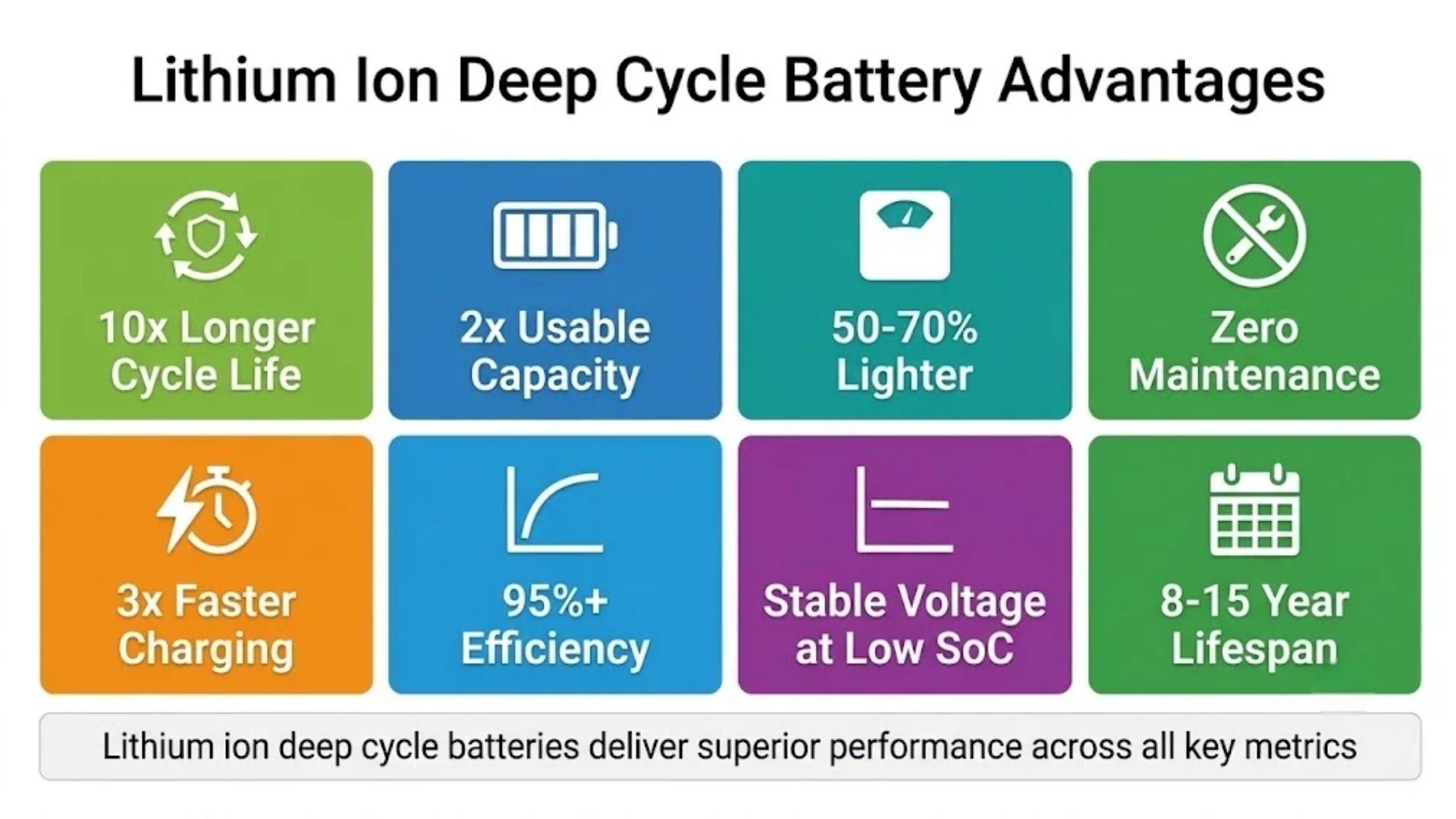
1. 10x Longer Cycle Life
Lithium ion deep cycle batteries typically deliver 3,000-6,000+ cycles at 80% DoD, compared to 500-1,200 cycles for lead-acid. Over 10 years, one lithium battery replaces 3-4 lead-acid batteries.
2. Nearly 2x More Usable Capacity
Lead-acid should not be discharged below 50% to avoid damage. Lithium ion can be safely discharged to 80-90% DoD, delivering nearly double the usable energy from the same rated capacity.
3. 50-70% Weight Reduction
Lithium deep cycle batteries are 50-70% lighter than equivalent lead-acid batteries. This means easier handling and installation, better fuel efficiency in RVs and boats, reduced wear on suspension and tires, and higher payload capacity.
4. Zero Maintenance
Unlike lead-acid, lithium deep cycle batteries require no watering, no terminal cleaning, and no equalization charges. This eliminates labor costs and reduces downtime.
5. Faster Charging
Lithium deep cycle batteries charge 3-5x faster than lead-acid — typically 1-2 hours vs 5-8 hours. This reduces generator run time and improves operational efficiency. The reason is that lead-acid has an absorption phase after 80% SOC where current must drop drastically; lithium takes full current right up to nearly 100%.
6. Higher Efficiency
Lithium deep cycle batteries achieve 95-98% round-trip efficiency, meaning more of the energy you put in is available for use. Lead-acid typically achieves only 80-85%. For solar systems, that 15% difference can mean hundreds of extra usable watt-hours from the same panels.
7. Stable Voltage at Deep Discharge
Lithium batteries maintain stable voltage even at low state of charge. Lead-acid voltage drops significantly as it discharges, which can cause inverters to shut down prematurely and appliances to struggle.
8. Longer Calendar Life
A high-quality lithium deep cycle battery lasts 8-15 years, while lead-acid typically lasts only 3-6 years.
The Role of BMS in Lithium Ion Deep Cycle Batteries
The Battery Management System (BMS) is essential for lithium ion deep cycle battery safety and performance. It's not optional — it's what makes the pack safe and long-lived.
| BMS Feature | Function |
|---|---|
| Over-voltage protection | Prevents overcharging and cell damage |
| Under-voltage protection | Prevents deep discharge damage |
| Over-current protection | Prevents short circuits and overheating |
| Temperature protection | Prevents operation outside safe ranges, including cold-temperature charging cutoff |
| Cell balancing | Ensures all cells charge evenly |
| Short circuit protection | Disconnects in case of a short circuit |
B2B Buying Tip: For fleet or commercial applications, choose a BMS with communication capabilities (CAN bus/RS485) for remote monitoring and diagnostics.
If the BMS ever trips due to over-discharge, over-current, or a short, it may need to be reset before the battery works again. Here's how to reset a BMS on lithium and LiFePO4 batteries →
For more information on BMS and battery safety, see our BESS Certification & Compliance Guide.
Temperature Performance & Cold Weather Charging
Discharging in cold and heat
Both chemistries have similar discharge temperature ranges, but lithium holds up better in the cold. LiFePO4 delivers full capacity down to about 0°C (32°F) and still gives 60-70% at -20°C (-4°F). Lead-acid loses capacity faster in cold weather. At -18°C (0°F), a lead-acid battery might only deliver 40-50% of its rated capacity.
In high heat, both chemistries are affected, but lead-acid is more sensitive to elevated temperatures accelerating grid corrosion. LiFePO4 handles heat well up to about 60°C (140°F), though sustained high temperatures will still shorten life.
Charging in cold: lithium's one weakness
This is the area where lead-acid genuinely has an advantage. LiFePO4 batteries should not be charged below 0°C (32°F) without low-temperature protection. Charging lithium when it's freezing causes lithium plating on the anode, which permanently reduces capacity and can create safety issues over time.
Quality lithium batteries have a BMS with low-temperature charging cutoff that automatically stops charging when cell temperature drops below 0°C (32°F) or 5°C (41°F), depending on the model. Some premium batteries include built-in heating pads for cold-weather charging.
If you charge in freezing temperatures, pay attention. Make sure your lithium battery has low-temperature charging cutoff protection. Never charge a LiFePO4 battery below 0°C (32°F), it causes permanent lithium plating damage. For winter camping or cold-climate solar, look for batteries with integrated heating or plan to heat the battery compartment.
Safety Considerations
Lead-acid safety issues
-
Off-gassing: Flooded batteries release hydrogen and oxygen during charging, which is an explosion risk in enclosed spaces. AGM and gel vent minimally under normal conditions but can vent if something goes wrong.
-
Acid: Sulfuric acid is corrosive and causes burns. Flooded batteries can spill if tipped over.
-
Lead: Toxic heavy metal, requires proper recycling.
-
Thermal runaway: Rare but possible with overcharging or internal shorts.
LiFePO4 safety
-
Thermal stability: LiFePO4 is the safest lithium chemistry. The phosphate cathode doesn't release oxygen at high temperatures, so thermal runaway is extremely unlikely. Cells don't begin decomposing until above 270°C (518°F).
-
No off-gassing: Sealed construction, no hydrogen, no acid fumes. Safe to install inside RVs, boats, and homes.
-
BMS protection: The built-in BMS protects against overcharge, over-discharge, overcurrent, short circuit, and over-temperature. Good BMS units also monitor individual cell temperatures.
-
No acid: Non-corrosive electrolyte, no spill risk.
Safety depends on build quality, not just chemistry. A cheap lithium battery with a bad BMS and low-quality cells is more dangerous than a well-built AGM. Always buy from a manufacturer that uses grade-A LiFePO4 cells and provides a real BMS with temperature sensing. Enerbe batteries are built with both. Our LiFePO4 safety guide covers what to look for →
Total Cost of Ownership (TCO)
The upfront cost is why most people hesitate on lithium. A 100Ah LiFePO4 battery costs $600-$900. The same size AGM is $250-$400. That's a big difference when you're standing at the checkout. But the upfront price is not the cost that matters. The cost that matters is what you pay per usable kilowatt-hour over the life of the system.
Here's a real comparison for a 12V 100Ah system that cycles daily, like a full-time RV or a small off-grid solar setup:
| Cost Factor | AGM Deep Cycle (with replacements) | LiFePO4 Lithium |
|---|---|---|
| Initial purchase (100Ah) | $300 | $750 |
| Replacement at Year 3 | $300 | $0 |
| Replacement at Year 6 | $300 | $0 |
| Maintenance (equalization, cleaning, water) | ~$50/year × 9 = $450 | $0 |
| Energy wasted in charging (15% vs 3%) | ~$300 over 9 years at $0.15/kWh | ~$60 over 9 years |
| Usable capacity note | Need 2x 100Ah AGM to match 1x 100Ah lithium usable energy | 1x 100Ah lithium |
| Total 9-Year Cost (equivalent usable energy) | ~$2,250+ | ~$810 |
| Cost per Usable kWh | ~$0.28/kWh | ~$0.10/kWh |
The payback timeline depends on how much you use the system:
-
Daily cycling (solar, full-time RV): Payback in 2-3 years
-
Moderate use (weekend RV, seasonal boat): Payback in 4-6 years
-
Light use (emergency backup, occasional camping): Payback may exceed the battery's life. For a battery that sits in a garage and gets used twice a year, lead-acid is probably the more economical choice.
Applications: Marine, RV, Solar, Off-Grid, Golf Carts
Marine & Boats
If you're comparing deep cycle marine battery vs lithium ion options, marine is an application where lithium makes a lot of sense, but you need to buy the right battery. A marine battery needs to handle vibration, humidity, and occasional water exposure. Look for IP65 or better water resistance, corrosion-resistant terminals (stainless steel or tin-plated copper), and shock/vibration certification.
The weight savings on a boat are more than just convenience. A typical 4-battery house bank switching from AGM to lithium saves 80-100 kg. That affects stability, fuel economy, and performance. Lithium's fast charging also means less generator runtime at anchor. Make sure your boat's charger and inverter are compatible with lithium, and install a DC-DC charger if charging from the engine alternator.
RV & Camping
For RVs, lithium is the clear choice for anyone who uses their RV regularly. Two 100Ah lithium batteries weigh about 28 kg total, where two 100Ah AGMs weigh 65 kg. That's 37 kg (82 lbs) you can use for food, water, or gear. A 100Ah lithium gives you about 80Ah of usable energy vs 50Ah for AGM — 60% more runtime from the same rated capacity. Charging from solar or alternator is 3-5x faster. There's no off-gassing so you can mount them inside under a bed or in a cabinet.
Solar Energy Storage
Solar is where lithium's advantages compound the most. A solar system cycles every day, charge during the day, discharge at night. That daily cycling is exactly what kills lead-acid batteries quickly. An AGM battery cycled daily at 50% DoD might last 1-2 years. A lithium battery cycled daily at 80% DoD lasts 8-12 years. The charge acceptance difference means lithium soaks up solar power at full current until nearly full, while AGM slows down after 80% and wastes afternoon sun. For residential solar storage, most systems are 48V now for higher efficiency.
Off-Grid Systems
Off-grid systems need to be reliable and low-maintenance, because you might not be at the site every day. Lithium checks both boxes. Zero maintenance means no watering, no equalization, no terminal cleaning. The long cycle life means you won't be replacing batteries every 2-3 years at a remote site. Many off-grid lithium batteries include communication ports (RS485, CAN bus) for remote monitoring. The one exception is very large off-grid systems (100+ kWh) where upfront budget is the primary constraint — in those cases, flooded lead-acid is still sometimes chosen.
Golf Carts & Mobility
A typical 48V golf cart lead-acid pack weighs 250-350 kg. The lithium equivalent weighs 50-80 kg. That's 200+ kg of weight savings, which dramatically improves acceleration, hill climbing, range, and tire wear. The flat voltage curve means the cart doesn't get sluggish as the battery discharges. Charging is 2-3 hours vs 8-12 hours for lead-acid, and partial charges are fine with lithium (no memory effect). Golf cart lithium batteries typically last 7-10 years vs 3-5 years for lead-acid.
Can You Replace Lead-Acid Deep Cycle with Lithium Directly?
If you're switching from deep cycle vs lithium battery, in most cases, yes. A 12V LiFePO4 battery (12.8V nominal) is electrically compatible with 12V lead-acid systems. Most 12V devices, inverters, lights, and appliances run fine on lithium. The fully charged voltage is 14.6V, which is within the operating range of virtually all 12V equipment.
But there are things to check before you swap:
-
Charger compatibility. This is the big one. Your charger needs to reach 14.2-14.6V to fully charge a 12V lithium battery. Some lead-acid chargers only go to 13.8V, which will leave the lithium perpetually undercharged. Also, make sure your charger doesn't have an equalization or desulfation mode that pushes voltage above 15V.
-
Inverter low-voltage cutoff. Some inverters have a low-voltage disconnect set for lead-acid (10.5-11.0V). For lithium, you typically want the cutoff around 10.0-10.5V, and the BMS will provide ultimate protection anyway.
-
Battery monitor. Lead-acid monitors estimate SOC by voltage, which doesn't work with lithium's flat voltage curve. Upgrade to a coulomb-counting monitor (like Victron BMV) for accurate readings.
-
Alternator charging (RV/marine). Install a DC-DC charger to protect the alternator from lithium's high current draw.
-
Series/parallel connections. Use identical batteries from the same manufacturer, same model, same age.
Never mix lithium and lead-acid in the same battery bank. Don't wire them in parallel or series together. Their different charging characteristics mean one chemistry will always be overcharged or undercharged. If you're upgrading, replace the entire bank with lithium.
Common Mistakes to Avoid
1. Buying the cheapest lithium battery you can find
The market is full of no-name brands using recycled cells, grade-B cells, or NMC cells labeled as LiFePO4. We've seen customers bring in cheap lithium batteries where the BMS was just a basic overvoltage cutoff with no cell balancing, no temperature monitoring, and no overcurrent protection. Spend the money on a reputable brand.
2. Using a lead-acid charger without checking
A lead-acid charger that only reaches 13.8V will never fully charge a lithium battery. A charger with an equalization mode can push 15V+ and damage lithium cells. Check your charger's specs before installing.
3. Comparing rated capacity instead of usable capacity
A 100Ah lead-acid gives you ~50Ah usable. A 100Ah lithium gives you ~80-90Ah usable. Calculate cost per usable amp-hour, then multiply by cycle life to get the real cost comparison.
4. Ignoring cold-temperature charging
Charging a lithium battery below freezing will damage it. Make sure the battery has low-temperature charging cutoff, or plan to heat the battery compartment.
5. Overlooking the BMS current rating
The BMS has a maximum continuous discharge current. If your inverter draws more than that, the BMS will shut the battery down. Check the BMS rating against your maximum load, including surge currents.
B2B Procurement Checklist for Lithium Ion Deep Cycle Batteries
When sourcing lithium ion deep cycle batteries for commercial projects, verify:
-
☐ Cycle life rating — Look for 3,000-6,000+ cycles at 80% DoD
-
☐ Depth of discharge — 80-90% DoD capability
-
☐ BMS protection — Full protection features including temperature sensing
-
☐ Certifications — UL, CE, UN38.3, MSDS
-
☐ IP rating — IP65 for marine and outdoor applications
-
☐ Weight — Confirm handling and installation requirements
-
☐ Dimensions — Verify fit in existing battery trays
-
☐ Terminal type — Matches your existing equipment
-
☐ Warranty — Industry standard is 5-10 years
-
☐ Cell grade — A-grade cells only
-
☐ Communication — CAN bus/RS485 for remote monitoring (fleet/commercial)
-
☐ Cold-temperature protection — Low-temp charging cutoff or heating pads
Related Resources
-
What Is a LiFePO4 Battery? Complete Guide — chemistry, specs, advantages, and applications for B2B buyers
-
LiFePO4 Battery Safety Guide — fire risk, thermal runaway, BMS protection, and certifications
-
LiFePO4 Battery Lifespan Guide — cycle life, calendar life, factors that affect longevity, and tips to extend life
-
Lead-Acid to LiFePO4 Conversion Guide — TCO comparison, sizing, installation checks for golf carts, RVs, marine
-
Enerbe LiFePO4 Battery Products — 12V, 24V, 48V certified deep cycle lithium batteries
Frequently Asked Questions
Can I use a lithium battery as a deep cycle battery?
Yes, and you probably should. LiFePO4 lithium batteries are deep cycle batteries by design, just a much better one. You can drain them to 80-90% regularly, get 3000-6000 cycles, charge them in a couple hours, and they weigh half as much. The upfront cost is higher, but most users break even in 2-3 years because they don't have to replace them.
What is the difference between lithium and deep cycle battery?
It's a chemistry question. When people compare deep cycle battery vs lithium, the traditional deep cycle battery is lead-acid (flooded, AGM, or gel) built to handle repeated draining, and it'll give you 500-1200 cycles if you keep discharges at 50% or less. A lithium battery, specifically LiFePO4, uses lithium iron phosphate cells, delivers 3000-6000 cycles at 80% DoD, charges faster, weighs far less, and needs zero maintenance. Lithium isn't a different category from deep cycle, it's just a far more advanced deep cycle technology.
How long does a lithium deep cycle battery last vs lead-acid?
A LiFePO4 lithium deep cycle battery will do 3000-6000 cycles at 80% depth of discharge, which works out to 8-15 years in most real installations. A lead-acid AGM or gel deep cycle battery does 500-1200 cycles at 50% DoD, so 3-6 years. Even when you drain lithium harder, it still lasts 3-5 times longer.
Is lithium ion better than lead-acid for deep cycle applications?
Yes, for most applications. Lithium offers 3-5x longer cycle life, nearly 2x usable capacity, 50-70% weight reduction, zero maintenance, faster charging, and lower total cost of ownership over 10 years. The one exception is light-use backup applications where the battery rarely cycles — in those cases, lead-acid's lower upfront cost may make more sense.
What is the best lithium chemistry for deep cycle batteries?
LiFePO4 (Lithium Iron Phosphate) is the best chemistry for deep cycle applications due to its safety, long cycle life, and thermal stability. Avoid NMC/NCA cells for deep cycle use — they have higher energy density but shorter cycle life (1000-2000 cycles) and lower thermal stability.
Are lithium deep cycle batteries worth the higher upfront cost?
Yes, for systems that cycle regularly. While upfront cost is higher, the total cost of ownership over 5-10 years is significantly lower due to longer lifespan, less maintenance, and higher efficiency. For daily-cycling systems (solar, full-time RV), payback is typically 2-3 years.
Can I replace my lead-acid deep cycle battery with a lithium battery directly?
Usually yes, but check your charger first. A 12V LiFePO4 battery is electrically compatible with 12V lead-acid systems. The catch is charging: your existing charger needs to hit 14.2-14.6V to fully charge lithium, and it shouldn't have an equalization or desulfation mode. If charging from a vehicle alternator, install a DC-DC charger to protect the alternator. When in doubt, talk to the battery manufacturer.
What is the best lithium deep cycle battery for marine use?
For marine use, look for a LiFePO4 battery with at least IP65 water resistance, a built-in BMS, and corrosion-resistant terminals. You'll also want shock and vibration resistance, low-temperature charging protection, and the ability to parallel or series multiple units. Enerbe builds marine-grade LiFePO4 batteries in 12V, 24V, and 48V with built-in BMS and CAN bus communication. Don't cheap out on marine batteries — a failure 20 miles offshore is a much bigger problem than one in your driveway.
Summary
Understanding the difference between lithium ion and deep cycle is simple:
| Feature | Lithium Ion Battery | Deep Cycle Battery | Lithium Ion Deep Cycle |
|---|---|---|---|
| Definition | Chemistry type | Design/discharge category | Combination of both |
| Best For | Energy density, weight | Repeated discharge/recharge | Both — best overall |
For B2B buyers, the lithium ion deep cycle battery is the superior choice:
-
3,000-6,000+ cycles (3-5x longer than lead-acid)
-
80-90% usable capacity (nearly 2x lead-acid)
-
50-70% lighter than lead-acid
-
Zero maintenance
-
95-98% efficiency
-
Lower total cost of ownership over 10 years
Enerbe provides lithium ion deep cycle batteries (LiFePO4) with integrated BMS, full shipping certifications, and customizable configurations. For wholesale pricing, custom configurations, or technical support, contact our team.
Get In Touch
Ready to source LiFePO4 batteries for your project? Contact Enerbe today.
📄 Request a Technical Datasheet
Contact Us →📞 Speak with Our Engineering Team
Get In Touch →🔗 Browse Our Custom Battery Solutions
View Products →Dongguan A&S Power Technology Co., Limited.
Building 1, No. 2, Keji 9th Road,
Songshan Lake, Dongguan, Guangdong, China
📞 +86 137 1383 1631
✉ info@aspowerbattery.com
Stay Charged. Stay Connected.



100Ah Deep Cycle Lithium Battery: B2B Sourcing Guide (2026)
LiFePO4 Battery Lifespan: How Long Do They Last? (2026)
Related Article


Get In Touch
Have questions about custom lithium batteries, energy storage solutions, or lead-to-lithium conversion? Our team is ready to help. Send us a message and we’ll respond within 24 hours.

Building 1, No. 2, Keji 9th Road, Songshan Lake, Dongguan, Guangdong, China
Office Address

info@aspowerbattery.com
Email Us

+86 137 1383 1631
Call Us

Sun - Fri (08AM - 10PM)
Office Open
