
51.2V LiFePO4 Battery: Wall-Mount & Rack Specs, 10–20kWh Systems & B2B Guide (2026)
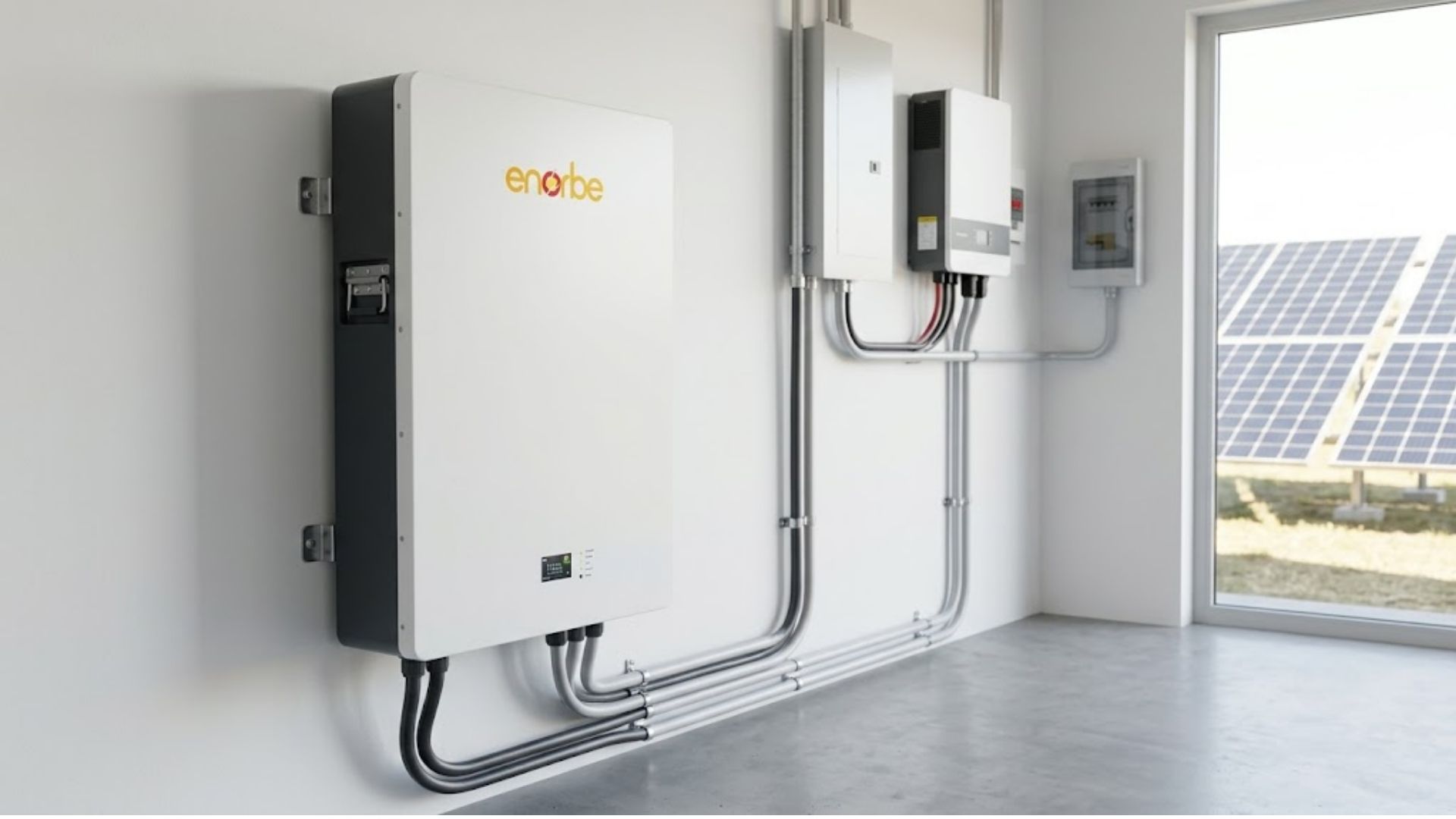
Table of Contents
- What Is a 51.2V LiFePO4 Battery?
- Full Specifications: 100Ah vs 200Ah vs 300Ah
- Wall-Mount vs Rack-Mount vs Floor-Stand
- 10kWh / 15kWh / 20kWh System Configurations
- Charging & Discharge Parameters
- Parallel Expansion & BMS Communication
- B2B Applications
- 51.2V vs 48V: What's the Difference?
- B2B Sourcing Considerations
- Frequently Asked Questions
51.2V LiFePO4 Battery: Wall-Mount & Rack Specs, 10–20kWh Systems & B2B Guide (2026)
Last updated: October 2026 | Written by the Enerbe Technical Team
Quick Answer: A 51.2V LiFePO4 battery is a 16-cell (16S) lithium iron phosphate pack — 16 × 3.2V = 51.2V — and is the standard voltage for residential and commercial solar energy storage. Common capacities: 100Ah = 5.12kWh, 200Ah = 10.24kWh, 300Ah = 15.36kWh. It charges at 58.4V, supports CAN/RS485 BMS communication, and modules can be paralleled to build 10kWh to 100kWh+ systems. 51.2V modules are available in wall-mount (residential & light commercial) and rack-mount (commercial & industrial) form factors, both supporting parallel expansion. For the 300Ah capacity deep-dive, see our 300Ah LiFePO4 Battery Guide.
What Is a 51.2V LiFePO4 Battery?
A 51.2V LiFePO4 battery is a lithium iron phosphate battery pack constructed from 16 cells connected in series (16S). Each LiFePO4 cell has a nominal voltage of 3.2V, so 16 cells × 3.2V = 51.2V nominal. This is the standard voltage platform for residential and commercial battery energy storage systems (BESS), battery modules, and industrial backup power.
The 51.2V platform has become the industry standard for stationary storage for three reasons:
- Safety: LiFePO4 chemistry is cobalt-free, thermally stable, and has a much lower fire risk than NMC. For stationary systems installed in buildings, this is the primary reason engineers specify LiFePO4 over other lithium chemistries.
- Voltage compatibility: 51.2V falls within the "48V" system voltage class that the entire solar inverter industry is built around. Every major hybrid inverter manufacturer (Victron, Deye, Sungrow, Growatt, GoodWe, Solis) supports 48V/51.2V battery input.
- Scalability: 51.2V modules can be connected in parallel to build systems from 5kWh (one 100Ah module) to 100kWh+ (16+ modules), with a single inverter managing the entire bank via CAN bus communication.
For B2B buyers — system integrators, EPC contractors, solar installers, and telecom providers — the 51.2V platform is the building block of energy storage. Understanding its exact specifications, charging parameters, and parallel expansion rules is essential before specifying a system.
Full Specifications: 100Ah vs 200Ah vs 300Ah
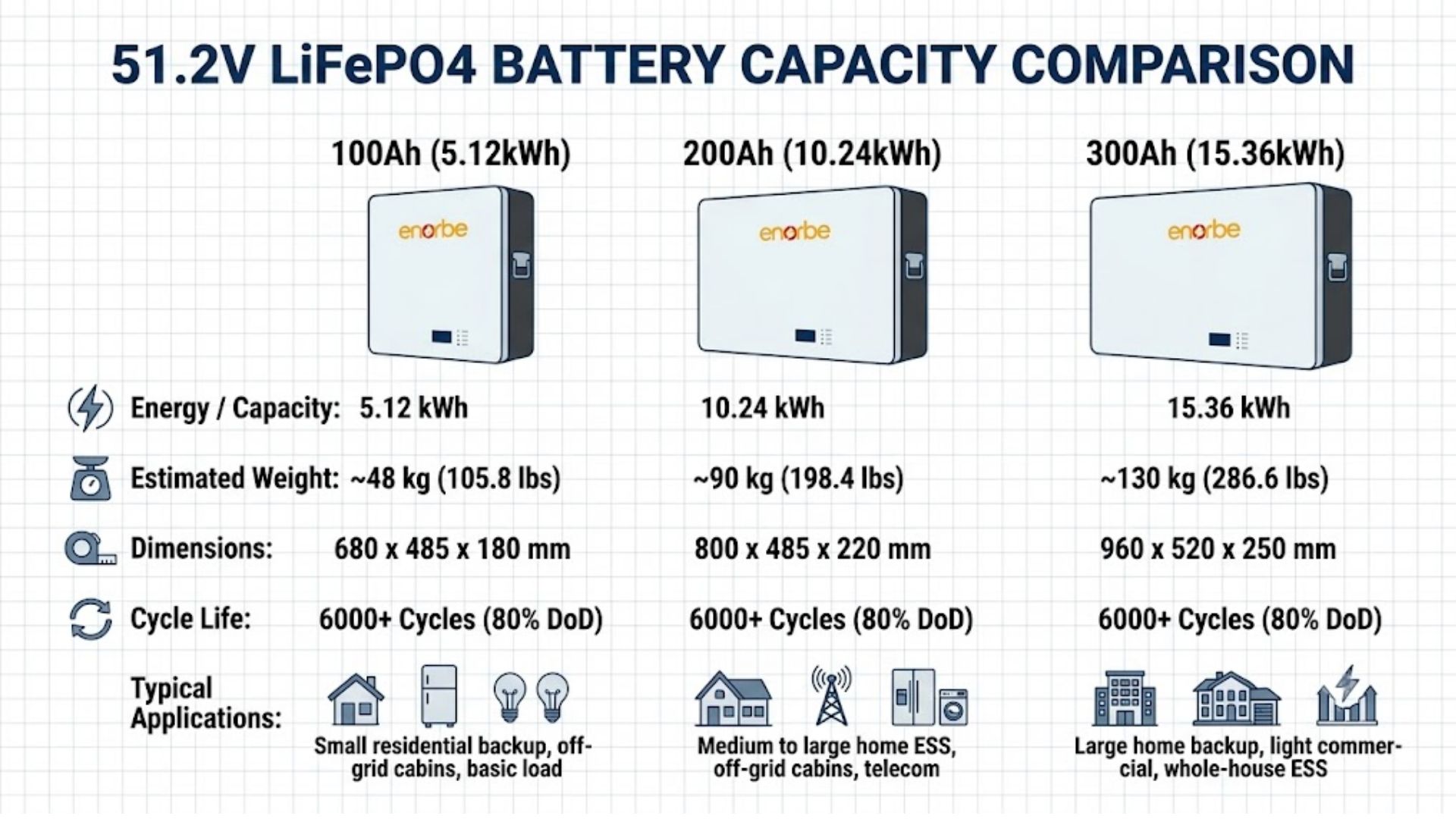
| Parameter | 51.2V 100Ah | 51.2V 200Ah | 51.2V 300Ah |
|---|---|---|---|
| Nominal Voltage | 51.2V (16S) | 51.2V (16S) | 51.2V (16S) |
| Total Energy | 5,120 Wh (5.12 kWh) | 10,240 Wh (10.24 kWh) | 15,360 Wh (15.36 kWh) |
| Charge Voltage (CV) | 58.4 ± 0.2V | 58.4 ± 0.2V | 58.4 ± 0.2V |
| Float Voltage | 54.0–55.2V (optional) | 54.0–55.2V (optional) | 54.0–55.2V (optional) |
| Low Voltage Cutoff | 40.0V | 40.0V | 40.0V |
| Recommended Charge Current | 20–50A (0.2–0.5C) | 40–100A (0.2–0.5C) | 60–150A (0.2–0.5C) |
| Continuous Discharge | 50–100A (BMS dependent) | 100–150A (BMS dependent) | 100–150A (BMS dependent) |
| Peak Discharge | 100–200A (5–10 sec) | 200–300A (5–10 sec) | 200–300A (5–10 sec) |
| Cycle Life (80% DoD) | 4,000–6,000+ | 4,000–6,000+ | 4,000–6,000+ |
| Weight | 35–45 kg | 65–80 kg | 95–120 kg |
| Typical Dimensions | ~540 x 360 x 180 mm | ~620 x 400 x 220 mm | ~700 x 440 x 260 mm |
| Communication | CAN / RS485 / Bluetooth | CAN / RS485 / Bluetooth | CAN / RS485 / Bluetooth |
| Best For | Small residential, backup | Residential + light commercial | Commercial, industrial |

For volume pricing, custom BMS configurations, or a full technical datasheet, contact the Enerbe engineering team.
Wall-Mount vs Rack-Mount vs Floor-Stand
51.2V LiFePO4 batteries come in three physical form factors. Understanding the tradeoffs helps you match the right form to the project:
| Form Factor | Typical Capacity | Best For | Pros | Cons |
|---|---|---|---|---|
| Wall-Mount (Powerwall) | 5–15 kWh per unit | Residential, garage, light commercial backup | Aesthetic, space-saving, integrated display | Limited parallel expansion, wall load capacity, harder to service |
| Rack-Mount | 5–15 kWh per module | Commercial, industrial, data centers, scalable systems | Fits 19" racks, easy parallel expansion, hot-swap, front access, EMS integration | Requires rack cabinet, heavier per module |
| Floor-Stand (Cabinet) | 10–30 kWh per cabinet | Commercial, outdoor, all-in-one systems | All-in-one (battery + inverter + EMS), IP65 outdoor option | Larger footprint, less flexible for mixed-vendor systems |
For B2B buyers: wall-mount 51.2V modules are the standard for residential and light commercial installations where aesthetics and space efficiency matter. Rack-mount modules (typically on the 48V platform) are preferred for larger commercial and industrial projects that require vertical stacking, hot-swap servicing, and integration into existing equipment racks. Enerbe offers 51.2V wall-mount batteries for residential and light commercial, and 48V rack-mount batteries for commercial and industrial scaling.
10kWh / 15kWh / 20kWh System Configurations
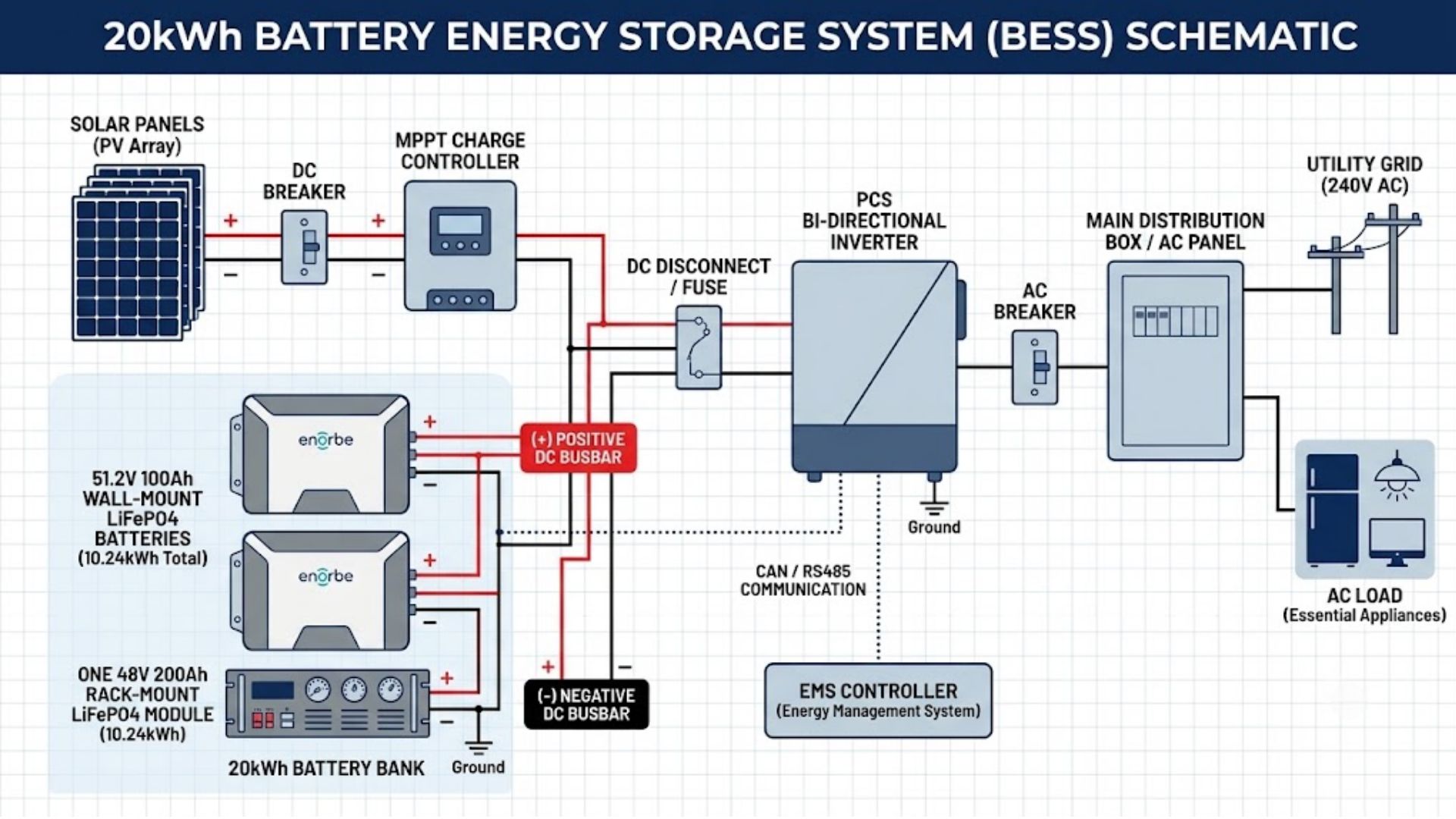
The most common 51.2V system sizes for commercial and residential-plus applications are built by paralleling standard modules:
| System Size | Configuration | Total Capacity | Typical Inverter | Best For |
|---|---|---|---|---|
| 10 kWh | 1 × 51.2V 200Ah wall-mount | 200Ah / 10.24kWh | 3–5 kW hybrid | Large residential, small office backup |
| 15 kWh | 1 × 51.2V 300Ah wall-mount | 300Ah / 15.36kWh | 5–8 kW hybrid | Residential with AC, small commercial |
| 20 kWh | 2 × 51.2V 200Ah wall-mount (parallel) | 400Ah / 20.48kWh | 8–12 kW hybrid | Commercial peak-shaving, off-grid home |
| 30 kWh | 2 × 51.2V 300Ah wall-mount (parallel) | 600Ah / 30.72kWh | 10–15 kW hybrid | Commercial, small factory, farm |
| 40 kWh | 4 × 48V 200Ah rack-mount (parallel) | 800Ah / 40.96kWh | 15–20 kW hybrid | Commercial solar self-consumption |
| 100 kWh+ | 8–16 × 48V 200/300Ah rack-mount | 1,600–4,800Ah | 30–100 kW PCS | Industrial, microgrid, C&I storage |
When sizing a system, calculate the customer's daily energy consumption and target autonomy (typically 1–2 days for off-grid, 4–8 hours for backup). For grid-tied commercial peak-shaving, size the battery to cover the peak demand window (usually 2–4 hours). For a complete BESS procurement and sizing methodology, see our BESS Procurement Guide.
Charging & Discharge Parameters
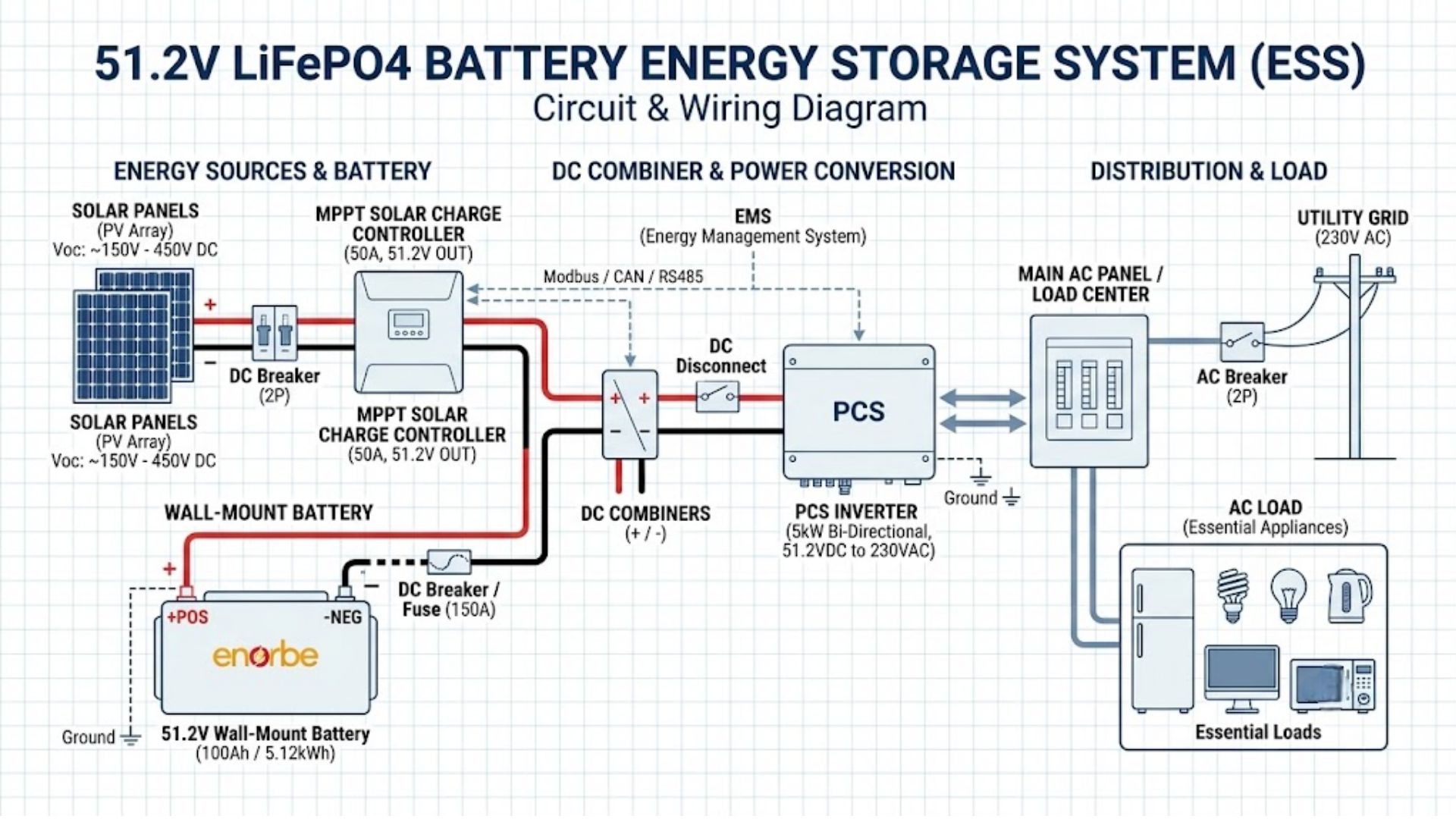
A 51.2V (16S) LiFePO4 battery uses a constant-current / constant-voltage (CC/CV) charging profile. The critical parameters are the same across all capacities — only the current scales with capacity:
| Parameter | Value | Notes |
|---|---|---|
| Charge Voltage (CV) | 58.4 ± 0.2V | 16 × 3.65V per cell. Not 54.6V (that is NMC 13S) |
| Float Voltage | 54.0–55.2V or disabled | LiFePO4 does not need float; many systems disable it |
| Low Voltage Cutoff | 40.0V | 16 × 2.5V per cell. BMS protects below this |
| Recommended Charge Rate | 0.2C–0.5C | 20–50A (100Ah), 40–100A (200Ah), 60–150A (300Ah) |
| Max Charge Rate | 1C | Frequent 1C charging reduces cycle life |
| Charge Temperature | 0°C – 45°C | BMS cuts off charging below 0°C to prevent lithium plating |
| Discharge Temperature | -20°C – 60°C | Capacity derates below 0°C |
Critical warning for installers: The 58.4V charge voltage is specific to 16S LiFePO4. A 48V lead-acid charger outputs 54.6–58.8V with periodic equalization at 62V+ — this can trigger BMS overvoltage protection or, on poorly protected packs, cause cell overcharge. An NMC 48V charger outputs 54.6V (13S) and will undercharge a 16S LiFePO4 pack to ~70% capacity. Always use a charger, inverter, or MPPT controller with a configurable LiFePO4 profile set to 58.4V. For complete charging guidance, see our How to Charge LiFePO4 Batteries Guide.
Parallel Expansion & BMS Communication
One of the biggest advantages of 51.2V battery modules — whether wall-mount or rack-mount — is the ability to connect them in parallel to scale capacity. But parallel operation requires attention to BMS design and installation procedure:
Parallel Connection Rules
- Use identical modules: Same manufacturer, same model, same capacity, same BMS firmware version. Mixing capacities or BMS versions causes uneven current sharing and premature failure.
- Voltage-match before connecting: All modules must be within 0.1V of each other before paralleling. If one module is at 52.0V and another at 50.5V, connecting them directly causes a large inrush current. Charge or discharge the lower/higher module to match first.
- Use a BMS with parallel support: Quality BMS units communicate via CAN bus in a master-slave or peer-to-peer configuration, ensuring all modules charge and discharge evenly. Cheap BMS units without parallel communication can cause one module to carry disproportionate current.
- Protect each module: Install a fuse or DC breaker on each module's positive terminal, rated at the module's max continuous current + 25%. This isolates a faulty module without taking down the whole system.
- Use equal-length cables or busbars: All parallel connections should have equal resistance to ensure even current sharing. Busbars are preferred over cables for high-current parallel systems.
BMS Communication Protocols
| Protocol | Use Case | Compatible Inverters |
|---|---|---|
| CAN Bus | Battery-inverter communication, parallel module sync | Victron, Deye, Sungrow, Growatt, GoodWe, Solis |
| RS485 / Modbus | Monitoring systems, EMS, SCADA integration | Most commercial inverters, building management systems |
| Bluetooth | Mobile app monitoring, commissioning | N/A (device-to-phone only) |
| TCP/IP (Ethernet) | Remote monitoring, cloud EMS, fleet management | Commercial EMS platforms, optional gateway |
For commercial systems, CAN bus is the standard for battery-inverter communication because it supports real-time data exchange (voltage, current, SOC, SOH, fault codes) and allows the inverter to control charging and discharging based on the battery's state. RS485/Modbus is used for integration with building management systems and third-party monitoring. When sourcing modules, confirm the BMS supports the protocol your inverter requires — not all inverters use the same CAN protocol mapping, and some require a custom cable or gateway.
B2B Applications
Commercial Solar Self-Consumption & Peak-Shaving: For businesses with high daytime electricity rates and demand charges, a 51.2V 20–40kWh system charged from rooftop solar and discharged during peak rate hours can reduce electricity bills by 30–50%. The 51.2V platform integrates with commercial hybrid inverters that support time-of-use scheduling and peak shaving. For a full guide to BESS procurement for commercial projects, see our BESS Procurement Guide for System Integrators.
Telecom & Base Station Backup: Telecom operators worldwide are replacing 48V lead-acid battery banks with 51.2V LiFePO4 modules. The 51.2V nominal voltage matches existing 48V telecom power systems, and LiFePO4 offers 10x the cycle life, 60% less weight, and zero maintenance. A single 51.2V 100Ah module provides 4–8 hours of backup for a typical cell site, with parallel modules for longer autonomy. For telecom-specific sizing, see our Telecom Battery Guide.
Data Center & UPS: For data center and UPS applications, 48V rack-mount modules fit standard 19-inch server racks, while 51.2V wall-mount units suit smaller IT facilities and edge computing sites. The high cycle life and fast charge/discharge capability support frequent test discharges and actual power events. LiFePO4's thermal stability is a critical safety advantage in enclosed environments.
Microgrids & Off-Grid Systems: For remote communities, mining sites, and island power systems, 51.2V modules paralleled to 100kWh+ form the energy storage backbone of solar-diesel hybrid microgrids. The CAN bus communication allows the EMS to coordinate charging from solar, discharging to loads, and generator start-stop control.
EV Charging Infrastructure: Battery systems buffer the grid for fast EV charging stations, reducing demand charges and allowing solar-powered charging. A 50–100kWh system can support a 50kW DC fast charger with significant peak-shaving benefit.
51.2V vs 48V: What's the Difference?
This is the most common source of confusion in the industry. The short answer: they refer to the same system, but the terms come from different traditions:
| Term | Origin | Exact Meaning | Who Uses It |
|---|---|---|---|
| 48V | Lead-acid tradition (24 cells × 2V = 48V) | The voltage class / system category | Electricians, installers, inverter spec sheets |
| 51.2V | Lithium precision (16 cells × 3.2V = 51.2V) | The exact nominal voltage of a 16S LiFePO4 pack | Battery manufacturers, engineers, BMS specs |
When you see a product labeled "48V 200Ah LiFePO4" and another labeled "51.2V 200Ah LiFePO4," they are electrically identical — both are 16S packs with 51.2V nominal and 58.4V charge voltage. The difference is marketing terminology. However, always verify the charge voltage on the datasheet: a 48V NMC battery is 13S (54.6V charge), and a 48V lead-acid battery is 24S (57.6V float, 62V equalization). If the datasheet says 58.4V charge voltage, it is 16S LiFePO4 regardless of whether the label says 48V or 51.2V.
B2B Sourcing Considerations
For volume buyers sourcing 51.2V battery modules, these are the critical factors to verify before issuing a PO:
- Cell grade and brand: Require Grade A prismatic cells from CATL, EVE, CALB, or Lishen with full batch traceability. 51.2V modules use large-format cells (typically 100Ah–300Ah prismatic) — cell quality directly determines cycle life and safety. Ask for the cell brand, model, and batch number, and verify against the manufacturer's test report.
- BMS parallel capability: Confirm the BMS supports the number of parallel modules you plan to use (typically up to 16). Verify the CAN protocol mapping matches your inverter — some manufacturers use proprietary CAN that requires a gateway. Ask for a list of compatible inverters and a protocol document.
- Form factor and dimensions: Confirm whether you need wall-mount (residential/light commercial) or rack-mount (commercial/industrial, typically 48V platform). For wall-mount, verify wall load capacity, mounting bracket design, and terminal accessibility. For rack-mount, confirm 19-inch rack fit, U-height, and front/rear terminal access.
- Certifications: For commercial installations in North America, UL 1973 (battery) and UL 9540 (system) are increasingly required by inspectors and insurance. For shipping, UN38.3 is mandatory. CE, RoHS, and IEC 62619 cover basic safety and compliance. For a full breakdown, see our BESS Certification Guide.
- Warranty and capacity guarantee: Require a minimum 10-year or 4,000-cycle warranty with a clear capacity retention guarantee (typically 70% at end of warranty). Confirm who pays for labor and shipping on warranty claims, and whether the warranty is backed by the manufacturer or a local distributor.
- Monitoring and EMS integration: For commercial fleet management, confirm the BMS supports remote monitoring via TCP/IP or a gateway, and that the data can integrate with your EMS or SCADA system. Per-cell voltage and temperature monitoring is essential for warranty claims and early fault detection.
- MOQ, lead time, and spares: 51.2V modules typically have an MOQ of 5–20 units for OEM pricing. Confirm production lead time (15–30 days), sample availability, and the supplier's ability to provide spare modules within a reasonable timeframe for warranty replacements.
Enerbe manufactures 51.2V wall-mount LiFePO4 batteries for residential and light commercial solar storage, and 48V rack-mount LiFePO4 batteries for commercial and industrial energy storage. Both platforms use Grade A prismatic cells, support CAN/RS485/Bluetooth BMS, parallel expansion, and carry full certifications. For wholesale pricing, custom configurations, or a factory audit, contact our team.
Frequently Asked Questions
Q: What is a 51.2V LiFePO4 battery?
A: A 51.2V LiFePO4 battery is a 16-cell (16S) lithium iron phosphate pack: 16 × 3.2V = 51.2V nominal. It is the standard voltage for residential and commercial solar energy storage, battery systems, and industrial backup. Common capacities: 100Ah (5.12kWh), 200Ah (10.24kWh), 300Ah (15.36kWh). Full charge voltage is 58.4V; low cutoff is 40.0V.
Q: Why is it called 51.2V and not 48V?
A: Both terms refer to the same 16S LiFePO4 system. "48V" is the industry voltage class name (from lead-acid: 24 × 2V = 48V). "51.2V" is the exact lithium nominal voltage (16 × 3.2V = 51.2V). Always confirm the charge voltage is 58.4V (LiFePO4), not 54.6V (NMC).
Q: How many kWh is a 51.2V 200Ah battery?
A: 51.2V × 200Ah = 10,240Wh = 10.24kWh. Other capacities: 100Ah = 5.12kWh, 300Ah = 15.36kWh, 400Ah = 20.48kWh. LiFePO4 delivers 80–100% usable capacity, so a 51.2V 200Ah ≈ 48V 400Ah lead-acid in usable energy at half the weight.
Q: What is the charging voltage for a 51.2V LiFePO4 battery?
A: 58.4V constant voltage (CV), with 0.2C–0.5C recommended charge current. Float: 54.0–55.2V or disabled. Low cutoff: 40.0V. Never use a lead-acid charger (equalization to 62V+) or NMC charger (54.6V) — use a LiFePO4 profile set to 58.4V.
Q: Can 51.2V LiFePO4 batteries be connected in parallel?
A: Yes. Typical configurations: 2 modules = 20.48kWh, 4 modules = 40.96kWh, up to 16 modules = 100kWh+. Rules: identical modules, voltage-match within 0.1V, BMS with parallel support (CAN bus), fuse each module, equal-length busbars.
Q: What size inverter do I need for a 51.2V battery?
A: 100Ah/50A BMS = ~2,500W (2–3kW inverter). 200Ah/100A BMS = ~5,000W (3–5kW). 300Ah/150A BMS = ~7,500W (5–8kW). Four 200Ah in parallel = 400A/~20kW (15–20kW inverter). Match inverter to 48V/51.2V and confirm CAN compatibility.
Q: What is the difference between wall-mount and rack-mount 51.2V batteries?
A: Wall-mount 51.2V batteries are for residential and light commercial, mounted like a powerwall, with integrated display. Rack-mount batteries fit 19-inch server racks, front access, easy parallel expansion, hot-swap — the standard for commercial. Enerbe offers 51.2V wall-mount for residential and 48V rack-mount for commercial scaling.
Summary
A 51.2V LiFePO4 battery is a 16-cell (16S) lithium iron phosphate pack — the standard voltage platform for residential and commercial energy storage. With capacities from 100Ah (5.12kWh) to 300Ah (15.36kWh), a 58.4V charge profile, CAN/RS485 BMS communication, and support for up to 16 modules in parallel, it is the building block of systems from 5kWh to 100kWh+.
For B2B buyers, the key decisions are: capacity (match to daily consumption and autonomy), form factor (wall-mount 51.2V for residential & light commercial, rack-mount 48V for commercial & industrial), BMS communication (CAN bus for inverter integration, RS485 for EMS), and parallel expansion capability. Always verify the charge voltage is 58.4V (not 54.6V for NMC), confirm cell grade and traceability, and ensure the BMS protocol matches your inverter.
Enerbe manufactures 51.2V wall-mount LiFePO4 batteries for residential and light commercial, and 48V rack-mount LiFePO4 batteries for commercial and industrial energy storage. For wholesale pricing, custom configurations, or technical support for your energy storage project, contact our team.
For related guides: 300Ah LiFePO4 Guide | Charging Guide | Certification Guide | BESS Procurement Guide | Telecom Battery Guide
Get In Touch
Need 51.2V wall-mount or 48V rack-mount LiFePO4 batteries for your energy storage project? Request datasheets, samples, or wholesale pricing from Enerbe.
📄 Request a Technical Datasheet
Contact Us →📞 Speak with Our Engineering Team
Get In Touch →🔗 Browse LiFePO4 Battery Products
View Products →Dongguan A&S Power Technology Co., Limited.
Building 1, No. 2, Keji 9th Road,
Songshan Lake, Dongguan, Guangdong, China
📞 +86 137 1383 1631
✉ info@aspowerbattery.com
Stay Charged. Stay Connected.



Battery Energy Storage Procurement Guide: 7-Phase BESS Framework for System Integrators (2026)
300Ah LiFePO4 Battery: 12V/48V Specs, Runtime & B2B Sourcing Guide (2026)
Related Article


Get In Touch
Have questions about custom lithium batteries, energy storage solutions, or lead-to-lithium conversion? Our team is ready to help. Send us a message and we’ll respond within 24 hours.

Building 1, No. 2, Keji 9th Road, Songshan Lake, Dongguan, Guangdong, China
Office Address

info@aspowerbattery.com
Email Us

+86 137 1383 1631
Call Us

Sun - Fri (08AM - 10PM)
Office Open
