
300Ah LiFePO4 Battery: 12V/48V Specs, Runtime & B2B Sourcing Guide (2026)

Table of Contents
300Ah LiFePO4 Battery: 12V/48V Specs, Runtime & B2B Sourcing Guide (2026)
Last updated: October 2026 | Written by the Enerbe Technical Team
Quick Answer: A 300Ah LiFePO4 battery is a high-capacity lithium iron phosphate pack available in 12V (3.84kWh), 24V (7.68kWh), or 48V/51.2V (15.36kWh) configurations. It delivers 4,000–6,000+ cycles at 80% DoD, supports 150–300A continuous discharge, and charges at 14.6V (12V), 29.2V (24V), or 58.4V (48V). The 12V 300Ah is the top choice for large RVs, marine house banks, and off-grid cabins; the 48V/51.2V 300Ah is the standard for residential and commercial solar storage. For charging setup across all voltages, see our LiFePO4 Charging Guide.
What Is a 300Ah LiFePO4 Battery?
A 300Ah LiFePO4 battery (also called a 300 amp hour lithium battery) is a deep-cycle lithium iron phosphate pack rated at 300 amp-hours of capacity. The "300Ah" rating means it can deliver 300 amps for one hour, or 30 amps for 10 hours, at its nominal voltage — though in practice, discharge current and temperature affect the actual delivered capacity.
Unlike lead-acid batteries, which only deliver 50% of their rated capacity before damage occurs, a LiFePO4 300Ah battery delivers 80–100% usable capacity. This means a 12V 300Ah LiFePO4 provides roughly the same usable energy as a 600Ah lead-acid bank, at about one-third the weight and with zero maintenance.
The three most common voltage configurations are:
- 12V / 12.8V (4S): 3,840Wh (3.84kWh), drop-in replacement for lead-acid in RVs, marine, and off-grid cabins
- 24V / 25.6V (8S): 7,680Wh (7.68kWh), trolling motors, larger marine systems, mid-size solar
- 48V / 51.2V (16S): 15,360Wh (15.36kWh), residential and commercial solar storage, server racks, telecom backup
For B2B buyers — system integrators, off-grid installers, RV and marine OEMs, and telecom providers — the 300Ah capacity sits at the sweet spot between energy density and physical manageability: large enough to power a full off-grid system for a day, yet small enough that a single 12V pack (55–65kg) can be installed by two technicians without specialized lifting equipment.
Full Specifications: 12V vs 48V 300Ah
| Parameter | 12V 300Ah | 48V / 51.2V 300Ah |
|---|---|---|
| Nominal Voltage | 12.8V (4S) | 51.2V (16S) |
| Total Energy | 3,840 Wh (3.84 kWh) | 15,360 Wh (15.36 kWh) |
| Charge Voltage | 14.6 ± 0.2V | 58.4 ± 0.2V |
| Low Voltage Cutoff | 10.0V | 40.0V |
| Recommended Charge Current | 60A – 150A (0.2C–0.5C) | 60A – 150A (0.2C–0.5C) |
| Max Charge Current | 300A (1C) | 300A (1C) |
| Continuous Discharge | 150A – 300A (BMS dependent) | 100A – 150A (BMS dependent) |
| Peak Discharge | 300A – 600A (5–10 sec) | 200A – 300A (5–10 sec) |
| Cycle Life (80% DoD) | 4,000 – 6,000+ | 4,000 – 6,000+ |
| Weight | 55 – 65 kg | 95 – 120 kg |
| Typical Dimensions | ~520 x 270 x 220 mm | ~440 x 440 x 180 mm (rack) |
| Charge Temperature | 0°C – 45°C | 0°C – 45°C |
| Discharge Temperature | -20°C – 60°C | -20°C – 60°C |
| Terminal Type | M8 or M10 copper | M6 / M8 copper busbar |
| Certifications | CE, UN38.3, RoHS, MSDS | CE, UN38.3, RoHS, MSDS, UL 1973 (optional) |
For volume pricing, custom BMS configurations (CAN bus, RS485, Bluetooth), or a full technical datasheet, contact the Enerbe engineering team.
12V vs 48V 300Ah: Which Configuration?
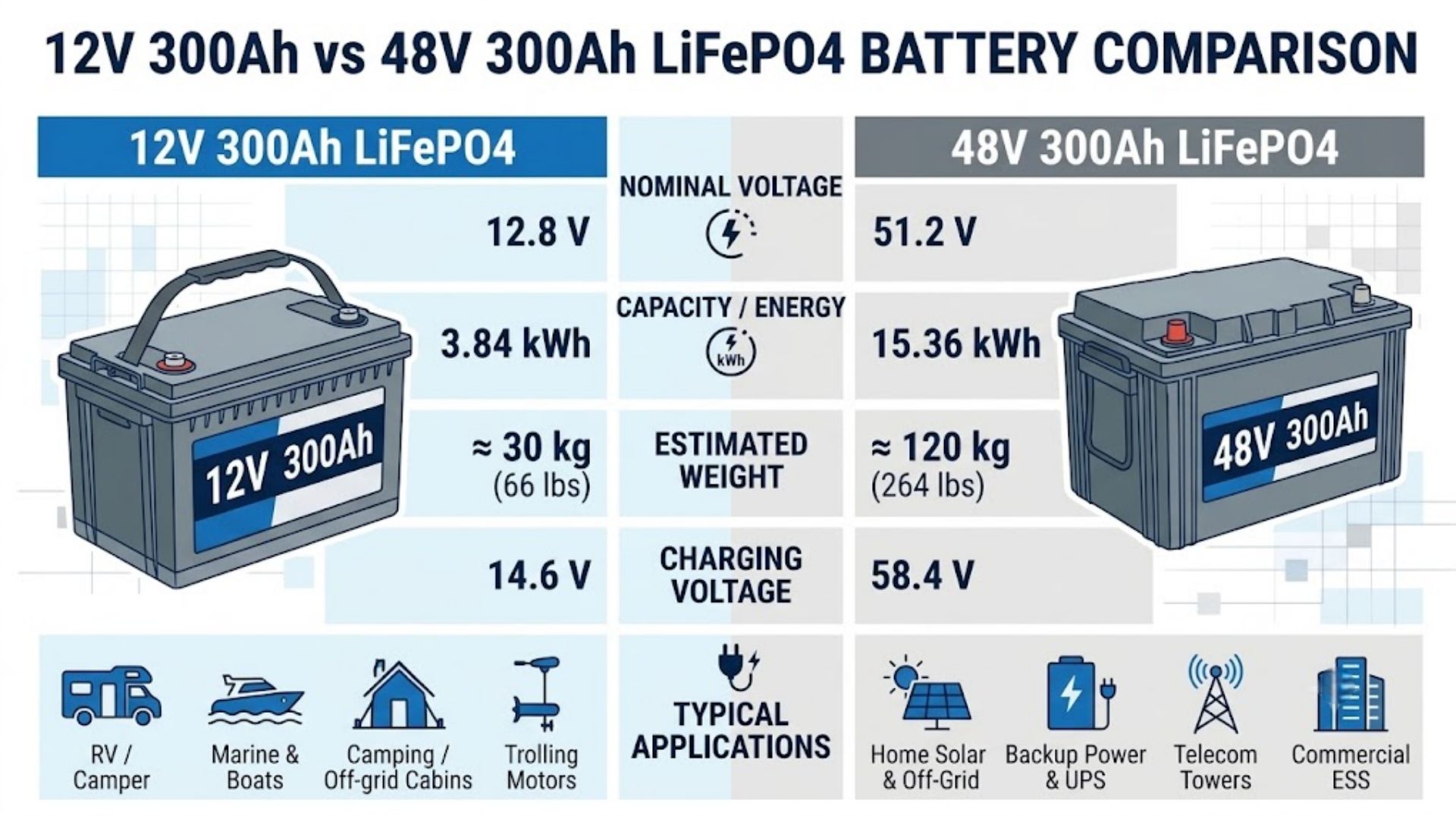
The choice between 12V and 48V at 300Ah comes down to your system architecture, inverter size, and cable runs. Here is the side-by-side comparison:
| Factor | 12V 300Ah | 48V / 51.2V 300Ah |
|---|---|---|
| Energy | 3.84 kWh | 15.36 kWh (4x) |
| Current at 3kW load | ~235A (high, thick cables) | ~59A (low, thinner cables) |
| Cable size (3kW) | 2/0 AWG or larger | 6–8 AWG |
| Inverter compatibility | Up to ~3,000W practical | 5,000–10,000W+ |
| Lead-acid drop-in? | Yes (direct replacement) | No (requires 48V inverter) |
| Best for | RVs, marine, off-grid cabins, small backup | Residential/commercial solar, server racks, telecom |
| System losses | Higher (I²R losses at high current) | Lower (higher voltage = lower current) |
| Parallel expansion | Easy (multiple 12V packs in parallel) | Rack-mount stacking (series/parallel) |
Rule of thumb for installers: If your system is under 3kW and you are replacing an existing lead-acid bank, use 12V 300Ah for drop-in compatibility. If you are designing a new system above 3kW, or if cable runs exceed 3 meters, use 48V / 51.2V 300Ah to minimize current, cable cost, and resistive losses. For a deeper voltage comparison, see our 12V vs 24V vs 48V LiFePO4 Guide.
Runtime: How Long Will a 300Ah Battery Last?
A 12V 300Ah LiFePO4 battery stores 3,840Wh. After accounting for 85–90% inverter efficiency and 80–90% usable depth of discharge, the practical usable energy is approximately 3,000–3,200Wh. Here is the runtime by common AC loads:
| Load / Application | Power Draw | 12V 300Ah Runtime | 48V 300Ah Runtime |
|---|---|---|---|
| LED lighting + electronics | 100W | 30–32 hours | 120–130 hours |
| RV fridge + LED lighting + water pump | 200–300W avg | 10–16 hours | 40–64 hours |
| Marine house bank (nav + fridge + entertainment) | 300W avg | 10–11 hours | 40–44 hours |
| Small inverter load (laptop, tools) | 500W | 6–6.5 hours | 24–26 hours |
| Microwave + small appliances | 1,000W | 3–3.5 hours | 12–14 hours |
| AC unit + heavy loads | 2,000W | 1.5–1.7 hours | 6–7 hours |
For off-grid solar installations, pair a 12V 300Ah battery with 800–1,200W of solar panels to fully recharge in one sunny day (producing 50–80A at 12V in full sun). A 48V 300Ah pack needs 3,000–4,500W of panels. For a full runtime and sizing methodology, see our What Size LiFePO4 Battery Do I Need? sizing guide.
Common Applications for B2B Buyers
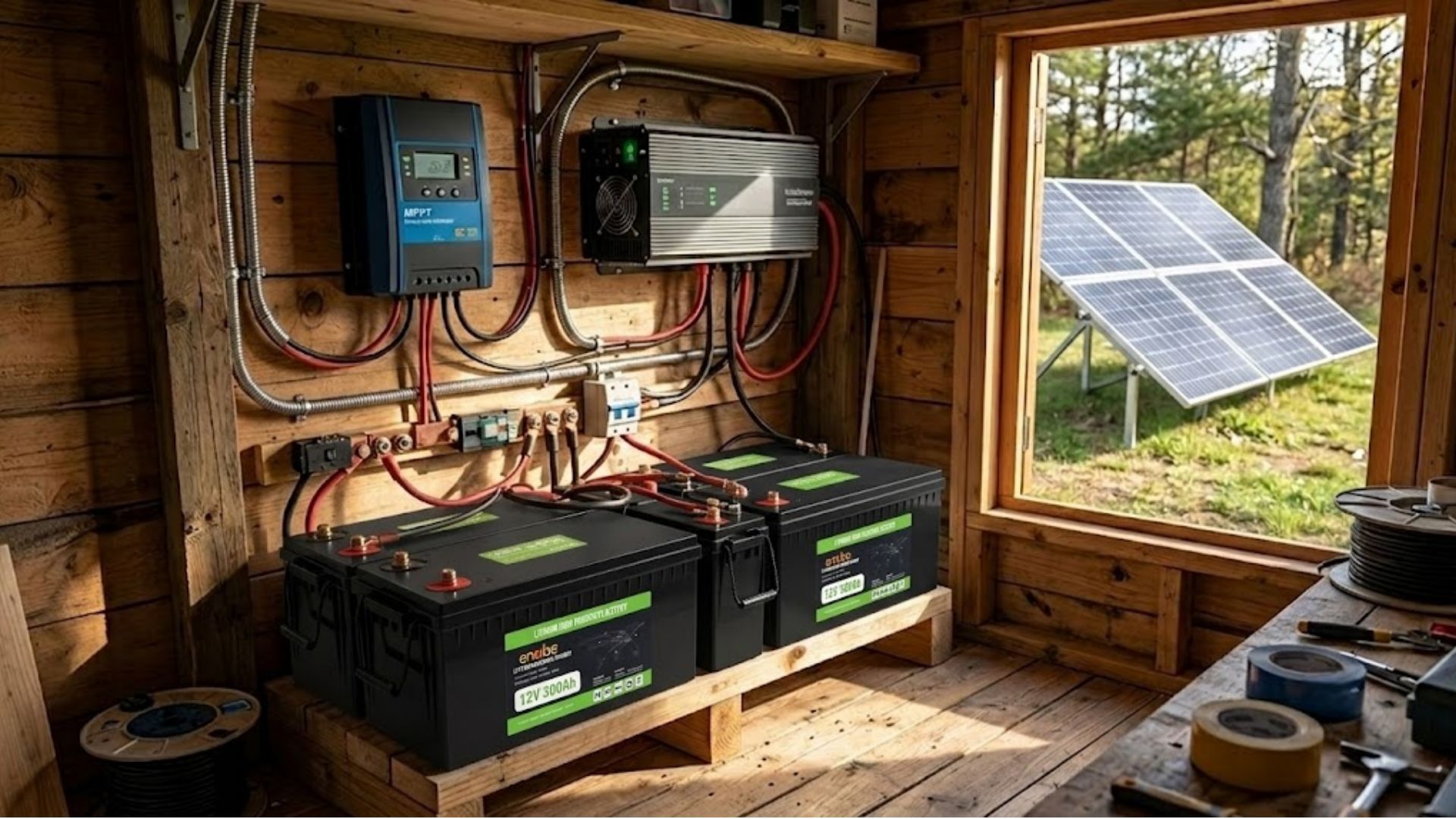
Off-Grid Solar & Cabins: A 12V 300Ah or 48V 300Ah pack is the backbone of off-grid solar systems. The 12V configuration suits small cabins and remote sites under 3kW; the 48V / 51.2V configuration is standard for homes and small commercial systems above 3kW. The 4,000+ cycle life means a single pack lasts 10–15 years of daily cycling — far longer than lead-acid, which would need replacement every 2–3 years in daily-cycling off-grid service.
Large RVs & Motorhomes: For Class A motorhomes, fifth wheels, and expedition vehicles running residential fridges, induction cooktops, and entertainment systems, a 12V 300Ah LiFePO4 provides 1–2 days of off-grid runtime. At 55–65kg, it is 60% lighter than an equivalent lead-acid bank, improving payload and fuel economy. For RV fleet operators, the zero-maintenance design eliminates battery watering and equalization across a fleet.
Marine House Banks: For sailboats, cruisers, and workboats, a 12V or 24V 300Ah house bank powers navigation electronics, refrigeration, lighting, and entertainment for 2–3 days without recharging. The LiFePO4 chemistry is cobalt-free and thermally stable — a critical safety advantage in enclosed engine rooms. For marine-specific guidance, see our Marine LiFePO4 Battery Guide.
Commercial & Telecom Backup: 48V / 51.2V 300Ah rack modules are the standard for telecom cell-site backup, UPS systems, and commercial emergency power. The 15.36kWh capacity provides 4–8 hours of backup for typical telecom loads, and the rack-mount form factor fits standard 19-inch server racks. For telecom-specific sizing, see our Telecom Battery Guide.
Golf Carts & Low-Speed Vehicles: For 36V/48V golf cart conversions, a 300Ah pack delivers 2–3x the range of lead-acid at half the weight, with zero watering and no equalization charging. For fleet operators, the 4,000+ cycle life means one LiFePO4 pack outlasts 6–8 lead-acid sets, dramatically reducing maintenance and replacement costs.
Charging & Inverter Sizing
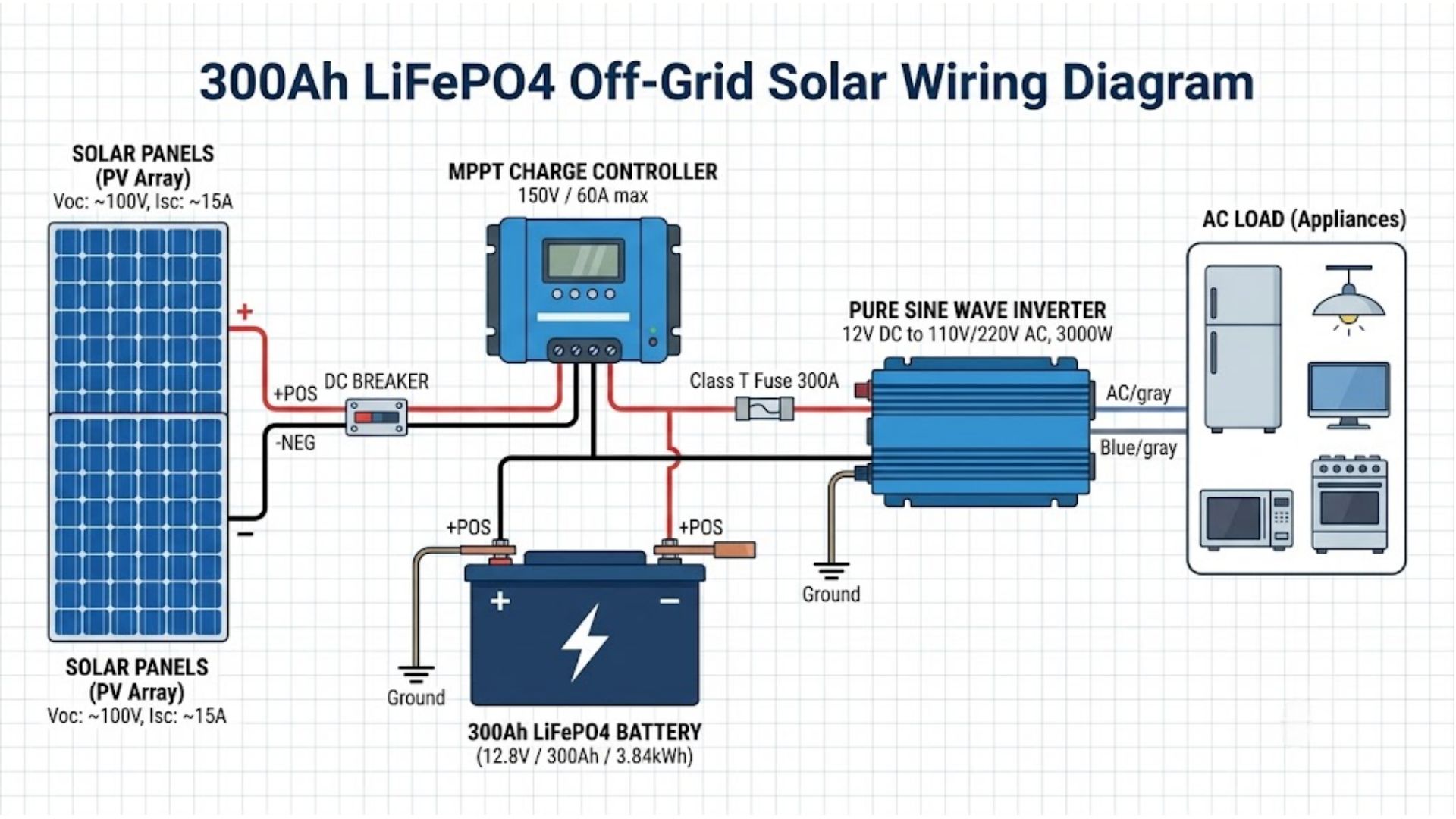
A 300Ah LiFePO4 battery charges using a constant-current / constant-voltage (CC/CV) profile. The charging parameters by voltage:
| Parameter | 12V 300Ah | 24V 300Ah | 48V 300Ah |
|---|---|---|---|
| Charge Voltage (CV) | 14.6V | 29.2V | 58.4V |
| Float Voltage (optional) | 13.6–13.8V | 27.0–27.6V | 54.0–55.2V |
| Recommended Charge Current | 60–150A | 60–150A | 60–150A |
| Charge Time @ 60A | ~5–6 hours | ~5–6 hours | ~5–6 hours |
| Charge Time @ 150A | ~2–2.5 hours | ~2–2.5 hours | ~2–2.5 hours |
| Recommended Solar Array | 800–1,200W | 1,500–2,500W | 3,000–4,500W |
Inverter sizing for 300Ah packs:
| Battery | BMS Continuous | Max Continuous Inverter | Recommended Inverter |
|---|---|---|---|
| 12V 300Ah (150A BMS) | 150A / ~1,800W | ~1,500–1,800W | 1,000–2,000W |
| 12V 300Ah (300A BMS) | 300A / ~3,800W | ~3,000–3,500W | 2,000–3,000W |
| 48V 300Ah (100A BMS) | 100A / ~5,000W | ~4,500–5,000W | 3,000–5,000W |
| 48V 300Ah (150A BMS) | 150A / ~7,500W | ~6,500–7,000W | 5,000–8,000W |
Always use a charger with a dedicated LiFePO4 / lithium mode — never a lead-acid charger. For solar, use an MPPT controller with a configurable LiFePO4 profile (bulk = charge voltage, float = 13.6V / 27.0V / 54.0V or disabled). Avoid charging below 0°C (32°F) — the BMS includes low-temperature charge cutoff to prevent lithium plating. For complete charging parameters across all voltages, see our How to Charge LiFePO4 Batteries Guide. For cable sizing at high current, see our wire gauge guide.
300Ah vs 200Ah vs 100Ah: When to Step Up
| Capacity (12V) | Energy | Weight | Daily Use Case | Best For |
|---|---|---|---|---|
| 100Ah | 1.28 kWh | ~13 kg | Under 1 kWh/day | Trolling motors, small RVs, golf carts, compact backup |
| 200Ah | 2.56 kWh | ~28 kg | 1–2.5 kWh/day | Marine house banks, mid-size RVs, small off-grid cabins |
| 300Ah | 3.84 kWh | ~55–65 kg | 2.5–4 kWh/day | Full-time RVs, large off-grid, commercial backup, telecom |
When to choose 300Ah: Your daily consumption exceeds 2.5kWh, you need 1+ days of autonomy without recharging, or you are running high-draw loads (residential fridge, AC, induction cooktop). If you need more than 4kWh at 12V, consider moving to 48V / 51.2V to reduce current and cable losses. Two 300Ah packs in parallel = 600Ah (7.68kWh at 12V) — but ensure both packs are from the same manufacturer, same batch, and use matched BMS settings.
For the 200Ah option, see our 24V 200Ah LiFePO4 Battery Guide. For 100Ah, see our 12V 100Ah LiFePO4 Buying Guide.
B2B Sourcing Considerations
For volume buyers — system integrators, OEMs, distributors, and installers — sourcing 300Ah LiFePO4 batteries requires attention to these critical factors:
- Cell grade and traceability: Require Grade A cells from reputable manufacturers (CATL, EVE, CALB, Lishen) with full batch traceability. 300Ah packs use large-format prismatic cells — cell quality directly affects cycle life and safety. Ask for cell brand and model, and verify batch numbers match test reports.
- BMS current rating: A 300Ah pack with a 100A BMS is a different product than one with a 300A BMS. Confirm the continuous and peak discharge ratings match your application. For high-draw applications (inverters above 2kW at 12V), require a minimum 150A continuous BMS.
- Communication protocol: For integrated systems, confirm the BMS supports your required protocol — CAN bus (for Victron, SMA, Deye inverters), RS485 (for monitoring systems), or Bluetooth (for consumer apps). Custom BMS firmware is available from OEM manufacturers.
- Certifications: Verify CE, UN38.3, RoHS, and MSDS for shipping and basic compliance. For North American commercial installations, UL 1973 is increasingly required by inspectors and insurance. For telecom and utility projects, additional certifications may apply.
- Cycle life warranty: Require a minimum 4,000-cycle warranty at 80% DoD, with a clear capacity retention guarantee (e.g., 70% at end of warranty). Avoid suppliers offering 6,000+ cycles without independent test data.
- Parallel configuration support: If you plan to parallel multiple 300Ah packs, confirm the BMS supports parallel operation and that the supplier provides parallel connection guidance. Some low-cost BMS units do not support parallel operation safely.
- MOQ and lead time: 300Ah packs are larger format — confirm MOQ (typically 10–50 pcs for OEM), production lead time (15–30 days), and sample availability. For repeat orders, confirm the supplier can maintain consistent cell sourcing.
Enerbe manufactures 12V, 24V, and 48V 300Ah LiFePO4 batteries with Grade A cells, configurable BMS (CAN/RS485/Bluetooth), full certifications, and OEM/ODM customization. For wholesale pricing, custom configurations, or a factory audit, contact our team.
Frequently Asked Questions
Q: What is a 300Ah LiFePO4 battery?
A: A 300Ah LiFePO4 battery is a lithium iron phosphate pack rated at 300 amp-hours. Common configurations: 12V (3.84kWh, 4S), 24V (7.68kWh, 8S), and 48V/51.2V (15.36kWh, 16S). It delivers 4,000–6,000+ cycles at 80% DoD, supports 150–300A continuous discharge, and requires zero maintenance. The 12V 300Ah weighs 55–65kg; the 48V 300Ah weighs 95–120kg.
Q: How many kWh is a 300Ah battery?
A: 12V 300Ah = 12.8V × 300Ah = 3,840Wh = 3.84kWh. 24V 300Ah = 7.68kWh. 48V/51.2V 300Ah = 15.36kWh. Usable energy is 80–100% of nominal for LiFePO4 (vs 50% for lead-acid), so a 12V 300Ah LiFePO4 ≈ 600Ah lead-acid in usable energy.
Q: How long will a 300Ah LiFePO4 battery last?
A: A 12V 300Ah pack (3,840Wh, ~3,200Wh usable after inverter losses): 100W = 32 hours, 300W = 10–11 hours, 1,000W = 3–3.5 hours, 2,000W = 1.5–1.7 hours. A 48V 300Ah pack lasts 4x longer at the same AC load. Cycle life: 4,000–6,000+ cycles at 80% DoD = 11–16 years of daily cycling.
Q: What voltage is a 300Ah LiFePO4 battery?
A: 12V = 12.8V nominal (4S, charge 14.6V). 24V = 25.6V (8S, charge 29.2V). 48V = 51.2V (16S, charge 58.4V). Match battery voltage to your inverter and charge controller. 12V is for drop-in lead-acid replacement; 48V is for solar storage and high-power systems.
Q: How do you charge a 300Ah LiFePO4 battery?
A: CC/CV profile: 14.6V (12V), 29.2V (24V), 58.4V (48V). Recommended current 60–150A (0.2C–0.5C). Full charge: 5–6 hours at 60A, 2–2.5 hours at 150A. Use a LiFePO4-specific charger or MPPT controller. Solar array: 800–1,200W (12V), 3,000–4,500W (48V). Do not charge below 0°C.
Q: 300Ah vs 200Ah vs 100Ah: which do I need?
A: Under 1kWh/day = 100Ah. 1–2.5kWh/day = 200Ah. 2.5kWh+/day or 1+ days autonomy = 300Ah. If you need more than 4kWh at 12V, move to 48V to reduce current and cable losses. Two packs in parallel doubles capacity but requires matched BMS.
Q: What size inverter can a 300Ah LiFePO4 battery handle?
A: 12V 300Ah with 150A BMS = ~1,800W continuous (recommend 1,000–2,000W inverter). 12V with 300A BMS = ~3,800W (recommend 2,000–3,000W). 48V 300Ah with 100A BMS = ~5,000W (recommend 3,000–5,000W). 48V with 150A BMS = ~7,500W (recommend 5,000–8,000W). Use 2/0 AWG+ cable for 150A+ at 12V.
Summary
A 300Ah LiFePO4 battery is the high-capacity workhorse of lithium deep-cycle storage — available in 12V (3.84kWh), 24V (7.68kWh), and 48V/51.2V (15.36kWh) configurations. It delivers 4,000–6,000+ cycles, supports 150–300A continuous discharge, and provides 2x the usable energy of an equivalent lead-acid bank at one-third the weight.
For B2B buyers, the key decisions are: voltage (12V for drop-in replacement under 3kW, 48V for new systems above 3kW), BMS current rating (match to inverter size), communication protocol (CAN/RS485/Bluetooth), and cell grade (Grade A with traceability). The 300Ah capacity is ideal for full-time RVs, large marine house banks, off-grid solar, telecom backup, and commercial UPS systems.
Enerbe manufactures 300Ah LiFePO4 batteries in all three voltage configurations, with Grade A cells, configurable BMS, full certifications, and OEM/ODM customization. For wholesale pricing, custom configurations, or technical support for your project, contact our team.
For related guides: Charging Guide | 24V 200Ah Guide | Voltage Comparison | Sizing Guide | Marine Guide
Get In Touch
Need 300Ah LiFePO4 batteries for your project? Request datasheets, samples, or wholesale pricing from Enerbe.
📄 Request a Technical Datasheet
Contact Us →📞 Speak with Our Engineering Team
Get In Touch →🔗 Browse LiFePO4 Battery Products
View Products →Dongguan A&S Power Technology Co., Limited.
Building 1, No. 2, Keji 9th Road,
Songshan Lake, Dongguan, Guangdong, China
📞 +86 137 1383 1631
✉ info@aspowerbattery.com
Stay Charged. Stay Connected.



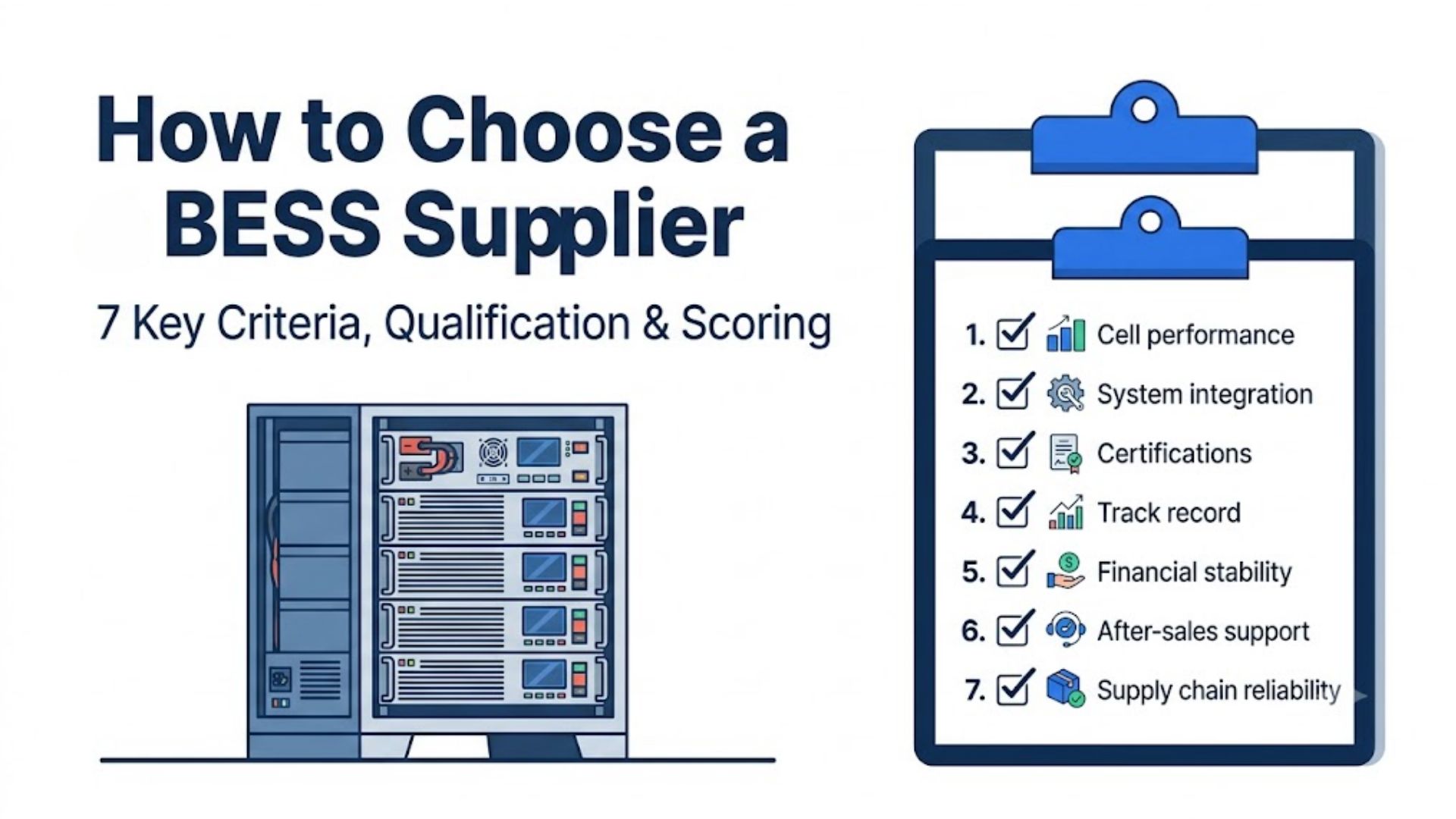
How to Choose a BESS Supplier: 7 Key Criteria, Qualification & Capability Assessment
Related Article


Get In Touch
Have questions about custom lithium batteries, energy storage solutions, or lead-to-lithium conversion? Our team is ready to help. Send us a message and we’ll respond within 24 hours.

Building 1, No. 2, Keji 9th Road, Songshan Lake, Dongguan, Guangdong, China
Office Address

info@aspowerbattery.com
Email Us

+86 137 1383 1631
Call Us

Sun - Fri (08AM - 10PM)
Office Open
