
How to Choose a BESS Supplier: 7 Key Criteria, Qualification & Capability Assessment
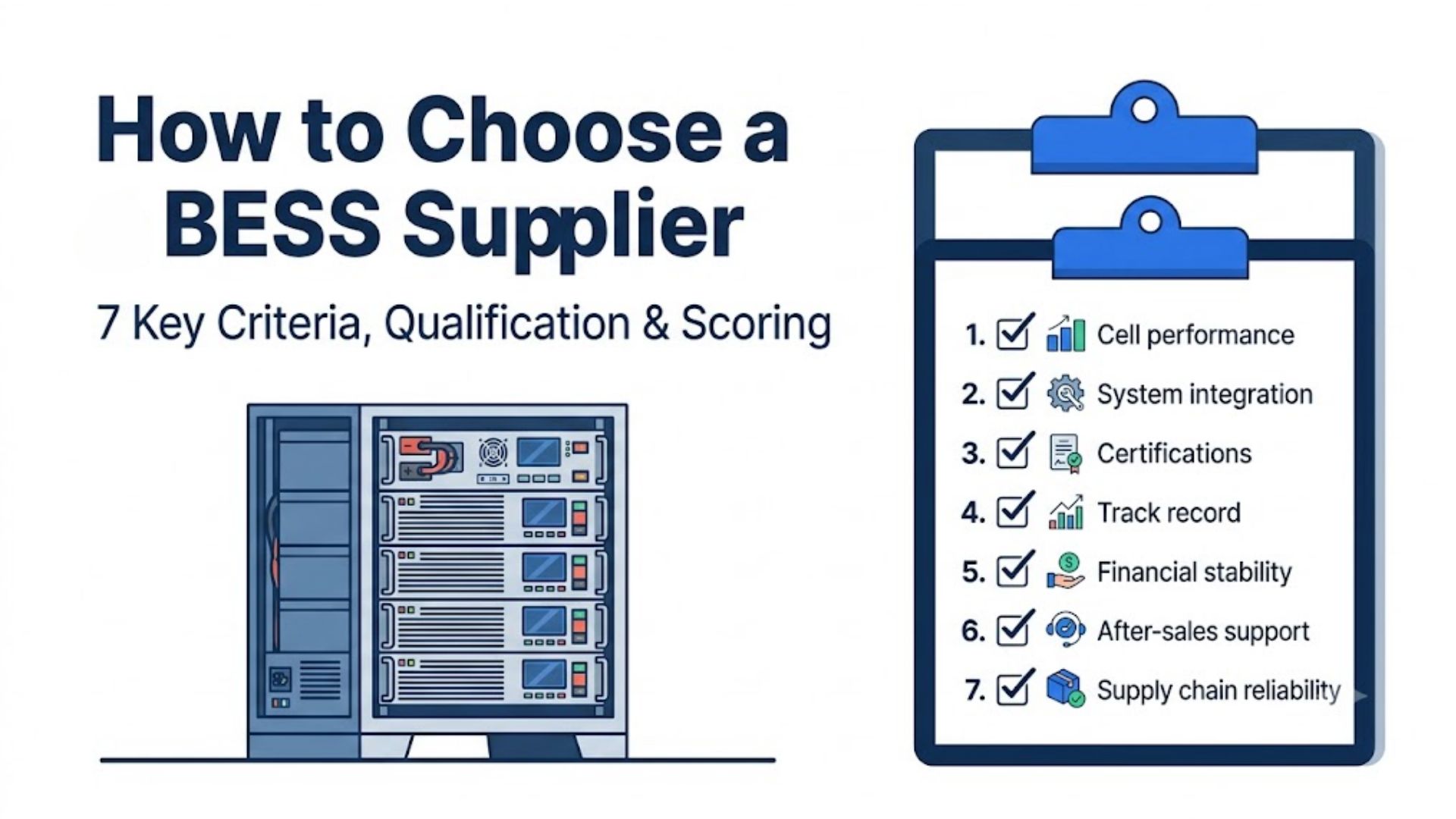
Table of Contents
- Introduction: The Supplier Decision
- Why the Wrong BESS Supplier Is So Costly
- First, Define Your Project
- The 7 Key BESS Supplier Selection Criteria
- Supplier Qualification and Prequalification
- Capability Assessment and Scoring
- Red Flags in Supplier Qualification
- From Shortlist to Purchase
- B2B Buyer's Selection Checklist
- Frequently Asked Questions
- Related Resources
- Summary
How to Choose a BESS Supplier: 7 Key Criteria, Qualification & Capability Assessment
Last updated: September 2026 | Written by the Enerbe Engineering Team
Introduction: The Supplier Decision
Short answer: Choose a BESS supplier on seven points: cell quality and traceability, BMS/PCS/EMS compatibility, certifications and grid compliance, manufacturing and QC capability, bankability and track record, warranty and service, and lifecycle cost. Run a documented qualification before you shortlist, score the candidates against the same table, and only then visit the factory and negotiate. The aim isn't to find the cheapest quote; it's to find a supplier that will still stand behind the system in year eight. This page covers the selection standards and qualification. For the on-site work, see our BESS factory audit guide; for the buying process end to end, see the BESS procurement guide.
A battery energy storage system is one of the few purchases you make where most of the cost is paid up front but most of the risk shows up years later. A pack that fails in year three, a warranty that no one honours, or a certification that turns out not to apply to your market can erase the return on an entire project. By the time the problem is visible, the supplier may have moved on, and you're left paying for replacement hardware and downtime.
This is why selection deserves more than a spreadsheet of prices. The good news is that reliable suppliers and risky ones separate quite clearly if you know what to ask for, and most of the evidence is available before you ever visit a factory. This guide lays out the seven criteria that actually predict performance, a qualification process you can run on paper, and a scoring table that keeps comparisons honest.
Why the Wrong BESS Supplier Is So Costly
It helps to be precise about what "a bad supplier" actually costs, because the line items are bigger than the purchase price:
| Failure | What it costs you |
|---|---|
| Cells degrade faster than promised | Lost revenue from capacity that should have been there; early replacement |
| Certifications don't match your market | Delayed commissioning, rejected grid connection, rework or re-import |
| BMS or integration faults | Trips and downtime; hard-to-diagnose site visits |
| Supplier exits or won't honour warranty | You pay for parts and labour the warranty was meant to cover |
| No spares or service network | Long outages waiting for parts shipped from abroad |
None of this is theoretical for developers running several sites, because one failed project ties up the team that should be building the next one. An hour spent qualifying a supplier is cheap compared with a month spent fixing a fleet.
First, Define Your Project
You can't evaluate a supplier until you know what you're actually buying, and many "supplier problems" start when a buyer compares quotes for systems that were never specified the same way. Before you approach anyone, write down:
-
The use case: front-of-meter, commercial peak-shaving, backup, microgrid, off-grid, or self-consumption.
-
Power and energy: kW rating, usable kWh, and the target duration (for example a 2-hour system).
-
How it connects: grid-tied, off-grid, or hybrid, and the PCS and communication setup you expect.
-
The site conditions: ambient temperature range, altitude, indoor or outdoor, available space.
-
The certifications your market and grid operator require, before anyone quotes.
-
The service life and warranty you need to make the project's numbers work.
With that on paper, every supplier quotes against the same requirements, which is the only way prices and promises become comparable. If a candidate can't quote to your spec or steers you toward whatever they have in stock, that's useful information early.
The 7 Key BESS Supplier Selection Criteria
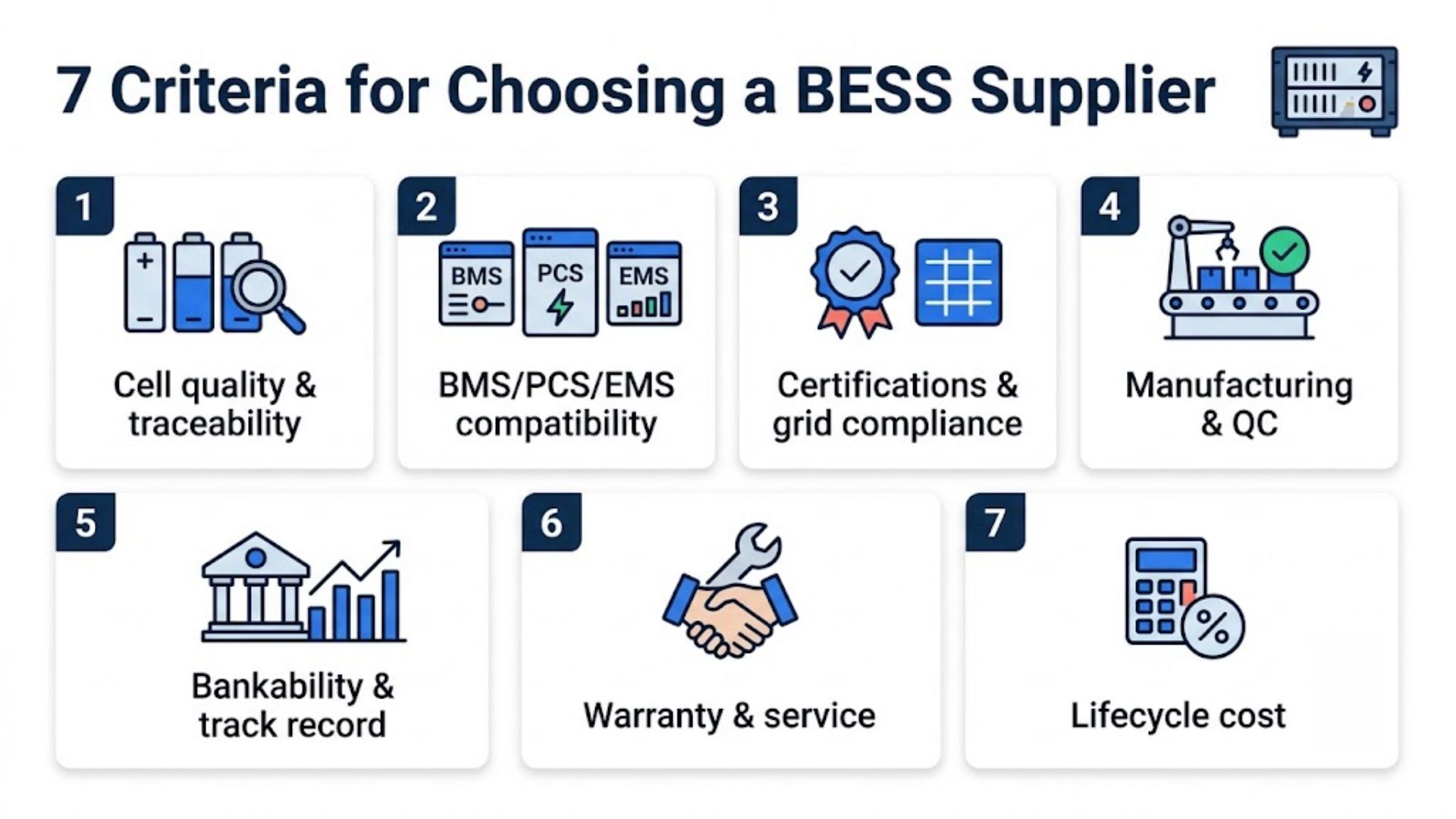
These seven points are ordered the way they matter. The first three decide whether the hardware is any good and whether you can connect it; the next two decide whether the company will still be there; the last two decide what you'll really pay and how it will be supported.
1. Cell quality and traceability
The cells set the ceiling on everything: cycle life, safety, and how much capacity remains after ten years. Ask which cell brand and model is used, whether they are Grade A, and whether you can trace the batch in your delivery to factory test records. Consistent, name-brand cells from a single matched batch perform and age together; mixed or untraceable cells are where imbalance and early failure start. For what to look for inside the chemistry, see the LFP materials and structure guide.
2. BMS, PCS and EMS compatibility
A storage system is only as good as the way its parts talk to each other. The BMS protects and balances the cells, the PCS converts power and follows grid commands, and the EMS runs the operating strategy. Confirm the communication protocols (CAN, RS485, Modbus/TCP), that the battery and PCS are validated to work together, and that you can read per-cell data for monitoring and warranty claims. A system that won't report cell-level information is hard to diagnose and almost impossible to manage under warranty. The role of balancing is explained in the cell balancing guide.
3. Certifications and grid compliance
Certifications have to match the market, not just exist on paper. For North American projects this commonly means UL 9540 for the system, UL 9540A thermal performance data, and PCS compliance such as UL 1741 with IEEE 1547; industrial cells often carry IEC 62619, and shipping needs UN 38.3. Ask for the certificates and check that the model names on them match what you're buying and that they're current. A full breakdown is in the BESS certification guide.
4. Manufacturing capacity and quality control
A supplier should be able to build your order on time and repeat the quality from the first unit to the hundredth. Ask about annual output, lead time for your volume, the QC steps each pack goes through, and what end-of-line testing (capacity, insulation, aging, BMS checks) is standard. This is also where on-site verification matters; the factory-floor checks belong in the factory audit guide rather than here.
5. Bankability and proven track record
"Bankable" simply means a supplier whose product and company are sound enough that financiers will accept the risk. Look for operating projects with references you can contact, years in business, stable finances, and independent test or bankability reports. A long list of shipped units is less convincing than a shorter list of projects that have been running for several years with data to show it. This criterion is what separates a supplier that can sell you a battery from one that can support a financed asset.
6. Warranty, service and spare parts
Read the warranty for what it actually promises: the term, the capacity it guarantees at the end (for example at least 70% after ten years), what voids it, who pays for labour and shipping, and how a claim is proved. Then confirm there are spare parts and a service route in your region, with a stated response time. A ten-year warranty from a company with no local support and no clear claims process is worth far less than it sounds. How cycle life and capacity warranties are set is covered in the LiFePO4 lifespan guide.
7. Lifecycle cost and commercial terms
The cheapest quote is rarely the cheapest system once you count the years. Compare total cost of ownership: usable (not nominal) kWh, round-trip efficiency, expected degradation, warranty length, and the cost of service and eventual replacement. A slightly higher price for better cells and a real warranty usually pays back well inside the project life. Compare commercial terms too: payment schedule, lead time, and penalties for delay. The commercial evaluation detail is in the procurement guide.
Supplier Qualification and Prequalification

Qualification is how you turn a long list of possible suppliers into a short list of qualified ones, using evidence rather than instinct. Run it before you ask for final pricing, so you don't spend weeks negotiating with a company that should have been screened out.
-
Identification: Build the initial list from manufacturers, integrators, distributors, trade shows and industry sources. If you're sourcing from China, the China manufacturer sourcing guide covers how to find and verify them.
-
Request for information: Send a short RFI asking for company background, cell and BMS details, certifications, reference projects, lead times and warranty terms.
-
Document review: Check the certificates, test reports and reference claims. Verify that names, models and dates line up, and contact one or two references.
-
Prequalification: Drop candidates that fail any hard requirement (missing certification, no track record, won't provide data) and keep those that pass.
-
Shortlist: Three to five qualified suppliers is usually enough to move into scoring, audit and final pricing.
The point of prequalification is that hard requirements act as gates. A supplier missing a certification your grid operator demands, or unwilling to disclose the cell brand, should not reach the shortlist regardless of price.
Capability Assessment and Scoring
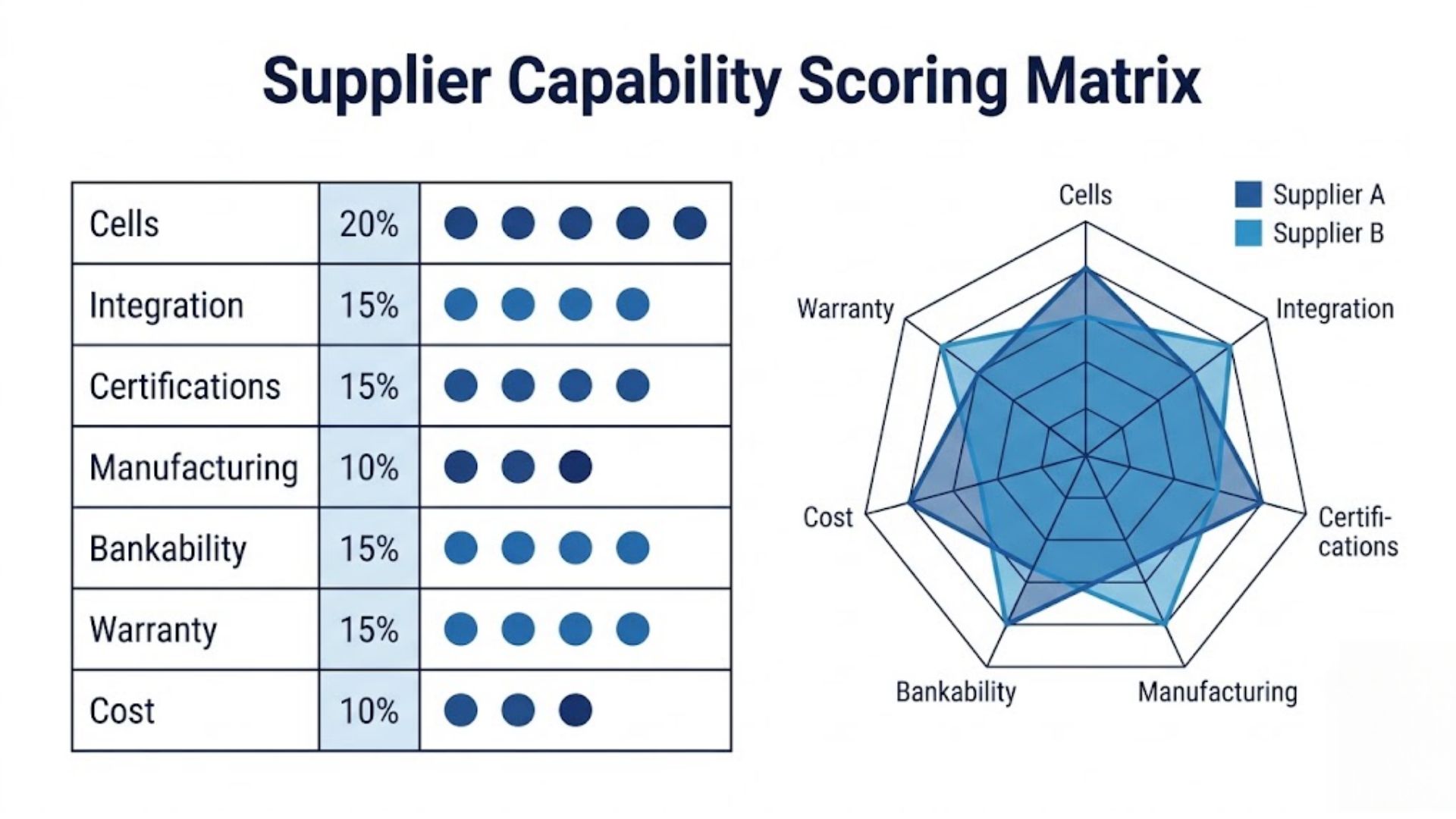
Once suppliers are qualified, score them against the same weighted table so the comparison is consistent and you can show how the decision was reached. Weight the criteria to fit your project; safety, certification and bankability usually carry more weight than the headline price.
| Criterion | Suggested weight | Score 1-5 on |
|---|---|---|
| Cell quality | 20% | Brand, grade, matched batch, traceability |
| System integration | 15% | BMS/PCS validated, monitoring, protocols |
| Certifications | 15% | Correct, current, matching the model |
| Manufacturing/QC | 10% | Capacity, lead time, end-of-line testing |
| Bankability | 15% | Track record, references, finances |
| Warranty/service | 15% | Terms, local support, spares |
| Lifecycle cost | 10% | TCO, usable kWh, efficiency, terms |
Multiply each score by its weight and total it. The number isn't there to replace judgement; it's to stop a loud sales pitch or a low price from overriding the criteria that actually predict a good system. If two suppliers score close, the audit and commercial terms usually decide it.
Red Flags in Supplier Qualification
These are the warning signs you can spot from documents and answers, before a site visit. Any one of them deserves a direct question; several together usually mean walk away.
-
Won't disclose the cell brand or batch, or cells vary from order to order.
-
Certificates are vague, expired, or for a different model than the one quoted.
-
No per-cell monitoring, or no way to export the data needed for a warranty claim.
-
No verifiable reference projects, or references that can't be contacted.
-
A quote far below everyone else, with pressure to commit quickly.
-
Vague warranty language, no local service, or no clear claims process.
-
Lead times that keep changing, or no evidence of capacity to build your volume.
The red flags that only appear in person—outsourced assembly, missing test equipment, cells relabelled in the warehouse—are covered in the factory audit guide. The safety implications of cutting these corners are set out in the LiFePO4 safety guide.
From Shortlist to Purchase
Selection doesn't end at a score. The qualified, scored shortlist then moves through two steps that have their own guides, so they're only outlined here:
-
Verify on site or remotely: Audit the top one or two suppliers to confirm what the documents claim. For the full procedure, use the BESS factory audit guide.
-
Run the purchase process: Issue comparable RFQs, evaluate commercials, and get the contract right before you commit. The step-by-step is in the BESS procurement guide.
Keeping these three stages separate is what prevents cannibalisation of your own time and, on the published site, keeps each page answering a distinct question: the criteria live here, the audit lives there, and the process lives in the procurement guide.
B2B Buyer's Selection Checklist
-
Project requirements (use case, kW/kWh, duration, site, certifications) defined in writing.
-
Cell brand, grade, batch matching and traceability confirmed.
-
BMS/PCS/EMS validated together; per-cell monitoring and protocols confirmed.
-
Required certifications present, current, and matching the quoted model.
-
Manufacturing capacity, lead time and end-of-line QC understood.
-
Reference projects contacted; bankability and finances reviewed.
-
Warranty terms, local service and spare parts verified.
-
Lifecycle cost compared on usable kWh, not just the quoted price.
-
Hard requirements used as gates before any price negotiation.
-
Shortlist scored on one weighted table, then moved to audit and RFQ.
Frequently Asked Questions
How do I choose a BESS supplier?
Define your project first, then evaluate candidates on the seven criteria: cells, system integration, certifications, manufacturing, bankability, warranty/service, and lifecycle cost. Run a documented qualification to screen out suppliers that fail hard requirements, score the rest on one weighted table, and only audit and negotiate with the top few. Choosing on price alone is where most failed projects start.
What are the most important BESS supplier selection criteria?
The ones that predict long-term performance are cell quality and traceability, validated BMS/PCS/EMS integration, the correct certifications for your market, and bankability backed by reference projects. Warranty/service and lifecycle cost then determine what you'll actually pay over the system's life. Manufacturing and QC matter for delivery and consistency. If you have to prioritise, weight cells, certification and bankability ahead of price.
What is supplier prequalification for BESS?
Prequalification is the screening step before final pricing. You send an RFI, review certificates and test reports, check references, and drop any supplier that fails a hard requirement such as a missing grid certification or no track record. The suppliers that pass form the shortlist you then score and audit. It keeps you from negotiating with companies that should never have been considered.
How do you assess a BESS supplier's capability?
Score each qualified supplier against a weighted table covering cells, integration, certifications, manufacturing/QC, bankability, warranty/service and lifecycle cost. Use a 1-5 score per criterion, multiply by the weight, and total it. Verify the important claims with documents and references, and confirm manufacturing and QC on site. The score makes the comparison consistent and gives you a record of how the decision was made.
What makes a BESS supplier bankable?
A bankable supplier has name-brand cells, the right certifications, several years of operating projects with contactable references, stable finances, and often an independent bankability or test report. Financiers accept the risk because the product and company are documented and sound. A long shipping list without years of operating data doesn't establish bankability.
Should I buy from a manufacturer, an integrator or a distributor?
It depends on volume and capability. At larger volume and with in-house engineering, a manufacturer gives the best price and direct support. An integrator handles design and the BMS/PCS/EMS fit for you, and a distributor gives local stock, service and lower minimums for smaller buyers. Decide based on your volume, how much engineering you can do, and the support you need locally rather than on price alone.
What BESS certifications do I need in the US?
For US projects you commonly need UL 9540 for the system, UL 9540A for thermal and large-scale fire performance, a PCS listed to UL 1741 with IEEE 1547 for grid connection, IEC or UL coverage for cells as applicable, and UN 38.3 for shipping. Exact requirements vary by state and the authority having jurisdiction, so confirm the list with your grid operator and local AHJ before suppliers quote.
How important is the warranty when choosing a supplier?
Very. Read the term, the guaranteed end-of-term capacity, what voids the warranty, who pays labour and shipping, and how a claim is evidenced with monitoring data. Then confirm local service and spare parts. A long warranty from a company with no support route or no way to prove a claim offers little. Treat the warranty as a commercial commitment, not just a number on a slide.
Why is the cheapest BESS quote risky?
An unusually low quote usually means something is missing: lower-grade or mixed cells, shorter or vaguer warranty, no local service, thinner certifications, or optimistic nominal rather than usable capacity. Over a ten-year life those gaps cost more than the up-front saving, through faster degradation, downtime and early replacement. Compare lifecycle cost on the same spec before treating a low price as value.
Do I need to visit the factory before choosing?
For financed or larger projects, an audit of the top one or two suppliers is worth it, because some claims can only be confirmed on the floor. For smaller orders, a remote video audit, verified certificates and contactable references may be enough. The full list of what to check on site is in the BESS factory audit guide. Don't skip verification, but scale it to the value of the order.
Related Resources
-
BESS Factory Audit Guide — on-site verification and the reliable vs risky checklist
-
BESS Procurement Guide — the 7-phase buying process, RFQ and contract
Summary
Choosing a BESS supplier is a qualification problem, not a price comparison.
-
Define the project and required certifications before anyone quotes.
-
Score candidates on seven criteria, with cells, certification and bankability weighted high.
-
Use hard requirements as gates to prequalify a short three-to-five supplier list.
-
Treat the warranty and lifecycle cost as the real measure of price.
-
Audit the finalists, then run the purchase through a documented procurement process.
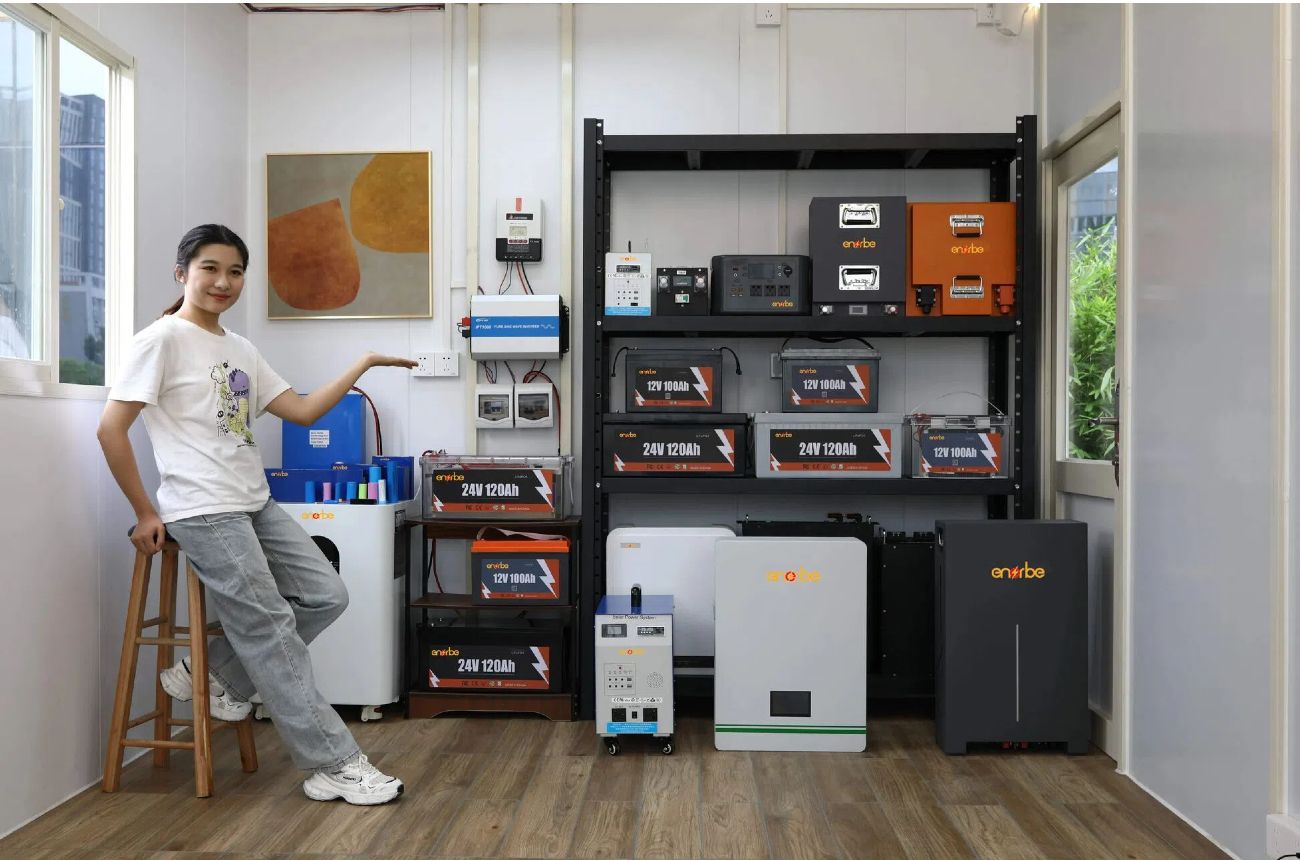
Enerbe supplies BESS and LiFePO4 batteries with traceable Grade A cells, validated BMS/PCS integration, the certifications needed for major markets, and a clearly written warranty. For datasheets, reference projects or volume pricing, contact our team or browse the product range.
Get In Touch
Need qualified, certified BESS batteries, samples or volume pricing? Contact Enerbe today.
📄 Request Datasheet & Certifications
Contact Us →📞 Speak With Our Engineering Team
Get In Touch →🔗 Browse Certified LiFePO4 Products
View Products →Dongguan A&S Power Technology Co., Limited.
Building 1, No. 2, Keji 9th Road,
Songshan Lake, Dongguan, Guangdong, China
📞 +86 137 1383 1631
✉ info@aspowerbattery.com
Stay Charged. Stay Safe.



BESS Factory Audit Guide: On-Site Supplier Audit Checklist for Battery Buyers
Do Lithium Batteries Work in Cold Weather? Complete LiFePO4 Winter Guide (2026)
Related Article


Get In Touch
Have questions about custom lithium batteries, energy storage solutions, or lead-to-lithium conversion? Our team is ready to help. Send us a message and we’ll respond within 24 hours.

Building 1, No. 2, Keji 9th Road, Songshan Lake, Dongguan, Guangdong, China
Office Address

info@aspowerbattery.com
Email Us

+86 137 1383 1631
Call Us

Sun - Fri (08AM - 10PM)
Office Open
