
Commercial and Industrial Energy Storage: A Buyer's Guide to C&I LiFePO4 Battery Systems (2026)

Table of Contents
- Introduction: The Line Item on Your Electricity Bill
- What Is Commercial and Industrial Energy Storage?
- C&I vs Residential vs Utility: Where Your Project Sits
- How a C&I Battery Earns Its Keep: The Six Value Streams
- When the Numbers Work (and When They Don't)
- What Is Inside a C&I Battery System
- Sizing by Industry: Load, Power and Duration
- Low-Voltage vs High-Voltage C&I Systems
- Running the Payback Numbers
- Safety and Certification for Commercial Sites
- Mistakes That Sink C&I Projects
- Related Resources
- Frequently Asked Questions
- Summary
Commercial and Industrial Energy Storage: A Buyer's Guide to C&I LiFePO4 Battery Systems (2026)
Last updated: October 2026 | Written by the Enerbe Engineering Team
Introduction: The Line Item on Your Electricity Bill
Open a factory electricity bill and the kilowatt-hour charge is usually not the biggest negotiable number. On many commercial tariffs in the U.S., the demand charge, billed on the single highest 15-minute average power draw of the month, can run to 30-50% of the total. A refrigerated warehouse, a batch-production line, or a row of EV chargers can spike that peak for a few minutes every afternoon, and the customer pays for that spike across the whole month.
A commercial battery fixes that. It stores energy when it is cheap and releases it exactly when the site needs it most, shaving the peak, shifting solar into the evening, and covering the load during an outage. That is what commercial and industrial (C&I) energy storage is for, and it is why a system that never takes a site off-grid can still pay for itself. This guide is written for the person signing the capex request: facility managers, EPCs, system integrators, distributors, and business owners. It covers what C&I storage is, where the money actually comes from, how to size a system by industry, what the hardware contains, and how to run the payback case without the sales spreadsheet.
Quick Answer: C&I energy storage is a LiFePO4 battery system (typically 100 kWh to several MWh) installed behind a factory, warehouse, retail site, or charging station. It earns money by cutting demand charges, shifting load from peak to off-peak hours, storing on-site solar, and providing backup power. A well-matched system is usually sized to the site's peak load and its daily energy gap, and on a favorable tariff it pays back in roughly 3-7 years. Where demand charges are low and there is no solar or time-of-use spread, the case is weak and the battery should not be forced in.
What Is Commercial and Industrial Energy Storage?
Commercial and industrial energy storage is a grid-connected battery placed on the customer's side of the meter, also called behind-the-meter storage. It sits next to the loads instead of at the utility substation, charges from the grid or on-site solar, and discharges on a schedule or in response to a signal from an energy management system.
The core hardware is a LiFePO4 battery energy storage system, or BESS. Lithium iron phosphate is the default chemistry for this segment because it lasts (6,000-10,000 cycles at 80% depth of discharge is common), does not need cobalt, and is far more resistant to thermal runaway than the NMC packs used in consumer electronics. The basic concepts and components are covered in the What Is a BESS guide; this page focuses on the business and engineering decisions that are specific to commercial sites.
C&I covers a broad middle ground. It starts at a single 100-215 kWh cabinet behind a shop or office and runs up to multi-MWh container systems for an industrial park. Smaller projects use wall-mounted or racked 51.2V modules; larger ones use outdoor cabinets or liquid-cooled containers connected through a dedicated inverter and transformer. The 48V rack battery guide covers the small end of that range in detail.
C&I vs Residential vs Utility: Where Your Project Sits
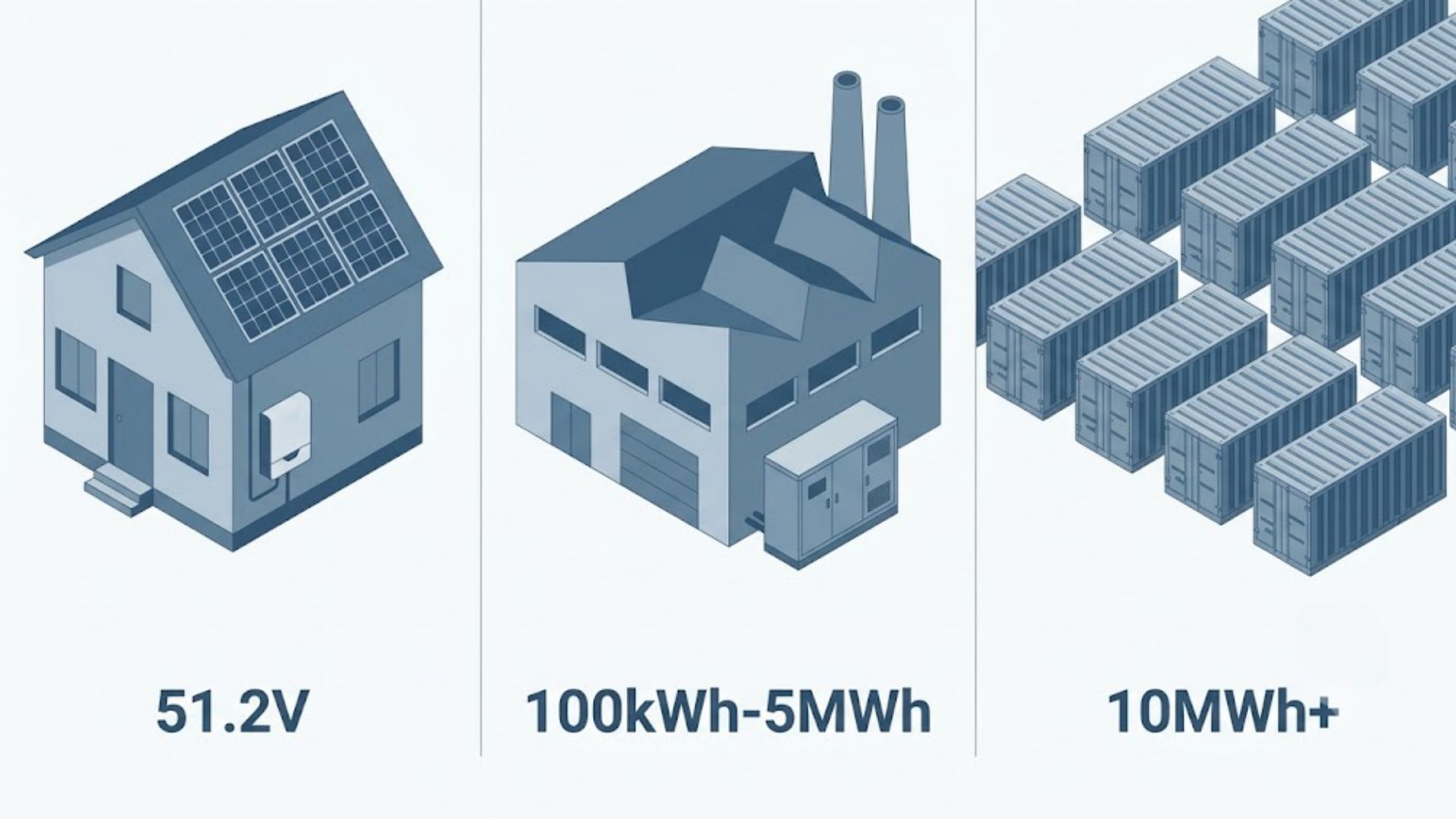
Energy storage is split into three segments, and the same battery technology behaves very differently in each. The split matters because the business model, the approvals, and the buyer are not the same.
| Segment | Typical size | Owner / buyer | Main goal |
|---|---|---|---|
| Residential | 5-30 kWh, 48V | Homeowner / installer | Solar self-use, backup, residential tariffs |
| C&I | 100 kWh-5 MWh | Business, EPC, investor | Demand charges, peak shifting, solar, backup |
| Utility / front-of-meter | 10 MWh+ | Utility, IPP, developer | Capacity, ancillary services, renewables firming |
This guide deals with the middle row. C&I is where a single buyer can make a decision on a clear financial case, without the multi-year grid interconnection queue that front-of-meter projects face. Residential systems are mostly about the household tariff; C&I is about bill structure and uptime.
How a C&I Battery Earns Its Keep: The Six Value Streams
A commercial battery does not have a single job. It stacks several value streams, and most of the revenue comes from whichever one the local tariff rewards most. The first step in any project is to pull 12 months of interval data and the actual tariff, then decide which of the following streams applies.
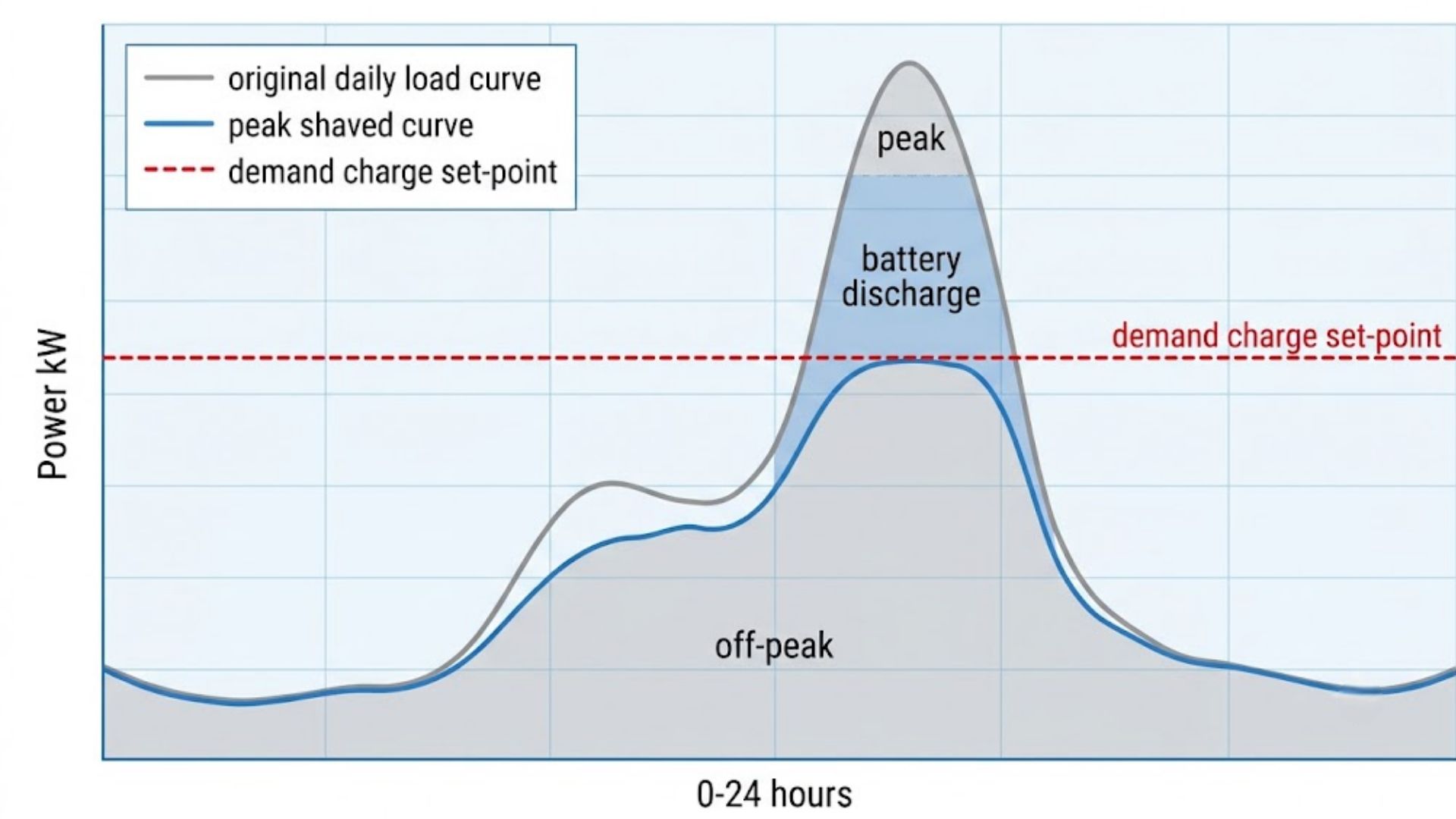
1. Peak shaving and demand charges
This is the largest and most reliable value stream in markets with demand tariffs. The battery monitors the load and discharges whenever power would exceed a target set-point, clipping the monthly peak. Because demand charges are billed on the maximum, not the average, trimming a handful of daily peaks can cut the whole month's charge.
Illustrative example: a site on a $12/kW demand charge trims 100 kW off its peak. That is about $1,200 a month, or $14,400 a year, before any other value stream. The dollar figure scales with the local demand rate and the kW actually trimmed, so it must be calculated from the site's own bill, not a benchmark.
2. Time-of-use energy arbitrage
On a time-of-use tariff, the battery charges during cheap overnight hours and discharges during expensive afternoon and evening peaks. The margin is the gap between the off-peak and peak energy price per kWh. The strategy works where the spread is wide enough to cover the round-trip losses (a LiFePO4 system returns roughly 85-95% on the AC side) and is stronger when the battery can run two cycles a day.
3. Storing on-site solar
Roof or ground-mount solar generates around midday, when many commercial sites are already drawing less power, and export rates are often lower than retail. The battery stores the midday surplus and releases it during the evening load or the next morning, raising self-consumption instead of exporting cheaply. The detailed solar-plus-storage configurations are covered in the solar battery storage guide.
4. Backup power and uptime
For cold storage, food processing, data rooms, and continuous manufacturing, a single outage can cost more than the battery itself. A grid-tied battery with grid-forming capability can island the site and carry critical loads, and it is cleaner and faster-responding than a diesel genset. Grid-tied systems typically back up designated circuits rather than the whole site; sizing critical loads correctly matters more than total kWh.
5. Demand response and grid services
Some utilities and grid operators pay commercial sites to reduce load on request. A battery can do this automatically by discharging instead of importing, without changing production. Availability and payments vary widely by region and program, so this is usually treated as an upside rather than a base case.
6. Avoiding a grid upgrade
When a site wants to add a new production line, compressors, or a bank of EV chargers, the utility may require a larger transformer, a new service, or a capacity upgrade before it will energize it. A battery that keeps the maximum import below the existing connection limit can defer or avoid that upgrade. Where the upgrade quote is large, this alone can justify the system.
Engineering note: a battery cannot stack all six streams at full value at once. Peak shaving needs held-back capacity; arbitrage needs the battery full in the morning; backup needs a permanent reserve. The energy management system allocates the same kWh between competing tasks, and the operating schedule has to be set to the priority the bill actually rewards.
When the Numbers Work (and When They Don't)
Storage is not a universal fit, and a buyer who skips this step is the one who ends up with a battery that never cycles. The case is strong when one or more of the following appear on the bill or the site plan:
-
A meaningful demand charge, or a tariff where the peak drives a large share of the bill.
-
A wide time-of-use spread, especially where two cycles per day are possible.
-
On-site solar that is being exported cheaply instead of used on site.
-
A repeatable, predictable daily peak rather than a rare random one.
-
Critical loads where downtime is costly, or a quoted grid-connection upgrade that is larger than the battery.
The case is weak where demand charges are absent, energy prices are flat, there is no solar, and the grid is reliable. In those conditions the battery is an insurance policy with no other revenue, and the customer should buy only the backup capacity they genuinely need. One caveat: a single short spike that happens once a month does not justify a full peak-shaving system; it often points to a soft-start compressor or a scheduling change instead. Confirm the shape of the load with 12 months of interval data before sizing hardware.
What Is Inside a C&I Battery System
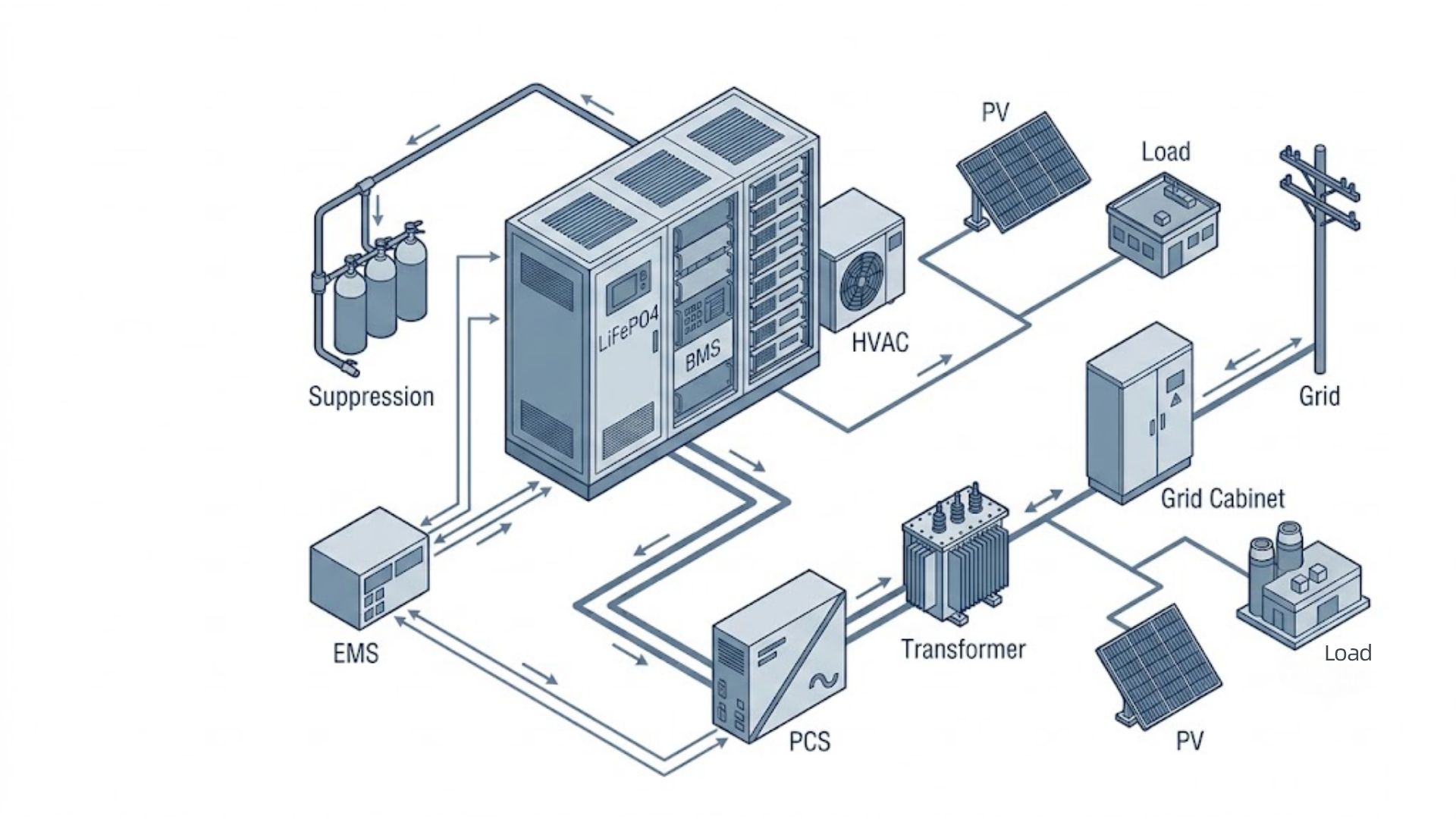
A commercial BESS is not a battery in a box. It is a small power plant, and the components are quoted separately or integrated in an outdoor cabinet. Understanding what each part does is the only way to compare quotes fairly.
| Component | What it does |
|---|---|
| LiFePO4 battery rack / cabinet | The cells and modules that store energy, with per-module BMS |
| BMS | Cell monitoring, balancing, over/under-voltage and thermal protection |
| PCS | Bi-directional power conversion system, DC to AC and back; sets the power rating |
| EMS | Energy management software; reads tariffs and load, schedules charge and discharge, logs revenue |
| Transformer / switchgear | Steps voltage up to the service and provides grid protection (high-voltage systems) |
| Thermal management | HVAC or liquid cooling; keeps cells in a narrow temperature band for rated life |
| Fire suppression | Detection and suppression at pack, rack, and cabinet levels; the part that passes the fire marshal's review |
Quotes that only list the battery price are hiding the balance of plant. On a turnkey project the PCS, EMS, civil work, integration, and commissioning can equal or exceed the cost of the cells, so compare total installed cost, not the battery headline.
Sizing by Industry: Load, Power and Duration
C&I sizing starts from two numbers the customer already has: the peak power in kW (from the demand bill) and the daily energy that can be shifted or stored in kWh. The power rating (kW) decides how much peak the battery can shave; the energy rating (kWh) decides how long it can hold it. Typical C&I systems use a 0.5C ratio, meaning two hours of duration, so a 100 kW system pairs with roughly 200 kWh. Backup-heavy projects use longer duration, 0.25C or below.
| Site type | Typical power | Typical energy | Primary value |
|---|---|---|---|
| Retail, office, restaurant | 30-100 kW | 60-215 kWh | Solar self-use, bill shaving, backup |
| EV charging, convenience | 50-200 kW | 100-400 kWh | Avoid upgrade, peak shaving, faster charging |
| Cold storage, warehouse | 100-300 kW | 215-600 kWh | Peak shaving, compressor uptime |
| Manufacturing plant | 200 kW-1 MW | 500 kWh-2 MWh | Demand, solar, arbitrage, backup |
| Data room / critical facility | 250 kW-1 MW | 2-4 h duration | UPS-grade backup, power quality |
| Industrial park / microgrid | 1 MW+ | 2-5 MWh+ | Multi-stream, grid services, shared backup |
These are typical ranges, not a specification. The only defensible sizing comes from the site's 15-minute interval data over a full year, including the hottest and coldest weeks. The 48V solar storage guide walks through the underlying sizing calculation.
Low-Voltage vs High-Voltage C&I Systems
Commercial BESS splits into two electrical architectures, and choosing the wrong one adds cost and risk.
Low-voltage (51.2V) modular systems parallel off-the-shelf 51.2V rack or wall modules. They are the standard choice for 100-600 kWh projects. They are simpler to install, can be expanded a few racks at a time, and keep service personnel below the high-voltage threshold. The 51.2V module guide covers the expansion and communication rules.
High-voltage systems (roughly 600-1500V DC) series battery clusters into a higher bus voltage and connect through a dedicated PCS and step-up transformer. At 500 kWh to several MWh, they cut cable size and losses and integrate directly with the site switchgear. They require professional high-voltage interconnection, more involved fire engineering, and a qualified integrator. A buyer should not be talked into a high-voltage container for a 200 kWh retail project, and should not expect a stack of 51.2V modules to be the cheapest path to 5 MWh. The crossover is generally around the 500 kWh-1 MWh range.
Running the Payback Numbers
A supplier spreadsheet that starts from a single payback figure should be treated as a marketing document. The case is built from four inputs the customer can verify.
-
Annual demand savings = kW of peak trimmed × demand charge ($/kW) × 12.
-
Annual arbitrage = usable daily kWh × (peak - off-peak price) × usable cycles × round-trip efficiency.
-
Annual solar and backup value = added self-consumed kWh at retail rate, plus avoided outage cost, plus any demand-response revenue.
-
Simple payback = total installed cost ÷ total annual net savings. A strong case lands in roughly 3-7 years; a system that reaches 10 years needs grants or a strong resilience case.
On cost, fully installed C&I prices still move widely with region, voltage, containment, and labor, and they have been falling as cell costs decline. Use the supplier's formal quote rather than a web figure, and compare projects on total cost per usable kWh over the warranty, not the sticker price. The cell-to-cycle economics, including why the cheapest pack often costs more per warranted kWh, are explained in the LiFePO4 cycle-life guide.
Safety and Certification for Commercial Sites
A commercial battery is a permitted, inspected installation, and the fire marshal and the utility both have a say. LiFePO4 is the safer chemistry, but a poorly integrated, uncooled cabinet can still fail. The engineering detail on thermal runaway and fire protection is in the BESS fire protection guide, and the full standard-by-standard requirements are in the BESS certification guide. For a C&I buyer the short list is:
-
UL 1973 for the battery, UL 9540 for the full system, and UL 9540A thermal-runaway test data for the configuration being installed.
-
IEC 62619 / 62040 where those apply, and local grid-interconnection certification such as IEEE 1547 / UL 1741-SB for the PCS.
-
UN 38.3 for transport, plus the site-level fire and environmental approvals from the authority having jurisdiction.
-
Thermal sizing for the actual ambient, including outdoor and cold-room conditions.
Mistakes That Sink C&I Projects
-
Buying on per-kWh price alone. Two packs with the same kWh and different cycle counts, operating temperature limits, or efficiency are not the same product. Compare warranted throughput.
-
Power and energy out of ratio. A 100 kW PCS bolted to a 500 kWh bank shaves slowly; a 300 kW PCS on 100 kWh empties in minutes and cannot hold a peak. Match the C-rate to the duty.
-
Sizing from a single bill. One month misses the seasonal peaks. The design needs 12 months of interval data.
-
Ignoring the operating temperature. Batteries in an unventilated outdoor container or next to a cold-room exhaust lose capacity and life; the thermal system is not optional.
-
Buying the battery without the EMS schedule. Hardware left on default settings never stacks the value streams; the dispatch logic is where the savings are made.
-
Leaving no room to expand. Adding parallel racks or a second container later requires compatible communication and a PCS with headroom. Specify it on day one.
-
Skipping supplier qualification. The C&I industry has resellers relabeling packs. The 7-point qualification process in the BESS supplier selection guide separates manufacturers from traders.
Related Resources
-
What Is a BESS?: components and how storage systems work
-
Solar Battery Storage Guide: storing on-site solar and AC vs DC coupling
-
48V Rack-Mounted Battery Guide: the small-to-mid C&I workhorse
-
51.2V LiFePO4 Battery Guide: modular capacity and parallel expansion
-
BESS Certification Guide: UL 9540, UL 9540A, UL 1973 and regional approval
-
BESS Supplier Selection: 7 Key Criteria: qualifying manufacturers for projects
-
BESS Procurement Guide: the 7-phase procurement process for integrators
-
LiFePO4 Cycle Life Explained: warranted throughput and service years
-
BESS Fire Protection Engineering Guide: thermal runaway and suppression
-
Enerbe C&I Battery Products: rack, wall, and container LiFePO4 systems
Frequently Asked Questions
What is commercial and industrial energy storage?
It is a battery system installed on the customer's side of the meter, usually between 100 kWh and several MWh, at a factory, warehouse, retail site, office, or charging station. It charges from the grid or on-site solar and discharges to reduce demand charges, shift load into cheaper hours, store solar, and back up critical loads. It is the middle segment between residential and utility-scale storage.
How does a commercial battery reduce demand charges?
Demand charges are billed on the highest 15-minute average power draw of the month. The battery watches the load and discharges whenever power would exceed a target set-point, cutting the peak the utility bills. If it trims 100 kW at a $12/kW demand charge, that is roughly $14,400 a year in demand savings, calculated from the site's own tariff and interval data.
What size commercial battery does a factory need?
It depends on the factory's peak kW and the duration of that peak. Most C&I systems use a 0.5C ratio, pairing two hours of storage with the power rating, so a 250 kW peak might use a 250 kW / 500 kWh system. Backup-heavy sites use longer duration. The only accurate size comes from a year of 15-minute interval data, not a rule of thumb.
What is the typical payback for commercial battery storage?
On a favorable tariff with a demand charge, solar, or a wide time-of-use spread, a well-sized C&I system typically pays back in roughly 3-7 years. Where demand charges are absent and prices are flat, the case weakens to resilience only and can run past ten years. The payback is total installed cost divided by the sum of the annual value streams.
Which pays first, peak shaving or arbitrage?
Peak shaving is usually the most reliable stream in markets with demand charges because the peak is predictable and repeatable. Time-of-use arbitrage depends on the price spread and can be larger in a two-cycle market, but it varies by season and policy. The EMS should prioritize the stream the local bill actually rewards, then stack solar and backup.
Do I need a battery if I already have commercial solar?
If the solar is exported at a low rate or if the site has a high evening load, a battery raises self-consumption by storing the midday surplus and using it later. If the export rate is close to retail and the site already consumes most of its solar at midday, a battery adds less. The answer depends on the net-metering terms and the load shape.
How long can a commercial battery back up a business?
Runtime is usable kWh divided by the critical load in kW. A 500 kWh system carrying 250 kW of designated critical loads lasts about two hours; carrying 100 kW it lasts roughly five. Grid-tied systems usually back up selected circuits, so the backup calculation should be based on the critical loads, not the entire site's full power draw.
Should I use low-voltage 51.2V or high-voltage 600V+ systems?
Use low-voltage 51.2V modular racks for 100-600 kWh projects: they are simpler, expandable, and easier to service. Move to high-voltage clusters with a dedicated PCS and transformer around 500 kWh-1 MWh and above, where the lower cable size and losses justify the more involved interconnection and fire engineering.
What power-to-energy ratio (C-rate) should a C&I battery use?
Most peak-shaving and arbitrage systems use 0.5C, meaning a 2-hour duration, such as 100 kW with 200 kWh. Backup and long-duration sites use lower ratios, 0.25C or less, while short power-quality duties may use higher ratios. The PCS sets the kW; the battery kWh sets how long that kW can be held.
What certifications must a C&I battery system have?
For North American sites, the battery should carry UL 1973, the full system UL 9540, and UL 9540A thermal-runaway test data for the installed configuration; the PCS should meet IEEE 1547 / UL 1741-SB. IEC 62619 and 62040 apply in many other markets, UN 38.3 is required for transport, and the site still needs local fire and utility interconnection approval.
Can a C&I battery replace a diesel generator?
It can carry critical loads and respond faster than a diesel generator, and it does not need fuel or on-site storage. For outages lasting longer than the battery's stored hours, or for full-site backup over days, batteries are usually paired with or kept alongside a generator, which tops them up during long events. The battery handles short outages and power quality; the generator handles extended ones.
How long does a C&I LiFePO4 battery last, and what maintenance does it need?
Quality LiFePO4 cells are rated for 6,000-10,000 cycles at 80% depth of discharge, which translates to roughly 15-20 years on a single daily cycle, and warranties typically cover 5-10 years or a warranted throughput. Maintenance is light: the EMS and BMS are monitored remotely, filters and cooling are serviced periodically, and the system is largely unmanned. Actual life depends on temperature, depth of discharge, and cycling.
Summary
| Decision | Guideline |
|---|---|
| Start point | 12 months of interval data and the actual tariff |
| Power rating | Set by the kW of peak to trim |
| Energy rating | Set by peak duration; 0.5C / 2h is typical |
| Architecture | 51.2V modules up to ~600 kWh; high voltage toward 1 MWh+ |
| Payback target | Roughly 3-7 years where demand charges or solar are strong |
C&I storage is first a financial decision about the tariff, and only then a hardware decision. The projects that pay are the ones with a real demand charge, a repeatable peak, solar to store, or a costly upgrade to avoid; the ones that disappoint were sized from a single bill or bought on the cheapest per-kWh quote. Get the interval data, size power and duration to the actual load, demand a certified and properly cooled system, and dispatch it against the value streams the bill actually rewards. Enerbe supplies matched LiFePO4 rack and container C&I batteries with compatible BMS, communication, and the shipping and safety certifications commercial projects require.
Get In Touch
Sizing a C&I storage project? Send a 12-month load profile and tariff and Enerbe will match the battery, PCS, and configuration.
📄 Request a Technical Datasheet
Contact Us →📞 Speak with Our Engineering Team
Get In Touch →🔗 Browse C&I Battery Solutions
View Products →Dongguan A&S Power Technology Co., Limited.
Building 1, No. 2, Keji 9th Road,
Songshan Lake, Dongguan, Guangdong, China
📞 +86 137 1383 1631
✉ info@aspowerbattery.com
Stay Charged. Stay Connected.



How to Connect LiFePO4 Batteries in Series vs Parallel: Voltage, Capacity & Safe Wiring (2026)
Related Article



Get In Touch
Have questions about custom lithium batteries, energy storage solutions, or lead-to-lithium conversion? Our team is ready to help. Send us a message and we’ll respond within 24 hours.

Building 1, No. 2, Keji 9th Road, Songshan Lake, Dongguan, Guangdong, China
Office Address

info@aspowerbattery.com
Email Us

+86 137 1383 1631
Call Us

Sun - Fri (08AM - 10PM)
Office Open
