
Solar Battery Storage Guide: LiFePO4 Systems for B2B Buyers
Table of Contents
- Introduction: The Growing Solar Storage Market
- What Is Solar Battery Storage?
- How Solar + Storage Works
- Core Components of a Solar Storage System
- Key Specifications for B2B Buyers
- Solar Storage Configurations: AC vs DC Coupling
- Installation Options: Wall, Stack, Rack & Container
- How to Size a Solar Battery System
- ROI Calculation: Key Factors & Payback Periods
- Common Mistakes to Avoid
- B2B Procurement Checklist
- Frequently Asked Questions
- Related Resources
Solar Battery Storage Guide: LiFePO4 Systems for B2B Buyers
Last updated: September 2026 | Written by the Enerbe Engineering Team
Introduction: The Growing Solar Storage Market
Quick Answer: Solar battery storage captures excess electricity generated by solar panels during the day and stores it in rechargeable batteries—typically LiFePO4 (Lithium Iron Phosphate)—for use in the evening, during cloudy periods, or when the grid goes down. A complete solar + storage system includes four core components: (1) solar panels generating DC electricity; (2) battery pack storing energy (LiFePO4 is the industry standard for stationary storage due to its safety—thermal runaway threshold >500°C—5,000+ cycle life, and zero maintenance); (3) hybrid inverter or PCS converting DC to AC and managing battery charging/discharging; (4) EMS (Energy Management System) optimizing when to charge from solar/grid and when to discharge based on electricity rates, solar generation, and grid signals. For B2B buyers, key specifications to verify are: usable capacity (kWh, not just nominal), depth of discharge (80-90% for LiFePO4), round-trip efficiency (95%+), cycle life (5,000+ at 80% DoD), operating temperature range, and inverter compatibility (CAN bus/RS485). Solar storage is used for solar self-consumption (increasing from 30-50% to 70-90%), peak shaving (saves 15-40% on demand charges), backup power, TOU arbitrage, and off-grid systems.
The solar battery storage market is experiencing explosive growth. In 2025, global solar battery storage installations exceeded 50 GW for the first time, driven by declining battery costs, rising electricity prices, increasing demand for energy independence, and growing concerns about grid reliability.
For B2B buyers—system integrators, EPC contractors, solar installers, and distributors—sourcing the right solar energy battery storage system is critical to project success. The wrong choice can lead to inverter compatibility issues, poor ROI, premature battery failure, and dissatisfied customers.
This guide provides a practical framework for B2B buyers sourcing solar battery storage systems, covering how solar + storage works, core components, key specifications, configuration options (AC vs DC coupling), installation types, sizing methodology, ROI calculation, common mistakes, and procurement criteria.
For a complete overview of LiFePO4 battery sourcing across all applications, see our B2B Sourcing Guide for LiFePO4 Batteries.
For 48V solar storage systems specifically, see our 48V Solar Battery Storage Guide. For rack-mounted systems, see our 48V Rack-Mounted Lithium Battery Guide for Project Buyers.
For detailed guidance on solar battery lifespan and degradation, see our How Long Do Solar Batteries Last?
What Is Solar Battery Storage?
Solar battery storage (also called solar + storage, PV storage, or solar energy storage) captures excess electricity generated by solar panels during peak production hours (typically midday) and stores it in rechargeable batteries for use at a later time—during evenings when solar production drops, on cloudy days, during peak electricity rate periods, or during grid outages.
In a complete solar + storage system, the battery is the core component that determines system performance, lifespan, safety, and return on investment. Without storage, excess solar generation is typically exported to the grid at low or zero feed-in rates. With storage, that excess energy is captured and used on-site, dramatically increasing solar self-consumption from 30-50% (without storage) to 70-90% (with storage).
Key benefits of solar battery storage:
-
Increased solar self-consumption: Store excess daytime solar for evening use, reducing grid dependency and electricity bills
-
Backup power: Keep critical loads running during grid outages (automatic transfer in <20ms with hybrid inverters)
-
Peak shaving / demand charge reduction: Discharge battery during peak demand to reduce maximum demand (kW), saving 15-40% on commercial electricity bills
-
Time-of-Use (TOU) arbitrage: Charge during low-rate periods, discharge during high-rate periods, reducing energy costs
-
Energy independence: Reduce reliance on the grid and protect against future electricity price increases
-
Off-grid capability: Enable complete energy independence for remote locations without grid access
How Solar + Storage Works
A solar battery storage system operates in a continuous cycle of solar generation, battery charging, energy storage, and battery discharging. Here is the step-by-step process:
-
Solar generation (daytime): Solar panels convert sunlight into DC electricity. The amount generated depends on solar irradiance, panel efficiency, temperature, and time of day.
-
Priority 1 — Power loads: Solar electricity first powers the home or business's immediate electrical loads (lights, appliances, equipment).
-
Priority 2 — Charge battery: Any excess solar generation beyond immediate load demand is directed to charge the battery pack. The hybrid inverter or charge controller manages the charging process, and the BMS (Battery Management System) monitors cell voltage, temperature, and current to ensure safe charging.
-
Priority 3 — Export to grid: If the battery is fully charged and solar generation still exceeds load demand, the excess is exported to the grid (if grid-tied and net metering is available).
-
Evening / low solar period: When solar generation drops below load demand (evening, cloudy days), the battery discharges to power the loads. The hybrid inverter converts the battery's DC power to AC power for use by the home or business.
-
Grid supplement: If the battery is depleted and solar is insufficient, the grid supplies the remaining power (grid-tied systems). In off-grid systems, a backup generator may start.
-
EMS optimization: Throughout the day, the Energy Management System (EMS) optimizes charging and discharging based on user-defined strategies (self-consumption, TOU arbitrage, backup reserve), real-time electricity prices, solar generation forecasts, and grid signals.
During a grid outage: The hybrid inverter automatically disconnects from the grid (anti-islanding protection) and switches to backup mode, powering critical loads from the battery and solar. This transfer happens in <20ms, too fast for most electronics to notice. When the grid returns, the inverter automatically reconnects.
Core Components of a Solar Storage System
A complete solar battery storage system consists of five core components that work together:
| Component | Function | Key Specifications to Verify |
|---|---|---|
| Solar Panels (PV Array) | Convert sunlight into DC electricity | Wattage (Wp), efficiency (%), degradation rate, warranty (25+ years typical), voltage/current matching to inverter MPPT |
| Battery Pack | Stores electrical energy as chemical energy (DC). LiFePO4 is the industry standard for stationary storage | Usable capacity (kWh), nominal voltage (48V standard), cell grade (Grade A required), cycle life (5,000+), DoD (80-90%), chemistry (LiFePO4 preferred) |
| BMS (Battery Management System) | The "brain" of the battery—monitors cell voltage/temperature/current, performs cell balancing, provides protection (over/under-voltage, over-current, short-circuit, over-temperature), communicates with inverter | Per-cell monitoring (not just pack-level), cell balancing (passive or active), communication protocol (CAN bus/RS485), low-temp charge cut-off, comprehensive protection features |
| Hybrid Inverter / PCS | Converts DC (solar/battery) to AC (loads/grid) and vice versa; manages solar MPPT, battery charging/discharging, grid synchronization, and backup transfer | Rated power (kW), efficiency (95%+), MPPT range, battery voltage compatibility (48V), backup transfer time (<20ms), surge capacity, grid compliance (IEEE 1547 / VDE-AR-N 4110 / G99) |
| EMS (Energy Management System) | Software that optimizes when to charge and discharge based on user strategy, electricity rates, solar generation, and grid signals | Supported strategies (self-consumption, TOU, peak shaving, backup), monitoring platform (app/web), API access, firmware update capability, CT sensor integration |
Key Specifications for B2B Buyers
When sourcing solar energy storage batteries, request specific datasheet values for these parameters. Never accept vague marketing claims like "long life" or "high efficiency"—demand specific, verifiable numbers.
1. Battery Chemistry
| Chemistry | Advantages | Disadvantages | Best For |
|---|---|---|---|
| LiFePO4 (LFP) | Safe (thermal runaway >500°C), long cycle life (5,000+), cobalt-free (ESG), zero maintenance, 80-90% DoD | Lower energy density than NMC | Residential, commercial, C&I, utility stationary storage (industry standard) |
| NMC | Higher energy density, compact size | Lower safety (~200°C thermal runaway), contains cobalt (ethical concerns), shorter life (2,000-4,000 cycles) | Mobile applications (EVs, portable power stations), weight-constrained |
| Lead-Acid (Flooded/AGM/Gel) | Low upfront cost, widely available | Very short cycle life (200-500), high maintenance (watering), only 50% DoD, heavy, acid/gas safety hazards | Short-term backup, budget-constrained projects (rarely cost-effective long-term) |
For B2B solar storage projects, LiFePO4 is the industry standard due to its superior safety, longevity, ESG compliance, and lowest total cost of ownership over 10-20 years. One LiFePO4 battery replaces 3-4 lead-acid batteries over a 10-year period.
2. Usable Capacity (kWh)
Usable capacity is the actual energy you can use, not the total (nominal) battery capacity. This is one of the most commonly misrepresented specifications.
-
Total (Nominal) Capacity: The battery's full storage capability as rated by the manufacturer (e.g., 10kWh)
-
Usable Capacity: Total capacity × Depth of Discharge (DoD). For a 10kWh LiFePO4 battery with 80% DoD: 10kWh × 0.80 = 8kWh usable
B2B Buying Tip: Always compare usable capacity, not total capacity. Some suppliers quote total capacity to make their batteries appear larger. A 10kWh lead-acid battery (50% DoD) delivers only 5kWh usable—less than a 6kWh LiFePO4 battery (80% DoD = 4.8kWh, but with 10x longer life).
3. Depth of Discharge (DoD)
DoD refers to how much of the battery's capacity can be safely used on a regular basis without significantly shortening its lifespan. Higher DoD = more usable energy = better ROI.
| Battery Type | Recommended DoD | Usable Capacity (per 10kWh rated) |
|---|---|---|
| LiFePO4 | 80-90% (100% possible but reduces life) | 8-9kWh |
| NMC | 80-90% | 8-9kWh |
| Lead-Acid | 50% max (going below 50% dramatically shortens life) | 5kWh |
4. Round-Trip Efficiency (RTE)
RTE measures how much energy is recovered compared to the energy stored, including all conversion losses (charging, BMS, inverter/PCS, discharging). Higher RTE = less energy wasted = lower operating costs = better ROI.
-
LiFePO4 systems typically achieve 95-98% AC-AC round-trip efficiency (including inverter losses)
-
Lead-acid systems typically achieve 70-85% RTE
-
NMC systems typically achieve 90-95% RTE
Example: If you store 10kWh of solar energy in a 95% RTE LiFePO4 system, you get 9.5kWh back. In a 75% RTE lead-acid system, you only get 7.5kWh back—a 2kWh (20%) difference per charge cycle. Over 5,000 cycles, that's 10,000kWh of wasted energy.
5. Cycle Life
Cycle life is the number of complete charge/discharge cycles a battery can perform before its capacity drops below a specified threshold (typically 70-80% of original capacity). Always check the DoD at which cycle life is rated—cycle life at 100% DoD is significantly lower than at 80% DoD.
| Battery Type | Cycle Life (80% DoD) | Expected Lifespan (daily cycling) |
|---|---|---|
| LiFePO4 (Grade A) | 5,000-6,000+ cycles | 10-15+ years |
| NMC | 2,000-4,000 cycles | 5-10 years |
| Lead-Acid (Flooded) | 200-500 cycles | 2-3 years |
| Lead-Acid (AGM/Gel) | 500-1,000 cycles | 3-5 years |
For commercial solar projects, 5,000+ cycle life is essential to ensure the battery outlasts the project ROI timeline (typically 5-8 years). A battery with only 2,000 cycles (5 years) will need replacement before the project pays for itself, destroying ROI.
6. Operating Temperature Range
Solar batteries are often installed in outdoor or unconditioned spaces (garages, basements, utility rooms, exterior cabinets), making temperature tolerance critical. Charging and discharging have different temperature limits.
| Parameter | LiFePO4 | NMC | Lead-Acid |
|---|---|---|---|
| Charge Temperature | 0°C to 55°C (do not charge below 0°C without low-temp protection—causes lithium plating) | 0°C to 45°C | -10°C to 40°C |
| Discharge Temperature | -20°C to 60°C | -10°C to 50°C | -10°C to 40°C |
| Optimal Operating Range | 15°C to 30°C (max life and performance) | 15°C to 30°C | 20°C to 25°C |
Critical Note: Never charge LiFePO4 batteries below 0°C without a BMS with low-temperature charge cut-off or a battery heater. Charging below 0°C causes lithium plating on the anode, which is irreversible and leads to rapid capacity loss and potential safety hazards. Quality BMS systems automatically disable charging below 0-5°C.
7. Scalability
Consider whether the system can be expanded as load grows or as budget allows. Modular systems allow adding battery units over time without replacing the entire system.
| Configuration | Scalability | Typical Max Capacity | Best For |
|---|---|---|---|
| Wall-Mounted | Limited (2-4 units parallel) | ~20-30kWh | Residential, light commercial, space-constrained |
| Stackable | Moderate (2-10 modules) | ~50kWh | Scalable residential, small commercial |
| Rack-Mounted | Excellent (10+ units per rack, multiple racks) | 100kWh to MWh+ | Data centers, telecom, large C&I, utility |
| Containerized | Maximum (pre-integrated, multiple containers) | MWh to GWh | Utility-scale, large commercial, off-grid communities |
Solar Storage Configurations: AC vs DC Coupling
There are two primary ways to connect battery storage to a solar system: DC-coupled and AC-coupled. The choice depends on whether this is a new installation or a retrofit, and on the specific project requirements.
DC-Coupled Systems
In a DC-coupled system, solar panels connect directly to a charge controller or hybrid inverter, which charges the battery with DC power. A single inverter converts DC (from solar and battery) to AC for the home, business, or grid. This is the most common configuration for new solar + storage installations.
Advantages:
-
Higher efficiency: Fewer DC-AC-DC conversion steps (solar DC → battery DC → inverter AC), typically 2-5% more efficient than AC-coupled
-
Lower equipment cost: Single hybrid inverter instead of separate solar inverter + battery inverter
-
Works during grid outages: Solar can continue charging the battery during an outage (with proper inverter configuration)
-
Simpler design: Fewer components, less wiring, smaller footprint
Best For: New solar + storage installations, off-grid systems, projects where maximum efficiency is critical
AC-Coupled Systems
In an AC-coupled system, solar panels connect to a standard grid-tied inverter (producing AC), and the battery has a separate bi-directional inverter that converts AC back to DC for charging and DC to AC for discharging. The battery is essentially connected to the AC side of the system, like any other appliance.
Advantages:
-
Easy retrofit: Can add battery storage to existing solar systems without replacing the existing solar inverter
-
More flexible system design: Battery capacity and solar array size can be independently scaled
-
Works with multiple inverter brands: The battery inverter is independent of the solar inverter brand
-
Easier expansion: Can add more batteries later without changing solar inverter
Best For: Retrofitting battery storage to existing solar installations, systems where solar inverter is already installed and under warranty
Which Configuration Is Right for Your Project?
| Project Type | Recommended Configuration | Why |
|---|---|---|
| New solar + storage (no existing solar) | DC-Coupled (hybrid inverter) | Higher efficiency (2-5% more), lower cost, simpler design |
| Existing solar with no battery (retrofit) | AC-Coupled | Easiest retrofit, no need to replace existing solar inverter or void its warranty |
| Off-grid system | DC-Coupled (off-grid inverter + charge controller) | Simpler, more reliable, higher efficiency critical when every watt matters |
| Hybrid (solar + grid + backup) with future expansion | Either (DC-coupled for new, AC-coupled for expandability) | Depends on inverter compatibility and future expansion plans |
| Large C&I / utility-scale | AC-Coupled (central inverter + PCS) or DC-Coupled (string inverter + DC-DC converter) | Depends on project scale, topology, and manufacturer ecosystem |
B2B Buying Tip: For most new commercial installations, DC-coupled systems with a hybrid inverter offer better ROI through higher efficiency and lower equipment cost. For retrofit projects (existing solar), AC-coupled is typically the only practical option. Always verify battery-inverter compatibility before specifying—use the inverter manufacturer's official battery compatibility list, not just marketing claims.
Installation Options: Wall, Stack, Rack & Container
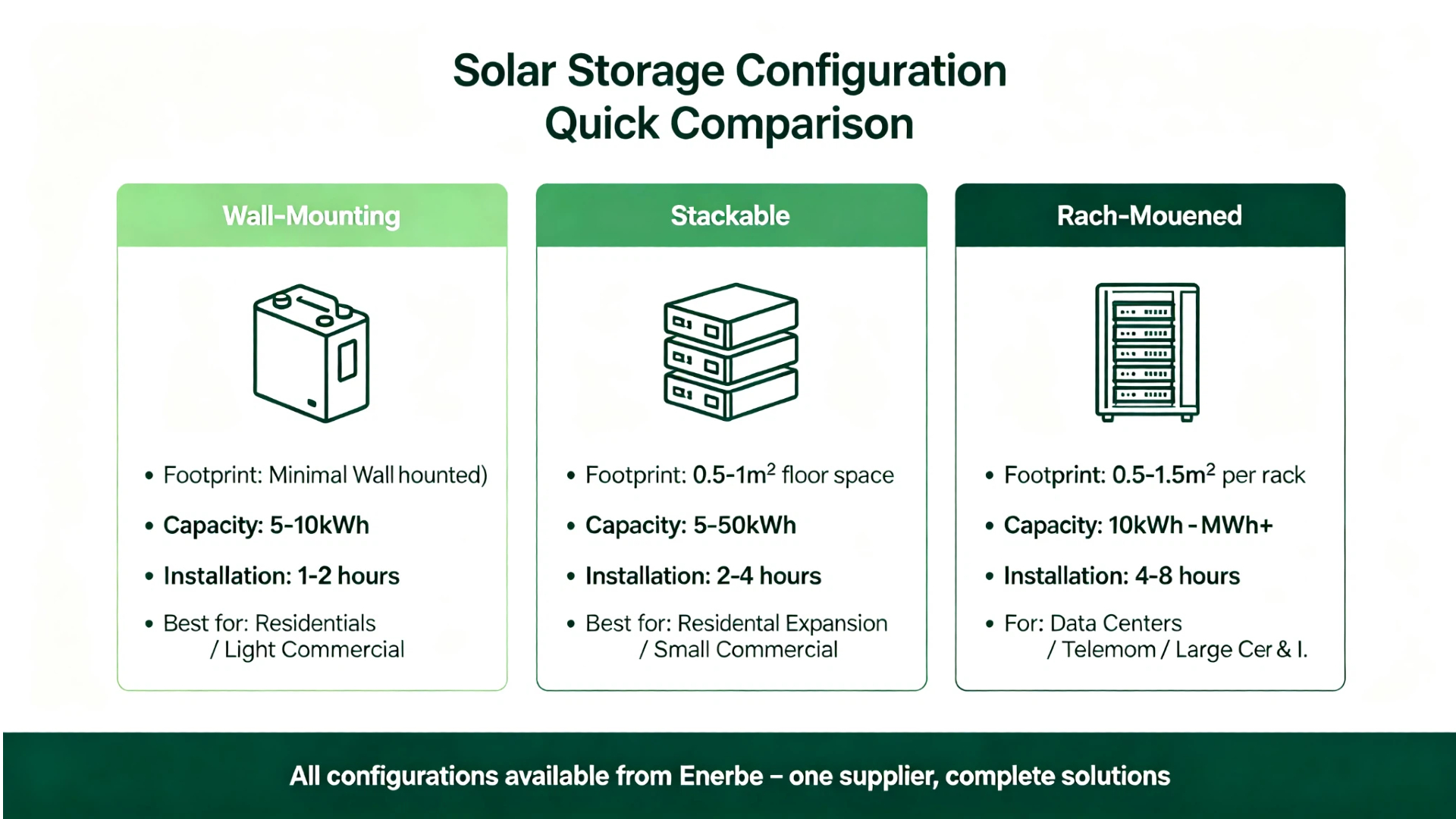
Solar battery systems come in several form factors, each suited to different project sizes and installation environments:
Wall-Mounted Systems
-
Footprint: Minimal—uses wall space only, no floor space required
-
Typical capacity: 4.8-10kWh per unit (48V 100Ah/200Ah)
-
Installation time: 1-2 hours for a trained installer
-
Weight: 35-70kg per unit (two-person lift recommended)
-
Best For: Residential, light commercial, space-constrained sites, garages, utility rooms
-
Wall requirement: Must be mounted on load-bearing wall (concrete, brick, reinforced stud). Drywall alone is not sufficient.
Stackable Systems
-
Footprint: 0.5-1m² floor space (modules stack vertically)
-
Typical capacity: 5kWh per module, expandable to 20-50kWh
-
Installation time: 2-4 hours (module stacking and interconnection)
-
Best For: Residential with expansion plans, small commercial, flexible capacity needs
-
Advantage: Easy to add modules later as budget or load grows; no wall mounting required
Rack-Mounted Systems
-
Footprint: 0.5-1.5m² per standard 19" server rack
-
Typical capacity: 2.4kWh (50Ah) to 100kWh+ per rack (48V 100Ah/200Ah units)
-
Installation time: 4-8 hours (rack assembly, module installation, cable management)
-
Best For: Data centers, telecom, large C&I projects, multi-unit residential buildings
-
Advantage: Maximum scalability, professional cable management, easy maintenance, front-to-back cooling
Floor-Mounted Container Systems
-
Footprint: Large (shipping container size: 20ft / 40ft)
-
Typical capacity: 500kWh to MWh+ per container
-
Installation time: 1-2 weeks (site preparation, container placement, grid connection)
-
Best For: Utility-scale, large commercial, off-grid communities, microgrids
-
Includes: Pre-integrated battery racks, PCS, thermal management, fire suppression, EMS, HVAC
How to Size a Solar Battery System
Correct sizing is critical for customer satisfaction and ROI. An undersized system won't meet backup or self-consumption goals; an oversized system wastes money. Follow this methodology:
Step 1: Determine the Primary Goal
| Primary Goal | Sizing Priority | Typical Residential Size |
|---|---|---|
| Solar self-consumption | Match battery to excess daily solar generation | 5-10kWh |
| Backup power (essential loads) | Match battery to essential load × desired backup hours | 5-15kWh (4-12h backup) |
| Whole-home backup | Match battery to total load × desired backup hours | 15-30kWh+ |
| TOU arbitrage | Match battery to peak-period consumption | 10-20kWh |
| Off-grid | Daily load × autonomy days (2-3 days) ÷ DoD | 20-50kWh+ |
Step 2: Calculate Required Battery Capacity
Use this formula to calculate the required nominal battery capacity:
Required Battery Capacity (kWh) = (Daily Energy Consumption × Backup Days) ÷ (DoD × Inverter Efficiency × Temperature Derating)
Example: A home using 15kWh/day, wanting 1 day of backup, with LiFePO4 (80% DoD), 92% inverter efficiency, and 95% temperature derating:
Required capacity = (15kWh × 1 day) ÷ (0.80 × 0.92 × 0.95) = 15 ÷ 0.699 = 21.5kWh nominal → approximately 4-5 × 4.8kWh units (19.2-24kWh)
Step 3: Size the Solar Array
The solar array should be large enough to fully charge the battery each day while also powering daytime loads:
-
Rule of thumb: Solar array (kWp) = Battery capacity (kWh) ÷ Peak sun hours (typically 3-5 hours depending on location)
-
Example: 10kWh battery ÷ 4 peak sun hours = 2.5kWp solar array minimum. For off-grid, oversize to 1.5-2x: 4-5kWp.
-
Grid-tied with backup: Size solar primarily for daytime load + battery charging; the grid supplements when solar is insufficient.
ROI Calculation: Key Factors & Payback Periods
Before committing to a solar storage purchase, calculate the expected return on investment. The key factors that determine ROI are:
| Factor | Impact on ROI | Notes |
|---|---|---|
| Electricity rate | Higher rates = faster payback | Each $0.10/kWh saved on 10kWh/day = $365/year |
| Peak demand charges (C&I) | Demand charge reduction can provide 20-40% savings | Often the largest ROI driver for commercial customers |
| Battery cycle life | Longer cycle life = lower replacement cost | 5,000+ cycles (10+ years) vs 2,000 cycles (5 years) = no replacement needed during ROI period |
| System efficiency (RTE) | Higher RTE = more usable energy = more savings | 95% RTE vs 80% RTE = 15% more energy delivered per cycle |
| Incentives and rebates | Can reduce CapEx by 20-50% | US Federal ITC (30%), state rebates, EU subsidies, Australia STCs |
| Maintenance costs | LiFePO4 = zero maintenance (vs lead-acid monthly) | Lead-acid maintenance can add $200-500/year in labor and parts |
| Net metering / feed-in tariff | Low export rates make storage more valuable; high export rates reduce storage value | If export rate < retail rate, storing excess solar is more valuable than exporting |
Typical Payback Periods by Region and Project Type:
| Project Type | US (with 30% ITC) | Europe | Australia |
|---|---|---|---|
| Residential Solar + Storage | 5-8 years | 4-7 years | 4-6 years |
| Commercial Solar + Storage (with demand charges) | 3-6 years | 3-5 years | 3-5 years |
| Off-Grid System (replacing grid connection/generator) | 3-7 years | 3-6 years | 3-5 years |
B2B Buying Tip: Always include battery replacement costs in your ROI calculation. A LiFePO4 battery with 5,000+ cycle life (10+ years) typically does not need replacement during the standard 20-25 year project lifecycle, significantly reducing long-term costs compared to a battery with 2,000 cycles (5 years) which would need 3-4 replacements. Also account for electricity price escalation (typically 2-5% annually), which accelerates payback over time.
Common Mistakes to Avoid
| Mistake | Consequence | Solution |
|---|---|---|
| Comparing total capacity instead of usable capacity | Battery appears larger on paper but delivers less actual energy | Always compare usable kWh (nominal × DoD), not nominal kWh |
| Ignoring battery-inverter compatibility | No communication, BMS errors, inverter shutdowns, warranty void, safety risks | Verify on inverter manufacturer's official battery compatibility list; request test unit before bulk order |
| Undersizing the battery | Frequent deep cycling (>90% DoD), shortened life, customer dissatisfaction, insufficient backup | Size for 80% max DoD and add 20-30% margin for aging and unexpected loads |
| Buying Grade B/C cells | Lower actual capacity, shorter cycle life, higher failure rate, inconsistent performance, safety risks | Always specify Grade A cells; request cell manufacturer name, lot number, and traceability documentation |
| Installing in unventilated / extreme temperature location | Overheating, BMS thermal shutdown, shortened life, charging disabled in cold (below 0°C) | Install in climate-controlled space (15-30°C optimal); use heated enclosure or low-temp BMS for cold climates; ensure ventilation for hot climates |
| Wrong charge voltage setting | Undercharging (capacity loss, sulfation-like degradation) or overcharging (BMS shutdown, cell damage, safety risk) | Set inverter charge voltage per battery datasheet: 54.75V for 15S (48V), 58.4V for 16S (51.2V). Verify with commissioning checklist. |
| Choosing lead-acid for low upfront cost | 3-4x more expensive over 10 years (replacement costs), high maintenance, only 50% DoD, safety hazards (acid, gas) | Calculate total cost of ownership over 10-20 years, not just upfront price. LiFePO4 is almost always cheaper long-term. |
| Not accounting for future expansion | Cannot add batteries later without replacing inverter or entire system; expensive upgrade path | Choose modular systems with parallel expansion capability; size inverter for future battery capacity; leave physical space and cable capacity |
B2B Procurement Checklist
Before finalizing a solar battery storage purchase, verify these items with the supplier:
-
Battery chemistry is LiFePO4 (safest, longest cycle life, ESG-compliant for stationary storage)
-
Grade A cells with cell manufacturer name and lot traceability (not Grade B/C or recycled cells)
-
Usable capacity meets project requirements (compare usable kWh, not nominal kWh)
-
Cycle life is 5,000+ at 80% DoD (verified by independent test report, not just marketing claim)
-
Round-trip efficiency is 95%+ (AC-AC, including inverter losses)
-
Depth of discharge is 80-90% (LiFePO4 standard; verify warranty covers this DoD)
-
Operating temperature range matches installation environment (charge: 0-55°C, discharge: -20-60°C for LiFePO4)
-
BMS features: per-cell voltage monitoring, cell balancing (passive or active), over/under-voltage, over-current, short-circuit, over-temperature protection, low-temp charge cut-off
-
Inverter compatibility confirmed (CAN bus/RS485 protocols; verified on target inverter's official compatibility list; request test unit for verification)
-
Certifications: UL 1973 / UL 9540 / UL 9540A (North America), IEC 62619 (EU), CE, UN38.3 (mandatory for shipping), RoHS, MSDS. Verify certificates are current and model-specific.
-
Warranty is 10 years or 5,000+ cycles (whichever comes first), with clear capacity guarantee threshold (typically 70-80%) and claim process
-
Scalability: system supports parallel expansion for future capacity increases (minimum 8-16 units parallel)
-
Supplier supports factory visits or virtual audits (verifies actual manufacturing capability, not just trading company)
-
Lead time meets project schedule (typical: 15-30 days for standard products, 30-60 days for OEM/custom)
-
Shipping compliance: UN38.3 test summary, MSDS, proper DG packaging; supplier handles all dangerous goods documentation
-
Technical support: dedicated engineering support for inverter compatibility, installation troubleshooting, firmware updates, and after-sales service
-
OEM/ODM capability: custom branding, packaging, BMS programming, capacity configurations for distributor/integrator partners
Frequently Asked Questions
What is solar battery storage and how does it work?
Solar battery storage captures excess electricity generated by solar panels during the day and stores it in rechargeable batteries (typically LiFePO4) for use later—at night, during cloudy periods, peak electricity rates, or grid outages. The system works in a continuous cycle: solar panels generate DC electricity, which first powers immediate loads, then charges the battery via a hybrid inverter or charge controller. When solar production drops (evening), the battery discharges to power loads, with the inverter converting DC to AC. An Energy Management System (EMS) optimizes charging and discharging based on electricity rates, solar generation, and user-defined strategies (self-consumption, TOU arbitrage, backup). During grid outages, the inverter automatically switches to backup mode in <20ms, powering critical loads from battery and solar.
What is the best battery chemistry for solar storage?
For 90% of stationary solar storage applications, LiFePO4 (Lithium Iron Phosphate) is the best chemistry and the industry standard. It offers: thermal runaway threshold >500°C (very safe, unlike NMC at ~200°C), 5,000-6,000+ cycle life at 80% DoD (10-15 years), 80-90% usable depth of discharge, 95%+ round-trip efficiency, zero maintenance, cobalt-free (ESG-compliant), and the lowest total cost of ownership over 10-20 years. NMC has higher energy density but lower safety, contains cobalt (ethical concerns), and shorter life—best only for mobile/weight-constrained applications. Lead-acid has low upfront cost but very short life (200-500 cycles), high maintenance, only 50% DoD, and safety hazards—rarely cost-effective over the project lifecycle despite lower initial price.
How long do solar batteries last?
A quality Grade A LiFePO4 solar battery lasts 10-15+ years with daily cycling. Specifically: 5,000-6,000+ cycles at 80% DoD, which translates to approximately 13.7-16.4 years of daily cycling (5,000 cycles ÷ 365 days/year ≈ 13.7 years). Even at 100% DoD, expect 4,000+ cycles (~11 years). NMC batteries last 5-10 years (2,000-4,000 cycles). Lead-acid lasts only 2-5 years (200-1,000 cycles). Actual lifespan depends on: depth of discharge (keep below 80% for max life), operating temperature (15-30°C optimal), charge/discharge rates (avoid sustained high C-rates), BMS quality, and cell grade (Grade A required). Most LiFePO4 solar batteries come with 10-year warranties. Capacity typically fades to 70-80% of original by end of warranty period.
How much does a solar battery storage system cost?
Solar battery storage costs vary by capacity, brand, and region. As of 2026: (1) Residential systems (5-15kWh): $6,000-$20,000 installed (including inverter and installation), or $800-$1,500 per kWh. With the US 30% Federal Investment Tax Credit (ITC), net cost drops to $4,200-$14,000. (2) Commercial systems (30-100kWh): $30,000-$120,000 installed, or $500-$1,000 per kWh (economies of scale reduce per-kWh cost). (3) Utility-scale (MWh+): $200-$400 per kWh for containerized systems. Battery-only costs (excluding inverter and installation) are typically $300-$700 per kWh for LiFePO4. Note: these are approximate ranges—actual pricing depends on brand, capacity, configuration, installation complexity, and local labor costs. Always get multiple quotes and calculate total cost of ownership (including replacement and maintenance) over 10-20 years, not just upfront price.
What is the difference between AC-coupled and DC-coupled solar storage?
DC-coupled systems connect solar panels directly to a charge controller or hybrid inverter, which charges the battery with DC power. A single inverter converts DC (solar + battery) to AC. Advantages: higher efficiency (2-5% more, fewer conversion steps), lower equipment cost (single inverter), simpler design, works during outages. Best for: new solar + storage installations, off-grid. AC-coupled systems have solar connected to a standard grid-tied inverter (AC output), and the battery has a separate bi-directional inverter that converts AC↔DC. Advantages: easy retrofit to existing solar (no inverter replacement), flexible design, works with multiple inverter brands, easier expansion. Best for: retrofitting battery to existing solar installations. For new installations, DC-coupled (hybrid inverter) is generally preferred for better efficiency and lower cost. For retrofits, AC-coupled is the practical choice. Always verify battery-inverter compatibility regardless of configuration.
Can I add more solar batteries later?
Yes, most modern LiFePO4 solar battery systems support parallel expansion—typically up to 8-16 units (40-80kWh+) for wall-mounted/stackable systems, and 100kWh to MWh+ for rack-mounted systems. However, for best performance and longest life, follow these rules: (1) All parallel units should be the same brand, model, capacity, and firmware version. (2) Ideally, all units should be the same age—mixing old and new batteries causes uneven current sharing and can shorten the life of the newer units. (3) Leave physical space and cable capacity for future units at initial installation. (4) Ensure the inverter/hybrid inverter supports the expanded capacity—some inverters have maximum battery capacity limits. (5) If adding units later, consult the manufacturer for the correct procedure (some systems require firmware updates or master/slave reconfiguration). Rack-mounted systems are the most expandable; wall-mounted systems have more limited expansion (typically 2-4 units).
Do solar batteries work during a power outage?
Yes, but only if the system is configured for backup power. Here is how it works: (1) When the grid goes down, the hybrid inverter automatically detects the outage and disconnects from the grid (anti-islanding protection required by electrical codes). (2) It then switches to backup mode, powering designated critical loads from the battery. This transfer happens in less than 20 milliseconds—too fast for most electronics (including computers and refrigerators) to notice. (3) If solar is available (daytime), the solar panels continue charging the battery during the outage, extending backup duration. (4) When the grid returns, the inverter automatically reconnects and resumes normal operation. Important notes: (a) Standard grid-tied inverters without battery backup will shut down during an outage (anti-islanding protection)—you need a hybrid inverter or backup-ready inverter. (b) The battery powers only the loads connected to the backup sub-panel (critical loads), not necessarily the entire home/business—unless the system is sized for whole-home backup. (c) Backup duration depends on battery capacity and load consumption—typically 4-24 hours for residential systems.
What size solar battery do I need for my home or business?
The right size depends on your primary goal and daily energy consumption. Use this methodology: (1) Determine your goal: solar self-consumption (5-10kWh residential), essential-load backup (5-15kWh for 4-12h), whole-home backup (15-30kWh+), TOU arbitrage (10-20kWh), or off-grid (20-50kWh+ with 2-3 days autonomy). (2) Calculate daily consumption: Review utility bills (kWh/month ÷ 30 = daily kWh) or use a monitoring device. For backup, calculate only essential loads (refrigerator, lights, Wi-Fi, medical equipment). (3) Apply the formula: Required battery capacity (kWh) = (Daily consumption × Backup days) ÷ (DoD × Inverter efficiency × Temperature derating). Example: 15kWh/day × 1 day ÷ (0.80 × 0.92 × 0.95) = 21.5kWh → ~4-5 × 4.8kWh units. (4) Add 20-30% margin for battery aging (capacity fades ~20% over 10 years) and unexpected loads. (5) Size the solar array: Array kWp = Battery kWh ÷ Peak sun hours (3-5h depending on location). For commercial/C&I, also consider demand charge reduction potential—size the battery to cover peak demand (kW) for 1-3 hours during peak periods. When in doubt, slightly oversize—it is always cheaper to add capacity at installation than to retrofit later.
Related Resources
-
48V Solar Battery Storage Guide — 48V platform deep dive: specifications, sizing, inverter compatibility, LiFePO4 vs lead-acid
-
48V Rack-Mounted Lithium Battery Guide for Project Buyers — rack-mounted systems, server rack integration, high-capacity C&I configurations
-
What Is a LiFePO4 Battery? Complete Guide — chemistry, voltage, capacity, BMS basics, why LiFePO4 is the standard
-
How Long Do Solar Batteries Last? — lifespan, degradation factors, cycle life comparison, warranty considerations
-
LiFePO4 Battery Safety Guide — thermal runaway risk, fire safety, safe handling and installation
-
How to Charge LiFePO4 Batteries Guide — correct charge voltage, charging methods, common charging mistakes
-
How to Install LiFePO4 Battery Guide — step-by-step installation, cable sizing, inverter configuration
-
BESS Certification & Conformity Assessment Guide — UL 1973, UL 9540, UL 9540A, IEC 62619, UN38.3, EU 2023/1542 compliance
-
B2B Sourcing Guide for LiFePO4 Batteries — complete overview across all applications (solar, golf cart, marine, RV, more)
Enerbe Solar Battery Storage Products
Enerbe offers a complete range of LiFePO4 solar battery storage solutions for residential, commercial, and industrial projects:
| Configuration | Key Specs | Best For |
|---|---|---|
| Wall-Mounted | 48V 100Ah / 200Ah (4.8kWh / 9.6kWh), 5,000+ cycles, CAN bus/RS485 | Residential, light commercial, space-constrained sites |
| Stackable | 5kWh modules, expandable to 20-50kWh, modular design | Scalable residential & commercial, flexible capacity |
| Rack-Mounted | 48V 50Ah / 100Ah / 200Ah (2.4-9.6kWh per unit), 19" standard rack, 100kWh+ per rack | Data centers, telecom, large C&I, multi-unit residential |
Enerbe Advantages for Solar Storage:
-
Factory-Direct Pricing: Manufacturer pricing with no middleman markups; bulk order discounts for system integrators and distributors
-
5,000+ Cycle Life: Grade A LiFePO4 cells for 10+ year service life; 85% production automation rate
-
Full Certifications: UL 1973, UL 9540, CE, IEC 62619, UN38.3, RoHS, MSDS; over 200 certified products
-
Smart BMS: Per-cell monitoring, active/passive balancing, CAN bus / RS485 communication for inverter compatibility (Victron, SMA, Sungrow, GoodWe, Growatt, Deye, etc.)
-
Global Shipping: Reliable logistics to US, Europe, Australia, Middle East; full dangerous goods documentation handled by supplier
-
OEM/ODM Capability: Custom voltage/capacity configurations (1S to 20S), custom branding and packaging, custom BMS programming for specific inverter compatibility
-
Technical Support: Dedicated engineering team for inverter compatibility, installation troubleshooting, firmware updates, and after-sales service
For wholesale pricing, custom configurations, or technical support, contact our team. View the full product lineup on our 48V LiFePO4 battery product page and complete product catalog.
Get In Touch
Ready to source solar battery storage systems for your project? Contact Enerbe today.
📄 Request Safety Certifications & Datasheet
Contact Us →📞 Speak with Our Engineering Team
Get In Touch →🔗 Browse Solar Battery Products
View Products →Dongguan A&S Power Technology Co., Limited.
Building 1, No. 2, Keji 9th Road,
Songshan Lake, Dongguan, Guangdong, China
📞 +86 137 1383 1631
✉ info@aspowerbattery.com
Stay Charged. Stay Safe.



LiFePO4 Thermal Runaway & BESS Fire Protection: Engineering Guide (2026)
48V Solar Battery Storage Guide: LiFePO4 Systems for B2B Buyers
Related Article


Get In Touch
Have questions about custom lithium batteries, energy storage solutions, or lead-to-lithium conversion? Our team is ready to help. Send us a message and we’ll respond within 24 hours.

Building 1, No. 2, Keji 9th Road, Songshan Lake, Dongguan, Guangdong, China
Office Address

info@aspowerbattery.com
Email Us

+86 137 1383 1631
Call Us

Sun - Fri (08AM - 10PM)
Office Open
