
What Is LiFePO4 (LFP) Battery? Complete Guide (2026)
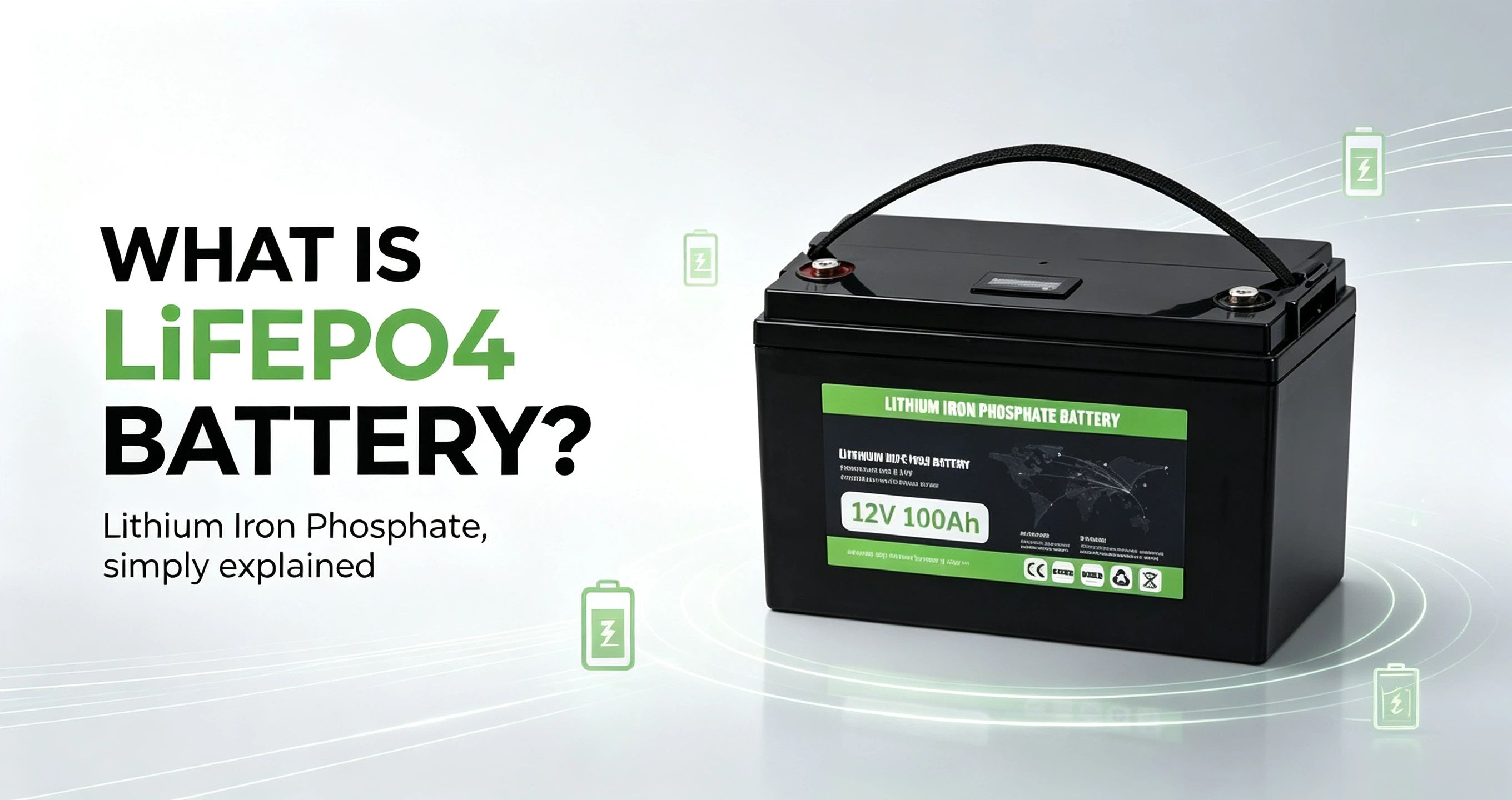
Table of Contents
- Introduction: What Is a LiFePO4 Battery?
- What Is LiFePO4 Battery? Chemistry Explained
- LiFePO4 vs NMC vs Lead-Acid: Full Comparison
- Key Specifications & Parameters
- 10 Advantages of LiFePO4 Batteries
- Limitations & Tradeoffs
- Common Applications
- How LiFePO4 Batteries Work (Charging & Discharging)
- LiFePO4 Safety Overview
- What to Look for When Buying LiFePO4 Batteries
- Related Resources
- Frequently Asked Questions
- Summary
What is LiFePO4 Battery? Chemistry, Specs, Applications & Complete Guide 2026
Last updated: September 2026 | Written by the Enerbe Engineering Team
Introduction: What Is a LiFePO4 Battery?
Quick Answer: LiFePO4 (Lithium Iron Phosphate, abbreviated LFP) is a rechargeable lithium-ion battery chemistry that uses lithium iron phosphate (LiFePO₄) as the cathode material and a graphite carbon anode. Compared to NMC (Nickel Manganese Cobalt) and lead-acid, LiFePO4 batteries offer 3,000-6,000 cycle life, higher thermal stability (~270°C thermal runaway threshold vs ~150°C for NMC), no oxygen release during decomposition, zero maintenance, and roughly half the weight of lead-acid for the same usable capacity. The main tradeoff is lower energy density (90-160 Wh/kg vs 150-280 Wh/kg for NMC), making LiFePO4 ideal for stationary energy storage, solar, marine, RV, and BESS applications where safety, cycle life, and total cost of ownership matter more than absolute energy density.
If you're researching energy storage options for a solar installation, marine vessel, RV, or commercial BESS project, you've likely encountered the term LiFePO4 battery—also written as LFP battery. But what exactly is it, and why has it become the dominant chemistry for stationary and deep-cycle applications?
This guide covers everything B2B buyers, system integrators, and project developers need to know: what is LFP, how the chemistry works, how it compares to NMC and lead-acid, key specifications, advantages and limitations, common applications, and what to verify before sourcing from a manufacturer.
For a complete overview of LiFePO4 battery sourcing across all applications, see our B2B Sourcing Guide.
What Is LiFePO4 Battery? Chemistry Explained
LiFePO4 stands for Lithium Iron Phosphate. The chemical formula is LiFePO₄, and the common industry abbreviation is LFP. It is a type of lithium-ion battery that uses lithium iron phosphate as the positive electrode (cathode) and a graphitic carbon electrode with a metallic backing as the negative electrode (anode).
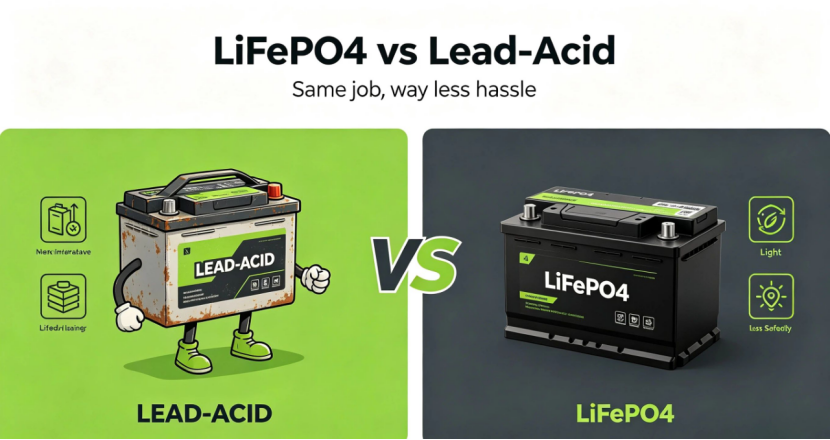
The LFP Meaning and Full Form
Understanding the LFP meaning starts with the full chemical name:
-
Li = Lithium (the alkali metal that provides the ions that shuttle between electrodes)
-
Fe = Iron (from the Latin "ferrum") — the transition metal in the cathode
-
P = Phosphorus — part of the phosphate group (PO₄³⁻)
-
O₄ = Four oxygen atoms bonded to phosphorus in the phosphate group
The LFP full form in battery terminology is simply "Lithium Iron Phosphate" — the same as LiFePO4. You may also see it written as "lithium ferrophosphate" or "Li-phosphate." All refer to the same chemistry.
Why the Phosphate Structure Matters for Safety
The key structural feature that makes LFP chemistry safer than NMC is the strong P-O covalent bond in the phosphate (PO₄³⁻) group. This bond is much stronger than the metal-oxygen bonds in NMC cathodes, which means:
-
Oxygen is not easily released during thermal decomposition — unlike NMC, which releases oxygen that feeds the fire
-
Higher thermal stability — the cathode remains stable up to ~270°C, compared to ~150-200°C for NMC
-
Lower heat release — when decomposition does occur, it releases less heat per unit mass than NMC
-
No cobalt — LFP cathodes contain no cobalt or nickel, reducing cost and ethical concerns associated with cobalt mining
This is why are LFP batteries safer is consistently answered "yes" by fire safety engineers and insurance underwriters for stationary energy storage applications. For a detailed safety analysis, see our LiFePO4 battery safety guide.
LiFePO4 vs NMC vs Lead-Acid: Full Comparison
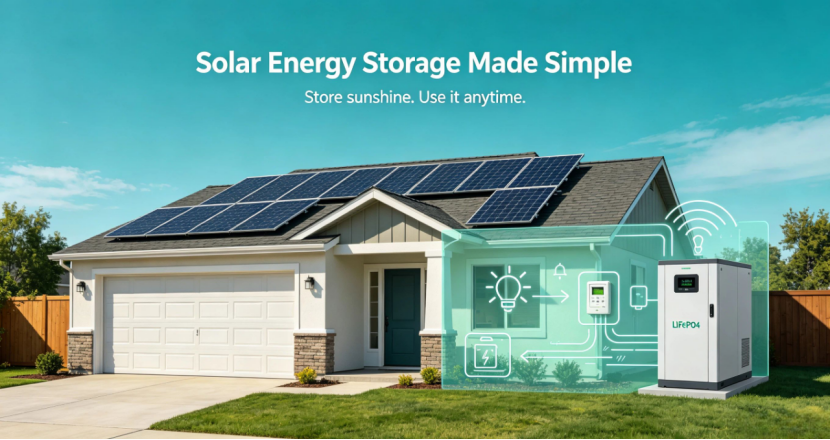
When evaluating LFP battery technology, it's essential to compare it against the two most common alternatives: NMC (Nickel Manganese Cobalt) lithium-ion and traditional lead-acid (flooded, AGM, gel).
| Parameter | LiFePO4 (LFP) | NMC / NCA | Lead-Acid (AGM/Gel) |
|---|---|---|---|
| Nominal cell voltage | 3.2V | 3.6-3.7V | 2.0V (2.12V for flooded) |
| Full charge voltage (per cell) | 3.65V | 4.2V | 2.45V (absorption) |
| Cut-off voltage (per cell) | 2.5V | 2.5-3.0V | 1.75V |
| Cycle life (80% DoD) | 3,000-6,000+ | 1,000-2,000 | 500-1,000 (deep cycle) |
| Energy density | 90-160 Wh/kg | 150-280 Wh/kg | 30-50 Wh/kg |
| Thermal runaway threshold | ~270°C | ~150-200°C | N/A (different failure mode) |
| Oxygen release on decomposition | No | Yes | N/A |
| Round-trip efficiency | 92-98% | 90-95% | 70-85% |
| Self-discharge rate | 2-3%/month | 3-5%/month | 3-20%/month |
| Depth of discharge (usable) | 80-90% | 80-90% | 50% (to preserve life) |
| Maintenance required | None (sealed) | None (sealed) | Water topping (flooded), equalization |
| Cobalt / nickel content | None | High (cobalt, nickel) | Lead (toxic) |
| Upfront cost (per kWh) | Medium-High | High | Low |
| Total cost of ownership (10 yr) | Lowest | Medium | Highest (replacements) |
Key takeaway for B2B buyers: For stationary energy storage, solar, marine, RV, and deep-cycle applications, LiFePO4 delivers the lowest total cost of ownership over a 10-year period despite higher upfront cost, because it lasts 3-6x longer than lead-acid, requires zero maintenance, and provides 80-90% usable capacity (vs 50% for lead-acid). NMC is preferred only for applications where weight and volume are critical constraints (e.g., EVs, portable electronics).
Key Specifications & Parameters
Understanding LFP battery specifications is essential for proper system design and sourcing. Here are the standard parameters for LiFePO4 cells and battery packs:
| Parameter | Typical Value | Notes |
|---|---|---|
| Nominal cell voltage | 3.2V | 4S = 12.8V, 8S = 25.6V, 16S = 51.2V |
| Charge voltage (per cell) | 3.65V ± 0.05V | 12V=14.6V, 24V=29.2V, 48V=58.4V |
| Discharge cut-off (per cell) | 2.5V | BMS typically cuts at 2.5-2.8V |
| Cycle life (100% DoD) | 3,000+ cycles | To 80% capacity retention |
| Cycle life (80% DoD) | 5,000-6,000+ cycles | Shallow cycling extends life significantly |
| Energy density (cell) | 120-160 Wh/kg | Pack-level: 90-130 Wh/kg (with BMS, enclosure) |
| Continuous discharge rate | 0.5C-1C (standard) | High-drain cells: 2C-3C continuous |
| Peak discharge rate | 2C-5C (5-10 seconds) | BMS limits peak current to protect cells |
| Charge temperature range | 0°C to 45°C | Charging below 0°C causes lithium plating |
| Discharge temperature range | -20°C to 60°C | Capacity drops below 0°C (~60% at -20°C) |
| Storage temperature | 15°C to 25°C (ideal) | Store at 50-70% SOC for long-term storage |
| Self-discharge rate | 2-3% per month | Much lower than lead-acid (3-20%/month) |
| Round-trip efficiency | 92-98% | Higher than lead-acid (70-85%) |
For specific product specifications, see our 24V LiFePO4 battery complete guide with detailed specs for 100Ah and 200Ah models.
10 Advantages of LiFePO4 Batteries

The key advantages of LFP batteries make them the preferred choice for stationary and deep-cycle applications:
1. Exceptional Cycle Life (3,000-6,000+ Cycles)
LiFePO4 batteries typically last 3,000-6,000+ cycles before reaching 80% capacity retention, compared to 500-1,000 cycles for deep-cycle lead-acid and 1,000-2,000 for NMC. At one cycle per day, that's 8-16+ years of service life. This is the single biggest driver of LiFePO4's lower total cost of ownership.
2. Superior Safety (No Oxygen Release, High Thermal Stability)
The phosphate cathode structure does not release oxygen during thermal decomposition, eliminating the self-feeding fire mechanism that makes NMC dangerous. With a thermal runaway threshold of ~270°C (vs ~150°C for NMC), LiFePO4 is significantly more resistant to thermal runaway. This is why LFP battery safety is the gold standard for stationary energy storage.
3. Zero Maintenance
Unlike flooded lead-acid batteries that require regular water topping, equalization charges, and terminal cleaning, LiFePO4 batteries are completely sealed and maintenance-free. No water, no equalization, no corrosion cleanup—just install and use.
4. High Usable Capacity (80-90% vs 50% for Lead-Acid)
Lead-acid batteries should only be discharged to 50% to preserve cycle life, meaning a 100Ah lead-acid battery only provides ~50Ah of usable capacity. LiFePO4 can be safely discharged to 80-90%, providing 80-90Ah from the same nominal 100Ah rating. This means you need roughly half the rated capacity of LiFePO4 to match the usable capacity of lead-acid.
5. Lightweight (Roughly Half the Weight of Lead-Acid)
A 12V 100Ah LiFePO4 battery weighs approximately 10-12 kg, while a comparable 12V 100Ah AGM lead-acid battery weighs 28-32 kg. For marine, RV, and mobile applications, this weight reduction translates to better fuel efficiency, increased payload capacity, and easier installation.
6. High Round-Trip Efficiency (92-98%)
LiFePO4 batteries achieve 92-98% round-trip efficiency, meaning very little energy is lost as heat during charge and discharge. Lead-acid batteries typically achieve only 70-85% efficiency. For solar installations, this means more of the energy generated by your panels actually reaches your loads, reducing overall system cost.
7. Fast Charging Capability
LiFePO4 batteries can accept high charge currents (0.5C-1C standard, up to 2C+ for high-drain cells), allowing much faster charging than lead-acid. A 100Ah LiFePO4 battery can be charged from 0-100% in approximately 1-2 hours with a 50-100A charger, compared to 8-12 hours for lead-acid.
8. Flat Discharge Voltage Curve
LiFePO4 maintains a nearly constant voltage (~3.2V per cell) throughout most of its discharge cycle, dropping sharply only in the last 10-15% of capacity. This means consistent power delivery to your loads—no dimming lights or slowing motors as the battery discharges, which is a common problem with lead-acid.
9. No Memory Effect
Unlike some older battery chemistries (notably NiCd), LiFePO4 has no memory effect. You can partially charge and discharge the battery at any state of charge without reducing long-term capacity. This makes it ideal for solar applications where the battery may not reach a full charge every day.
10. Environmentally Friendly (No Cobalt, No Lead)
LiFePO4 batteries contain no lead (toxic heavy metal) and no cobalt (ethical concerns, price volatility). The cathode materials (iron, phosphate) are abundant and non-toxic. At end of life, LiFePO4 batteries are recyclable, with lithium, iron, phosphate, copper, and aluminum all recoverable.
Limitations & Tradeoffs
While LiFePO4 offers many advantages, it is important to understand its limitations to make an informed sourcing decision:
| Limitation | Impact | Mitigation |
|---|---|---|
| Lower energy density | Larger and heavier than NMC for the same capacity; not ideal for weight-critical applications (EVs, drones, portable electronics) | For stationary storage, lower density is actually a safety advantage (less energy per kg = less energy in a fire). Use NMC only when weight/volume is critical |
| Poor low-temperature performance | Capacity drops significantly below 0°C (~60% at -20°C); charging below 0°C causes lithium plating and permanent damage | Use battery heating systems for cold climates; ensure BMS has low-temperature charge protection; locate batteries in conditioned spaces when possible |
| Higher upfront cost | LiFePO4 costs 2-3x more per kWh upfront than lead-acid | Lower total cost of ownership over 5-10 years due to 3-6x longer life, zero maintenance, and higher usable capacity. Calculate TCO, not just purchase price |
| Requires BMS | All lithium-ion batteries require a Battery Management System for safe operation; adds cost and complexity | Quality BMS is included in reputable battery packs. Verify BMS manufacturer, protection thresholds, and certification (UL 1973, IEC 62619) |
| Lower nominal voltage per cell | 3.2V per cell vs 3.6-3.7V for NMC, requiring more cells in series for the same pack voltage (16S for 48V vs 13S-14S for NMC) | Standardized configurations (4S=12V, 8S=24V, 16S=48V) are widely available. More cells = more redundancy and lower per-cell stress |
Common Applications
LFP battery applications span residential, commercial, and industrial sectors. The chemistry's combination of safety, cycle life, and low maintenance makes it ideal for:
Solar Energy Storage (Residential & Commercial)
LiFePO4 is the dominant chemistry for solar energy storage systems. Its high round-trip efficiency (92-98%), long cycle life (3,000-6,000+), and zero maintenance make it perfect for daily charge-discharge cycles paired with solar panels. LFP battery solar systems range from small 5kWh residential setups to multi-MWh commercial installations.
Battery Energy Storage Systems (BESS)
For utility-scale and commercial BESS projects, LFP battery storage has become the industry standard. Major BESS integrators (including Tesla Megapack, Fluence, Wärtsilä, and Sungrow) have shifted to LFP chemistry for new installations due to its superior safety profile and lower cost per kWh over the project lifetime. LFP battery systems are used for peak shaving, load shifting, frequency regulation, and grid resilience.
Marine & Boating
Marine applications benefit from LiFePO4's lightweight design (half the weight of lead-acid), zero maintenance (no water topping in a moving vessel), and high usable capacity. Common uses include house banks for sailboats and yachts, trolling motor batteries for fishing boats, and propulsion batteries for electric boats. For more details, see our 24V lithium marine battery guide.
RV & Camper Vans
RV owners choose LiFePO4 for off-grid camping: longer runtime between charges, no generator noise, lightweight for better fuel economy, and no maintenance during travel. A 12V 100Ah or 200Ah LiFePO4 battery can power RV appliances (fridge, lights, water pump, inverter) for 1-3 days without recharging.
Golf Carts & Low-Speed Vehicles
LiFePO4 batteries for golf carts offer 2-3x longer range per charge, 5-10x longer service life, and zero maintenance compared to lead-acid. The flat discharge curve means consistent power throughout the round, no slowing down as the battery drains.
Telecom & Data Center Backup
Telecom base stations and data centers use LiFePO4 for UPS (Uninterruptible Power Supply) backup power. Long cycle life, high reliability, and remote monitoring capability (via BMS communication) make LiFePO4 superior to valve-regulated lead-acid (VRLA) batteries for critical backup applications.
Trolling Motors & Fishing
24V and 36V LiFePO4 trolling motor batteries provide 40+ hours of runtime on low speed, weigh 70% less than lead-acid equivalents, and require no maintenance. For more details, see our 24V lithium trolling motor battery guide.
Forklifts & Material Handling
Electric forklifts are increasingly using LiFePO4 batteries due to fast charging (1-2 hours vs 8-12 hours for lead-acid), opportunity charging capability (no need for full charge cycles), and zero maintenance (no battery room, no water, no acid spills).
How LiFePO4 Batteries Work (Charging & Discharging)
Like all lithium-ion batteries, LiFePO4 operates through the reversible intercalation (insertion and removal) of lithium ions between the cathode and anode. Understanding this process helps explain how LFP batteries work and why they require specific charging parameters.
Discharge Process (Lithium Ions Move from Anode to Cathode)
-
When a load is connected, lithium ions (Li⁺) are released from the graphite anode and travel through the electrolyte to the LiFePO₄ cathode
-
At the cathode, lithium ions insert into the LiFePO₄ structure, forming LiₓFePO₄ (where x increases as discharge progresses)
-
Electrons flow through the external circuit from anode to cathode, providing electrical power to the load
-
The process continues until the battery reaches its cut-off voltage (typically 2.5V per cell) or the load is disconnected
Charge Process (Lithium Ions Move from Cathode to Anode)
-
When a charger is connected, an external voltage is applied that drives lithium ions out of the LiFePO₄ cathode and back into the graphite anode
-
The charger first applies a constant current (CC) phase: current flows at a fixed rate (e.g., 0.5C) while the battery voltage rises from its discharged state to the full charge voltage (3.65V per cell)
-
Once the battery reaches 3.65V per cell, the charger switches to a constant voltage (CV) phase: voltage is held at 3.65V while the current gradually tapers down as the battery reaches full charge
-
Charging is complete when the current drops to approximately 0.05C (e.g., 5A for a 100Ah battery) or when the BMS terminates charging
💡 Important: Use the Correct Charger
LiFePO4 requires a charger with a specific CC-CV charging profile and correct voltage (14.6V for 12V, 29.2V for 24V, 58.4V for 48V). Using a lead-acid charger (13.8V float / 14.4V absorption) will undercharge the battery, reducing usable capacity and cycle life. Using a NMC charger (16.8V for 4S) will overcharge and potentially damage the battery. Always use a LiFePO4-specific charger or a charger with selectable LiFePO4 mode.
The Role of the BMS (Battery Management System)
A Battery Management System (BMS) is an essential component of every LiFePO4 battery pack. It monitors and controls:
-
Cell voltage monitoring — measures individual cell voltages to prevent over-charge and over-discharge
-
Temperature monitoring — monitors cell and MOSFET temperatures to prevent over-temperature charging/discharging
-
Current monitoring — measures charge/discharge current to provide SOC (State of Charge) estimation and over-current protection
-
Cell balancing — equalizes cell voltages during charging to ensure all cells reach full charge simultaneously
-
Protection — disconnects the battery in case of over-voltage, under-voltage, over-current, short circuit, or over-temperature
-
Communication — provides data to external devices via CAN bus, RS485, or Bluetooth for monitoring and integration with inverters
For a detailed guide to BMS operation and reset procedures, see our How to Reset BMS on LiFePO4 Battery guide.
LiFePO4 Safety Overview
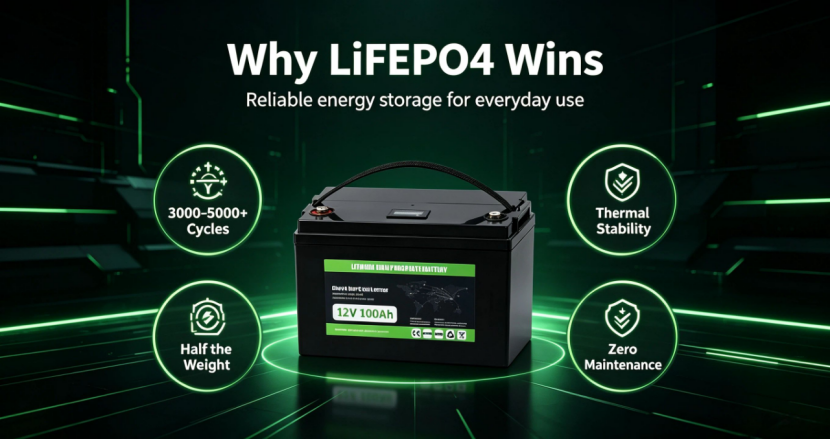
Safety is one of the primary reasons LiFePO4 has become the dominant chemistry for stationary energy storage. The key safety characteristics include:
-
High thermal stability: Thermal runaway onset at ~270°C (vs ~150°C for NMC)
-
No oxygen release: The P-O bond in the phosphate group prevents oxygen release during decomposition
-
Lower fire probability: Statistical data shows LiFePO4 fire incidents are roughly 2-3 times less frequent than NMC
-
Comprehensive BMS protection: Over-voltage, under-voltage, over-current, short-circuit, and over-temperature protection
-
Certified safety: UL 1973, UL 9540, UL 9540A, IEC 62619, UN38.3 certifications available from reputable manufacturers
However, LiFePO4 is not fireproof—physical damage, overcharging (if BMS is bypassed or failed), short circuits, and external fire can still trigger thermal runaway. Proper installation, correct charging, and regular maintenance are essential. For a comprehensive safety analysis including thermal runaway triggers, fire emergency response, and certification requirements, see our complete LiFePO4 battery safety guide.
What to Look for When Buying LiFePO4 Batteries
For B2B buyers sourcing LiFePO4 batteries, quality varies significantly between manufacturers. Here is what to verify before making a purchase decision:
1. BMS Quality and Manufacturer
The BMS is the most critical safety component. Ask for: BMS manufacturer name, firmware version, protection thresholds (over-voltage, under-voltage, over-current, short-circuit, temperature), cell balancing current, and whether the BMS has been tested to UL 1973 or IEC 62619. Avoid batteries with unknown or generic BMS units.
2. Cell Manufacturer and Grade
Ask for the cell manufacturer (e.g., CATL, BYD, EVE, CALB, Lishen, or the manufacturer's own cells). Verify whether cells are Grade A (new, tested, with full capacity) or Grade B/C (rejected cells with reduced capacity or higher internal resistance). Grade A cells from reputable manufacturers are essential for B2B applications.
3. Safety Certifications
Verify that the battery pack (not just the cells) holds relevant certifications: UL 1973 (stationary battery safety), UN38.3 (transport safety), CE (EU conformity), RoHS (environmental compliance), and for BESS applications, UL 9540 and UL 9540A. Always verify certificates directly with the issuing body—never rely solely on the supplier's marketing materials.
4. Cycle Life and Warranty
Ask for cycle life test data (not just marketing claims) and warranty terms. A reputable manufacturer should provide at least a 3-5 year warranty and cycle life data showing 80% capacity retention after 3,000+ cycles. Be wary of manufacturers claiming 10,000+ cycles without independent test data.
5. Manufacturing Quality and Factory Audit
For large-volume purchases, request a factory audit or at minimum, factory photos/videos showing the production line, quality control processes, and testing equipment. Verify ISO 9001 quality management certification. A manufacturer that refuses factory visits is a red flag.
6. Technical Support and After-Sales Service
For B2B projects, technical support is critical. Verify: response time for technical inquiries (24 hours or less is standard), availability of engineering support for system integration, warranty claim process, and availability of replacement parts (BMS, cells, connectors) for the warranty period and beyond.
For a comprehensive supplier evaluation framework, see our reliable BESS supplier vs risky supplier guide with a 17-point audit checklist.
Related Resources
-
24V LiFePO4 Battery Complete Guide — detailed specs, charging parameters, BMS settings, and factory test data
-
LiFePO4 Battery Safety Guide — thermal runaway, fire risk, certifications, and emergency response
-
How to Reset BMS on LiFePO4 Battery — BMS protection mode, reset procedures, and troubleshooting
-
Reliable BESS Supplier vs Risky Supplier — 17-point audit checklist for supplier evaluation
-
LiFePO4 Battery Products — 12V, 24V, 48V certified LiFePO4 batteries for all applications
Frequently Asked Questions
What is a LiFePO4 battery?
A LiFePO4 (Lithium Iron Phosphate, abbreviated LFP) battery is a type of rechargeable lithium-ion battery that uses lithium iron phosphate (LiFePO₄) as the cathode material and graphite as the anode. It is known for its long cycle life (3,000-6,000+ cycles), high thermal stability (~270°C thermal runaway threshold), no oxygen release during decomposition, zero maintenance, and high round-trip efficiency (92-98%). LiFePO4 is the dominant chemistry for stationary energy storage, solar, marine, RV, and BESS applications.
What does LFP stand for in batteries?
LFP stands for Lithium Iron Phosphate. The abbreviation comes from the chemical formula LiFePO₄: Li = Lithium, Fe = Iron (from the Latin "ferrum"), P = Phosphorus (part of the phosphate group PO₄³⁻). LFP is the same chemistry as LiFePO4—they are interchangeable terms. You may also see it written as "lithium ferrophosphate" or "Li-phosphate."
What is the difference between LiFePO4 and lithium-ion batteries?
LiFePO4 is a type of lithium-ion battery. The term "lithium-ion" is a broad category that includes multiple cathode chemistries: LiFePO4 (LFP), NMC (Nickel Manganese Cobalt), NCA (Nickel Cobalt Aluminum), LCO (Lithium Cobalt Oxide), and LMO (Lithium Manganese Oxide). LiFePO4 differs from other lithium-ion chemistries in that it uses an iron phosphate cathode instead of a cobalt- or nickel-based cathode, resulting in higher safety, longer cycle life, lower energy density, and lower cost. When people say "lithium-ion battery" without specifying the chemistry, they often mean NMC (the most common chemistry in EVs and consumer electronics).
How long do LiFePO4 batteries last?
LiFePO4 batteries typically last 3,000-6,000+ charge-discharge cycles before reaching 80% capacity retention, depending on depth of discharge (DoD). At 80% DoD, 5,000-6,000 cycles is typical; at 100% DoD, 3,000+ cycles is standard. In calendar terms, this translates to 8-15+ years of service life for most applications (at 1 cycle per day). Factors that affect lifespan include: depth of discharge (shallower = longer), charge rate (slower = longer), operating temperature (15-25°C ideal), and quality of the BMS and cells.
Can I use a lead-acid charger on a LiFePO4 battery?
No, you should not use a standard lead-acid charger on a LiFePO4 battery. Lead-acid chargers typically output 13.8V (float) or 14.4V (absorption) for a 12V battery, which is below the 14.6V required to fully charge a 12V LiFePO4 battery (4S × 3.65V = 14.6V). This will result in undercharging, reducing usable capacity and potentially causing cell imbalance over time. Some advanced chargers have a selectable "LiFePO4" or "LFP" mode that adjusts the voltage profile—these are fine to use. Always verify the charger's output voltage matches your battery's required charge voltage: 14.6V for 12V, 29.2V for 24V, 58.4V for 48V/51.2V.
Are LiFePO4 batteries safe?
Yes, LiFePO4 batteries are among the safest rechargeable lithium battery chemistries. The phosphate cathode structure does not release oxygen during thermal decomposition (unlike NMC), the thermal runaway threshold is ~270°C (vs ~150°C for NMC), and fire probability is roughly 2-3 times lower than NMC. However, LiFePO4 is not fireproof—physical damage (puncture, crush), overcharging (if BMS is bypassed or failed), short circuits, and external fire can still trigger thermal runaway. A properly manufactured LiFePO4 battery with a functioning BMS, correct charger, and proper installation has an extremely low fire risk. For a detailed safety analysis, see our complete LiFePO4 battery safety guide.
What voltage should a LiFePO4 battery be?
A LiFePO4 cell has a nominal voltage of 3.2V. Common battery pack configurations are: 4S = 12.8V nominal (often marketed as "12V"), full charge 14.6V; 8S = 25.6V nominal (marketed as "24V"), full charge 29.2V; 16S = 51.2V nominal (marketed as "48V"), full charge 58.4V. A fully charged 12V LiFePO4 battery rests at approximately 13.4-13.6V (after surface charge dissipates); at 50% SOC, it rests at ~13.0V; at 20% SOC, ~12.8V; and the BMS typically cuts off discharge at ~10.0V (2.5V per cell). The flat voltage curve means voltage is not a precise SOC indicator—use a BMS or battery monitor for accurate SOC.
Is LiFePO4 better than NMC?
It depends on the application. For stationary energy storage, solar, marine, RV, golf carts, and BESS—where safety, cycle life, maintenance, and total cost of ownership are priorities—LiFePO4 is better. It offers 3-6x longer cycle life, higher safety (no oxygen release, higher thermal stability), zero maintenance, lower total cost of ownership, and no cobalt. For EVs, portable electronics, drones, and other weight/volume-critical applications—NMC is better because it offers 1.5-2x higher energy density (150-280 Wh/kg vs 90-160 Wh/kg for LFP), meaning smaller and lighter batteries for the same capacity. The industry trend is clear: for stationary storage, LFP has become the dominant choice (Tesla, CATL, BYD, and all major BESS integrators have shifted to LFP for new installations).
Summary
What is a LiFePO4 battery? It is a rechargeable lithium-ion battery that uses lithium iron phosphate (LiFePO₄) as the cathode and graphite as the anode. The LFP meaning is simply Lithium Iron Phosphate—the same chemistry as LiFePO4.
Key takeaways for B2B buyers:
-
Chemistry: LiFePO₄ cathode, graphite anode, 3.2V nominal per cell, 3.65V full charge per cell
-
Cycle life: 3,000-6,000+ cycles (80% capacity retention), 8-15+ years service life
-
Safety: ~270°C thermal runaway threshold, no oxygen release, ~2-3x lower fire probability than NMC
-
Advantages: Zero maintenance, 80-90% usable capacity (vs 50% for lead-acid), half the weight, 92-98% efficiency, fast charging, no memory effect, no cobalt/lead
-
Limitations: Lower energy density (90-160 Wh/kg), poor low-temperature performance (no charging below 0°C), higher upfront cost, requires BMS
-
Applications: Solar storage, BESS, marine, RV, golf carts, telecom backup, trolling motors, forklifts
-
Buying criteria: BMS quality, cell manufacturer and grade, safety certifications (UL 1973, UN38.3, CE), cycle life test data, warranty, factory audit, technical support
-
Total cost of ownership: Lowest among all battery chemistries for stationary/deep-cycle applications over a 10-year period, despite higher upfront cost
Enerbe designs and manufactures certified LiFePO4 batteries with Grade A cells, quality BMS, and full safety certifications (UL 1973, UN38.3, CE, RoHS, MSDS). We serve B2B customers across Europe, North America, Asia, and beyond with standard stock units and fully custom ODM/OEM builds. For wholesale pricing, custom configurations, or technical specifications, contact our engineering team.
Get In Touch
Ready to source certified LiFePO4 batteries for your project? Contact Enerbe today.
📄 Request Technical Datasheets & Certifications
Contact Us →📞 Speak with Our Engineering Team
Get In Touch →🔗 Browse Our LiFePO4 Battery Products
View Products →Dongguan A&S Power Technology Co., Limited.
Building 1, No. 2, Keji 9th Road,
Songshan Lake, Dongguan, Guangdong, China
📞 +86 137 1383 1631
✉ info@aspowerbattery.com
Stay Charged. Stay Connected.



48V Golf Cart Battery LiFePO4 Guide
100Ah Deep Cycle Lithium Battery: B2B Sourcing Guide (2026)
Related Article


Get In Touch
Have questions about custom lithium batteries, energy storage solutions, or lead-to-lithium conversion? Our team is ready to help. Send us a message and we’ll respond within 24 hours.

Building 1, No. 2, Keji 9th Road, Songshan Lake, Dongguan, Guangdong, China
Office Address

info@aspowerbattery.com
Email Us

+86 137 1383 1631
Call Us

Sun - Fri (08AM - 10PM)
Office Open
