
24V Lithium Marine Battery: Complete Guide for Boat Builders & Dealers

By Enerbe Technical Team | Updated: September 1, 2026
Table of Contents
- Why 24V Lithium for Marine Applications?
- LiFePO4 vs AGM vs Lead-Acid for Marine
- 100Ah vs 200Ah: Sizing Your House Bank
- Runtime: How Long Will It Last at Anchor?
- Marine-Specific Features to Verify
- Installation & Wiring for Boats
- On-Board Charging Methods
- Safety & Certifications
- Frequently Asked Questions
24V Lithium Marine Battery: Complete Guide for Boat Builders & Dealers
A 24 volt lithium marine battery (LiFePO4) is the most impactful upgrade for any 24V boat electrical system — 60% lighter than AGM, 10x longer cycle life, zero maintenance, zero off-gassing, and consistent voltage from 100% to 10% state of charge. For boat builders, marine dealers, yacht manufacturers, and marina operators, a 24v lithium marine battery reduces vessel weight, increases usable house capacity, eliminates battery maintenance, and creates a high-margin upgrade sale.
This guide covers everything B2B buyers need to specify and source 24V lithium marine batteries: LiFePO4 vs AGM/lead-acid, house bank sizing (100Ah vs 200Ah), real-world runtime, marine-grade construction requirements, installation and wiring best practices, on-board charging methods, and safety certifications. For trolling motor-specific applications, see our 24V Lithium Trolling Motor Battery Guide.
Why 24V Lithium for Marine Applications?
24V electrical systems are standard on mid-to-large boats — sailboats 30ft+, cruisers, fishing boats, trawlers, and small yachts. The 24V architecture offers higher thrust capability for trolling motors, lower current for house loads (thinner cable, less voltage drop), and compatibility with 24V inverters, windlasses, and thrusters.
Within the 24V marine space, lithium (specifically LiFePO4) has rapidly become the preferred chemistry for new boat builds and retrofits, driven by six key advantages:
1. Weight Reduction: A 24V 100Ah LiFePO4 battery weighs 19 kg vs 55-65 kg for an equivalent AGM battery. For boats with multiple house batteries, this can reduce total vessel weight by 100-200 kg — improving fuel efficiency, stability, and performance. This is particularly valuable for performance-oriented boats and electric propulsion conversions.
2. Usable Capacity: LiFePO4 provides 80-100% usable capacity vs 50% for lead-acid/AGM. A 100Ah LiFePO4 delivers the same usable energy as a 200Ah AGM bank — at one-third the weight. This means boat builders can spec a smaller, lighter battery bank with the same or better runtime.
3. Zero Off-Gassing: Unlike flooded lead-acid (which produces hydrogen gas during charging), LiFePO4 batteries are fully sealed and produce zero gas. This eliminates the need for ventilated battery compartments, allows installation in enclosed spaces (under seats, in cabin lockers, in engine rooms), and removes a major safety concern for boat builders and surveyors.
4. Zero Maintenance: No watering, no equalization charging, no terminal cleaning (corrosion-free stainless terminals), no specific gravity checks. For boat owners, this means no more monthly battery maintenance trips to the boat. For marine dealers, this means fewer warranty claims and service calls related to dead or poorly maintained batteries.
5. Consistent Voltage: LiFePO4 maintains a flat voltage discharge curve — 25.6V from 100% down to 10% state of charge. This means marine electronics (GPS, radar, autopilot, VHF), inverters, and trolling motors maintain full performance until the battery is nearly empty. With AGM, voltage sags as the battery drains, causing electronics to brown out, inverters to shut down, and trolling motors to lose thrust.
6. Long Cycle Life: 3,000+ cycles at 100% DoD (5,000+ at 80% DoD) vs 300-500 cycles for AGM. For a boat used 100 days per year, a LiFePO4 battery lasts 8-15 years vs 1-3 years for AGM. This dramatically reduces total cost of ownership and replacement frequency for boat owners and fleet operators.
LiFePO4 vs AGM vs Lead-Acid for Marine
For boat builders and marine dealers specifying house banks, here's the side-by-side comparison:
| Metric | 24V 100Ah LiFePO4 | 24V 100Ah AGM | 24V 100Ah Flooded |
|---|---|---|---|
| Usable Capacity | 80-100% (2,048-2,560Wh) | 50% (1,280Wh) | 50% (1,280Wh) |
| Weight | 19 kg | 55-65 kg | 60-70 kg |
| Cycle Life | 3,000+ (100% DoD) | 300-500 (50% DoD) | 500-1,000 (50% DoD) |
| Off-Gassing | None (sealed) | Minimal (sealed) | Hydrogen gas (vent required) |
| Maintenance | Zero | Minimal (no watering) | Monthly watering + equalization |
| Voltage Under Load | Stable 24-25.6V | Sags to 22-23V | Sags to 21-22V |
| Mounting Orientation | Any | Any (sealed) | Upright only |
| Replacement Frequency | Every 8-15 years | Every 2-4 years | Every 3-5 years |
The business case for boat builders: While LiFePO4 has a higher upfront cost, the total cost of ownership over 10 years is dramatically lower — one LiFePO4 battery replaces 3-5 AGM batteries, with zero maintenance labor and no ventilation infrastructure. For new boat builds, specifying LiFePO4 as standard or premium equipment increases vessel value, reduces warranty claims, and creates a competitive differentiator. For retrofits, it's a high-margin upgrade sale that boat owners are increasingly requesting.
100Ah vs 200Ah: Sizing Your House Bank
The most common specification question from boat builders and dealers is whether to spec a 24v 100ah or 24v 200ah house bank. The decision comes down to vessel size, daily energy consumption, and desired autonomy:
| Vessel Type / Usage | Daily Load | Recommended Capacity |
|---|---|---|
| Day boat / center console (minimal electronics) | 50-100Wh | 24V 50-100Ah |
| Fishing boat / weekender (fridge + electronics + trolling motor) | 100-300Wh | 24V 100Ah min, 200Ah recommended |
| Cruising sailboat / trawler (full house loads, inverter) | 300-800Wh | 24V 200Ah or 2×100Ah parallel |
| Large yacht / liveaboard (AC, appliances, full comfort) | 800+ Wh | 24V 400Ah+ or 48V system |
For boat builders and marine dealers, stocking both 100Ah and 200Ah covers the widest range of vessel sizes. The 100Ah is the entry-level upgrade for smaller boats; the 200Ah is the premium choice for cruisers and liveaboards. Both share the same 522mm length and 220mm height — the 200Ah is only 29mm deeper (269mm vs 240mm), so it fits most standard Group 31/8D battery compartments.
See our dedicated guides for 24V 100Ah and 24V 200Ah for full specifications.
Runtime: How Long Will It Last at Anchor?
Real-world runtime depends on your total house load. Here are practical estimates for a 24V 100Ah LiFePO4 marine battery (2,560Wh):
| House Load Profile | Power Draw | 24V 100Ah Runtime | 24V 200Ah Runtime |
|---|---|---|---|
| Minimal (LED lights, phone charge, VHF) | 50-80W | 28-40 hours | 56-80 hours |
| Moderate (fridge, GPS, fishfinder, water pump) | 100-200W | 10-20 hours | 20-40 hours |
| Heavy (inverter, microwave, electric winch) | 500-1000W | 2-4 hours | 4-8 hours |
For a typical cruising sailboat with a 100-150W average house load (fridge cycling on/off, LED lights at night, occasional water pump use, electronics on during the day), a single 24V 100Ah LiFePO4 battery provides 15-20 hours — enough for an overnight anchorage. For multi-day cruising without shore power, pair a 24V 200Ah battery (or 2×100Ah parallel) with 200-400W of solar panels for daily recharging at anchor.
Marine-Specific Features to Verify
Not all lithium batteries are suitable for marine use. For B2B buyers sourcing for boat builders and marine dealers, verify these marine-specific features:
1. Ingress Protection (IP Rating): Look for IP65 or higher — dust-tight and protected against water jets from any direction. Marine environments involve salt spray, rain, bilge water, and occasional hose-downs. A battery with only IP20 or IP30 protection will fail prematurely in a boat environment. The Enerbe marine-grade 24V LiFePO4 batteries feature IP65-rated enclosures.
2. Corrosion Resistance: Saltwater is highly corrosive. Verify: stainless steel (316 grade preferred) or tin-plated copper terminals (not bare brass or steel), corrosion-resistant powder-coated or anodized enclosure, and sealed terminal connections. Avoid batteries with exposed circuit boards or unprotected terminals that can corrode in salt air.
3. Vibration & Shock Resistance: Boats experience constant vibration from engines, generators, and wave impact. Verify the battery has a rugged enclosure, internal cell retention (cells bonded or strapped to prevent movement), and vibration testing certification (ISO 12405 or similar). A battery that rattles internally will fail prematurely in marine service.
4. BMS with Low-Temperature Charge Cutoff: Boats operate in cold environments — early spring, late fall, high latitudes. Charging LiFePO4 below 0°C (32°F) causes permanent lithium plating and capacity loss. The BMS must include low-temperature charge cutoff that prevents charging when the cell temperature is below 0°C. Also verify over-voltage, under-voltage, over-current, short-circuit, and over-temperature protection.
5. Marine-Grade Cable & Terminal Compatibility: Ensure the terminal type (M8 or 5/16" standard) matches existing marine battery cables and trolling motor connectors. Some marine batteries offer both threaded terminals and wingnut-compatible posts for easy installation. Verify the terminal spacing matches standard Group 31/8D footprints for drop-in replacement.
6. Thermal Stability: LiFePO4 chemistry is inherently safer than NMC or LCO — it does not enter thermal runaway at temperatures below 270°C (vs 150°C for NMC). This is critical for enclosed boat battery compartments where a thermal runaway event could be catastrophic. Verify the battery uses true LiFePO4 cells, not NMC or LCO, and ask for thermal stability test data.
Installation & Wiring for Boats
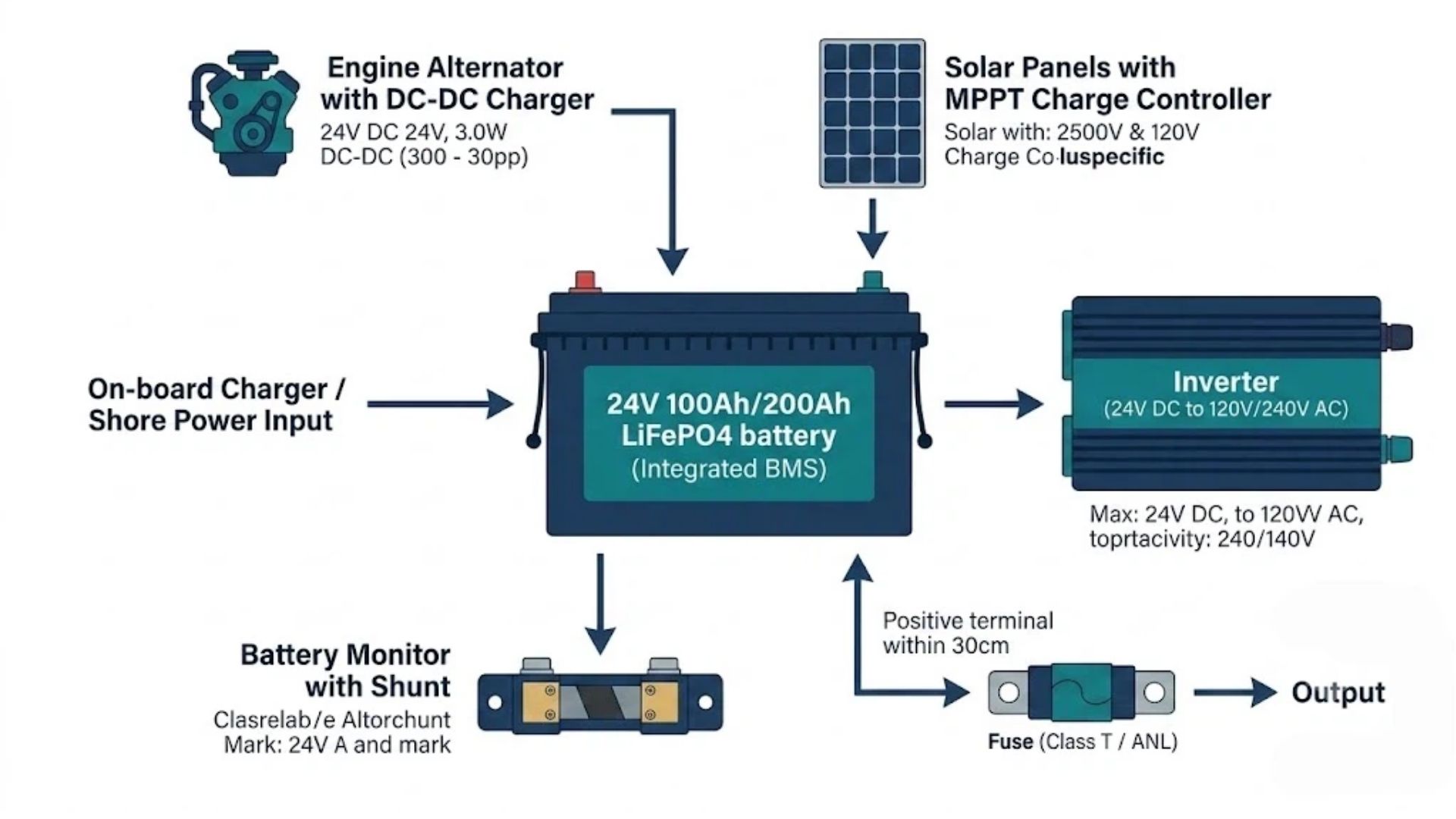
Proper installation ensures safety, performance, and battery life. For boat builders and marine installers, follow these best practices:
1. Cable Sizing: Use marine-grade tinned copper cable (not plain copper — tinned resists corrosion in salt air). Size for the maximum current: for 24V house banks with 50-100A inverters, use 4 AWG for runs under 3m, 2 AWG for 3-5m, and 1/0 AWG for runs over 5m. Undersized cable causes voltage drop, reduced inverter performance, and overheating — a particular safety concern in enclosed boat compartments.
2. Fuse Protection: Install a Class T fuse or ANL fuse rated at 125-150% of maximum expected current (typically 100-200A for 24V marine systems) within 30cm of the battery positive terminal. This is a critical safety requirement — it protects the boat from electrical fires caused by short circuits or damaged cables. Use marine-grade fuse holders with corrosion-resistant construction.
3. Battery Securing: Use marine-grade battery trays or strap systems rated for the battery weight (19kg for 100Ah, 34.5kg for 200Ah). Ensure the battery is secured against movement in rough seas and during vessel heel. A loose battery in a seaway can damage cables, terminals, bulkheads, or injure crew. LiFePO4 batteries can be mounted in any orientation (no liquid electrolyte), giving more flexible placement options than flooded lead-acid.
4. Parallel Wiring (for 2×100Ah = 200Ah): When wiring two 100Ah batteries in parallel to achieve 200Ah, connect positive to positive and negative to negative using equal-length marine-grade cable. Use a bus bar or parallel connector to ensure balanced current sharing. Both batteries should be the same model, age, and state of charge before paralleling. The resulting system charges at 29.2V (same as a single battery) but accepts double the charge current. For larger banks (400Ah+), use a battery management system that supports parallel configuration.
5. Series Wiring Warning: Do NOT wire two 24V batteries in series to make 48V unless both batteries are identical and you have a 48V-rated BMS system. For 24V marine house bank applications, only use parallel wiring (to increase capacity) or single battery operation. Never mix LiFePO4 and lead-acid batteries in the same bank — different charge voltages and discharge characteristics will cause one chemistry to overcharge or undercharge.
6. Ventilation: Unlike flooded lead-acid, LiFePO4 batteries produce zero gas during charging or discharging — no hydrogen, no off-gassing. This means they can be installed in enclosed compartments, under seats, in cabin lockers, or in engine rooms without ventilation requirements. This is a major advantage for boat builders — it eliminates the need for dedicated ventilated battery boxes and allows more flexible placement. However, always follow ABYC (American Boat and Yacht Council) standards and local regulations for battery installation.
7. Battery Monitor: Install a marine-grade battery monitor (Victron BMV, Xantrex Link, or similar) with a shunt on the negative terminal to accurately track state of charge, current flow, and remaining capacity. LiFePO4's flat voltage curve makes voltage-based state-of-charge estimation unreliable — a proper battery monitor with coulomb counting is essential for accurate battery management.
On-Board Charging Methods
A 24V LiFePO4 marine battery charges at 29.2 ± 0.2V (29.0V-29.4V) using a constant-current / constant-voltage (CC/CV) profile. Always use a charger with a dedicated LiFePO4/lithium mode — never a lead-acid charger (its equalization and desulfation modes can damage cells).
There are four common on-board charging methods for boats:
1. Shore Power / On-Board Charger: The most common method for boats kept at marinas. Use a marine-grade on-board charger with a dedicated LiFePO4/lithium mode (NOCO Genius, ProMariner ProSport, Xantrex Freedom XC, Guest ChargePro). Plug into shore power at the dock, charge overnight. For 100Ah: 20A charger = 5-6 hours; for 200Ah: 40-50A charger = 5-6 hours. Many modern marine chargers offer multiple battery banks and can charge both the house bank and starting battery simultaneously.
2. Engine Alternator: While running the engine, the alternator can charge the house battery via a battery combiner, VSR (voltage-sensitive relay), or DC-DC charger. Important: ensure the alternator regulator is LiFePO4-compatible — some older alternator regulators output 28.8V (for lead-acid), which is too low to fully charge LiFePO4 (needs 29.2V). A DC-DC charger (also called a DC-to-DC battery charger) is the safest and most efficient method — it takes the alternator's variable voltage output and converts it to a precise 29.2V CC/CV charge profile for LiFePO4. For boats with high-output alternators (100A+), a DC-DC charger is strongly recommended.
3. Solar: 200-400W of marine solar panels (flexible or rigid, mounted on bimini tops, davits, or cabin roofs) with a 24V MPPT charge controller (set to 29.2V bulk / 27.0V float) provides daily recharging while at anchor. A 300W array adds ~60-90Ah per day in full sun — enough to offset typical house loads (100-150W average) for indefinite anchorage. Use marine-grade solar panels with UV-resistant encapsulation and corrosion-resistant junction boxes. For bluewater cruising, solar is often the primary charging method while at anchor.
4. Portable Generator / Wind Generator: For extended off-grid cruising or vessels with limited solar exposure, a portable generator (with a LiFePO4-compatible battery charger) or marine wind generator provides supplementary charging. Generators are useful for high-demand periods (running inverter loads, recharging after cloudy days) but are noisy and consume fuel. Wind generators are silent and work day and night but are less predictable and require mounting at height. For most recreational boats, a combination of shore power (at dock), alternator (underway), and solar (at anchor) provides complete charging coverage.
Charging best practices for marine: Avoid charging below 0°C (32°F) — the BMS includes low-temperature charge cutoff. For long-term storage (winter layup), charge to 50-70% state of charge, disconnect from loads, and store in a cool, dry place. LiFePO4 has very low self-discharge (1-3% per month), so a battery stored at 50% will still have 30-40% charge after 6 months. For a complete guide to charging 24V LiFePO4 batteries, see our charging guide in the 24V LiFePO4 Battery Complete Guide.
Safety & Certifications
For marine applications, safety and regulatory compliance are non-negotiable. Verify these certifications and safety features:
1. CE Certification: Required for sale and use in the European Union and many other markets. CE marking indicates conformity with health, safety, and environmental protection standards. All Enerbe 24V marine LiFePO4 batteries are CE certified.
2. UN38.3: Required for international shipping of lithium batteries by air, sea, or land. UN38.3 certification verifies the battery has passed altitude simulation, thermal testing, vibration, shock, external short circuit, impact, overcharge, and forced discharge tests. This is essential for B2B buyers importing batteries for boat building or retail.
3. RoHS: Restriction of Hazardous Substances — limits the use of lead, mercury, cadmium, and other hazardous materials in electrical and electronic equipment. LiFePO4 chemistry is inherently RoHS-compliant (no lead, no cadmium, no mercury).
4. MSDS / SDS: Material Safety Data Sheet (now called Safety Data Sheet) — required for transportation and handling of lithium batteries. Provides information on hazards, safe handling, emergency procedures, and disposal. Enerbe provides full MSDS/SDS documentation for all marine batteries.
5. UL 1973 (for North American installations): UL 1973 is the standard for batteries for use in stationary applications, including marine and RV. While not universally required for aftermarket marine batteries, UL 1973 certification is increasingly required by marine surveyors, insurance companies, and boat builders for new vessel construction. Enerbe offers UL 1973-certified options for volume buyers.
6. ABYC Compliance: The American Boat and Yacht Council (ABYC) publishes standards for electrical systems on boats. While ABYC doesn't specifically certify batteries, ensuring your battery installation follows ABYC E-10 (Storage Batteries) and E-11 (AC and DC Electrical Systems) standards is essential for safety, insurance, and resale value. Key ABYC requirements include: proper fuse protection, battery securing, cable sizing, and battery disconnect switches.
7. BMS Safety Features: The Battery Management System is the primary safety component. Verify: over-voltage protection (cuts charging above 29.6V), under-voltage protection (cuts discharge below 20V), over-current protection (cuts discharge above rated continuous current), short-circuit protection (instant cutoff on short circuit), over-temperature protection (cuts charge/discharge above 60°C), and low-temperature charge cutoff (prevents charging below 0°C). A quality BMS also includes cell balancing to ensure all cells charge and discharge evenly, maximizing battery life and safety.
Frequently Asked Questions
Q: What is the best 24V lithium battery for marine use?
A: The best is a LiFePO4 (lithium iron phosphate) battery rated 24V (25.6V nominal) with marine-grade construction: IP65+ ingress protection, corrosion-resistant stainless terminals, vibration-resistant enclosure, and BMS with low-temperature charge cutoff. LiFePO4 offers 3,000+ cycles (10x AGM), 60% less weight, zero maintenance, zero off-gassing, and consistent voltage. For 100-300Wh daily loads, 24V 100Ah (2,560Wh, 19kg) is sufficient; for 300-800Wh (cruisers, liveaboards), choose 24V 200Ah (5,120Wh, 34.5kg) or 2×100Ah parallel. Enerbe manufactures marine-grade 24V LiFePO4 batteries with IP65, M8 stainless terminals, and full CE/UN38.3/RoHS certification.
Q: How long will a 24V 100Ah lithium battery last on a boat?
A: A 24V 100Ah LiFePO4 stores 2,560Wh. Runtime: minimal load (LED, phone, VHF — 50-80W) = 28-40 hours (1.5-2 days); moderate load (fridge, GPS, fishfinder, pump — 100-200W) = 10-20 hours (overnight); heavy load (inverter, microwave — 500-1000W) = 2-4 hours. A typical cruising boat with 100-150W average gets 15-20 hours from a single 100Ah — enough for an overnight anchorage. For multi-day cruising, use 200Ah (5,120Wh) or 2×100Ah parallel with 200-400W solar for daily recharging. AGM provides only 50% usable capacity, so runtime is roughly half with voltage sag.
Q: Can I replace my 24V lead-acid marine battery with lithium?
A: Yes — LiFePO4 is a direct drop-in replacement for 24V lead-acid (flooded, AGM, gel) in most applications. Nominal voltage is compatible (25.6V LiFePO4 vs 24V lead-acid), physical footprint is similar or smaller, and weight is 60% less. Three changes required: (1) Charger — MUST use LiFePO4-compatible charger set to 29.2V (not 28.8V for lead-acid); lead-acid equalization/desulfation modes damage LiFePO4. (2) Alternator regulator — ensure LiFePO4-compatible or install DC-DC charger; some older regulators undercharge LiFePO4. (3) Low-voltage cutoff — LiFePO4 BMS cuts at 20V; ensure inverter/electronics operate down to 20V. No ventilation required (zero gas), any mounting orientation. This is a high-value upgrade for boat builders.
Q: What size 24V lithium battery do I need for my boat?
A: Size based on daily energy consumption (Wh) and desired autonomy. Calculate daily load = sum of all house loads (watts × hours/day). Apply 85% usable DoD for LiFePO4. Typical: day boat/center console (50-100Wh/day) = 24V 50-100Ah; fishing boat/weekender (100-300Wh, fridge + electronics + trolling motor) = 24V 100Ah min, 200Ah recommended; cruising sailboat/trawler (300-800Wh, full house loads + inverter) = 24V 200Ah or 2×100Ah parallel; large yacht/liveaboard (800+Wh, AC + appliances) = 24V 400Ah+ or 48V system. Rule of thumb: 100Ah covers 80% of recreational boats; 200Ah covers serious cruisers. Both fit most Group 31/8D compartments (100Ah: 522×240×220mm, 200Ah: 522×269×220mm).
Q: How do you charge a 24V lithium marine battery on board?
A: Charge at 29.2 ± 0.2V using CC/CV profile. Four methods: (1) Shore power/on-board charger — marine-grade charger with LiFePO4 mode (NOCO, ProMariner, Xantrex); 20A = 5-6hrs for 100Ah, 40-50A = 5-6hrs for 200Ah. (2) Engine alternator — via battery combiner, VSR, or DC-DC charger; ensure LiFePO4-compatible regulator or use DC-DC charger (safest method). (3) Solar — 200-400W marine panels + 24V MPPT controller (29.2V bulk/27.0V float); 300W adds 60-90Ah/day in full sun. (4) Generator/wind — supplementary for extended off-grid. NEVER use lead-acid charger on LiFePO4. Avoid charging below 0°C. Maintenance is zero: no watering, equalization, or terminal cleaning.
Summary
A 24V lithium marine battery (LiFePO4) is the most impactful electrical upgrade for any 24V boat — 60% lighter, 10x longer cycle life, zero maintenance, zero off-gassing, and consistent voltage from full to nearly empty. For boat builders, marine dealers, yacht manufacturers, and marina operators, it reduces vessel weight, increases usable house capacity, eliminates maintenance, and creates a high-margin upgrade sale.
When sourcing at volume, prioritize true LiFePO4 chemistry with A-grade cells, IP65+ marine-grade construction, corrosion-resistant stainless terminals, vibration-resistant enclosure, BMS with low-temperature charge cutoff, 3,000+ cycle life with test data, full certifications (CE, UN38.3, RoHS, MSDS, UL 1973 option), and direct manufacturer sourcing. Enerbe manufactures marine-grade 24V 100Ah and 200Ah LiFePO4 batteries with all of the above, offers OEM/ODM private label for boat builders and marine dealers, and provides wholesale pricing for volume buyers.
For the broader 24V LiFePO4 lineup, see our 24V LiFePO4 Battery Complete Guide, 24V 100Ah Guide, 24V 200Ah Guide, and 24V Trolling Motor Battery Guide.
Get In Touch
Ready to source LiFePO4 batteries for your project? Contact Enerbe today.
📄 Request a Technical Datasheet
Contact Us →📞 Speak with Our Engineering Team
Get In Touch →🔗 Browse Our Custom Battery Solutions
View Products →Dongguan A&S Power Technology Co., Limited.
Building 1, No. 2, Keji 9th Road,
Songshan Lake, Dongguan, Guangdong, China
📞 +86 137 1383 1631
✉ info@aspowerbattery.com
Stay Charged. Stay Connected.



24V LiFePO4 Battery: The Complete Guide for B2B Buyers
24V Lithium Trolling Motor Battery: Complete Guide for Buyers
Related Article



Get In Touch
Have questions about custom lithium batteries, energy storage solutions, or lead-to-lithium conversion? Our team is ready to help. Send us a message and we’ll respond within 24 hours.

Building 1, No. 2, Keji 9th Road, Songshan Lake, Dongguan, Guangdong, China
Office Address

info@aspowerbattery.com
Email Us

+86 137 1383 1631
Call Us

Sun - Fri (08AM - 10PM)
Office Open
