
How to Test LiFePO4 Battery Capacity – A Complete Guide
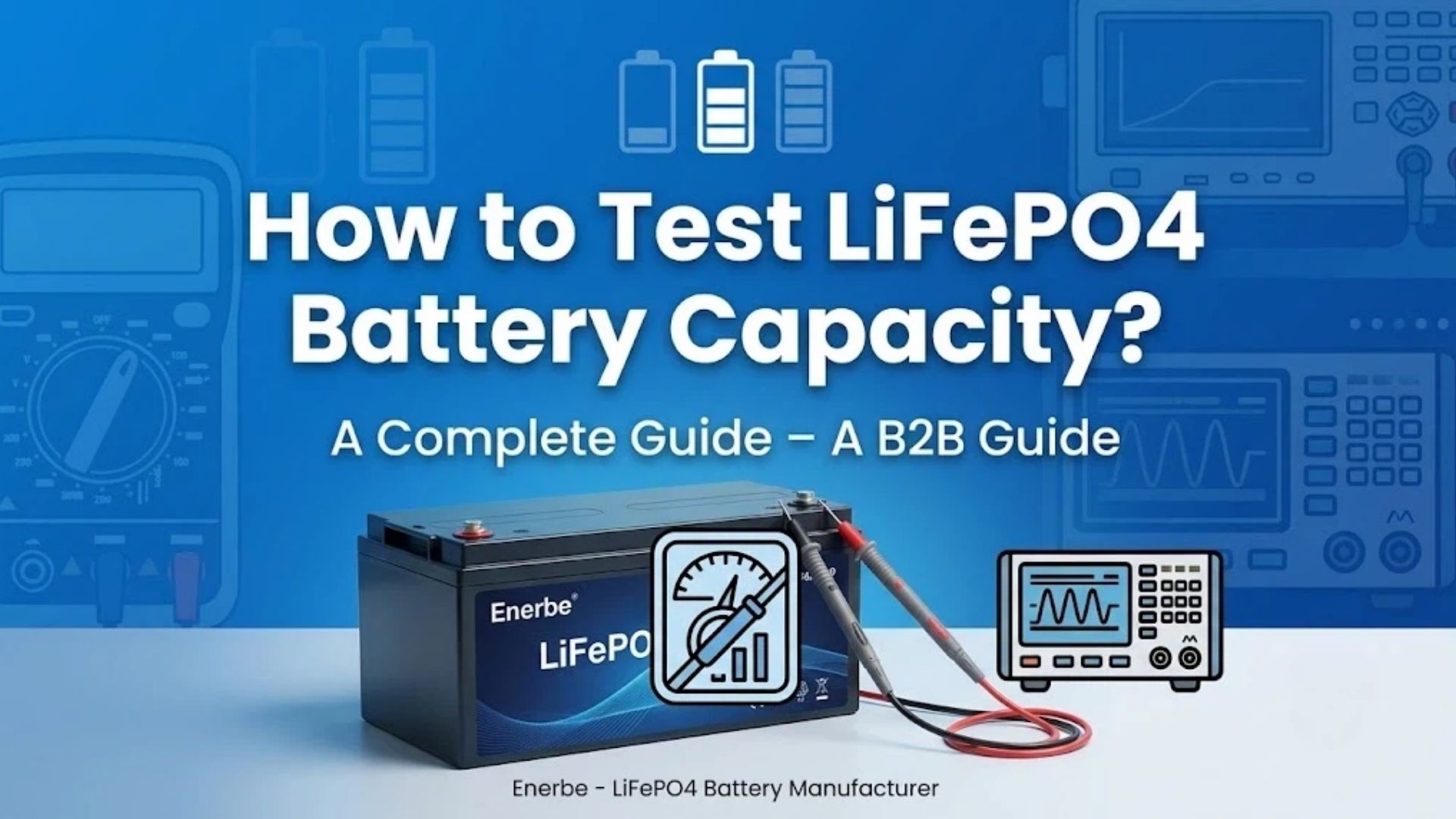
Table of Contents
- Introduction: Why Test Battery Capacity?
- Understanding Battery Capacity
- Method 1: BMS Capacity Reading (Easiest)
- Method 2: Load Test (Most Accurate)
- Method 3: Charging Cycle Test
- How Often Should You Test LiFePO4 Battery Capacity?
- Signs Your Battery Needs Testing
- B2B Procurement Checklist
- Frequently Asked Questions
- Summary
Introduction: Why Test Battery Capacity?
For B2B buyers, fleet operators, and system integrators, battery capacity is a key indicator of performance and return on investment.
Testing LiFePO4 battery capacity helps you:
-
Track degradation — know when to replace batteries
-
Verify supplier claims — confirm the battery delivers what was promised
-
Plan maintenance — schedule replacements before failure
-
Calculate ROI — know exactly how much energy you're getting
For a complete overview of LiFePO4 battery sourcing across all applications, see our B2B Sourcing Guide.
Understanding Battery Capacity
What Is Capacity?
Battery capacity is the total amount of energy a battery can store, measured in amp-hours (Ah) or watt-hours (Wh).
| Term | Definition | Example |
|---|---|---|
| Rated Capacity | What the manufacturer claims | 100Ah |
| Usable Capacity | What you can actually use (80-100% of rated) | 80-100Ah |
| Measured Capacity | What a test shows | 95Ah (95% SoH) |
The 80% Rule: A LiFePO4 battery is considered "end of life" when its measured capacity falls below 80% of its rated capacity.
For example: A 100Ah battery with a measured capacity of 75Ah should be replaced.
For more information on battery lifespan, see our LiFePO4 Battery Lifespan Guide.
Method 1: BMS Capacity Reading (Easiest)
Many LiFePO4 batteries have a BMS that reports State of Health (SoH).
| BMS Data | What It Shows | How to Access |
|---|---|---|
| State of Health (SoH) | Current capacity as % of rated | CAN bus, RS485, Bluetooth app |
| Total Cycle Count | Number of charge/discharge cycles | BMS internal log |
| Cell Voltage Variance | Any imbalance between cells | BMS monitoring software |
Step-by-Step:
-
Connect to the BMS using the manufacturer's app or software
-
Find the State of Health (SoH) reading
-
SoH of 80% or higher = healthy battery
-
SoH below 80% = battery should be replaced
B2B Buying Tip: When sourcing batteries, specify that you require a BMS with SoH reporting. This makes fleet monitoring much easier.
Note: BMS SoH readings are estimates, not exact measurements. For accurate verification, use Method 2 or 3.
Method 2: Load Test (Most Accurate)

A load test provides the most accurate capacity measurement by simulating real-world usage.
What You'll Need
| Equipment | Purpose |
|---|---|
| Known load | e.g., a resistive load, heater, or inverter driving a load |
| Voltage meter | To measure voltage during the test |
| Current meter or clamp meter | To measure current draw |
| Stopwatch or timer | To track test duration |
Step-by-Step Capacity Test
Step 1: Full Charge
-
Charge the battery to 100% using a LiFePO4-specific charger
-
Allow the battery to rest for 30 minutes
Step 2: Apply a Known Load
-
Apply a constant load to the battery
-
Record the exact current draw (e.g., 20A)
Step 3: Measure Time
-
Start the timer
-
Record the time until the battery voltage drops to the cut-off voltage (typically 10.0V for a 12V system)
Step 4: Calculate Capacity
-
Capacity (Ah) = Current (A) × Time (hours)
-
Example: 20A × 5 hours = 100Ah
Step 5: Calculate State of Health (SoH)
-
SoH (%) = (Measured Capacity ÷ Rated Capacity) × 100
-
Example: (95Ah ÷ 100Ah) × 100 = 95% SoH
Example Test
| Parameter | Value |
|---|---|
| Rated Capacity | 100Ah |
| Load Current | 20A |
| Run Time | 4.5 hours |
| Measured Capacity | 20A × 4.5h = 90Ah |
| State of Health | (90 ÷ 100) × 100 = 90% |
Result: The battery is at 90% SoH—still healthy, but showing some degradation.
Method 3: Charging Cycle Test (For BMS-Equipped Batteries)
Some BMS units track capacity by measuring energy during charging.
Procedure:
-
Discharge the battery to the recommended cut-off voltage
-
Charge the battery to 100% using a LiFePO4-specific charger
-
The BMS (or a battery monitor) will display the energy (Ah) put back into the battery
-
This value represents the battery's usable capacity
How Often Should You Test LiFePO4 Battery Capacity?
| Application | Recommended Frequency |
|---|---|
| Fleet operations | Every 3-6 months |
| Solar storage | Every 6-12 months |
| Industrial equipment | Every 3 months |
| UPS backup | Once per year |
| High-cycle applications | Every 2-3 months |
Testing frequency should increase as the battery approaches its expected cycle life.
Signs Your Battery Needs Testing
| Sign | What It Means |
|---|---|
| Reduced runtime | Battery doesn't last as long as it used to |
| BMS warning codes | SoH reading below 80% |
| Voltage drop under load | Battery can't maintain voltage during high current draw |
| Longer charging times | Battery takes longer to charge than before |
| Unexpected shutdowns | System shuts down before expected SoC |
B2B Procurement Checklist
When sourcing LiFePO4 batteries with capacity testing requirements, verify:
- Does the BMS provide SoH reporting?□
-
Is the communication protocol compatible with your monitoring system?□
-
Does the supplier provide capacity test reports for each battery?□
-
What is the warranty coverage for capacity degradation?□
-
Are there recommended testing procedures for your specific application?
Frequently Asked Questions
Q1: How do I know if my LiFePO4 battery needs capacity testing?
Test if you notice reduced runtime, BMS warnings, voltage drops under load, or as part of routine maintenance (every 6-12 months).
Q2: What is a good State of Health (SoH) reading?
Any SoH reading above 80% is considered healthy. Below 80% means the battery is approaching end of life and should be replaced.
Q3: How long does a capacity test take?
Testing can take several hours, depending on the discharge current. A typical 100Ah battery at 20A discharge will take approximately 5 hours.
Q4: Can I test capacity without specialized equipment?
Yes—using a known load (like a household appliance or heater) and measuring current and time will give you a good estimate. For best accuracy, use a dedicated battery tester.
Q5: What equipment do I need for capacity testing?
A known load (resistive load or inverter with load), voltage meter, current meter or clamp meter, and a stopwatch or timer.
Summary
Testing LiFePO4 battery capacity is straightforward and essential for maximizing ROI:
| Method | Accuracy | Equipment Needed |
|---|---|---|
| BMS SoH Reading | Good (estimate) | BMS software or app |
| Load Test | Excellent | Known load, voltmeter, ammeter |
| Charging Cycle Test | Good | Compatible charger, battery monitor |
Regular capacity testing helps you track degradation, plan replacements, and ensure system reliability. A State of Health below 80% indicates it's time to replace your battery.
Enerbe provides LiFePO4 batteries with advanced BMS that includes SoH reporting and full protection features. For wholesale pricing, custom configurations, or technical support, contact our team.
All technical information in this guide is provided for informational purposes. Testing procedures may vary by manufacturer.
Get In Touch
Ready to source LiFePO4 batteries for your project? Contact Enerbe today.
📄 Request a Technical Datasheet
Contact Us →📞 Speak with Our Engineering Team
Get In Touch →🔗 Browse Our Custom Battery Solutions
View Products →Dongguan A&S Power Technology Co., Limited.
Building 1, No. 2, Keji 9th Road,
Songshan Lake, Dongguan, Guangdong, China
📞 +86 137 1383 1631
✉ info@aspowerbattery.com
Stay Charged. Stay Connected.



LiFePO4 Battery Storage and Maintenance Guide
25.6V 100Ah LiFePO4 Battery – A Complete B2B Sourcing Guide
Related Article


Get In Touch
Have questions about custom lithium batteries, energy storage solutions, or lead-to-lithium conversion? Our team is ready to help. Send us a message and we’ll respond within 24 hours.

Building 1, No. 2, Keji 9th Road, Songshan Lake, Dongguan, Guangdong, China
Office Address

info@aspowerbattery.com
Email Us

+86 137 1383 1631
Call Us

Sun - Fri (08AM - 10PM)
Office Open
