
Do Lithium Batteries Work in Cold Weather? Complete LiFePO4 Winter Guide (2026)

Table of Contents
- Introduction: Do Lithium Batteries Work in Cold Weather?
- Why Cold Weather Is Hard on Batteries
- How Cold Changes Capacity and Performance
- LiFePO4 vs AGM vs Lead-Acid in the Cold
- The Real Risk: Charging LiFePO4 Below Freezing
- Self-Heating LiFePO4 Batteries
- Keeping the Pack Warm: Insulation and Heaters
- Cold-Weather Charging Rules
- Winter Storage
- Cold-Weather Use by Application
- Sizing for Cold Weather
- B2B Sourcing: Specifying Winter Packs
- Frequently Asked Questions
- Related Resources
- Summary
Do Lithium Batteries Work in Cold Weather? Complete LiFePO4 Winter Guide (2026)
Last updated: September 2026 | Written by the Enerbe Engineering Team
Introduction: Do Lithium Batteries Work in Cold Weather?
Short answer: Yes, you can use a LiFePO4 battery in the cold, and it will usually outperform lead-acid at the same temperature. The catch is charging. A standard LiFePO4 pack should not be charged below about 0°C (32°F); doing so can plate metallic lithium onto the cells and cause permanent damage. The BMS will normally block charging until the pack warms up. For winter travel, the clean fix is a self-heating battery that warms itself before it accepts a charge. Discharging is less restricted—most packs can discharge well below freezing—but available capacity drops as the temperature falls, so size the bank a little larger.
If you've spent time off-grid in winter, you've probably watched a battery that worked fine in October struggle by January. Lights dim, the refrigerator cycles differently, and a bank that used to last two nights runs out in one. Most of that traces back to one thing: batteries are electrochemical devices, and cold slows the chemistry that stores and releases energy.
This guide explains what cold actually does to a LiFePO4 pack, where the real danger lies (it's not what most people assume), how self-heating and insulation solve it, and how to charge and store the battery through winter. It's written for owners upgrading an RV, boat or off-grid system and for the builders and dealers who spec batteries for cold climates.
Why Cold Weather Is Hard on Batteries
Inside every lithium battery, charged lithium ions move through the electrolyte and settle into the electrode materials. That movement depends on temperature. When it gets cold, three things happen at once:
-
The electrolyte thickens, so lithium ions move more slowly and meet more resistance.
-
The electrodes accept and release ions less readily, because the reactions at their surface slow down.
-
The battery's internal resistance rises, so pushing current in or out generates more heat and wastes more energy.
None of this is unique to lithium—lead-acid suffers the same effects, often more sharply. The practical result is that a cold battery behaves like a smaller, more sluggish version of itself. Warm it back up and the capacity returns. That last point matters: the temporary loss from being cold is not damage, and it reverses when the temperature does.
The structure that makes LiFePO4 stable through all of this—its olivine crystal lattice—is covered in our page on LFP chemistry and crystal structure.
How Cold Changes Capacity and Performance
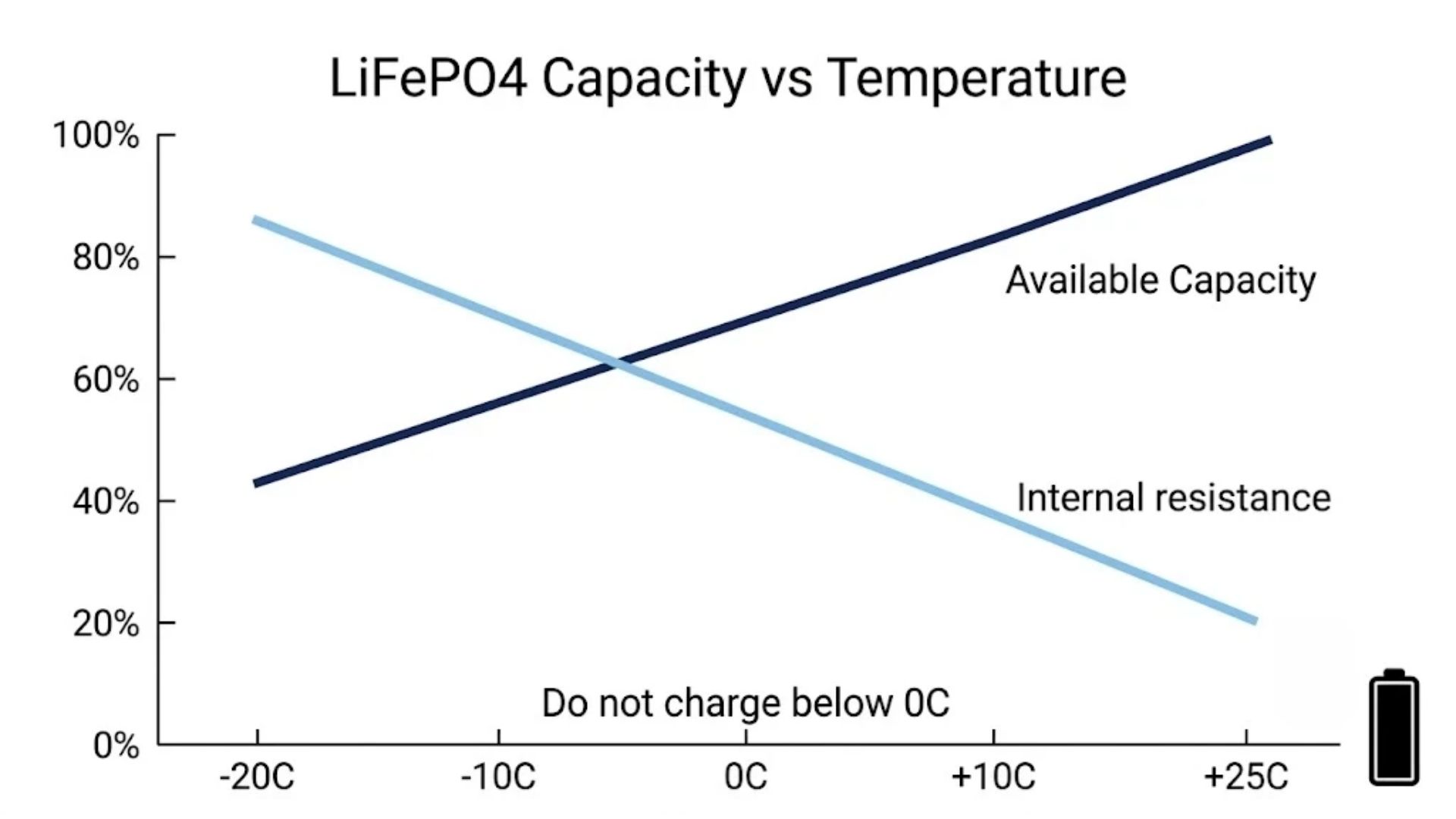
The colder it gets, the less energy you can pull from the pack, and the effect gets worse at high current. A battery that delivers its full rated capacity at room temperature might give you only a fraction of it at −20°C, especially under a heavy load like an inverter or a compressor.
The exact figures vary a lot from one pack to another, which is why we don't quote a single universal number here. The honest approach is to check the manufacturer's capacity-vs-temperature curve for the specific model and the discharge rate you'll actually use. Two things are consistent across almost every pack:
-
The drop is modest near freezing and steepens sharply well below it.
-
Low-current loads (LEDs, electronics) fare far better than high-current ones (motors, inverters, air conditioning).
If you want reliable numbers for sizing, ask the supplier for the capacity curve at the temperatures and currents your application sees. A spec that only lists capacity at 25°C doesn't tell you how the battery will behave in a January battery bay.
LiFePO4 vs AGM vs Lead-Acid in the Cold
No chemistry likes the cold, but they don't handle it equally. Here is how the common options compare in winter use.
| In cold weather | LiFePO4 | AGM | Flooded lead-acid |
|---|---|---|---|
| Discharge below freezing | Good, down to rated limit | Reduced | Reduced most |
| Charge acceptance | Blocked below ~0°C by BMS | Poor when cold | Worst |
| Freezing risk | Electrolyte does not freeze in normal range | Low | Can freeze if discharged |
| Maintenance | None | Low | Watering, freeze checks |
Flooded lead-acid has a specific winter failure that lithium doesn't: as it discharges, its electrolyte weakens and its freezing point rises, so a partly discharged lead-acid battery can actually freeze and crack. LiFePO4 has no equivalent failure. Its one limitation—the cold-charge cutoff—is at least a controlled one, enforced by the BMS rather than left to chance. The broader chemistry trade-offs are in the LFP vs other chemistries comparison and the lithium vs deep-cycle guide.
The Real Risk: Charging LiFePO4 Below Freezing
Discharging a cold LiFePO4 battery is generally fine. Charging one is not. This is the single most important rule in this guide.
When you charge a lithium battery, lithium ions travel to the negative electrode and are supposed to insert themselves neatly into it. In the cold, that insertion slows down. If you keep forcing charge current, the ions that can't find a place in the electrode instead pile up as metallic lithium on its surface. This is called lithium plating, and it causes two problems:
-
It is largely irreversible, so the capacity tied up in that plated lithium is lost.
-
The plated metal can grow into sharp, needle-like structures that may pierce the separator and create an internal short—a genuine safety fault.
A good BMS prevents this by refusing to charge below the pack's rated minimum charge temperature, typically around 0°C. If you wake on a freezing morning, plug in, and find that the battery simply won't take charge, that is the protection working—not a fault. The pack is waiting to warm up. The general safety background, including what happens when cells are abused, is covered in the are LiFePO4 batteries safe guide.
Self-Heating LiFePO4 Batteries
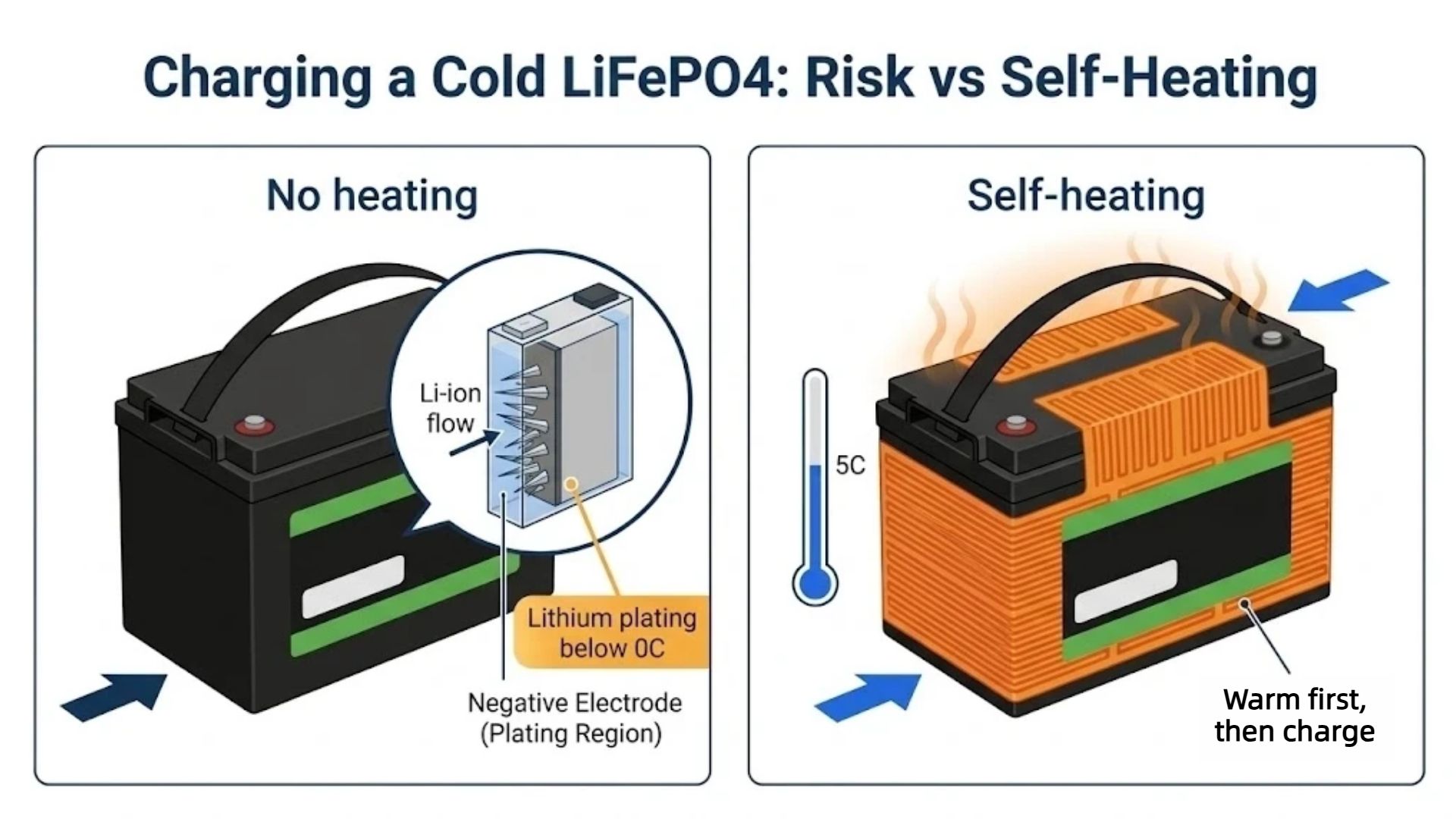
A self-heating pack removes the cold-charge problem without any action from you. Built-in heating elements—usually thin heating films bonded to the cells or the pack—switch on automatically when charging is requested and the cells are below the safe temperature. The pack warms itself to the threshold, then begins a normal charge.
Depending on the design, the heater draws power from the charging source, the battery itself, or both. A well-designed system sequences this so it never drains a cold battery trying to heat itself, and it verifies cell temperature before allowing charge. For anyone who camps, sails or runs solar through real winters, self-heating is the feature that turns lithium from "great until it freezes" into a year-round battery.
It is worth asking how the heating is controlled, not just whether it exists. Better packs heat the cells evenly, report heater status, and fall back safely if a heater fails.
Keeping the Pack Warm: Insulation and Heaters
If your battery isn't self-heating, you can still reduce the problem by managing where it sits and how it's protected. These are the practical measures that make the most difference:
-
Keep the battery inside the heated envelope of the vehicle rather than in an exposed bay, where practical.
-
Insulate the battery compartment against cold walls and drafts, while leaving the airflow the pack needs.
-
Use a thermostatically controlled heating pad if you run on shore power through winter.
-
Charge during the warmer part of the day, after the pack has had time to rise above freezing.
The goal isn't to make the battery hot, just to keep it above the charge cutoff and slow the capacity loss. A few degrees of insulation often decide whether a morning charge happens at all.
Cold-Weather Charging Rules
An RV or off-grid system can charge from the alternator, solar or shore power, and each source behaves differently in winter. The rule behind all of them is simple: don't push charge into a pack that's below its minimum charge temperature.
| Source | Winter note |
|---|---|
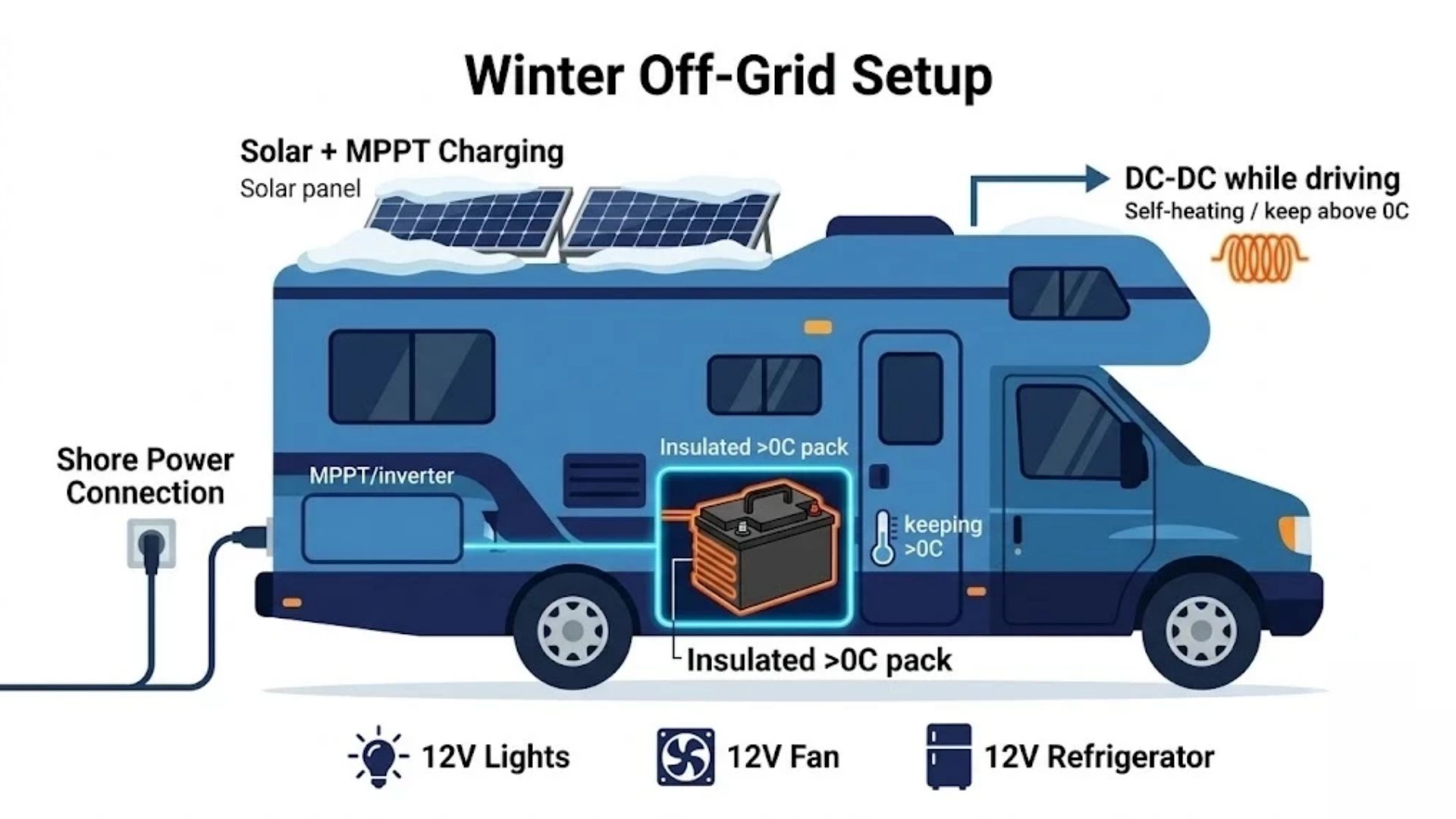
| Driving / alternator (DC-DC) | A cold start may not charge the house pack until it warms; the DC-DC charger and BMS should respect the cutoff. |
| Solar / MPPT | Clear snow and angle panels for low sun; the controller won't charge a frozen pack, so morning output can be delayed. |
| Shore power / converter | Use a lithium profile; a heating pad can run from shore power so the pack is ready to charge. |
The voltages, charge stages and the role of the constant-voltage phase are set out in the how to charge LiFePO4 guide, and commercial and multi-rack setups are covered in the commercial charging guide.
Winter Storage
Putting an RV or boat away for the winter is a slightly different job from using it in the cold. The aim is to store the battery in a state that protects it without asking it to do anything over the idle months.
-
Store at the charge level the manufacturer recommends, commonly around half charge rather than full or empty.
-
Choose a dry, reasonably temperate place; avoid leaving the pack in a location that swings far below freezing if you can.
-
Check it periodically and top up if the charge has drifted down.
-
Disconnect loads so nothing slowly drains the pack while it sits.
A LiFePO4 battery self-discharges only a few percent a month, so it doesn't need much attention over a normal winter, but a pack left fully discharged for a long time can be driven into a deep, hard-to-recover state. The full routine is in the LiFePO4 storage and maintenance guide and the how to store LiFePO4 batteries guide.
Cold-Weather Use by Application
RVs and campers
Winter camping is where self-heating earns its keep. A frozen house pack won't charge from morning solar or the drive until it warms, which is exactly when you want heat and lighting. Specify a self-heating pack, keep the bay insulated, and run a shunt monitor so you know the real state of charge rather than guessing from voltage. Owners who dry-camp through late autumn and winter usually consider the heater essential rather than optional.
Solar off-grid
Winter solar is a mixed picture. Panels actually work a little more efficiently in cold air, but the days are short, the sun sits low, and snow can cover the array. Size for the worst month rather than the annual average, clear the panels, and remember the controller will hold off charging until the battery warms. The sizing details are in the solar battery storage guide.
Marine
Sailing or living aboard in cold water brings the same rules: discharge is manageable, charging needs a warm pack, and winter lay-up follows the storage steps above. The boat-specific details are in the marine LiFePO4 guide.
Sizing for Cold Weather
If a system will spend real time below freezing, size it on the capacity actually available at those temperatures, not the 25°C rating. Two adjustments cover most of the gap:
-
Add headroom for the capacity the cold removes, so the bank still covers your daily load on the coldest days.
-
Avoid planning to run the pack to empty, which matters more in winter and under heavy loads.
The practical way to do this is to take your normal daily amp-hour figure, then scale it up using the supplier's capacity curve at your winter temperature and discharge rate. A bank that's exactly right in mild weather will come up short in January; a modest over-spec is cheaper than running out. General sizing, including the load-table method, is in the battery sizing guide.
B2B Sourcing: Specifying Winter Packs
For builders, brands and dealers selling into cold climates, the spec sheet needs to answer more than the room-temperature numbers. These are the points to pin down with a supplier:
-
The rated charge and discharge temperature ranges, and the low-temp charge cutoff.
-
Whether self-heating is available, how it's powered and controlled, and how it behaves if it fails.
-
A capacity-vs-temperature curve at the discharge currents your application uses.
-
Whether the BMS reports temperature and heater status, and how it logs cold-charge events.
-
Storage guidance for end users who lay the equipment up over winter.
The wider evaluation of a manufacturer—cell quality, BMS, certifications, consistency and support—follows the process in how to choose a LiFePO4 supplier, the wholesale sourcing guide and the end-to-end B2B sourcing guide.
Frequently Asked Questions
Do lithium batteries work in cold weather?
Yes, for discharge. A LiFePO4 battery will run below freezing and usually does better than lead-acid at the same temperature, though available capacity falls as it gets colder. The limitation is charging: a standard pack shouldn't be charged below about 0°C, and the BMS will block it. A self-heating battery clears that limitation.
Does cold weather hurt lithium batteries?
Being cold temporarily reduces capacity and raises resistance, but that reverses when the battery warms and isn't permanent damage. The lasting harm comes from charging a frozen pack, which can plate lithium onto the cells, and from leaving a battery discharged for a long time. Avoid those two and normal cold use is fine.
What happens if you charge a LiFePO4 battery below freezing?
Lithium ions that can't enter the cold negative electrode may plate out as metallic lithium instead. That loses capacity and can grow into structures that pierce the separator and cause an internal short. A good BMS prevents it by refusing charge below the rated temperature, typically around 0°C.
How does a self-heating LiFePO4 battery work?
Heating films or elements inside the pack switch on when charging is requested below the safe temperature. The battery warms itself to the threshold, then starts a normal charge, with no action from you. The heater is usually powered from the charge source, the battery, or both, and is sequenced so it doesn't drain a cold pack.
Are lithium batteries better than lead-acid in winter?
For most winter use, yes. LiFePO4 discharges well in the cold, needs no watering, and can't freeze the way a discharged flooded lead-acid battery can. Its cold-charge cutoff is a controlled protection; lead-acid simply loses charge acceptance and risks freezing as it discharges. The main trade-off is the higher upfront price.
How cold is too cold for a LiFePO4 battery?
It depends on the model, so check the rated ranges. Most packs can discharge to around −20°C, but standard packs shouldn't be charged below about 0°C. Well below the rated discharge limit, capacity and voltage drop sharply and high-current loads become hard to sustain. A self-heating pack extends the usable range in winter.
How do I keep my RV battery warm in winter?
Keep it inside the heated part of the RV if you can, insulate the battery bay, and use a thermostatically controlled heating pad on shore power or a self-heating battery. Charge during the warmer part of the day and use a monitor to track the real state of charge.
Can I store a LiFePO4 battery in a cold garage?
A dry, cool garage is usually fine for storage; the battery doesn't need to be room temperature. Store it around half charge, disconnect loads, and check it now and then. Avoid leaving it fully discharged, and don't expose it to prolonged deep cold if a milder spot is available.
Does solar charge lithium in winter?
It can, but the days are short and the sun is low, and the controller will hold off until the battery warms above freezing. Clear snow off the panels, angle them for winter sun, and size the array for the worst month rather than the average.
Why won't my lithium battery charge when it's freezing?
That's the BMS following its low-temperature cutoff to prevent lithium plating. It isn't a fault. Warm the pack above the threshold—with a self-heating pack, an external heater, or simply the warmer part of the day—and charging will resume.
Related Resources
-
How to Charge LiFePO4 Batteries — voltages and stages
Summary
LiFePO4 works in winter as long as you separate discharge from charging.
-
Cold temporarily lowers capacity and raises resistance; that reverses when it warms.
-
Don't charge below about 0°C, or lithium can plate onto the cells. The BMS enforces this.
-
A self-heating pack, insulation and a heating pad are the practical fixes.
-
Store around half charge, disconnected and dry, and check it through the winter.
-
Size for the coldest month and the capacity actually available at those temperatures.
Enerbe supplies LiFePO4 batteries with self-heating options, low-temperature charge protection and the capacity data that winter applications need. For specifications, samples or volume pricing, contact our team or browse the product range.
Get In Touch
Need self-heating LiFePO4 batteries for winter use, samples or volume pricing? Contact Enerbe today.
📄 Request Datasheet & Certifications
Contact Us →📞 Speak With Our Engineering Team
Get In Touch →🔗 Browse Certified LiFePO4 Products
View Products →Dongguan A&S Power Technology Co., Limited.
Building 1, No. 2, Keji 9th Road,
Songshan Lake, Dongguan, Guangdong, China
📞 +86 137 1383 1631
✉ info@aspowerbattery.com
Stay Charged. Stay Safe.



Telecom Battery Guide: 48V LiFePO4 Backup for Cell Towers & B2B Buyers (2026)
Related Article


Get In Touch
Have questions about custom lithium batteries, energy storage solutions, or lead-to-lithium conversion? Our team is ready to help. Send us a message and we’ll respond within 24 hours.

Building 1, No. 2, Keji 9th Road, Songshan Lake, Dongguan, Guangdong, China
Office Address

info@aspowerbattery.com
Email Us

+86 137 1383 1631
Call Us

Sun - Fri (08AM - 10PM)
Office Open
