
What Size LiFePO4 Battery Do I Need? – A B2B Sizing Guide
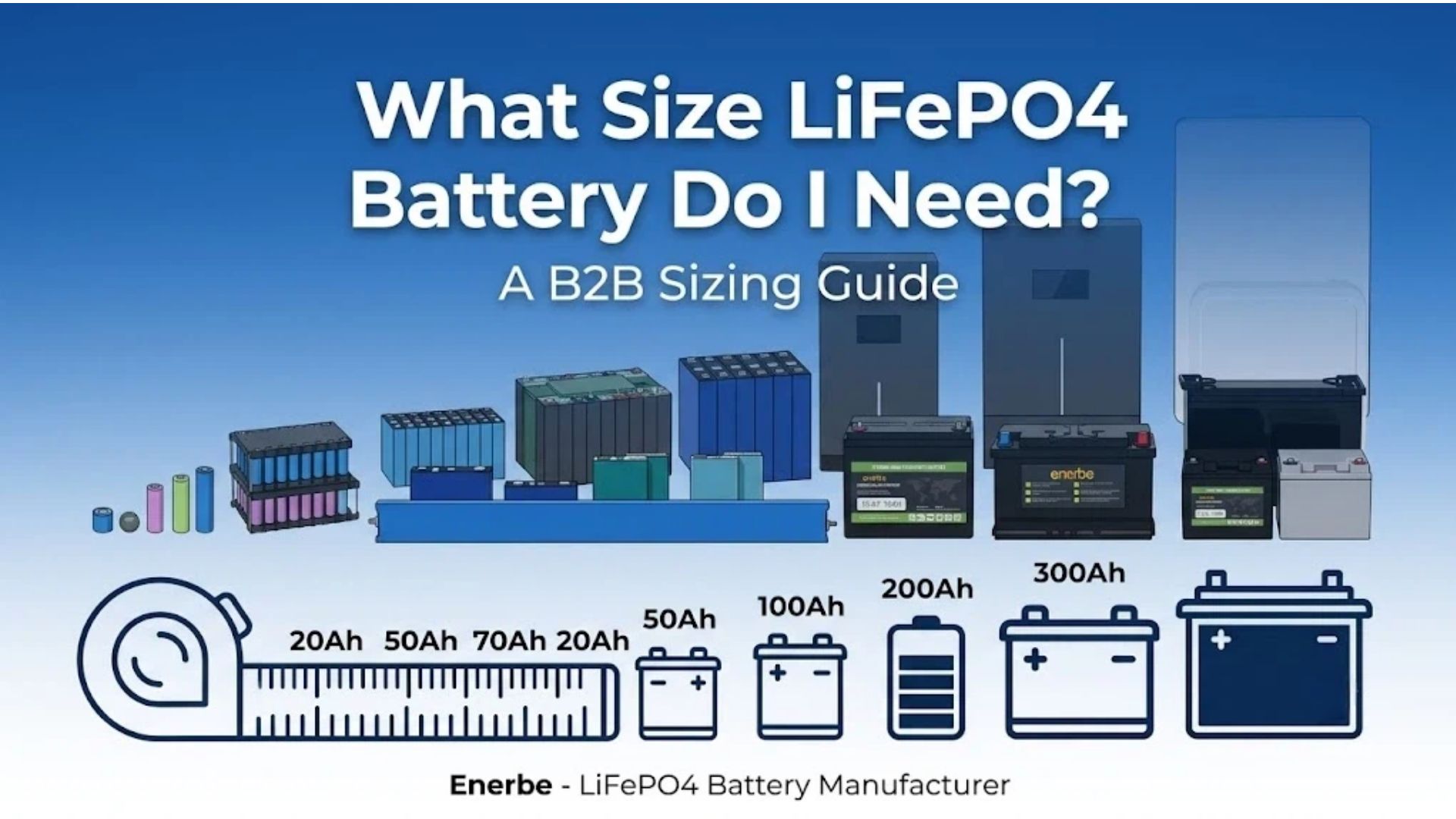
Table of Contents
Introduction
One of the most common questions B2B buyers ask is: “What size LiFePO4 battery do I need for my project?”
The answer depends on three factors: your power requirements, your application, and your budget. Choosing the right size is critical—too small and your system won’t perform; too large and you’re wasting money.
This guide will walk you through a simple 3-step process to calculate the right battery size for your application.
For a complete overview of LiFePO4 battery sourcing across all applications, see our B2B Sourcing Guide.
Step 1: Calculate Your Daily Energy Consumption
Start by listing everything you need to power and how long you need it to run.
Quick Formula
Battery Capacity (Ah) = (Daily Energy Consumption (Wh) × Days of Autonomy) ÷ (Battery Voltage × Depth of Discharge)
Example Calculation
| Load | Power (W) | Hours/Day | Daily Energy (Wh) |
|---|---|---|---|
| Lights | 50W | 5h | 250Wh |
| Refrigerator | 100W | 24h | 2400Wh |
| Water Pump | 200W | 2h | 400Wh |
| Total | 3050Wh |
Scenario: You need 3,050Wh of daily energy with 2 days of autonomy, using a 12V LiFePO4 battery at 80% depth of discharge.
Battery Capacity (Ah) = (3,050Wh × 2) ÷ (12V × 0.8)
= 6,100 ÷ 9.6
= 635Ah
Result: You would need approximately 635Ah of battery capacity at 12V.
Step 2: Choose Your System Voltage
The voltage you choose affects system efficiency and scalability:
| System Voltage | Typical Capacity Range | Best For |
|---|---|---|
| 12V | 50Ah – 300Ah | RVs, small boats, automotive |
| 24V | 50Ah – 200Ah | Golf carts, mid-size solar |
| 48V | 100Ah – 300Ah | Large solar storage, commercial |
For more detailed guidance on voltage selection, see our guide.
Step 3: Apply the 80% Rule

LiFePO4 batteries should not be fully discharged regularly. For maximum cycle life, use 80% depth of discharge (DoD) as your planning target.
| Battery Rated Capacity | Usable Capacity (80%) |
|---|---|
| 100Ah | 80Ah |
| 200Ah | 160Ah |
| 300Ah | 240Ah |
B2B Buying Tip: Always plan for 20% extra capacity to account for aging and peak loads. A 100Ah battery bank should be sized to 120Ah for a 100Ah usable load.
Common Application Sizing Guidelines
For RVs and Campervans
| RV Type | Typical Daily Load | Recommended Battery Size |
|---|---|---|
| Small van | 500-1000Wh | 100Ah (12V) |
| Mid-size RV | 1000-2000Wh | 200Ah (12V) |
| Large RV | 2000-3000Wh | 300Ah (12V) |
For Solar Storage Systems
| Solar System Size | Daily Generation | Recommended Battery Size |
|---|---|---|
| 3kW system | 12kWh | 48V 200Ah (10kWh) |
| 5kW system | 20kWh | 48V 300Ah (15kWh) |
| 10kW system | 40kWh | 48V 400Ah+ (20kWh+) |
For Golf Carts and Commercial Fleets
| Use Case | Battery Size | Runtime |
|---|---|---|
| 36V golf cart | 100Ah | 2-3 rounds |
| 48V golf cart | 100Ah | 3-4 rounds |
| Fleet golf cart | 150Ah | Extended runtime |
Need a custom recommendation? Enerbe offers custom configurations for fleet, solar, and industrial applications. Contact our team for a tailored sizing guide.
Sizing Checklist for B2B Buyers
- List all loads and calculate daily consumption (Wh)□
-
Determine desired days of autonomy□
-
Choose system voltage (12V, 24V, or 48V)□
-
Apply 80% depth of discharge for planning□
-
Add 20% extra capacity for aging and peaks
- Match inverter and charge controller compatibility
Frequently Asked Questions
Q1: How many Ah do I need for a 1000W load?
For a 1000W load running 8 hours at 12V: 1000W × 8h ÷ 12V = 667Ah per day. With 80% DoD, you would need approximately 834Ah of total battery capacity.
Q2: What size battery for a 5kW solar system?
A 5kW solar system typically generates 20kWh per day. At 48V, with 80% DoD: 20,000Wh ÷ 48V ÷ 0.8 = 520Ah. Recommended: 48V 300-400Ah.
Q3: Can I connect multiple batteries to increase capacity?
Yes. You can connect batteries in parallel to increase total capacity. For example, two 100Ah batteries in parallel = 200Ah total capacity. Always use identical batteries and ensure proper BMS settings.
Q4: What happens if I undersize my battery?
Undersized batteries will be deeply discharged frequently, significantly reducing cycle life. You may also experience system shutdowns during peak demand.
Q5: What happens if I oversize my battery?
Oversized batteries cost more upfront but provide longer runtime and extended cycle life due to shallower daily discharges. This can be a cost-effective long-term investment for critical applications.
Summary
Sizing a LiFePO4 battery correctly comes down to three steps:
-
Calculate your daily energy consumption
-
Choose your system voltage
-
Apply the 80% depth of discharge rule
A properly sized battery saves money, extends lifespan, and ensures reliable operation. If you’re unsure, start with your daily energy needs and add 20-30% buffer.
Enerbe provides LiFePO4 batteries in 12V, 24V, and 48V configurations from 50Ah to 300Ah. For custom sizing, wholesale pricing, or a personalized recommendation, contact our team.
All technical information in this guide is provided for informational purposes. Battery sizing requirements may vary by application.
📞 Speak with Our Engineering Team – Get In Touch
🔗 Browse Our Custom Battery Solutions – View Products
Building 1, No. 2, Keji 9th Road, Songshan Lake, Dongguan, Guangdong, China
📞 +86 137 1383 1631 | ✉ info@aspowerbattery.com



How to Store LiFePO4 Batteries? – A Complete Guide
China LFP Battery & NEV Market H1 2026 – Key Insights for B2B Buyers
Related Article


Get In Touch
Have questions about custom lithium batteries, energy storage solutions, or lead-to-lithium conversion? Our team is ready to help. Send us a message and we’ll respond within 24 hours.

Building 1, No. 2, Keji 9th Road, Songshan Lake, Dongguan, Guangdong, China
Office Address

info@aspowerbattery.com
Email Us

+86 137 1383 1631
Call Us

Sun - Fri (08AM - 10PM)
Office Open
