
BESS Supplier Audit: 17-Point Checklist (2026)

Table of Contents
- Introduction: One Wrong Choice Can Cost You Millions
- 5 Key Criteria: Reliable BESS Supplier vs Risky Supplier
- A Simple Supplier Evaluation Framework
- 17-Point BESS Supplier Qualification & Due Diligence Checklist
- Red Flags to Watch For
- Related BESS & LiFePO4 Resources
- Frequently Asked Questions
- Summary
BESS Supplier Audit: 17-Point Checklist to Avoid $1M+ Project Failures
Last updated: September 2026 | Written by the Enerbe Engineering Team
Introduction: One Wrong Choice Can Cost You Millions
Choosing between a reliable BESS supplier vs risky supplier is one of the most critical decisions for any energy storage project. In 2026, the difference is not just about price—it's about financial stability, certification compliance, delivery track record, and long-term warranty support. One wrong choice can mean project delays, failed permitting, voided insurance, and millions in lost revenue. This guide gives you a practical framework to evaluate BESS suppliers across 5 key dimensions, plus a 17-point audit checklist you can use today.
Quick Answer: A reliable BESS supplier has current model-specific certifications (UL 1973, UL 9540, IEC 62619), verifiable reference projects, transparent financials, in-house BMS/cell manufacturing, and 5-10 year warranty terms. A risky supplier shows "pending" certifications, no references, vague pricing, and refuses factory visits. Use our 17-point audit checklist below to evaluate any supplier in 30 minutes.
According to industry analysts, the global BESS market continues rapid expansion, and the supplier landscape is more complex than ever. Buyers must choose between vertically integrated cell manufacturers and pure-play system integrators—each with different risk profiles.
For a complete overview of LiFePO4 battery sourcing across all applications, see our complete B2B LiFePO4 battery sourcing guide.
5 Key Criteria: Reliable BESS Supplier vs Risky Supplier
1. BESS Certification & Safety Compliance (UL 1973, UL 9540, IEC 62619)
This is non-negotiable. A reliable supplier must hold current, model-specific certifications:
| Certification | What It Covers | Why It Matters |
|---|---|---|
| UL 1973 | Battery safety (stationary storage) | Required for US projects, insurance coverage |
| UL 9540 | Complete system safety | Required by many local fire codes |
| UL 9540A | Thermal runaway fire propagation testing | Critical for fire safety and permitting |
| IEC 62619 | International safety standard | Required for EU and global projects |
| UN38.3 | Transport safety | Mandatory for shipping lithium batteries |
Red Flag: "Pending" certifications or certificates that are expired or not model-specific. Always verify directly with the certification body—such as UL or IEC—when possible, as certificates can be expired or falsified.
For a technical introduction to BESS systems, see our battery energy storage system (BESS) technical guide.
2. Financial Stability & BESS Supplier Bankability (Will They Honor Your 10-Year Warranty?)
A supplier's financial health directly impacts warranty enforcement and long-term project support. A financially unstable supplier may not be around to honor its warranty in 5-10 years.
For more on how financial health impacts supplier reliability, see our BESS procurement framework for system integrators
What to Check:
-
Track record: How long has the company been in business?
-
Financial reports: Are they publicly available and positive?
-
Industry rankings: Wood Mackenzie's Global BESS Integrator Ranking evaluates suppliers across 10 criteria including financial strength, R&D, and supply chain resilience. Vertically integrated manufacturers such as Sungrow, Tesla, and CATL consistently lead these rankings, while reliable second-tier suppliers also exist—they just require more thorough vetting.
-
References: Can they provide verifiable references for similar projects?
3. BESS Supplier Track Record & Project References (Verify Before You Sign)
Reliable Supplier vs Risky Supplier – Quick Comparison
| Evaluation Criteria | Reliable Supplier | Risky Supplier |
|---|---|---|
| Financial Stability | Transparent financial reports | Vague or unavailable |
| Certifications | Current, model-specific | "Pending" or expired |
| Track Record | Verifiable references | No references provided |
| Vertical Integration | Owns manufacturing | Relies on third-party assembly |
| Warranty Support | Clear 5-10 year terms | Vague or short coverage |
| Test Reports | Full reports with raw data | Summary certificates only |
A reliable supplier should have experience with projects similar to yours—same scale, same application, same region.
Questions to Ask:
-
Have they delivered projects of similar size and complexity?
-
Do they have reference projects you can verify?
-
Have they manufactured at scale before?
-
What is their delivery track record (on-time, on-budget)?
B2B Tip: Request reference calls with previous clients. Ask about responsiveness, problem-solving, and warranty support after commissioning.
4. Technical Capability & Vertical Integration (BMS, Cell Sourcing, R&D)
In 2026, the most reliable BESS suppliers are those with strong vertical integration—control over cell manufacturing, BMS development, and system assembly.
| Supplier Type | Advantages | Risks |
|---|---|---|
| Vertically Integrated Manufacturer | Full control over quality, supply chain, and cost | May lack flexibility for custom projects |
| Pure-Play Integrator | Wider range of component options | Less control over cell quality and supply |
What to Evaluate:
-
Do they manufacture their own cells or rely on third-party suppliers?
-
What BMS (Battery Management System) capabilities do they have?
-
Can they customize the system to your specific requirements?
-
Do they have in-house engineering and R&D?
Explore our 48V rack-mount LiFePO4 BESS solutions with UL 1973 certification and integrated BMS, built for commercial and utility-scale energy storage projects.
5. BESS Total Cost of Ownership (Why the Cheapest Supplier Costs You More)
The cheapest supplier is rarely the best choice. Evaluate total cost of ownership over the project's lifecycle:
| Cost Component | What to Include |
|---|---|
| Upfront Cost | Battery packs, BMS, inverter/PCS, shipping, installation |
| Operating Cost | Energy losses (round-trip efficiency), cooling, monitoring |
| Maintenance | Scheduled maintenance, parts replacement |
| Replacement | Battery replacement at end of life (5,000+ cycles = 10+ years) |
| Risk Cost | Warranty claims, project delays, compliance failures |
Ask suppliers for: Detailed TCO projections, not just sticker price. A supplier with higher upfront cost but longer cycle life and better efficiency often delivers better long-term value.
For a complete procurement framework for system integrators, see our BESS procurement framework for system integrators.
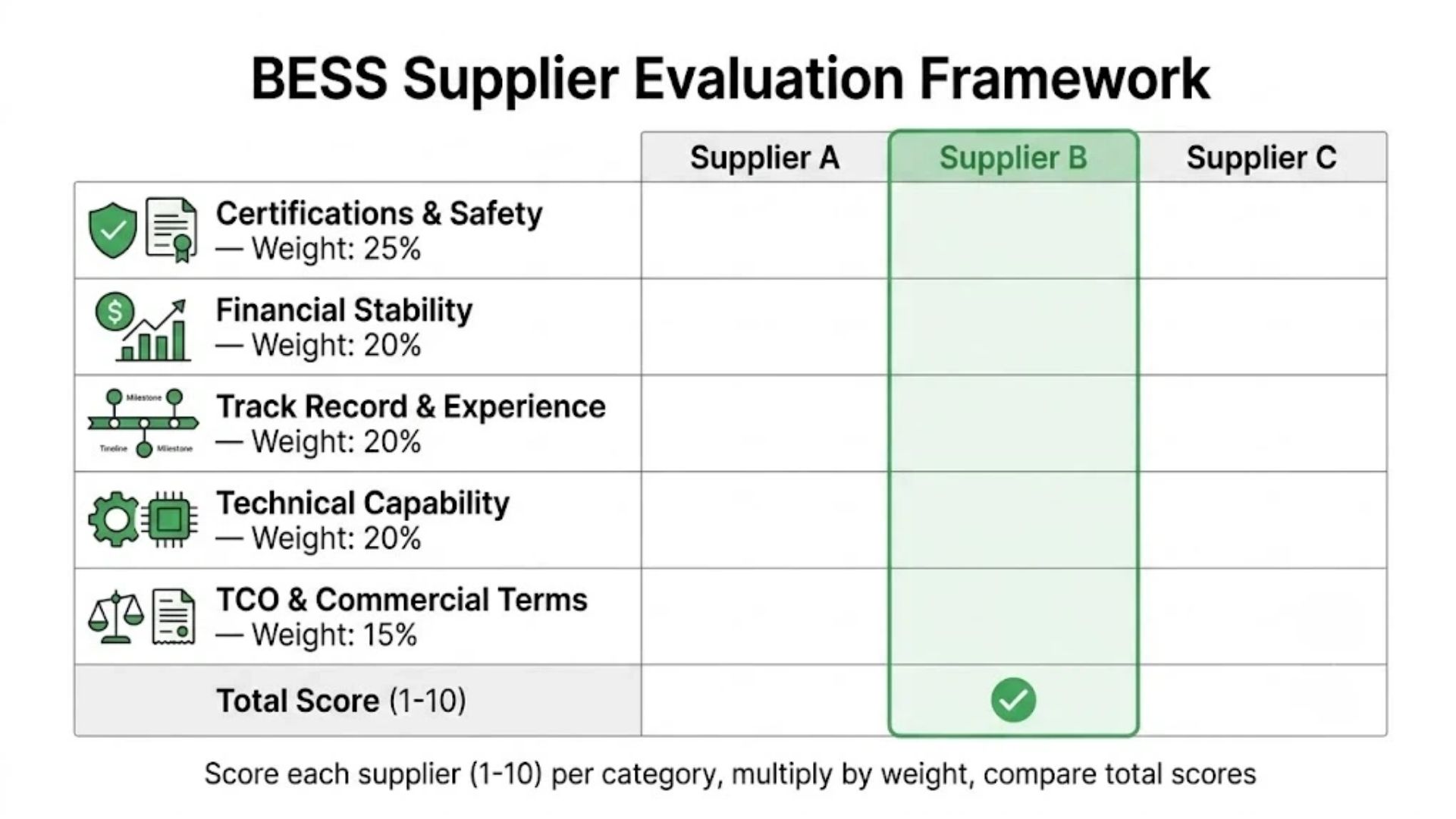
A Simple Supplier Evaluation Framework
When comparing multiple BESS suppliers, use this weighted scoring model:
| Evaluation Category | Weight | Supplier A | Supplier B | Supplier C |
|---|---|---|---|---|
| Certifications & Safety | 25% | — | — | — |
| Financial Stability | 20% | — | — | — |
| Track Record & Experience | 20% | — | — | — |
| Technical Capability | 20% | — | — | — |
| TCO & Commercial Terms | 15% | — | — | — |
| Total Score | 100% | — | — | — |
Score each supplier (1-10) in each category, multiply by the weight, and compare total scores. This removes emotion from the decision and highlights the best overall partner.
17-Point BESS Supplier Qualification & Due Diligence Checklist
Use this step-by-step checklist to verify BESS supplier capability before signing any contract. A proper BESS supplier qualification process typically takes 2-4 weeks but can save millions in project failures down the line.
-
Verify certifications directly: Request and verify UL 1973, UL 9540, UL 9540A, and IEC 62619 certificates directly with the issuing body—not just from the supplier's marketing materials.
-
Conduct an on-site BESS supplier audit: Visit their manufacturing facility to inspect cell sourcing, BMS development, quality control processes, and production capacity. A supplier that refuses factory visits is a major red flag.
-
Run a financial health check: Review financial statements, credit reports, and years in business as part of your BESS supplier due diligence process. The supplier must be financially stable enough to honor 5-10 year warranties.
-
Contact reference clients: Speak with at least 3 previous clients who completed similar-scale projects in your region. Ask about on-time delivery, post-commissioning support, and warranty claim responsiveness.
-
Verify cell sourcing and BMS capabilities: For proper BESS supplier identification, confirm whether the supplier manufactures its own cells, develops its own BMS firmware, or relies on third-party components. Vertical integration generally means better quality control and supply chain resilience.
-
Request full test reports: Ask for complete cycle life test data, thermal runaway test results, and efficiency reports—not just summary certificates. A supplier willing to share raw data demonstrates confidence in their product.
-
Assess BESS supplier quality systems: Check for ISO 9001 certification, documented QC procedures, and incoming cell inspection protocols. These are strong indicators of consistent manufacturing quality.
-
Verify BESS conformity assessment documentation: Request full test reports for IEEE 1547, grid code compliance, and local fire code requirements—not just a certificate number.
-
Check BESS supplier qualification credentials: Verify ISO 9001 quality management, ISO 14001 environmental, and OHSAS 18001 occupational health certifications.
-
Assess BESS supplier identification and ownership structure: Confirm the legal entity, parent company, and whether they are a manufacturer or trading company. A supplier that hides its ownership structure is a red flag.
-
Request BESS manufacturing capability assessment: Ask for monthly production capacity, cell sourcing agreements, and BMS firmware development team size. A supplier without in-house BMS development is dependent on third-party support.
-
Verify grid-scale project delivery capability: For utility-scale projects, confirm they have delivered projects of similar MW capacity and can provide performance guarantees (availability, round-trip efficiency, degradation rate).
-
Check cybersecurity compliance: For grid-connected BESS, verify IEC 62443 or NERC CIP cybersecurity compliance. A supplier without cybersecurity documentation creates grid security risk.
-
Assess spare parts and after-sales support: Confirm availability of replacement modules, BMS boards, and cooling components for 10+ years. A supplier that cannot guarantee spare parts will leave you stranded.
-
Verify insurance coverage: Request proof of product liability insurance and professional indemnity insurance. A supplier without adequate insurance may not survive a major claim.
-
Check export and logistics capability: For international projects, verify they have experience with UN38.3 shipping, customs clearance, and on-site installation support in your region.
-
Request a performance bond or warranty escrow: For large projects, require a performance bond or third-party warranty escrow to guarantee the supplier honors its obligations even if financial conditions change.
For developers and IPPs, consider engaging a third-party engineering firm to conduct a formal BESS supplier audit before finalizing any large-volume procurement agreement.
Red Flags to Watch For
| Red Flag | Why It's a Problem |
|---|---|
| "Pending" or expired certifications | Not certified means not compliant |
| Reluctance to share test reports | Likely hiding something |
| No verifiable references | No proven track record |
| Vague pricing breakdowns | Hidden costs will appear later |
| No factory visit available | Quality claims cannot be verified |
| Short warranty period | Lack of confidence in their own product |
| No financial transparency | May not survive to honor the warranty |
Related BESS & LiFePO4 Resources
-
24V LiFePO4 Battery Complete Guide — specs, applications, charging, and sourcing for commercial & industrial energy storage
-
48V Rack-Mounted Lithium Battery Guide — rack-mount BESS solutions for data centers, telecom, and commercial ESS
-
BESS Technical Sourcing Guide — system architecture, components, and procurement framework
-
48V LiFePO4 Battery Products — rack-mount and wall-mount energy storage solutions
Frequently Asked Questions
What is the difference between a reliable BESS supplier and a risky supplier?
A reliable BESS supplier holds current, model-specific certifications (UL 1973, UL 9540, IEC 62619), provides verifiable project references, demonstrates financial stability, and offers clear 5-10 year warranty terms. A risky supplier typically has "pending" certifications, no verifiable references, vague pricing breakdowns, and short or unclear warranty periods.
How do I verify BESS supplier capability?
Verify BESS supplier capability by: (1) checking certifications directly with the issuing body such as UL or IEC, (2) conducting an on-site factory audit to inspect manufacturing and quality control, (3) requesting full test reports with raw data—not just summary certificates, (4) contacting at least 3 reference clients for similar-scale projects, and (5) reviewing financial statements to confirm the supplier can honor long-term warranties.
What certifications should a BESS supplier have?
Key certifications include UL 1973 (stationary battery safety), UL 9540 (complete energy storage system safety), UL 9540A (thermal runaway fire propagation testing), IEC 62619 (international industrial battery safety), and UN38.3 (lithium battery transport safety). For grid-scale projects, also verify IEEE 1547 compliance and local grid code requirements.
How important is vertical integration for BESS suppliers?
Vertical integration—controlling cell manufacturing, BMS development, and system assembly—significantly reduces supply chain risk and improves quality control. While pure-play integrators may offer more component flexibility, vertically integrated manufacturers generally provide better long-term support, faster issue resolution, and stronger warranty enforcement because they control every layer of the product.
What is BESS supplier due diligence and why does it matter?
BESS supplier due diligence is the process of investigating and verifying a supplier's financial health, technical capability, certifications, track record, and quality systems before entering a procurement agreement. It matters because a failed BESS supplier can lead to project delays, voided warranties, unavailable replacement parts, and millions in lost revenue—especially for projects with 10-20 year operational lifespans.
What is BESS supplier qualification and why is it required?
BESS supplier qualification is the formal process of evaluating and approving a supplier before they are allowed to bid on or supply a battery energy storage system project. It typically involves verifying certifications, financial stability, technical capability, track record, and quality systems. Qualification is required because BESS projects involve 10-20 year operational lifespans, high upfront capital, and safety-critical equipment—working with an unqualified supplier can lead to project failures, safety incidents, and voided warranties. Most utilities, IPPs, and large project developers maintain a pre-qualified supplier list and require new suppliers to complete a formal qualification process before bidding.
What is BESS conformity assessment and what standards apply?
BESS conformity assessment is the process of verifying that a battery energy storage system meets all applicable safety, performance, and grid integration standards. Key standards include: UL 1973 (stationary battery safety), UL 9540 (complete energy storage system safety), UL 9540A (thermal runaway fire propagation testing), IEC 62619 (industrial lithium battery safety), IEEE 1547 (grid interconnection), and local grid codes (varies by country/region). Conformity assessment typically involves third-party testing, factory inspections, and ongoing production monitoring. A supplier that cannot provide full conformity assessment documentation for the specific model you are purchasing is a major risk—many projects have been delayed or canceled because the system failed certification testing after installation.
What factors should utilities consider when selecting grid-scale battery storage vendors?
When selecting grid-scale BESS vendors, utilities should evaluate: (1) Grid code compliance—verify IEEE 1547, frequency response, voltage regulation, and ramp rate capabilities meet local grid requirements; (2) Cybersecurity—confirm IEC 62443 or NERC CIP compliance for grid-connected systems; (3) Performance guarantees—require contractual guarantees for round-trip efficiency (>85%), availability (>97%), and capacity degradation (<2% per year); (4) Financial strength—the vendor must be financially stable enough to honor 10-20 year warranties and performance guarantees; (5) Utility-scale track record—prior experience with projects of similar or larger MW capacity, with verifiable reference sites; (6) O&M capability—ability to provide long-term operations and maintenance support, including remote monitoring, predictive maintenance, and rapid response; (7) Supply chain resilience—secure cell sourcing agreements and production capacity to meet delivery schedules; (8) Decommissioning and recycling plan—the vendor should provide a clear end-of-life plan including battery recycling and disposal. For utility-scale projects, consider requiring a third-party engineer to conduct an independent BESS supplier audit before final selection.
Summary
Choosing a reliable BESS supplier is about reducing risk, not just finding the lowest price. Focus on:
-
Certifications that are current and model-specific
-
Financial stability to ensure long-term warranty support
-
Track record with similar projects
-
Technical capability including vertical integration
-
Total cost of ownership, not just upfront cost
Use our 17-point BESS supplier audit checklist to evaluate any supplier in 30 minutes, and don't skip the due diligence—one wrong choice can cost you millions. In modern BESS projects, the right manufacturer is not just a supplier—they are a long-term partner in system performance and reliability. Take the time to evaluate thoroughly, and your project will benefit for decades.
All market analysis and procurement recommendations in this article are the independent analysis of Enerbe.
Get In Touch
Ready to source BESS solutions for your project? Contact Enerbe today.
📄 Request a Technical Datasheet
Contact Us →📞 Speak with Our Engineering Team
Get In Touch →🔗 Browse Our Custom Battery Solutions
View Products →Dongguan A&S Power Technology Co., Limited.
Building 1, No. 2, Keji 9th Road,
Songshan Lake, Dongguan, Guangdong, China
📞 +86 137 1383 1631
✉ info@aspowerbattery.com
Stay Charged. Stay Connected.



BESS Procurement Guide: 7-Phase Framework (2026)
48V Rack-Mounted LiFePO4 Battery Guide (2026)
Related Article



Get In Touch
Have questions about custom lithium batteries, energy storage solutions, or lead-to-lithium conversion? Our team is ready to help. Send us a message and we’ll respond within 24 hours.

Building 1, No. 2, Keji 9th Road, Songshan Lake, Dongguan, Guangdong, China
Office Address

info@aspowerbattery.com
Email Us

+86 137 1383 1631
Call Us

Sun - Fri (08AM - 10PM)
Office Open
