
How to Wake Up a LiFePO4 Battery: Revive a Deeply Discharged/0V Pack (2026)

Table of Contents
- Introduction: Dead or Just Sleeping?
- Why Does a LiFePO4 BMS Go to Sleep?
- Sleeping vs Dead: Read the Voltage First
- What You'll Need to Wake the Battery
- How to Wake Up a LiFePO4 Battery: Step by Step
- Charger Won't Recognize 0V? Force/Boost & Safe Jumper Methods
- Wake-Up for 12V, 24V and 48V (Including Rack Modules)
- After It Wakes: Full Charge, Balancing & SOC Recalibration
- How to Stop Your Battery Going to Sleep
- Wake-Up Didn't Work? Troubleshooting vs Hardware Failure
- Related Resources
- Frequently Asked Questions
- Summary
How to Wake Up a LiFePO4 Battery: Revive a Deeply Discharged/0V Pack (2026)
Last updated: September 2026 | Written by the Enerbe Engineering Team
Introduction: Dead or Just Sleeping?
Quick Answer: A LiFePO4 battery that reads 0V and won't charge is usually not dead—its BMS has switched the charge MOSFET off after a deep discharge, so the charger sees 0V and refuses to start. To wake it: disconnect all loads, connect a LiFePO4 charger with a 0V wake-up/boost mode and leave it 10-30 minutes (sometimes a few hours); if the charger will not output at 0V, raise the terminal voltage with a same-voltage LiFePO4 battery through a 10-15A fuse for 5-10 minutes, then charge normally. Cells reading 2.0-3.0V can almost always be revived; a cell stuck below ~1.5V may be permanently damaged.
You connect a LiFePO4 battery to its charger and nothing happens—no voltage, no charging current, no response. Before assuming the pack is dead, understand that a LiFePO4 Battery Management System (BMS) deliberately puts a deeply discharged battery into a sleep mode (under-voltage lockout) to protect the cells. The chemistry is usually fine; the BMS has simply disconnected the output and charge path.
This guide is the complete reference for waking up / reviving a sleeping or deeply discharged LiFePO4 battery: why the BMS sleeps, how to confirm it is sleeping rather than failed, what equipment you need, the safe step-by-step wake-up, what to do when the charger will not recognize 0V, the correct voltages for 12V/24V/48V, and how to finish with a balance charge and SOC recalibration.
Waking a deeply discharged pack is different from resetting a BMS that has tripped on a short, over-current, or temperature fault. If your battery has a fault lockout, an error code, or needs a reset button/app procedure, use our How to Reset BMS on LiFePO4 Battery guide. To understand exactly which BMS protection has triggered and how the charge MOSFET works, see our What Is a LiFePO4 BMS? Functions & Parameters guide.
Why Does a LiFePO4 BMS Go to Sleep?
A LiFePO4 BMS protects cells from conditions that would age or damage them. When a cell approaches the lower voltage limit, the BMS opens the discharge MOSFET; if voltage falls further, it also opens the charge path and the pack appears dead. The most common causes are:
| Cause | What Happens | Typical Situation |
|---|---|---|
| Deep over-discharge | Cell voltage falls below the cut-off (~2.5V/cell) and the BMS enters under-voltage lockout | Pack left discharged for weeks/months, or stored at low SOC |
| Parasitic load | A small continuous drain (monitor, inverter standby, alarm) empties the pack over time | RV/boat left connected over the off-season |
| Self-discharge in storage | LiFePO4 self-discharges ~1-3%/month; long storage without top-up drifts below cut-off | Inventory or spare battery idle for months |
| One weak/imbalanced cell | A single lagging cell hits the lower limit first and trips the whole pack | Older pack, or after a previous deep discharge |
| Charger sees 0V and stays off | With the charge MOSFET open, many chargers detect no battery and output nothing—a catch-22 | Plugging in a standard charger shows 0V/no current forever |
The key point: in sleep mode the cells still hold charge, but the BMS hides the pack from both the load and the charger. The goal of a wake-up is to present enough voltage at the terminals for the BMS to close its charge MOSFET and hand control back to the charger.
Sleeping vs Dead: Read the Voltage First
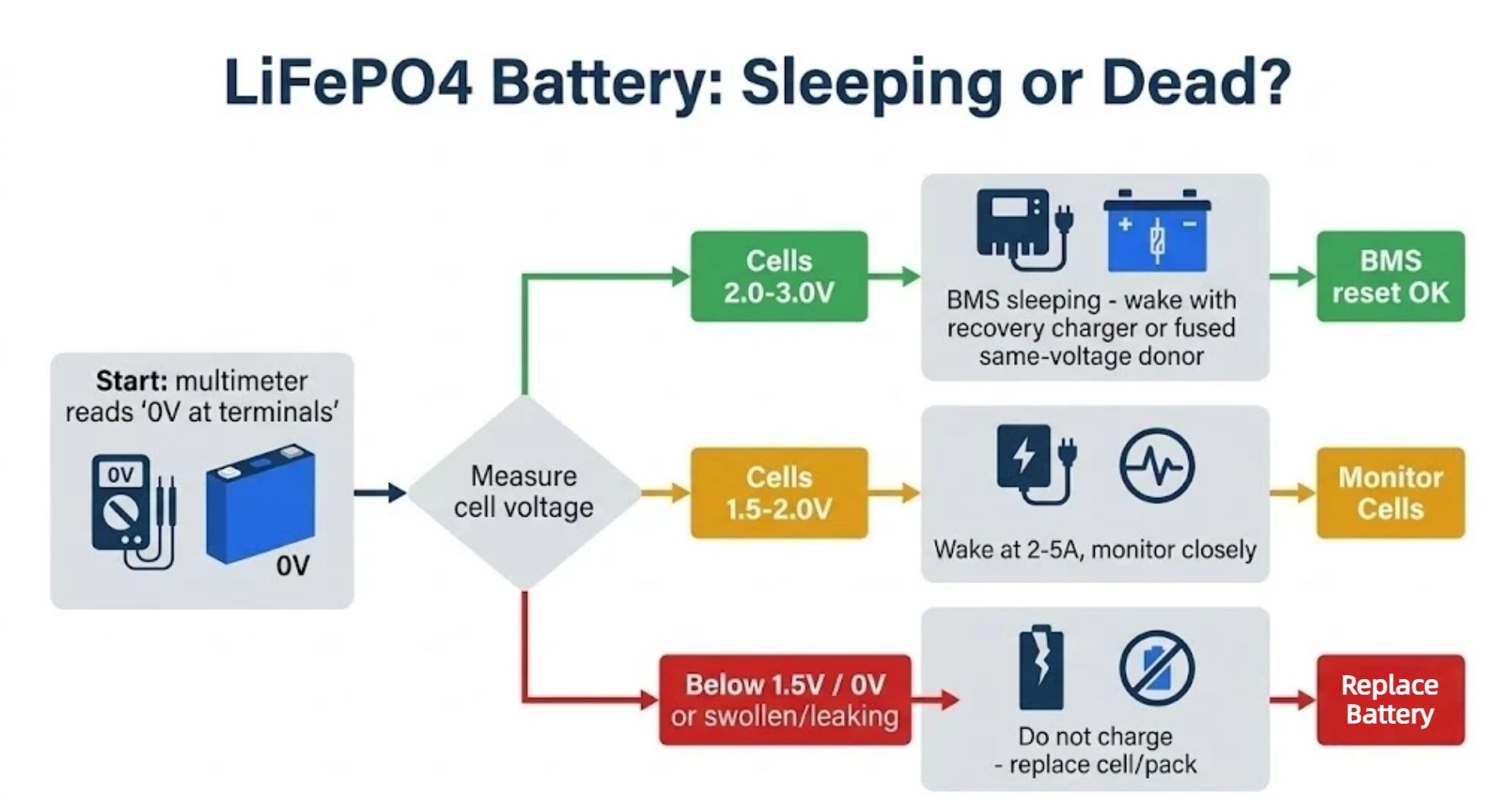
Never force current into a pack before checking its state. Measure at the battery output terminals first; if you can safely access cell-level taps (or a smart BMS app), read individual cell voltages.
| Reading (per cell) | State | Action |
|---|---|---|
| Terminals 0V, cells 2.0-3.0V | Sleeping—BMS lockout, cells recoverable | Proceed with wake-up below |
| Cells 2.5-3.2V, terminals low | Deep discharge, BMS disconnected | Wake-up, then slow charge |
| Cells ~1.5-2.0V | Borderline—possible cell damage | Wake at very low current while monitoring; reject if it won't rise or gets warm |
| Any cell below ~1.5V / 0V | Likely permanently damaged | Do not force-charge; replace the cell/pack |
| Swollen case, leak, burn smell | Physical damage | Stop—isolate and replace (see safety guide) |
Safety: LiFePO4 is far more tolerant of deep discharge than NMC, but no lithium cell should be force-charged from near 0V unattended. If a cell is below ~1.5V, will not accept current, or warms/swells during recovery, do not continue. Never use a car battery or an unregulated high-current power supply to "jump" a lithium pack.
What You'll Need to Wake the Battery
| Item | Why |
|---|---|
| LiFePO4 charger with 0V wake-up / boost / recovery mode | Outputs a small current even at 0V so the BMS can close—the preferred tool |
| Digital multimeter (DC) | Confirm terminal and cell voltage before and during wake-up |
| A second, fully charged LiFePO4 battery of the SAME voltage | Used to raise terminal voltage if your charger has no wake-up mode |
| Jumper lead with in-line 10-15A fuse | Limits inrush when paralleling batteries—never jumper without a fuse |
| Current-limited bench power supply (optional, pros only) | Last-resort 2-5A boost at the output terminals, closely monitored |
| BMS app / smart monitor (if fitted) | Read per-cell voltage and watch the charge MOSFET re-enable |
How to Wake Up a LiFePO4 Battery: Step by Step

Follow these steps in order. Most sleeping packs recover at Step 2 or 3.
Step 1 — Disconnect all loads and check voltage
Turn off the inverter/DC switch and remove every load so nothing continues to drain the pack. Measure the terminal voltage and, if available, individual cell voltage in the BMS app. Confirm the pack matches the "sleeping" rows in the table above rather than a damaged cell.
Step 2 — Connect a LiFePO4 charger with wake-up mode
Connect the correctly sized LiFePO4 charger (observe polarity) and plug it in. A wake-up/boost-capable charger sends a small conditioning current even at 0V. Leave it connected for 10-30 minutes; the charger may show 0A at first. Watch for current to begin flowing and voltage to rise—that means the BMS has closed the charge path.
Step 3 — Be patient; do not interrupt
A deeply discharged pack can take 30 minutes to several hours before normal charging starts. Once current flows, let it continue; charge at a modest rate (5-10A) for the first hour if your charger allows current control.
Step 4 — If the charger refuses 0V, boost the terminals
If the charger outputs nothing because it detects no battery, use the force/boost or same-voltage jumper method in the next section to raise terminal voltage just enough for the BMS to wake, then remove the booster and let the proper charger take over.
Step 5 — Charge fully to 100% and hold for balance
Once awake, charge to 100%—14.6V (12V), 29.2V (24V), 58.4V (48V/51.2V, 16S)—and hold through the constant-voltage (CV) tail so the BMS can passive-balance the cells. This is especially important after a deep discharge.
Step 6 — Run one full cycle to recalibrate SOC
Discharge to about 20% and recharge to 100% once so the BMS relearns state of charge. The SOC reading often jumps or reads incorrectly after a deep sleep and needs this cycle to become accurate again.
Charger Won't Recognize 0V? Force/Boost & Safe Jumper Methods
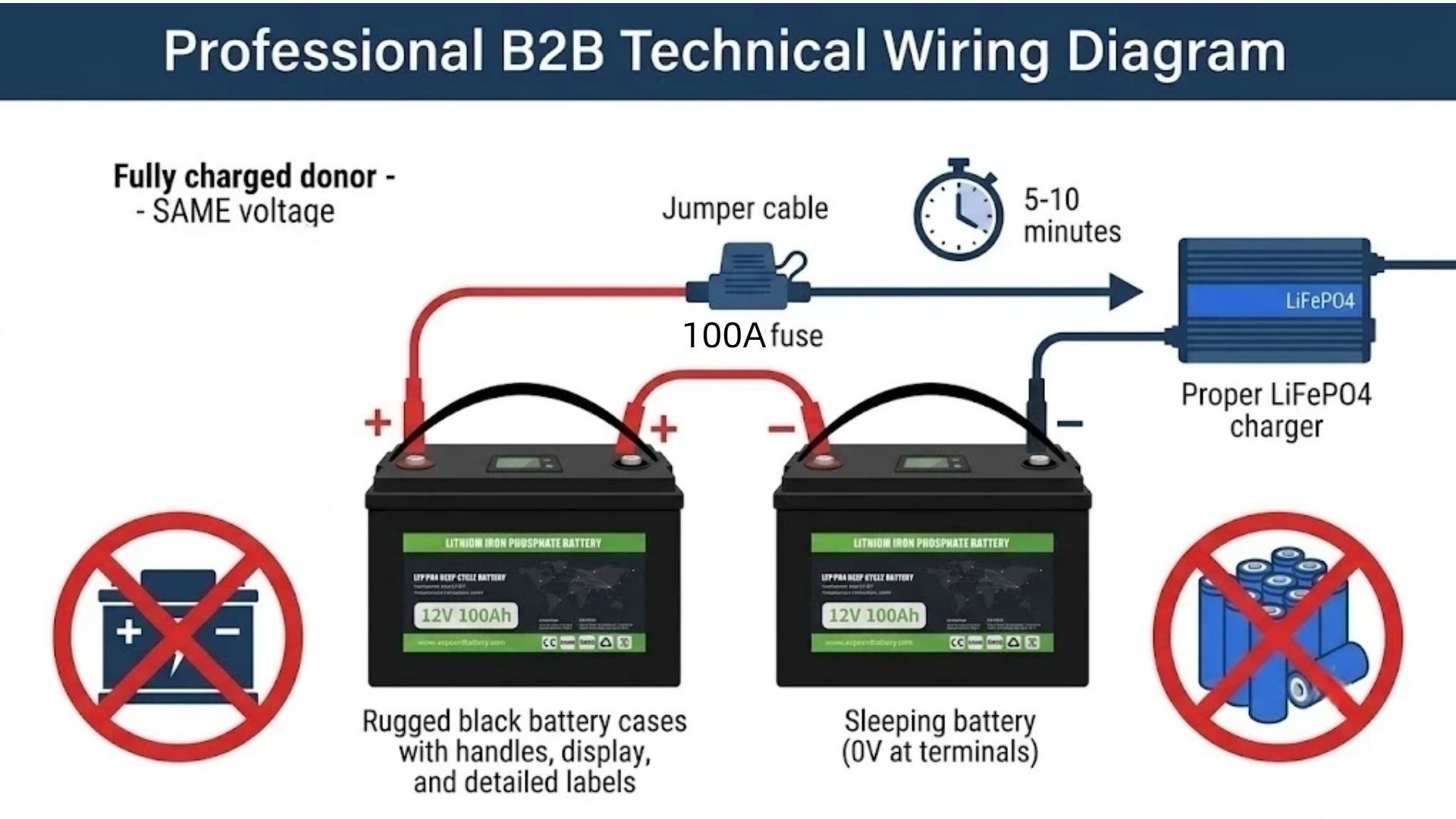
Method A — Same-voltage LiFePO4 battery through a fuse (recommended)
- Take a fully charged LiFePO4 battery of the same nominal voltage (12V-to-12V, 24V-to-24V, 48V-to-48V).
- Connect positive-to-positive and negative-to-negative at the output terminals, with a 10-15A fuse in line on the positive jumper.
- Leave connected for 5-10 minutes. The small parallel current raises the sleeping pack's terminal voltage so its BMS closes the charge MOSFET.
- Disconnect the booster, immediately connect the proper LiFePO4 charger, and charge at ~5A for the first hour, increasing current as voltage rises.
Method B — Charger force-charge / recovery mode
Some LiFePO4 chargers and inverter-chargers have a "force charge," "boost," or "0V activation" setting that bypasses the no-battery detection for a short period. Enable it per the manufacturer's instructions, monitor closely, and switch back to the normal LiFePO4 profile once charging begins.
Method C — Current-limited bench power supply (professionals only)
Set a current-limited bench supply to the pack's charge voltage and cap the current to 2-5A. Connect to the battery output terminals (BMS output—do not open the pack and attach directly to bare cells) for 5-10 minutes until the BMS detects voltage and closes, then move straight to the proper LiFePO4 charger. Stay with the battery, watch temperature and voltage continuously, and stop immediately if it heats, swells, or the voltage does not climb.
Never use a car/lead–acid battery, a jump pack, or an unregulated power supply to wake a LiFePO4 pack, and never connect different nominal voltages. The uncontrolled inrush can damage the BMS or cells and is a fire risk. A fused, same-voltage LiFePO4 donor or a purpose-built recovery charger is the safe route.
Wake-Up for 12V, 24V and 48V (Including Rack Modules)
| System | Configuration | Nominal | Full charge | BMS cut-off (~2.5V/cell) |
|---|---|---|---|---|
| 12V | 4S | 12.8V | 14.6V | ~10V |
| 24V | 8S | 25.6V | 29.2V | ~20V |
| 48V / 51.2V | 16S | 51.2V | 58.4V | ~40V |
For a single 12V/24V drop-in battery the steps above apply directly. For multi-module 48V server-rack and solar systems, wake each module individually before paralleling: if one module is deeply discharged while its neighbors are full, connecting them together causes a large inrush that can trip every BMS. Use the rack master BMS/monitor to verify each module's voltage as it wakes. The full rack power-cycle, master-BMS reset, PCS/inverter reconnection sequence, and 48V fault handling are covered in the 48V rack & solar reset section of the reset guide; rack specifications are in the 48V rack-mounted battery guide.
After It Wakes: Full Charge, Balancing & SOC Recalibration
- Charge to 100% and hold the CV stage so the BMS passive-balances the string; healthy cells settle within ~0.05V of each other.
- Run one full cycle (charge to 100%, discharge to ~20%, recharge) to recalibrate the SOC gauge.
- Check per-cell voltage in the app. If one cell repeatedly lags by more than ~0.1V after a full balance, it may be failing—see the balancing guide.
- Use the correct charge profile (14.6/29.2/58.4V, LiFePO4, no lead–acid float); see the charging guide.
How to Stop Your Battery Going to Sleep
| Measure | Why It Prevents Deep Sleep |
|---|---|
| Set a low-voltage disconnect (LVD) | Cut loads at the maker's threshold (~10/20/40V) before the BMS has to lock out |
| Eliminate parasitic loads | Isolate standby devices/monitors when the system is idle for long periods |
| Store at 50-60% SOC | Never store empty; cool, dry storage at 15-25°C |
| Top up every 3-6 months | Counter self-discharge and keep cells above cut-off; full details in the storage guide |
| Check voltage monthly | Early catch of a drifting pack before it reaches lockout |
| Keep a wake-up-capable charger | Makes recovery trivial if a pack does sleep |
Wake-Up Didn't Work? Troubleshooting vs Hardware Failure
If the pack still won't take a charge, separate a sleeping BMS from other—non-BMS—causes:
- Wrong charger / wrong voltage: must be LiFePO4 at 14.6/29.2/58.4V; a lead–acid charger cannot wake it.
- Blown inline fuse, tripped breaker, loose or reversed leads: check all connections.
- Temperature lockout: LiFePO4 will not charge below 0°C (lithium plating)—warm the pack above 5°C first.
- Fault lockout rather than sleep: short, over-current, or comms trips need a reset, not a wake-up—see the BMS reset guide.
These and the other non-BMS causes are mapped in our LiFePO4 battery not charging troubleshooting guide. Signs of genuine failure that no wake-up will fix—voltage collapsing within minutes, one cell stuck at 0V, a fault code that returns instantly, normal cell voltage but 0V output after every attempt, swelling or overheating—are listed in the hardware-failure section; stop recovery and contact the manufacturer.
Related Resources
-
How to Reset BMS on LiFePO4 Battery — fault lockouts, reset button, unlock, fault codes, and 48V rack reset
-
What Is a LiFePO4 BMS? Functions, Parameters & Selection Guide — how UVP, the charge MOSFET, and every BMS protection works
-
LiFePO4 Battery Not Charging? 7 Causes & Fixes — charger, fuse, wiring, and temperature causes beyond deep sleep
-
How to Balance LiFePO4 Batteries — passive/active balancing and cell-voltage checks after recovery
-
How to Charge LiFePO4 Batteries — correct voltage, current, and CV stage
-
LiFePO4 Battery Safety Guide — handling deep-discharged and damaged packs safely
-
LiFePO4 Battery Storage & Maintenance — SOC and top-up schedule to prevent sleep
-
B2B Sourcing Guide for LiFePO4 Batteries — applications and wholesale selection
Frequently Asked Questions
How do you wake up a sleeping LiFePO4 battery?
Disconnect all loads, connect a LiFePO4-specific charger with a 0V wake-up/boost mode, and leave it connected for 10-30 minutes (sometimes a few hours) until the BMS closes the charge path and current begins to flow. If the charger will not output at 0V, raise the terminal voltage for 5-10 minutes using a fully charged LiFePO4 battery of the same voltage connected through a 10-15A fused jumper, then remove it and charge normally. Finish with a full charge to 100% to balance the cells.
How do you revive a "dead" LiFePO4 battery?
Most "dead" LiFePO4 packs are simply in BMS under-voltage sleep, not failed. Confirm cell voltage: cells at 2.0-3.0V are recoverable with the wake-up procedure and a slow charge. Use a recovery charger or a fused same-voltage donor battery to wake the BMS, charge at 5-10A initially, then fully charge and run one complete cycle to recalibrate SOC. If a cell reads below ~1.5V, will not accept current, or swells/heats, the pack is genuinely damaged and should be replaced rather than forced.
Can a completely dead LiFePO4 battery that reads 0V be revived?
Often yes. A 0V reading at the terminals with healthy cell voltage (2.0-3.0V per cell) means the BMS—not the cells—is disconnected, and a wake-up usually recovers it. LiFePO4 tolerates deep discharge far better than NMC. The exceptions are a cell stuck below ~1.5V or at true 0V, a pack that will not accept current after several wake-up attempts, or physical damage (swelling/leak/heat); these are not safely revivable.
Why won't my LiFePO4 charger detect or charge the battery (it shows 0V)?
When the BMS opens the charge MOSFET after a deep discharge, the charger sees 0V at its terminals and many chargers refuse to output for safety—a catch-22 that keeps the pack "asleep." You need a charger with a 0V wake-up/force-charge mode, or you briefly raise terminal voltage with a fused same-voltage LiFePO4 donor so the BMS closes and the normal charger can take over. A charger that simply has no wake-up feature may show 0V/no current indefinitely.
How long does it take to wake a LiFePO4 BMS?
With a wake-up-capable charger, typically 10-30 minutes; a fused same-voltage jumper takes about 5-10 minutes to close the BMS. A pack that has sat at 0V for months can take 30 minutes to several hours before normal charging starts—be patient and do not interrupt once current flows. After waking, allow a full charge (several hours depending on capacity) plus one full cycle for SOC recalibration.
Can I jump-start or wake a LiFePO4 battery with another battery or a power supply?
Only with a fully charged LiFePO4 battery of the same nominal voltage, connected positive-to-positive/negative-to-negative at the output terminals through a 10-15A fused jumper for 5-10 minutes. A current-limited bench supply capped at 2-5A is a professional alternative connected to the output terminals only, with constant monitoring. Never use a car or lead–acid battery, an unregulated jump pack, mismatched voltages, or direct connection to bare cells—the uncontrolled inrush can destroy the BMS or cause a fire.
What is the sleeping / low-voltage cut-off for 12V, 24V and 48V LiFePO4?
At ~2.5V per cell the BMS cuts discharge: roughly 10V for a 12V (4S), 20V for a 24V (8S), and 40V for a 48V/51.2V (16S) pack. Nominal voltages are 12.8/25.6/51.2V and full-charge voltages are 14.6/29.2/58.4V. If terminal voltage is at or below these cut-offs and the pack reads 0V, it is in under-voltage sleep; per-cell voltage tells you whether it is still recoverable.
Do I need a special LiFePO4 charger with a wake-up mode?
A LiFePO4-specific charger is required regardless (correct 14.6/29.2/58.4V profile), and choosing one with a 0V wake-up, boost, or recovery mode makes reviving a sleeping pack straightforward because it outputs a small current even at 0V. Without that feature the charger may not start on a fully slept pack, in which case you use the fused same-voltage donor method first. Lead–acid chargers have neither the right profile nor a safe wake-up function.
Is it safe to revive a deeply discharged LiFePO4 battery, and when should I give up?
Waking a pack whose cells read 2.0-3.0V using a recovery charger or fused same-voltage donor is safe and routine. Give up and replace when any cell is below ~1.5V or true 0V, the pack will not accept current after multiple attempts, voltage collapses within minutes of charging, or the battery swells, leaks, smells, or heats during recovery—do not force current in these cases. See our battery safety guide for handling and disposal.
After waking it up, why is the SOC percentage or capacity reading wrong?
A deep discharge and BMS lockout interrupt the coulomb counting the BMS uses to estimate state of charge, so after recovery the SOC can jump, stick, or read inaccurately. It is not permanent: charge to 100% (holding the CV stage for balancing), then run one full discharge-to-20% and recharge cycle so the BMS relearns capacity. If readings stay erratic after a full cycle, check for an imbalanced or weak cell.
Why does my LiFePO4 battery keep going to sleep?
Repeated sleep points to an ongoing drain or charging gap: a parasitic load left connected, an inverter/load larger than the recharge, no low-voltage disconnect, long storage without top-up, or one weak cell dragging the pack down. Set an LVD at ~10/20/40V, isolate standby loads, store at 50-60% SOC, top up every 3-6 months, and check monthly. A single lagging cell that keeps tripping the BMS should be identified and balanced.
What if the battery still won't charge after waking it?
If the BMS is awake (terminals show voltage) but charging still fails, the cause is likely not deep sleep: verify the charger is LiFePO4-correct at 14.6/29.2/58.4V, check for a blown fuse/tripped breaker, loose or reversed wiring, and a low-temperature lockout below 0°C. A short, over-current, or communication fault instead needs a BMS reset. The full diagnostic path is in the not-charging troubleshooting guide and the BMS reset guide.
Summary
- A 0V LiFePO4 pack is usually sleeping in BMS under-voltage lockout, not dead—the charge MOSFET is open so the charger sees no battery.
- Confirm before forcing current: cells at 2.0-3.0V are recoverable; below ~1.5V, true 0V, swelling, or heat means replace.
- Preferred wake-up: a LiFePO4 charger with 0V wake-up/boost for 10-30 minutes; otherwise a fused same-voltage LiFePO4 donor for 5-10 minutes.
- Never use a car battery, unregulated supply, mismatched voltage, or bare-cell connection.
- Use 14.6 / 29.2 / 58.4V for 12V / 24V / 48V; wake 48V rack modules one at a time before paralleling.
- Finish with a full balance charge and one full cycle to restore capacity and an accurate SOC.
- Prevent recurrence with an LVD, no parasitic loads, 50-60% storage SOC, and 3-6 month top-ups.
Enerbe LiFePO4 batteries use a smart BMS with under-voltage protection and wake-up compatibility to survive accidental deep discharge, backed by multi-year warranty coverage. If a pack will not revive using these steps, our engineering team can diagnose whether it is a BMS or cell issue. For wholesale pricing, custom configurations, or technical support, contact our team.
Get In Touch
Need a LiFePO4 battery that reliably wakes from deep discharge, or help diagnosing a pack? Contact Enerbe today.
📄 Request a Technical Datasheet
Contact Us →📞 Speak with Our Engineering Team
Get In Touch →🔗 Browse Our Custom Battery Solutions
View Products →Dongguan A&S Power Technology Co., Limited.
Building 1, No. 2, Keji 9th Road,
Songshan Lake, Dongguan, Guangdong, China
📞 +86 137 1383 1631
✉ info@aspowerbattery.com
Stay Charged. Stay Safe.



What Is a LiFePO4 BMS? Functions, Parameters & Selection Guide (2026)
How to Reset BMS on LiFePO4 Battery: Step-by-Step Guide (2026)
Related Article



Get In Touch
Have questions about custom lithium batteries, energy storage solutions, or lead-to-lithium conversion? Our team is ready to help. Send us a message and we’ll respond within 24 hours.

Building 1, No. 2, Keji 9th Road, Songshan Lake, Dongguan, Guangdong, China
Office Address

info@aspowerbattery.com
Email Us

+86 137 1383 1631
Call Us

Sun - Fri (08AM - 10PM)
Office Open
