
48V Rack-Mounted Lithium Battery Guide for Project Buyers (2026)
Table of Contents
- Introduction
- What Is a 48V Rack-Mounted Lithium Battery?
- Key Specifications
- Why Choose 48V Rack-Mounted Systems?
- Key Applications
- How to Choose a Rack-Mounted Battery for Your Project
- Rack-Mounted vs Wall-Mounted vs Stackable
- B2B Procurement Checklist
- Frequently Asked Questions
- Why Enerbe for Rack-Mounted Batteries?
Last updated: August 2026 | Written by the Enerbe Engineering Team
Introduction
This 48V rack-mounted lithium battery guide for project buyers covers everything you need to know about sourcing rack batteries for data centers, telecom, and commercial projects. From key specifications and rack compatibility to procurement checklists and inverter integration—this guide helps project buyers make informed decisions and avoid costly sourcing mistakes.
For B2B buyers—project developers, system integrators, data center operators, and telecom engineers—48V rack-mounted systems have become the standard for scalable, maintainable battery energy storage. This guide walks you through the critical specs, applications, and selection criteria to find the best 48V lithium battery energy storage system for your project.
For a complete overview of LiFePO4 battery sourcing across all applications, see our complete B2B LiFePO4 battery sourcing guide.
What Is a 48V Rack-Mounted Lithium Battery?
A 48V rack-mounted lithium battery (often rated at 51.2V nominal for LiFePO4 chemistry) is a modular energy storage unit designed to slide into standard 19-inch server racks or dedicated battery cabinets. These systems are the backbone of modern 48V battery storage for data center UPS, telecom backup, and commercial energy storage applications.
-
Data center UPS backup
-
Telecom base stations
-
Commercial energy storage
-
Server room power protection
-
Renewable energy storage (solar + battery)
Key advantages over traditional battery cabinets include standardized form factor, hot-swappable modules, and active cooling compatibility.
For more detailed information on LiFePO4 battery technology, see our complete guide to LiFePO4 battery technology.
Key Specifications
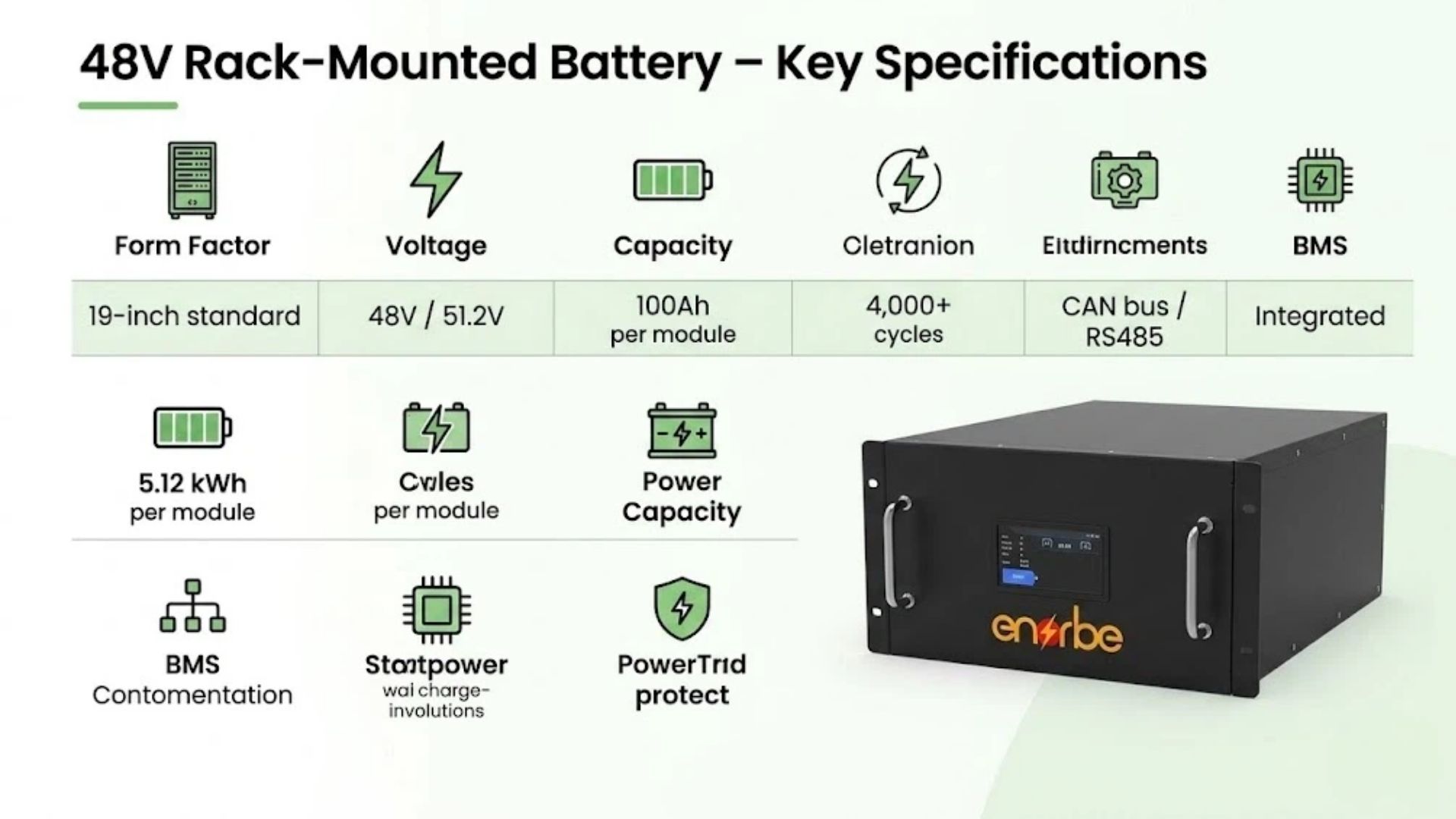
| Specification | Typical Value |
|---|---|
| Nominal Voltage | 48V / 51.2V (LiFePO4) |
| Capacity per Module | 50Ah – 100Ah (high-capacity models up to 200Ah) |
| Energy per Module | 2.5 – 5.12 kWh (100Ah = 5.12 kWh) |
| Form Factor | 19-inch standard, 3U–6U height |
| Rack Capacity | 4–15 modules per rack |
| Communication | CAN bus / RS485 (supports inverter and EMS integration) |
| BMS Protection | Over-voltage, under-voltage, over-current, short circuit, temperature |
| Cycle Life | 4,000+ cycles at 80% DoD |
| Cooling | Active (rack fans / AC-controlled) |
| Certifications | UL 1973, IEC 62619, UN38.3, CE |
The integrated Battery Management System (BMS) provides comprehensive protection and enables remote monitoring through CAN bus or RS485 communication. For high-capacity 48V battery with CAN bus integration, ensure the BMS supports your specific inverter brand—most major inverters (Victron, Deye, Growatt, GoodWe) offer CAN bus compatibility with rack-mounted LiFePO4 modules.
For more information on BMS and battery safety, see our BESS certification and compliance guide.
Why Choose 48V Rack-Mounted Systems?
1. Standardized Form Factor
The 19-inch rack format is the industry standard for data centers and telecom facilities. Rack-mounted batteries integrate seamlessly with existing server racks, requiring no custom enclosures or additional floor space.
2. Modular Scalability
Start with 1-2 modules and expand to 15+ modules as load grows. Each module is a complete battery with its own BMS, allowing capacity expansion without system redesign. This makes 48V rack systems ideal for growing commercial energy storage deployments.
3. Hot-Swappable Maintenance
Slide-out modules can be replaced without powering down the entire system—critical for data centers and telecom operations where downtime is not an option.
4. Active Cooling Compatibility
Designed for rack cooling systems, rack-mounted batteries maintain optimal operating temperatures even in high-density installations.
5. Communication Integration
CAN bus and RS485 communication enable integration with existing monitoring systems, providing real-time visibility into battery health, state of charge, and system status.
For rack battery installation guidance, see our step-by-step LiFePO4 battery installation guide
Key Applications
1. Data Center UPS Backup
48V rack-mounted batteries provide reliable backup power for server racks, ensuring uninterrupted operation during grid outages.
Typical setup: 1-3 racks per data center aisle, each with 4-8 modules.
2. Telecom Base Stations
The 48V platform is the telecom industry standard. Rack-mounted batteries are ideal for cell towers and communication facilities, offering reliable backup in a compact form factor.
Typical setup: 2-4 modules per base station.
3. Commercial Energy Storage
Rack-mounted batteries are increasingly used in commercial buildings for peak shaving, demand charge reduction, and backup power. When paired with solar inverters, they form a complete 48V battery solar storage system for behind-the-meter applications.
Typical setup: 1-2 racks per commercial installation.
4. Server Room Protection
Small to mid-size server rooms benefit from rack-mounted batteries for UPS protection without dedicated battery rooms.
Typical setup: 1 rack with 4-8 modules.
How to Choose a Rack-Mounted Battery for Your Project
Step 1: Determine Your Capacity Requirements
| Application | Typical Capacity | Number of Modules (100Ah) |
|---|---|---|
| Small server room | 5-10 kWh | 1-2 modules |
| Data center rack | 10-20 kWh | 2-4 modules |
| Telecom base station | 5-10 kWh | 1-2 modules |
| Commercial ESS | 20-50 kWh | 4-10 modules |
Step 2: Verify Rack Compatibility
-
Rack height: 3U–6U per module
-
Rack depth: Standard server rack compatibility
-
Weight: Confirm rack load capacity
-
Cooling: Ensure rack has adequate airflow
Step 3: Check Communication Protocols
-
CAN bus: Compatible with most major inverter brands
-
RS485: Common for telecom and industrial monitoring
Step 4: Verify Certifications
-
UL 1973: Required for North American installations—look for UL listed 48V LiFePO4 battery modules with model-specific certification
-
IEC 62619: International safety standard
-
UN38.3: Mandatory for shipping
Rack-Mounted vs Wall-Mounted vs Stackable
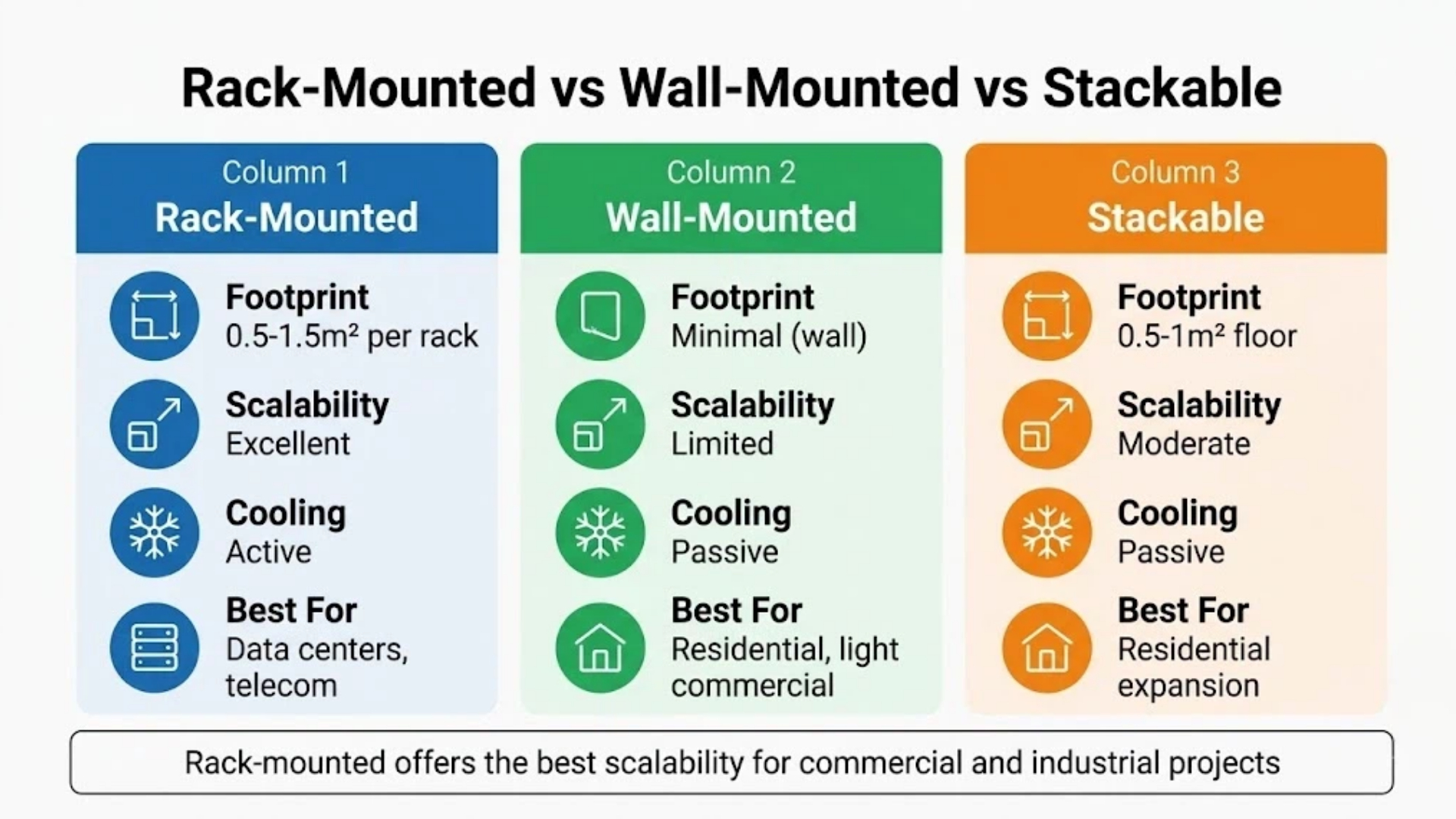
| Feature | Rack-Mounted | Wall-Mounted | Stackable |
|---|---|---|---|
| Footprint | 0.5-1.5m² per rack | Minimal (wall) | 0.5-1m² floor |
| Scalability | Excellent (10+ racks) | Limited (2-3 units) | Moderate (2-10 modules) |
| Cooling | Active | Passive | Passive + optional active |
| Maintenance | Slide-out (hot-swappable) | Fixed | Stack access |
| Best For | Data centers, telecom, commercial ESS | Residential, light commercial | Residential expansion |
For project buyers, rack-mounted systems offer the best scalability and maintenance accessibility—critical for commercial and industrial installations.
B2B Procurement Checklist
When sourcing 48V rack-mounted lithium batteries for commercial projects, verify:
-
Form factor — 19-inch rack compatibility
-
Module height — 3U–6U, fits your rack
-
Capacity — 50Ah–100Ah per module (high-capacity options available)
-
Communication protocol — CAN bus / RS485, compatible with your inverter
-
Certifications — UL 1973, IEC 62619, UN38.3
-
BMS protection — Full protection features included
-
Warranty — 5-10 years industry standard
-
Hot-swappable — Modules can be replaced without system shutdown
-
Shipping compliance — UN38.3 certified for safe transport
Need a Custom 48V Rack Battery Configuration?
Our engineering team can help you size the right 48V rack-mounted LiFePO4 system for your data center, telecom, or commercial energy storage project.
Request a Free Sizing Consultation →Frequently Asked Questions
What is the difference between 48V and 51.2V rack-mounted batteries?
48V and 51.2V refer to the same LiFePO4 battery system—48V is the industry nominal classification, while 51.2V is the actual nominal voltage of a 16-cell LiFePO4 module (3.2V × 16 = 51.2V). Most inverters labeled "48V" are designed to accept 51.2V LiFePO4 batteries. Always confirm compatibility with your specific inverter model.
How many kWh is a 48V 100Ah rack battery?
A 48V 100Ah rack-mounted battery delivers approximately 5.12 kWh of usable energy (51.2V × 100Ah = 5,120 Wh = 5.12 kWh). A standard 19-inch rack can hold 4-15 modules, providing 20 kWh to 76 kWh of storage per rack depending on module height and cooling requirements.
Can 48V rack-mounted batteries be used for solar energy storage?
Yes. 48V rack-mounted LiFePO4 batteries are an excellent choice for solar energy storage when paired with a compatible hybrid inverter or charge controller. The CAN bus communication allows the inverter to monitor battery state of charge, control charging/discharging, and optimize solar self-consumption. Typical commercial solar + storage installations use 1-2 racks (20-50 kWh).
What certifications do 48V rack batteries need?
For commercial deployments, key certifications include UL 1973 (stationary battery safety for North America), IEC 62619 (international industrial safety), UN38.3 (transport safety), and CE (European compliance). For grid-tied systems, also verify IEEE 1547 compliance and local fire code requirements. Always request model-specific certificates—not just factory-wide certifications.
How long do 48V rack-mounted LiFePO4 batteries last?
Quality 48V rack-mounted LiFePO4 batteries typically last 4,000-6,000 cycles at 80% depth of discharge, which translates to 10-15 years of operational life in most commercial applications. Actual lifespan depends on discharge depth, operating temperature, charging rates, and BMS quality. Rack-mounted systems with active cooling and robust BMS protection generally achieve the longest cycle life.
Can I mix different brands of rack-mounted battery modules?
It is not recommended to mix different brands of rack-mounted battery modules in the same parallel/series configuration. Different BMS firmware, charging profiles, and communication protocols can cause imbalance, reduced cycle life, or safety issues. For expansions, always use the same brand, model, and capacity as your existing modules. If you need to expand with a different brand, use a separate battery bank with its own inverter.
What is the best 48V lithium battery for commercial energy storage?
The best 48V lithium battery for commercial energy storage depends on your specific application, but key factors to prioritize are: UL 1973 certification, 4,000+ cycle life, CAN bus communication for inverter integration, hot-swappable rack form factor, and a manufacturer with 5+ years of track record. For data center and telecom applications, prioritize suppliers with proven reference projects in your region.
Why Enerbe for Rack-Mounted Batteries?
Enerbe provides 48V rack-mounted LiFePO4 batteries designed for data center, telecom, and commercial applications. Our 48V LiFePO4 battery rack modules are built with automotive-grade cells and integrated BMS for reliable, long-lasting performance.
Key Advantages:
-
19-inch standard form factor (3U-5U options)
-
100Ah capacity per module (5.12 kWh), scalable to 200Ah high-capacity models
-
4,000+ cycle life at 80% DoD
-
CAN bus / RS485 communication (compatible with Victron, Deye, Growatt, GoodWe and more)
-
Integrated BMS with full protection and remote monitoring
-
UL 1973, CE, IEC 62619, UN38.3 certified
-
Hot-swappable modules for zero-downtime maintenance
View our full product lineup and request a quote on our 48V rack-mounted LiFePO4 battery product page.
Get In Touch
Ready to source 48V rack-mounted LiFePO4 batteries for your project? Contact Enerbe today.
📄 Request a Technical Datasheet
Contact Us →📞 Speak with Our Engineering Team
Get In Touch →🔗 Browse Our 48V Rack Battery Solutions
View Products →Dongguan A&S Power Technology Co., Limited.
Building 1, No. 2, Keji 9th Road,
Songshan Lake, Dongguan, Guangdong, China
📞 +86 137 1383 1631
✉ info@aspowerbattery.com
Stay Charged. Stay Connected.



Deep Cycle Battery vs Lithium Ion – Which is Better for Your Application?
48V Lithium Battery – A Complete B2B Sourcing Guide
Related Article



Get In Touch
Have questions about custom lithium batteries, energy storage solutions, or lead-to-lithium conversion? Our team is ready to help. Send us a message and we’ll respond within 24 hours.

Building 1, No. 2, Keji 9th Road, Songshan Lake, Dongguan, Guangdong, China
Office Address

info@aspowerbattery.com
Email Us

+86 137 1383 1631
Call Us

Sun - Fri (08AM - 10PM)
Office Open
