
48V Golf Cart Battery LiFePO4 Guide

Table of Contents
48V Golf Cart Batteries – LiFePO4 Upgrade Guide for Fleet Operators
Last updated: September 2026 | Written by the Enerbe Engineering Team
Introduction
Quick Answer: A 48V LiFePO4 golf cart battery is the best upgrade for fleet operators replacing aging lead-acid systems. It delivers 4,000+ cycles (10x longer than lead-acid), zero maintenance, 50% less weight, 40-50% more runtime per charge, and 3x faster charging. Most fleets recover the upfront cost within 18-24 months, saving $3,000-$5,000 per cart over 10 years. The key is choosing a battery with Grade A cells, integrated BMS, and correct charging voltage (54.75V for 48V systems).
Golf course operators and fleet managers are increasingly switching to 48V golf cart batteries to replace aging lead-acid systems. Among the options, 48V lithium golf cart batteries are the most popular choice, delivering longer runtime, faster charging, and zero maintenance compared to traditional lead-acid.
For B2B buyers managing fleets of 20+ carts, upgrading to 48V LiFePO4 golf cart batteries can reduce operating costs by thousands of dollars per year.
This guide covers everything you need to know about 48V golf cart batteries—from specifications and benefits to fleet ROI calculations.
For a complete overview of LiFePO4 battery sourcing, see our B2B Sourcing Guide.
For a detailed comparison of LiFePO4 and lead-acid, see our Lead-Acid to LiFePO4 Conversion Guide.
Why 48V Golf Cart Batteries?
The 48V system is the most common voltage platform for modern golf carts. When you search for 48V golf cart batteries, you're looking at the industry standard—the voltage used by most major golf cart manufacturers.
A 48V LiFePO4 golf cart battery delivers 4,800Wh of usable energy with exceptional cycle life and safety.
Typical Golf Cart Battery Configurations
| Voltage | Typical Use | Best For |
|---|---|---|
| 36V | Older carts, small fleets | Light duty |
| 48V | Most modern carts | Standard fleets |
| 72V | High-performance carts | Heavy duty |
48V is the sweet spot for most golf course operations—balancing power, efficiency, and component availability. For fleet operators looking for 48V lithium golf cart batteries, this voltage offers the best combination of performance and cost-effectiveness.
For more detailed information on LiFePO4 battery technology, see our What Is a LiFePO4 Battery Guide.
Key Specifications
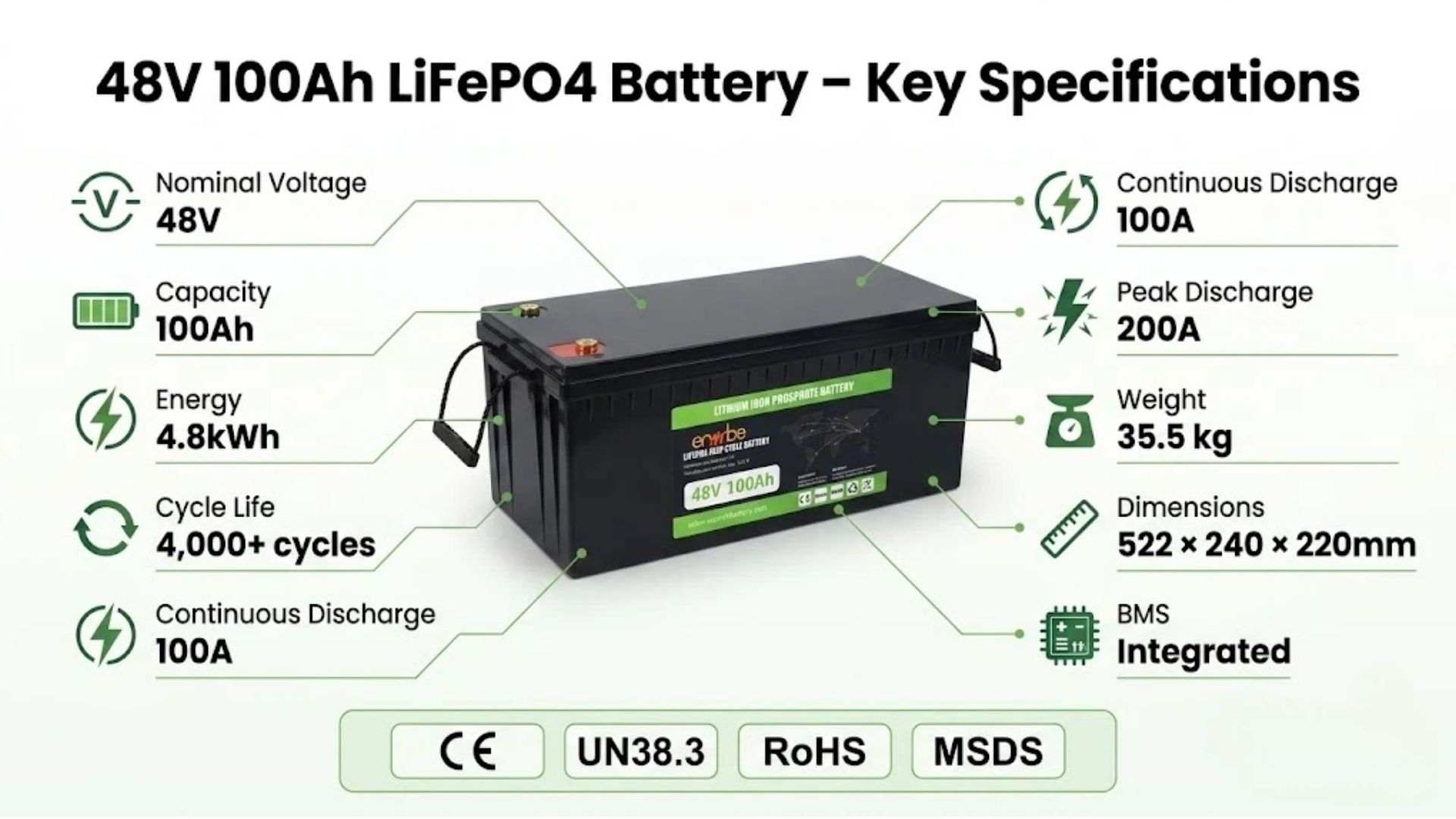
| Specification | Value |
|---|---|
| Nominal Voltage | 48V (51.2V full charge) |
| Rated Capacity | 100Ah |
| Total Energy | 4,800 Wh (4.8 kWh) |
| Cell Type | Grade A 3.2V LiFePO4 |
| Recommended Charge Current | 5A – 50A |
| Maximum Charge Current | 50A |
| Continuous Discharge Current | 100A |
| Peak Discharge Current | 200A (10s) |
| Low Voltage Disconnect | 37.5V |
| Recommended Charge Voltage | 54.75 ± 0.2V |
| Charge Temperature | 0°C to 45°C |
| Discharge Temperature | -20°C to 60°C |
| Storage Temperature | -10°C to 50°C |
| Dimensions (L × D × H) | 522 × 240 × 220 mm |
| Weight | 35.5 kg |
| Terminal Type | M8 |
| Cycle Life | >4,000 cycles (100% DoD) / >5,500 cycles (80% DoD) |
| Self-Discharge Rate | Less than 3% per month |
| Certifications | CE, UN38.3, RoHS, MSDS |
The integrated Battery Management System (BMS) provides comprehensive protection against overcharge, over-discharge, over-current, and short circuits, ensuring safe and reliable operation.
For a detailed comparison of LiFePO4 and lead-acid, see our Lead-Acid to LiFePO4 Conversion Guide.
LiFePO4 vs Lead-Acid for Golf Carts
| Metric | 48V LiFePO4 | 48V Lead-Acid | Advantage |
|---|---|---|---|
| Cycle Life | 4,000+ cycles | 300-500 cycles | ✅ 10x longer |
| Weight | 35.5 kg | ~60-70 kg | ✅ ~50% lighter |
| Usable Capacity | 80-100% | 50% max | ✅ 2x usable energy |
| Charging Time | 2-4 hours | 8-10 hours | ✅ 3x faster |
| Maintenance | Zero | Monthly watering & cleaning | ✅ Zero maintenance |
| Runtime per Charge | Extended | Standard | ✅ 40-50% more range |
| 10-Year TCO | Lower | Higher | ✅ Significant savings |
The bottom line: One 48V LiFePO4 golf cart battery replaces 3-4 lead-acid batteries over a 10-year period, with zero maintenance and significantly lower total cost of ownership.
For a detailed comparison of LiFePO4 and lead-acid, see our Lead-Acid to LiFePO4 Conversion Guide.
Fleet ROI Calculation
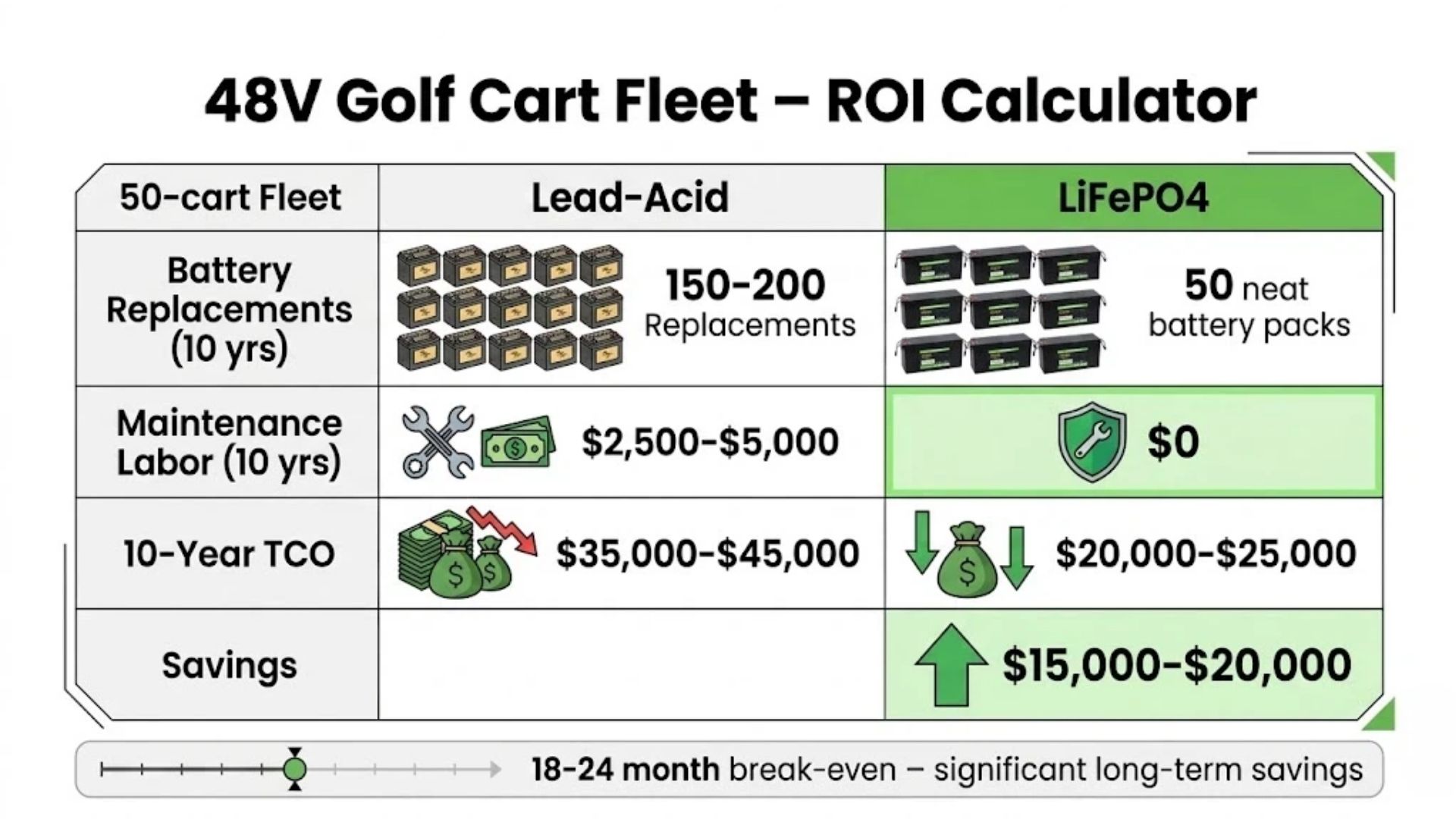
Annual Cost Comparison per Cart
| Cost Factor | Lead-Acid | LiFePO4 | Savings |
|---|---|---|---|
| Battery Replacement (10 years) | 3-4 replacements | 1 replacement | $1,500-$2,500 |
| Maintenance Labor | $100-200/year | $0 | $1,000-$2,000 |
| Water/Distilled Water | $50/year | $0 | $500 |
| Downtime (Lost Revenue) | 5-10 days/year | 1-2 days/year | Varies |
| Total 10-Year Savings per Cart | $3,000-$5,000 |
Fleet Example: 50-Cart Fleet
| Metric | Lead-Acid Fleet | LiFePO4 Fleet | Difference |
|---|---|---|---|
| Battery Replacements (10 years) | 150-200 batteries | 50 batteries | 100-150 fewer batteries |
| Maintenance Hours (10 years) | 2,500-5,000 hours | 0 hours | Labor savings |
| 10-Year TCO | $35,000-$45,000 | $20,000-$25,000 | $15,000-$20,000 savings |
Break-even point: Most golf course fleets recover the upfront cost within 18-24 months.
Installation and Compatibility
Drop-In Replacement
Most 48V lithium golf cart batteries are designed as drop-in replacements for lead-acid batteries, requiring no modifications to existing battery trays or terminal connections. When selecting a 48V golf cart battery, compatibility with your existing system is a key consideration.
What to Check Before Installation:
-
Battery tray dimensions match the LiFePO4 battery size
-
Terminal type and orientation match your cart
-
Charger is LiFePO4-compatible (or upgrade required)
-
BMS communication (if applicable to your cart model)
-
Trolling motor compatibility (if applicable)
Battery Management System (BMS)
The integrated BMS provides essential protection for golf cart applications:
| BMS Feature | Function |
|---|---|
| Over-voltage protection (OVP) | Disconnects charging when any cell exceeds 3.65V |
| Under-voltage protection (UVP) | Disconnects discharge when any cell drops below 2.5V |
| Over-current protection (OCP) | Disconnects discharge when current exceeds 100A continuous |
| Short-circuit protection (SCP) | Instantly disconnects output on short circuit (<1ms response) |
| Over-temperature protection (OTP) | Disconnects charge/discharge when temperature exceeds 60°C |
| Cell balancing | Equalizes cell voltages during charge to prevent over-voltage |
For more on BMS functionality and troubleshooting, see our How to Reset BMS on LiFePO4 Battery Guide.
B2B Procurement Checklist
When sourcing 48V golf cart batteries for your fleet, verify:
-
Capacity — 100Ah, 150Ah, or 200Ah based on daily usage
-
Cycle life — 4,000+ cycles at 100% DoD
-
Weight — 35.5 kg for 100Ah model
-
Dimensions — 522 × 240 × 220 mm
-
Terminal type — Matches your existing equipment (M8 standard)
-
Certifications — CE, UN38.3, RoHS, MSDS
-
BMS protection — Full protection features included (OVP, UVP, OCP, SCP, OTP)
-
Warranty — 5-10 years industry standard
-
Charger compatibility — 54.75V charge voltage for 48V LiFePO4 systems
-
Cell grade — Grade A cells with accurate sorting and grading
Frequently Asked Questions
What are the best 48V golf cart batteries?
For most fleets, a 48V 100Ah LiFePO4 battery offers the best balance of capacity, weight, and cost. For extended runtime, consider 150Ah or 200Ah options. When comparing 48 volt lithium golf cart batteries, look for Grade A cells, integrated BMS with full protection features, and UN38.3 shipping certification.
How long do 48V golf cart batteries last?
A 48V LiFePO4 golf cart battery provides 4,000+ cycles at 100% DoD—approximately 10+ years of reliable service, compared to 2-3 years for lead-acid. At 80% DoD, cycle life extends to 5,500+ cycles. Actual lifespan depends on usage patterns, charging practices, and temperature conditions.
Can I upgrade my 36V golf cart to 48V?
Yes, but this requires upgrading the motor, controller, and charger. Most fleet operators choose to purchase new 48V carts or work with a conversion specialist. The 48V golf cart batteries are the most common upgrade path for modern fleets. If your carts are already 48V, the LiFePO4 upgrade is a simple drop-in replacement.
Do I need a special charger for 48V LiFePO4 golf cart batteries?
Yes. Lead-acid chargers are not compatible with LiFePO4 batteries. You will need a LiFePO4-specific charger set to 54.75V (±0.2V) for 48V systems. Using a lead-acid charger (typically 58.8V or lower float voltage) can cause undercharging, overcharging, or BMS protection triggers. For more on charging parameters, see our How to Charge LiFePO4 Batteries Guide.
Is it worth upgrading a golf cart fleet to LiFePO4?
Yes. Most fleets recover the upfront cost within 18-24 months through reduced replacement frequency, zero maintenance, and improved runtime. 48V lithium golf cart batteries offer the best ROI for fleet operators, with $3,000-$5,000 savings per cart over 10 years. For a 50-cart fleet, total savings can reach $150,000-$250,000 over a decade.
What is the weight of a 48V LiFePO4 golf cart battery?
A 48V 100Ah LiFePO4 battery weighs 35.5 kg—about half the weight of an equivalent lead-acid battery (~60-70 kg), making installation and handling significantly easier. The reduced weight also improves cart efficiency, extends tire life, and reduces wear on suspension components.
Can I use my existing lead-acid charger for a LiFePO4 golf cart battery?
No. Lead-acid chargers use different voltage profiles (typically 58.8V absorption with float mode) that are incompatible with LiFePO4 chemistry. A 48V LiFePO4 battery requires a charger set to 54.75V with no float mode. Using the wrong charger can trigger BMS over-voltage protection, reduce battery life, or create safety risks. Always use a LiFePO4-specific charger.
What is the typical break-even period for a golf cart fleet LiFePO4 upgrade?
Most golf course fleets recover the upfront cost of a LiFePO4 upgrade within 18-24 months. The break-even point depends on fleet size, daily usage, local electricity costs, and current lead-acid replacement frequency. Fleets with high daily usage (36+ holes per day) and frequent lead-acid replacements typically see the fastest ROI. The savings come from zero maintenance, 10x longer cycle life, and reduced downtime.
Related Resources
-
What Is a LiFePO4 Battery? Complete Guide — chemistry, cycle life, safety, and applications for B2B buyers
-
Lead-Acid to LiFePO4 Conversion Guide — step-by-step conversion for golf carts, RVs, marine, and automotive
-
How to Charge LiFePO4 Batteries Guide — charging voltage, current, charger selection, and BMS protection
-
LiFePO4 Battery Safety Guide — thermal runaway risk, fire hazard, handling, storage, and certifications
-
How to Reset BMS on LiFePO4 Battery — BMS protection mode, reset procedures, and troubleshooting
-
48V Rack-Mounted Lithium Battery Guide — rack-mounted 48V LiFePO4 batteries for commercial energy storage
Summary
Upgrading to 48V LiFePO4 golf cart batteries delivers significant benefits for fleet operators:
-
10x longer cycle life — 4,000+ cycles vs 300-500 for lead-acid
-
50% weight reduction — Better cart handling and efficiency
-
40-50% more range — Extended runtime per charge
-
Zero maintenance — No watering, cleaning, or equalization
-
3x faster charging — 2-4 hours vs 8-10 hours
-
$3,000-$5,000 savings per cart over 10 years
-
18-24 month break-even for most fleets
Whether you're searching for 48V golf cart batteries, 48V lithium golf cart batteries, or golf cart batteries 48V, Enerbe provides reliable LiFePO4 solutions with integrated BMS and full shipping certifications.
View the full product specifications on the product page:
👉 View 48V 100Ah LiFePO4 Golf Cart Battery Product Page

Get In Touch
Need safety documentation or a quote for certified LiFePO4 batteries? Contact Enerbe today.
📄 Request Safety Certifications & Datasheet
Contact Us →📞 Speak with Our Engineering Team
Get In Touch →🔗 Browse Certified LiFePO4 Battery Products
View Products →Dongguan A&S Power Technology Co., Limited.
Building 1, No. 2, Keji 9th Road,
Songshan Lake, Dongguan, Guangdong, China
📞 +86 137 1383 1631
✉ info@aspowerbattery.com
Stay Charged. Stay Safe.



LiFePO4 Battery Installation Guide
What Is LiFePO4 (LFP) Battery? Complete Guide (2026)
Related Article


Get In Touch
Have questions about custom lithium batteries, energy storage solutions, or lead-to-lithium conversion? Our team is ready to help. Send us a message and we’ll respond within 24 hours.

Building 1, No. 2, Keji 9th Road, Songshan Lake, Dongguan, Guangdong, China
Office Address

info@aspowerbattery.com
Email Us

+86 137 1383 1631
Call Us

Sun - Fri (08AM - 10PM)
Office Open
