
How to Ensure Custom Lithium Battery Compliance – A Real Case Study
Table of Contents
Introduction
When a B2B buyer orders custom lithium batteries from overseas suppliers, one question always comes up: “How do I know these batteries can be shipped safely and legally?”
Unlike off-the-shelf products, custom batteries don‘t have pre-existing compliance documentation. Every custom model must go through its own certification process—and for B2B buyers, verifying this documentation is essential before placing an order.
This article walks through a real case study of a custom 12.8V 20Ah LiFePO4 battery (model EN1220) that recently completed its full shipping compliance package. We’ll explain what each document means for B2B buyers.
For a complete overview of LiFePO4 battery sourcing across all applications, see our B2B Sourcing Guide.
The Challenge: Custom Battery, No Existing Documentation
A client approached Enerbe with a specific requirement: a 12.8V 20Ah 256Wh LiFePO4 battery for a specialized application. While Enerbe has standard battery models, this custom configuration required its own set of shipping certifications.
Any lithium battery shipped internationally must have:
| Document | Purpose |
|---|---|
| UN38.3 Test Report | Proves the battery has passed 8 transportation safety tests |
| MSDS (Material Safety Data Sheet) | Provides safety information for handling and emergencies |
| Transport Certificate (by Sea or Air) | Confirms compliance for shipping |
Without these documents, the shipment cannot be booked with freight forwarders or cleared through customs.
For more detailed information on lithium battery certifications, see our BESS Certification & Compliance Guide.
The Solution: Completing the Full Compliance Package
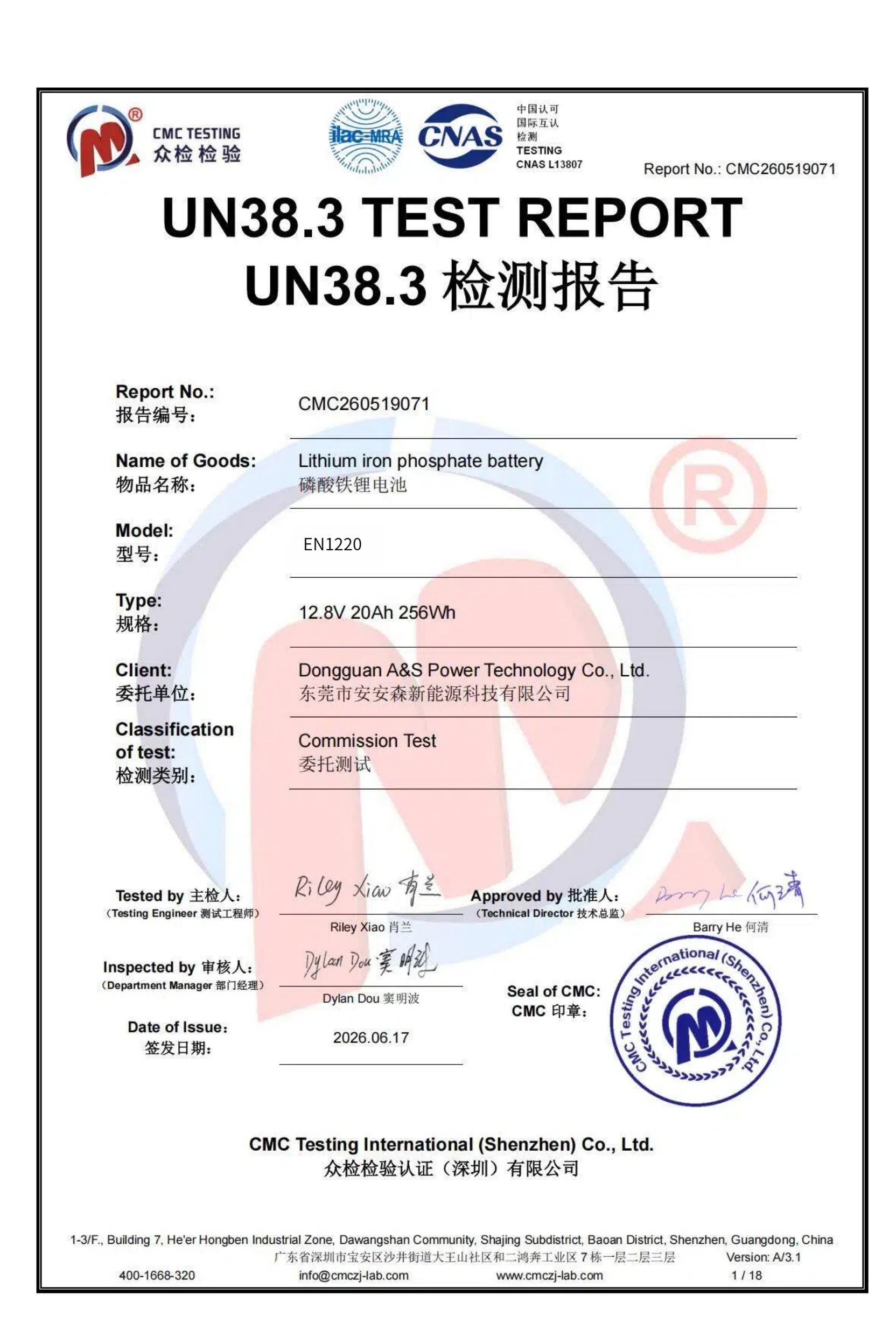
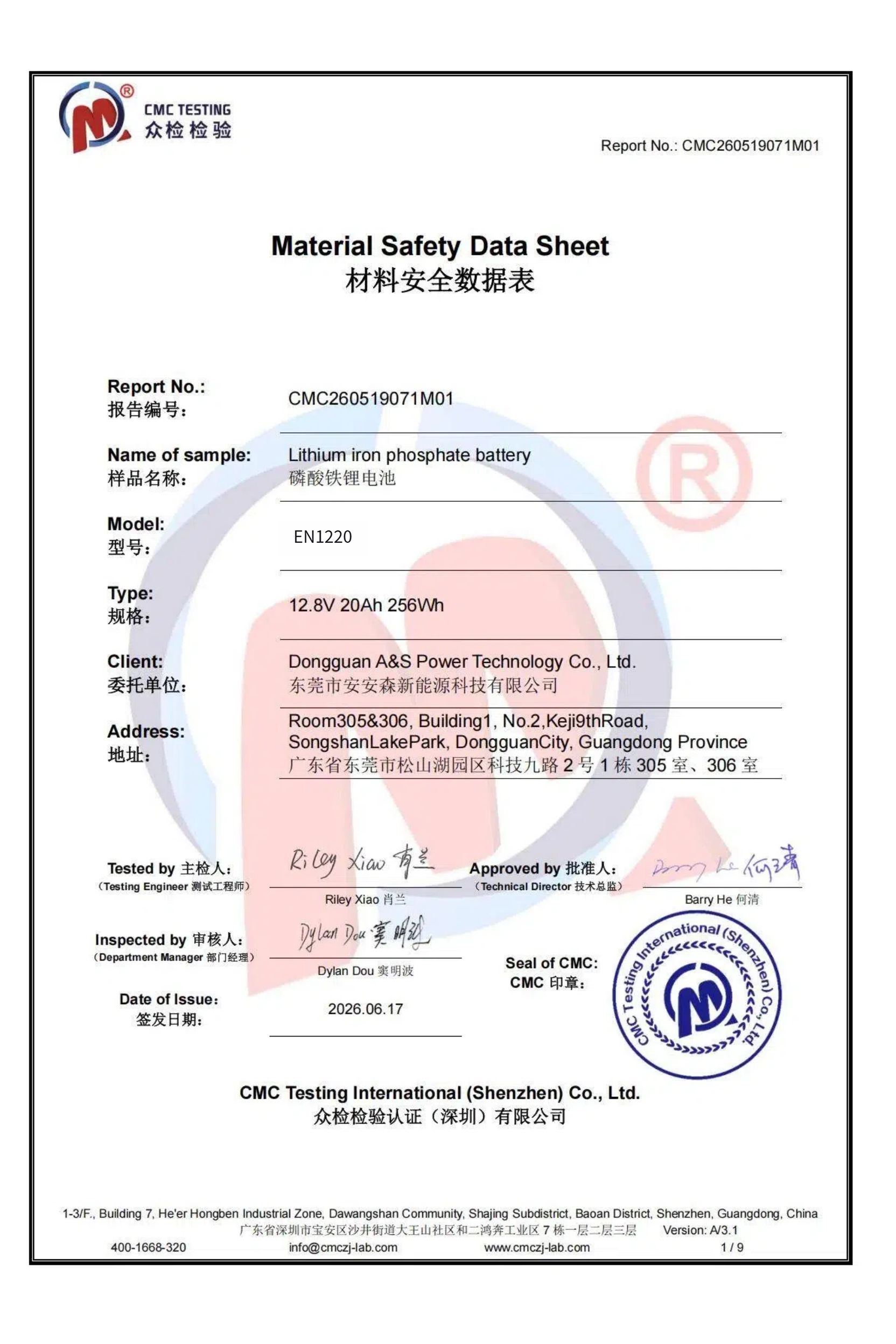

Step 1: UN38.3 Testing
UN38.3 is the United Nations standard for lithium battery transport safety. It requires passing eight tests:
| Test | What It Simulates |
|---|---|
| T1: Altitude Simulation | Air transport conditions |
| T2: Thermal Test | Extreme temperature cycling |
| T3: Vibration Test | Vibration during transport |
| T4: Shock Test | Impact during handling |
| T5: External Short Circuit | Accidental short circuit |
| T6: Impact Test | Physical impact during transport |
| T7: Overcharge Test | Charger malfunction |
| T8: Forced Discharge | Installation error |
For the custom EN1220 battery, Enerbe submitted samples to an accredited testing laboratory (CMC Testing International). After completing all 8 tests, the battery received its UN38.3 Test Report.
What B2B buyers should check: Always verify that the UN38.3 report covers the specific model you are purchasing. Generic reports are not acceptable for shipping.
Step 2: MSDS Documentation
The Material Safety Data Sheet (MSDS) provides critical safety information about the battery‘s chemical composition, hazards, and handling procedures.
For B2B buyers, the MSDS is essential for:
-
Customs clearance (many countries require it for import)
-
Shipping documentation (required by freight forwarders)
-
Emergency response (firefighting and spill handling)
-
Workplace safety (proper handling and storage)
The custom EN1220 battery received a full MSDS following GHS (Globally Harmonized System) standards, ensuring compliance across multiple regions.
What B2B buyers should check: Make sure the MSDS is available in English and covers the specific model you are purchasing.
Step 3: Transport Certificate (By Sea)
The transport certificate (or Transport Hazard Identification Report) confirms that the battery has been properly classified for transport. For the EN1220 battery, Enerbe obtained a Maritime Transport Certificate through China Inspection & Testing Group.
This certificate provides:
-
Traceability for shipping and customs compliance
-
Confirmation that the battery has been professionally evaluated for transport
-
Reassurance to freight forwarders that the shipment meets international standards
What B2B buyers should check: Confirm whether your shipment requires a sea or air certificate (or both). Sea and air certificates are not interchangeable.
Why This Matters for B2B Buyers
When sourcing custom lithium batteries from overseas suppliers, always verify these three documents before placing your order:
| Document | What to Verify |
|---|---|
| UN38.3 | Does it cover your specific model? Is it current? |
| MSDS | Is it in English? Does it cover your specific model? |
| Transport Certificate | Sea or air? Is it current? |
B2B Buying Tip: Ask your supplier to provide these documents for review before confirming the order. A legitimate supplier will have these documents ready for any custom battery model—and will be happy to share them.
For a complete procurement framework for system integrators, see our BESS Procurement Guide.
Frequently Asked Questions
Q1: Does every custom battery model need its own UN38.3 report?
Yes. UN38.3 testing is model-specific. A generic report for a similar battery does not cover a custom model. Always verify that the report matches your exact model number.
Q2: What is the difference between UN38.3 and MSDS?
UN38.3 proves the battery has passed transport safety tests. MSDS provides safety information for handling, storage, and emergency response. Both are required for shipping.
Q3: How long is a UN38.3 report valid?
UN38.3 testing is a one-time certification per battery model. However, if the battery design or chemistry changes, retesting may be required.
Q4: What happens if my shipment doesn‘t have these documents?
Your shipment may be rejected by the freight forwarder, delayed at customs, seized, or subject to fines. Non-compliance can also void insurance coverage.
Q5: Can I ship custom lithium batteries by air?
Yes, but air transport has stricter requirements and additional restrictions (such as state of charge limits). Always check with your supplier and freight forwarder before shipping by air.
Summary
For custom lithium battery orders, shipping compliance is not optional—it’s mandatory. Every custom battery model requires its own UN38.3 test report, MSDS, and transport certificate before it can be shipped internationally.
Enerbe provides complete shipping compliance documentation for all standard and custom LiFePO4 batteries, including UN38.3 reports, MSDS, and transport certificates for sea and air shipping. For custom orders, these documents are prepared during the production phase and delivered with the shipment.
All certification information in this guide is provided for informational purposes. B2B buyers should verify shipping compliance requirements for their specific destination country.
📞 Speak with Our Engineering Team – Get In Touch
🔗 Browse Our Custom Battery Solutions – View Products
Building 1, No. 2, Keji 9th Road, Songshan Lake, Dongguan, Guangdong, China
📞 +86 137 1383 1631 | ✉ info@aspowerbattery.com



LiFePO4 Battery Shipping Certifications – A Complete Compliance Guide (EN1250 Case Study)
Lithium Battery Shipping Certifications – What Every B2B Buyer Should Know

Get In Touch
Have questions about custom lithium batteries, energy storage solutions, or lead-to-lithium conversion? Our team is ready to help. Send us a message and we’ll respond within 24 hours.

Building 1, No. 2, Keji 9th Road, Songshan Lake, Dongguan, Guangdong, China
Office Address

info@aspowerbattery.com
Email Us

+86 137 1383 1631
Call Us

Sun - Fri (08AM - 10PM)
Office Open
