
Commercial & Residential Energy Storage Systems: Sourcing Wall-Mounted, Rack-Mounted & Portable LiFePO4 Batteries
Table of Contents
- Introduction: The Energy Storage Market Opportunity
- Understanding Energy Storage System Components
- Key Technical Parameters Every B2B Buyer Must Verify
- Wall-Mounted vs. Rack-Mounted vs. Portable: Configuration Comparison
- Grid-Tied vs. Off-Grid vs. Hybrid: Which System Configuration?
- B2B Procurement Checklist for System Integrators and Installers
- Why Enerbe for Energy Storage?
Introduction: The Energy Storage Market Opportunity
The global energy storage market is projected to exceed 500 GWh of annual installations by 2030. For system integrators, EPC contractors, installers, and distributors, the opportunity is massive—but so is the complexity of sourcing the right LiFePO4 battery systems.
Unlike consumer-facing purchases, B2B energy storage procurement involves evaluating technical specifications, certification compliance, supply chain reliability, and long-term warranty support. This guide provides a practical framework for sourcing wall-mounted, rack-mounted, and portable LiFePO4 battery systems for both commercial and residential applications—written specifically for B2B buyers, not end consumers.
For a complete overview of LiFePO4 battery sourcing across all applications, see our B2B Sourcing Guide.
To decide between 12V, 24V, or 48V systems for your storage project, refer to our voltage selection guide.
For help choosing between wall-mounted, stackable, and rack-mounted configurations, see our energy storage configuration guide.
For a complete guide to battery energy storage systems (BESS), see our BESS sourcing guide.
For a detailed guide to solar energy battery storage systems, see our solar storage guide.
Understanding Energy Storage System Components
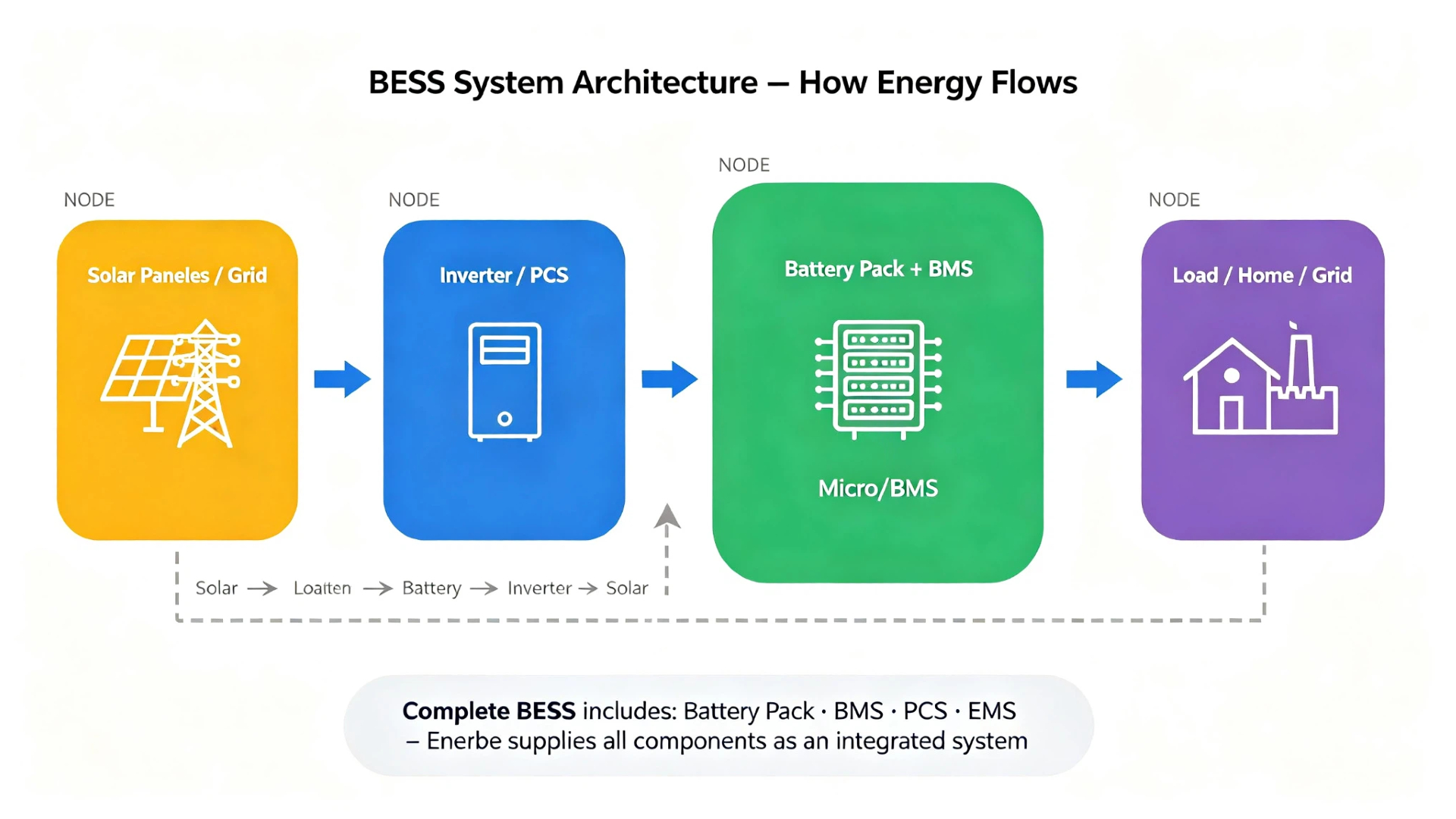
A complete Battery Energy Storage System (BESS) includes multiple integrated components that work together to store and dispatch energy efficiently. Understanding each component is essential for making informed procurement decisions.
| Component | Function | What B2B Buyers Should Check |
|---|---|---|
| Battery Cells/Packs | Energy storage medium (LiFePO4) | Cell grade (A-grade vs B-grade), cycle life certification |
| Battery Management System (BMS) | Monitors cell voltage, temperature, and current; ensures safe operation | Communication protocols (CAN bus/RS485), compatibility with target inverters |
| Power Conversion System (PCS) | Converts DC to AC and vice versa | Efficiency rating, surge capacity, grid compliance |
| Energy Management System (EMS) | Controls when energy is stored or released based on demand, pricing, or grid signals | Software integration, remote monitoring capabilities |
Enerbe provides integrated solutions combining all these components, simplifying procurement and ensuring system compatibility. For B2B buyers, the benefit of a single-source supplier is reduced integration risk and a single point of warranty responsibility.
Key Technical Parameters Every B2B Buyer Must Verify
When evaluating LiFePO4 energy storage systems, request specific datasheet values for these parameters. Do not accept generic marketing claims—verify the numbers.
1. Nominal Voltage and Capacity
Verify the configuration (e.g., 48V/51.2V systems, 100Ah to 300Ah). Ensure the system matches your inverter voltage and required backup duration. For commercial projects, 48V systems are the industry standard due to better efficiency and scalability.
2. Cycle Life
Reputable manufacturers specify cycle life at 80% Depth of Discharge (DOD). Look for 5,000+ cycles, which translates to approximately 10+ years of daily cycling. Some premium cells now offer 6,000–8,000 cycles.
3. BMS Features
Must include over-voltage, under-voltage, over-current, short-circuit, and temperature protection. Advanced BMS offers CAN bus/RS485 communication for integration with inverters (Victron, SMA, Sungrow, GoodWe, Growatt, Deye, etc.).
4. Operating Temperature Range
Confirm charge (typically 0°C to 55°C) and discharge (-20°C to 60°C) ranges. For outdoor installations in extreme climates, verify that the system includes active thermal management.
5. Round-Trip Efficiency
Look for 95%+ efficiency to maximize solar self-consumption and minimize energy loss. Higher efficiency directly impacts project ROI.
Wall-Mounted vs. Rack-Mounted vs. Portable: Configuration Comparison
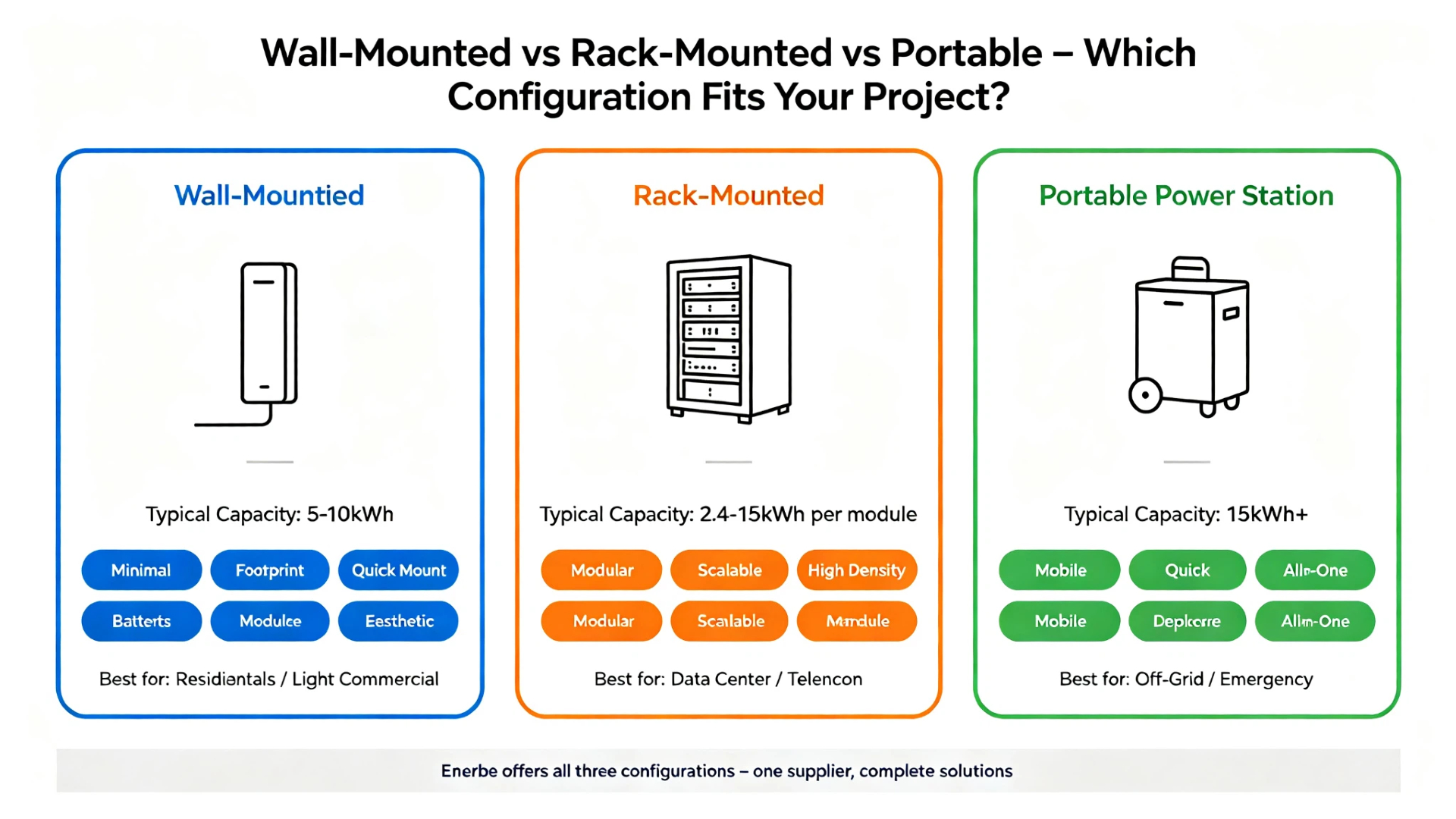
Wall-Mounted Battery Storage
What It Is: A compact battery (typically 48V 50Ah–200Ah) designed to mount on interior walls, usually in garages, utility rooms, or exterior shade-protected walls.
Best For:
-
Residential solar installations (installer channel)
-
Light commercial: retail stores, small offices, telecom micro-shelters
-
Space-constrained projects where floor space is at a premium
Key Advantages:
-
Minimal footprint — occupies virtually no floor space
-
Aesthetic design with LED displays for customer-facing installations
-
Quick bracket mounting — pre-assembled cables reduce installation time
-
Scalable — 2–3 units can be paralleled for increased capacity
Enerbe Solution: 48V 100Ah Wall-Mounted LiFePO4 Battery System for home energy storage (search volume: 260) — featuring slim profile and plug-and-play connectivity.
B2B Buying Tip: For residential solar installers, wall-mounted units are your fastest-moving SKU. Stock the 48V 100Ah configuration as your entry-level product and offer 200Ah for customers with higher consumption.
Rack-Mounted Battery Storage
What It Is: Standardized 19-inch server-rack form factor batteries designed to slide into standard IT or telecom racks.
Best For:
-
Data centers & server rooms (UPS backup)
-
Telecom base stations (48V is the telecom industry standard)
-
Large-scale C&I projects requiring high energy density
-
Utility-scale storage arrays where modular expansion is critical
Key Advantages:
-
Modular and scalable — unlimited parallel connection; add modules as load grows
-
High energy density per U (e.g., 5.12kWh in 3U)
-
Designed for active/passive rack cooling systems
-
Slide-out trays for easy maintenance and hot-swappable replacement
Enerbe Solution: 48V 100Ah Rack-Mounted LiFePO4 Battery for data center & telecom storage — standard 19-inch form factor, 3U height, front LCD display.
B2B Buying Tip: For telecom and data center projects, confirm that the rack-mounted battery supports the required communication protocol (CAN bus for SMA, RS485 for Sungrow, etc.). Enerbe offers BMS customization for specific inverter handshake requirements.
Portable Power Systems
What It Is: Mobile battery systems with built-in inverter and MPPT solar input, typically mounted on wheels for easy transport.
Best For:
-
Off-grid construction sites requiring temporary power
-
Emergency response and disaster relief operations
-
Temporary event power for outdoor festivals and exhibitions
-
Remote mining and agricultural sites without grid access
Key Advantages:
-
Wheeled chassis for mobility — deploy where needed
-
All-in-one solution — battery + inverter + MPPT solar input
-
Quick deployment — set up in minutes, not hours
-
15kWh+ capacity — enough to power critical loads for extended periods
Enerbe Solution: 15kWh LiFePO4 Battery Portable Power System (48V/51.2V 300Ah Lithium) — search volume: 1.3K. Built-in 5kW inverter, MPPT solar input, wheeled chassis.
B2B Buying Tip: Portable power systems are ideal for rental fleets and emergency response contractors. Offer leasing options to capture recurring revenue from this segment.
Grid-Tied vs. Off-Grid vs. Hybrid: Which System Configuration?
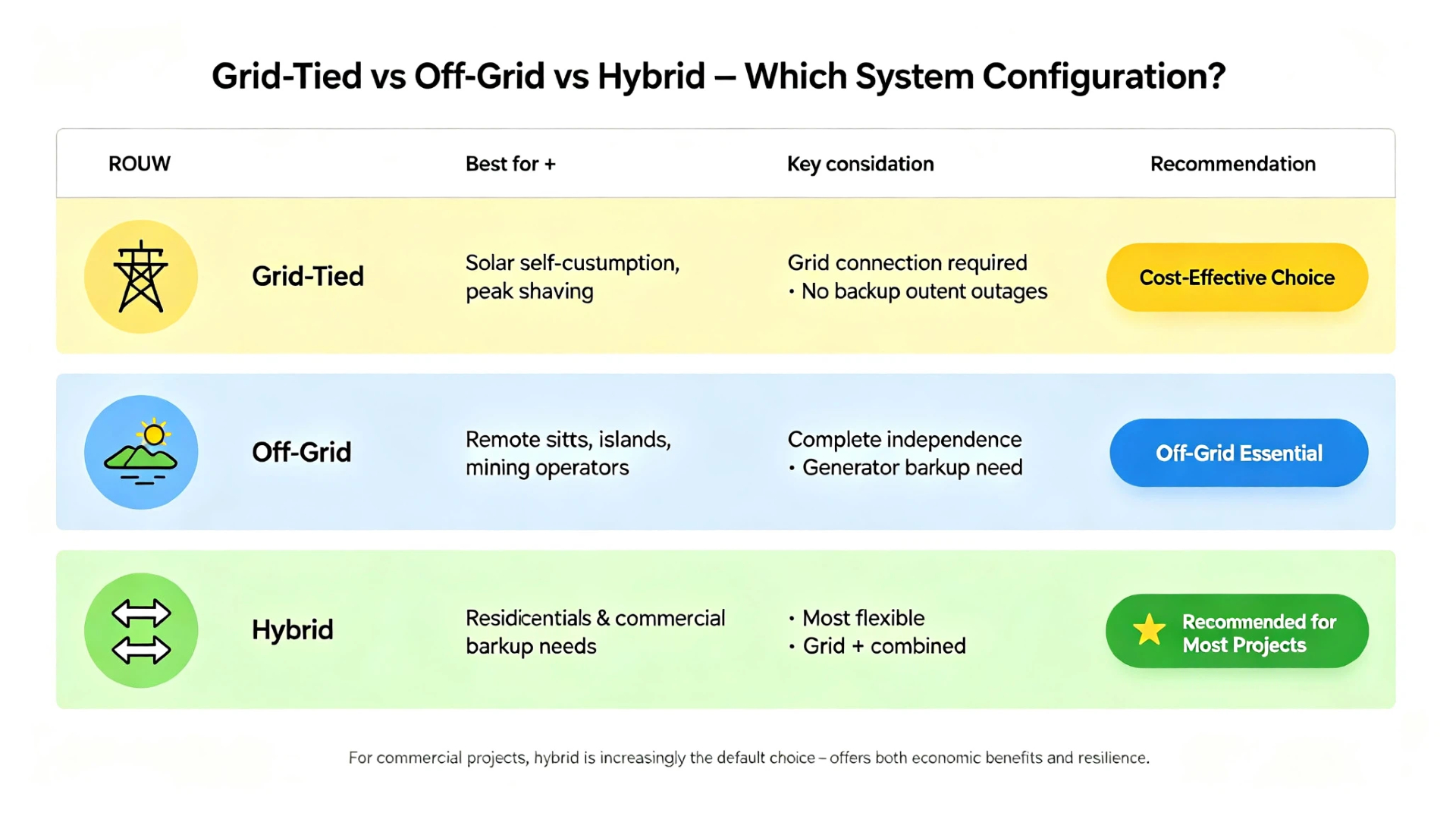
The choice of system configuration depends on grid availability, project objectives, and budget. Each configuration serves distinct use cases.
| Configuration | Best For | Key Consideration |
|---|---|---|
| Grid-Tied | Solar self-consumption, peak shaving, demand charge reduction | Requires grid connection; no backup during outages unless paired with hybrid inverter |
| Off-Grid | Remote sites, islands, mining camps, agricultural operations | Complete power independence; requires generator backup for extended cloudy periods |
| Hybrid | Residential and commercial applications requiring backup power | Most flexible — grid connection + battery backup; can operate in both modes |
B2B Buying Tip: For commercial projects, hybrid systems are increasingly the default choice because they offer both economic benefits (peak shaving, solar self-consumption) and resilience (backup power during outages). The incremental cost of hybrid over grid-tied is typically recovered within 1–2 years.
B2B Procurement Checklist for System Integrators and Installers
Before placing an order for energy storage systems, verify every item on this checklist. Missing any of these can delay your project and erode margins.
-
Inverter compatibility — Does the battery support CAN bus/RS485 protocols for your target inverter brands (Victron, SMA, Sungrow, GoodWe, Growatt, Deye)?
-
Certification compliance — Does the system hold UL 1973, UL 9540A (US), CE/IEC 62619 (Europe), or CEC (Australia) as required by your market?
-
Cycle life warranty — Is the warranty 10 years or 5,000+ cycles? What is the fine print on DOD and temperature conditions?
-
Operating temperature range — Does the system meet your installation environment requirements (indoor vs outdoor, climate zone)?
-
IP rating — For outdoor installations, IP65 minimum is required for dust and water resistance.
-
Lead time for bulk orders — What is the standard lead time for a 20ft/40ft container order? Can the supplier expedite?
-
After-sales support — What is the warranty claim process? Are spare parts available locally?
Why Enerbe for Energy Storage?
Enerbe brings 15+ years of battery manufacturing expertise to the energy storage market, with a track record of serving B2B clients across 138+ countries.
1. Factory Direct Pricing: As a manufacturer, not a trader, Enerbe eliminates middleman markups. This reduces CapEx for large-scale projects by 15–25% compared to trading company alternatives.
2. Flexible Configurations: Enerbe supports 24V, 48V, and custom voltages to match any inverter. Wall-mounted, rack-mounted, portable, and stackable form factors are all available from a single supplier.
3. Comprehensive BMS: CAN bus/RS485 communication, Bluetooth monitoring, GPS remote tracking, and active current balance. Enerbe's BMS includes full protection suite: over-voltage, under-voltage, over-current, short-circuit, over-temperature, and reverse polarity.
4. Global Shipping: Expertise in containerized shipping to US, Europe, Australia, and Middle East with full insurance coverage. Enerbe manages export documentation, customs clearance, and delivery to your warehouse or project site.
5. Certifications: UL, CE, IEC 62619, UN38.3 compliant. All certifications are current and verifiable—not expired or pending.
6. OEM/ODM Services: Custom branding, packaging, voltage configurations, and BMS programming available for distributors and system integrators. Enerbe has delivered custom solutions for brands like LEGO, Philips, and Best Buy—proof of enterprise-grade quality.
📞 Speak with Our Engineering Team – Get In Touch
🔗 Browse Our Custom Battery Solutions – View Products
Building 1, No. 2, Keji 9th Road, Songshan Lake, Dongguan, Guangdong, China
📞 +86 137 1383 1631 | ✉ info@aspowerbattery.com



Lead-Acid to LiFePO4 Conversion: A B2B Sourcing Guide for Golf Carts, RVs, Marine & Automotive Applications
The Complete B2B Sourcing Guide for LiFePO4 Batteries: Energy Storage, Golf Carts, Marine, RV & More (2026)
Related Article


Get In Touch
Have questions about custom lithium batteries, energy storage solutions, or lead-to-lithium conversion? Our team is ready to help. Send us a message and we’ll respond within 24 hours.

Building 1, No. 2, Keji 9th Road, Songshan Lake, Dongguan, Guangdong, China
Office Address

info@aspowerbattery.com
Email Us

+86 137 1383 1631
Call Us

Sun - Fri (08AM - 10PM)
Office Open
