
Lead-Acid Battery Fading Too Fast? Why Golf Course Fleets Are Switching to LiFePO4

Table of Contents
- Introduction: The Hidden Cost of Lead-Acid in Golf Course Operations
- Why Lead-Acid Batteries Are Draining Your Operating Budget
- LiFePO4: The Golf Course Fleet Game-Changer
- Drop-In Replacement: What Golf Course Fleet Managers Need to Know
- Enerbe Solutions for Golf Course Fleets
- Enerbe Advantage for Golf Course Fleet Managers
- B2B Procurement Checklist: What to Ask Your LiFePO4 Supplier
Introduction: The Hidden Cost of Lead-Acid in Golf Course Operations
For golf course operators and fleet managers, batteries are one of the largest ongoing operational expenses. A typical 18-hole course operates 60–100 golf carts, each requiring 6–8 lead-acid batteries, replaced every 2–3 years. The math is staggering: a 100-cart fleet can consume 500–800 lead-acid batteries every 3 years, costing $50,000–$80,000 in replacement batteries alone—not counting labor, disposal fees, and downtime.
But the real cost isn't just the purchase price. It's the hidden costs: weekly watering, terminal cleaning, mid-round cart failures, member complaints, and the environmental liability of hazardous waste disposal.
For B2B buyers managing golf course fleets, this guide explains why the industry is rapidly switching to LiFePO4 batteries and how to evaluate suppliers for a fleet-wide conversion.
Why Lead-Acid Batteries Are Draining Your Operating Budget
Before exploring the solution, understand the problem. Lead-acid batteries are not designed for the demands of a modern golf course:
1. Short Cycle Life
Lead-acid batteries deliver 200–500 cycles at 50% depth of discharge. For a golf cart used daily during peak season, this translates to just 18–24 months of usable life.
The math:
-
200–500 cycles ÷ 365 days = less than 1.5 years of daily use
-
In high-use courses (double shifts, tournaments), replacement can be as frequent as 12–14 months
2. 50% Usable Capacity Rule
Lead-acid should never be discharged below 50% to avoid permanent damage. This means a 200Ah lead-acid battery only delivers 100Ah of usable capacity—you paid for 200Ah but can only use half.
3. Weekly Maintenance
Each battery requires regular maintenance:
-
Watering: Distilled water must be added weekly during peak season
-
Terminal cleaning: Corrosion buildup reduces efficiency and creates resistance
-
Equalization charging: Monthly equalization cycles to balance cells (takes 8+ hours)
For a 100-cart fleet, maintenance consumes 30–50 hours of labor per month—the equivalent of one full-time employee.
4. Voltage Sag and Performance Drop
As lead-acid discharges, voltage drops significantly. A cart starting with 48V may deliver only 42V when the battery is at 50%—resulting in slower speeds, reduced torque, and poor hill-climbing performance. Members notice. Complaints increase.
5. Temperature Sensitivity
Lead-acid performance degrades in heat and freezes in cold. Summer temperatures above 35°C accelerate corrosion and water loss. Winter storage in unheated buildings reduces capacity by up to 40%.
6. Environmental and Safety Liability
Lead-acid batteries are classified as hazardous waste. Disposal requires certified handlers, documentation, and proper storage to avoid soil and water contamination. A single spill can trigger fines of $10,000–$50,000 from environmental agencies.
B2B Buying Insight: For golf course operators, the decision to switch is not just about battery cost—it's about reducing liability, improving member experience, and freeing up labor.
LiFePO4: The Golf Course Fleet Game-Changer
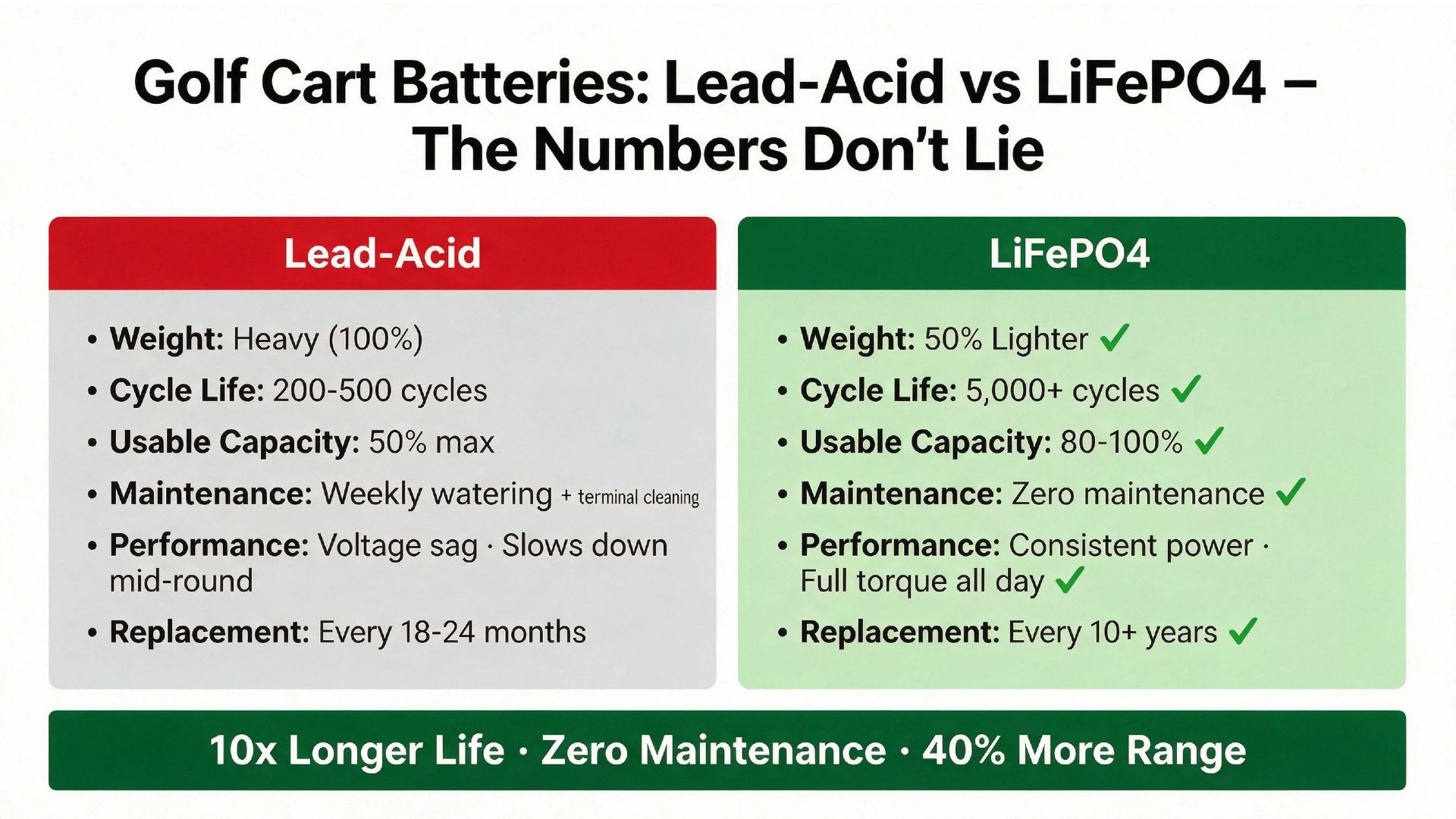
LiFePO4 (Lithium Iron Phosphate) batteries are purpose-built for the daily demands of golf course operations:
1. 10x Longer Cycle Life
-
LiFePO4 delivers 5,000+ cycles at 80% depth of discharge
-
For a daily-use golf cart, this means 10–12 years of service
-
One LiFePO4 battery replaces 10–25 lead-acid batteries over its lifetime
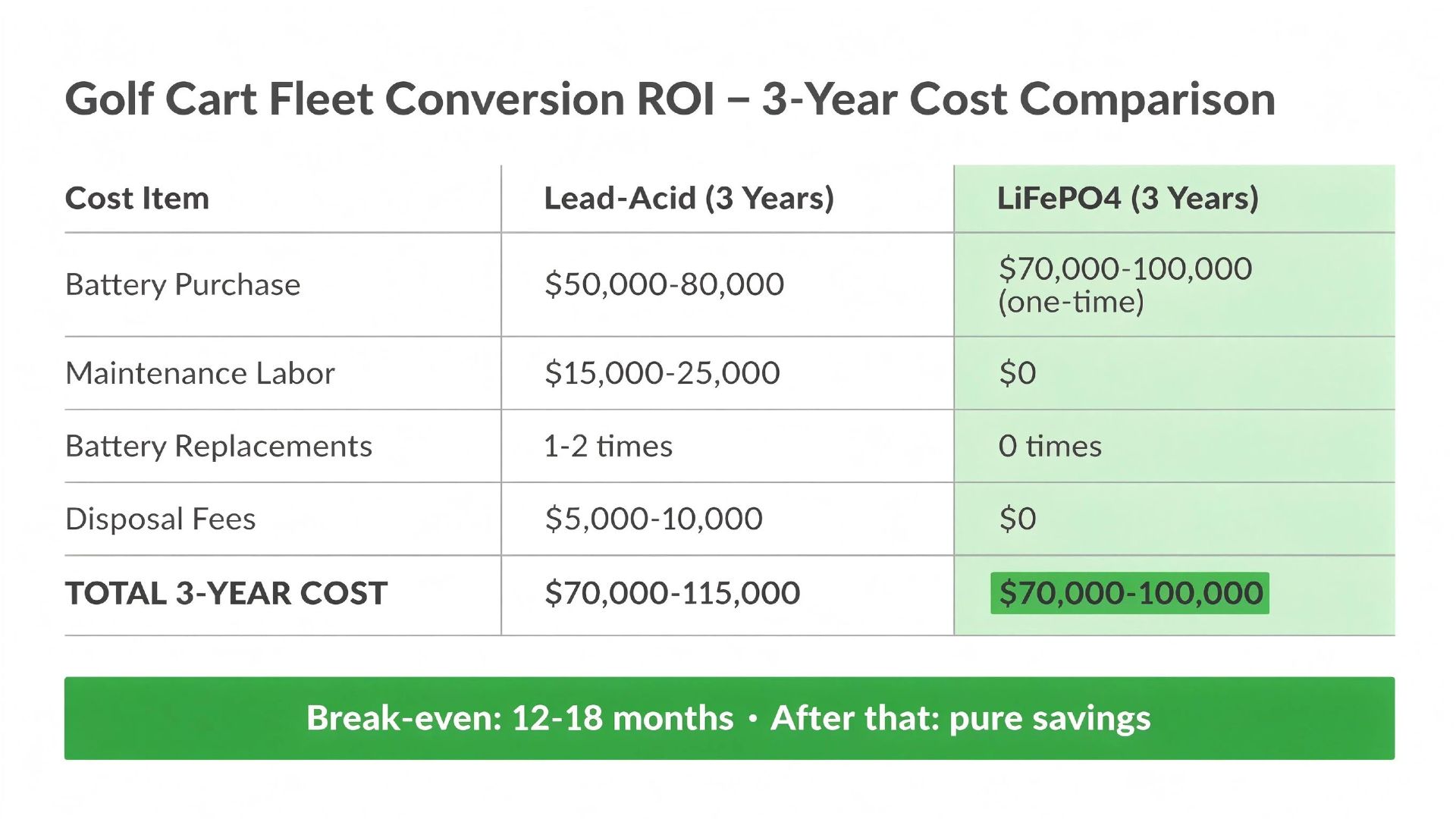
The ROI math:
| Cost Type | Lead-Acid (3-Year Period) | LiFePO4 (3-Year Period) |
|---|---|---|
| Battery replacements | 1–2 replacements | 0 replacements |
| Battery purchase cost | $50,000–$80,000 | $70,000–$100,000 (one-time) |
| Labor for maintenance | $15,000–$25,000 | $0 |
| Disposal cost | $5,000–$10,000 | $0 |
| Total 3-year cost | $70,000–$115,000 | $70,000–$100,000 |
Break-even: 12–18 months. After that, pure savings.
2. 80-100% Usable Capacity
Unlike lead-acid, LiFePO4 can be safely discharged to 80%—delivering nearly double the usable energy from the same rated capacity:
-
100Ah LiFePO4 = 80–100Ah usable
-
100Ah Lead-Acid = 50Ah usable (at 50% DoD)
3. Zero Maintenance
-
No watering—eliminating weekly labor and water costs
-
No terminal cleaning—no corrosion buildup
-
No equalization charges—BMS automatically balances cells
-
No off-gassing—safe for enclosed spaces, no ventilation required
4. Consistent Power Delivery (No Voltage Sag)
LiFePO4 maintains stable voltage throughout discharge. A cart starts and finishes the round with consistent speed and torque:
-
Flat voltage curve—no mid-round performance drop
-
Strong hill-climbing power—full torque until the battery is nearly empty
-
Extended range—20–40% more distance per charge versus lead-acid
5. Wide Temperature Range
LiFePO4 operates reliably from -20°C to 60°C. Enerbe's self-heating technology available on select models ensures reliable charging even in sub-zero temperatures—ideal for northern courses.
6. Environmental Compliance
-
Cobalt-free and non-toxic
-
Fully recyclable (up to 95% material recovery)
-
No hazardous waste classification
-
Meets ESG (Environmental, Social, Governance) mandates increasingly required by corporate course owners and resorts
Drop-In Replacement: What Golf Course Fleet Managers Need to Know
One of the biggest advantages of LiFePO4 replacement batteries is drop-in compatibility. Most Enerbe LiFePO4 batteries are designed to fit existing battery trays and use standard terminals, minimizing conversion labor.
Installation Checklist for Fleet Managers
1. Verify Physical Dimensions
Measure existing battery tray dimensions. Enerbe batteries are designed to match standard tray sizes.
2. Confirm Terminal Type and Orientation
Check if your carts use top post, side post, or stud terminals. Most golf carts use 6x 8V batteries or 4x 12V batteries. Enerbe offers matching terminal configurations.
3. Check Charger Compatibility
Lead-acid chargers are NOT compatible with LiFePO4. You will need to install LiFePO4-compatible chargers or upgrade existing units. Many new chargers support both chemistries with a selector switch—check with your supplier.
4. BMS and Communication
Enerbe's built-in BMS handles all protection automatically. For fleet management, BMS communication (CAN bus/RS485) enables remote monitoring of battery health, state of charge, and temperature across all carts.
5. Train Maintenance Staff
LiFePO4 maintenance is minimal, but different:
-
Do NOT add water (sealed units)
-
Do NOT use a lead-acid charger (will damage BMS)
-
Store at 50–80% SoC during off-season (lead-acid requires full charge)
-
Check terminal connections once per season (vs weekly for lead-acid)
Fleet Conversion Timeline
| Phase | Activity | Timeline |
|---|---|---|
| Assessment | Audit fleet size, battery tray dimensions, charger compatibility | 1 week |
| Pilot | Convert 2–3 carts (different models) for testing | 2 weeks |
| Evaluation | Track performance, member feedback, charge times | 4 weeks |
| Full Deployment | Convert remaining fleet in batches of 10–20 carts | 6–8 weeks |
B2B Buying Tip: Request a pilot program from your supplier—convert 2–3 carts to LiFePO4, test for 4 weeks, then roll out the full fleet. This reduces risk and builds internal confidence.
Enerbe Solutions for Golf Course Fleets
Enerbe offers purpose-built LiFePO4 replacement batteries for golf carts:
Enerbe 48V 100Ah Golf Cart Battery
| Specification | Details |
|---|---|
| Nominal Voltage | 51.2V (16 cells in series) |
| Rated Capacity | 100Ah / 5.12kWh |
| Cycle Life | 5,000+ cycles at 80% DOD |
| Weight | Approx. 45kg (50% lighter than equivalent lead-acid) |
| BMS | Full protection: over-voltage, under-voltage, over-current, short-circuit, temperature |
| Communication | CAN bus / RS485 (compatible with fleet management systems) |
| Operating Temperature | Charge: 0°C to 55°C / Discharge: -20°C to 60°C |
| Self-Heating | Optional on select models for cold climates |
| Certifications | UL, CE, IEC 62619, UN38.3 |
Key Benefits for Golf Course Fleets:
-
48V 100Ah configuration matches the most common 4x12V and 6x8V golf cart systems
-
50% weight reduction improves handling and reduces tire and suspension wear
-
Extended range—up to 20–40% more distance per charge
-
Faster charging—full charge in 2–4 hours vs 8–10 hours for lead-acid
-
Fleet-ready BMS—CAN bus/RS485 enables central monitoring of all carts
Enerbe Advantage for Golf Course Fleet Managers
1. Factory-Direct Pricing
Enerbe is a manufacturer, not a trader. No middleman markups—fleet pricing is available for orders of 50+ batteries.
2. Custom Configurations
Need a specific terminal type or tray dimension? Enerbe offers OEM/ODM custom solutions for golf cart manufacturers and large fleet operators.
3. Global Export Experience
Enerbe serves B2B clients across the US, Europe, Australia, and the Middle East with reliable container shipping and customs clearance support.
4. Full Certification Package
All Enerbe golf cart batteries are UL, CE, IEC 62619, and UN38.3 compliant—essential for insurance compliance and regulatory approval.
5. 5,000+ Cycles = 10+ Year Service Life
Enerbe's high-grade A+ LiFePO4 cells ensure 5,000+ cycles at 80% DOD, delivering 10+ years of reliable service with zero maintenance.
B2B Procurement Checklist: What to Ask Your LiFePO4 Supplier
When evaluating LiFePO4 battery suppliers for your golf course fleet, ask these questions:
-
What is the actual cycle life at 80% DOD? (Look for 5,000+)
-
What is the warranty period and what does it cover? (Look for 10-year warranty)
-
Are cells A-grade or B-grade? (Only accept A-grade)
-
Does the BMS support CAN bus/RS485 for fleet monitoring?
-
What certifications are current? (UL, CE, IEC 62619, UN38.3)
-
Is self-heating available for cold-weather locations?
-
What is the lead time for a full fleet order?
-
Does the supplier offer a pilot program?
-
What technical support is available during installation?
For a complete overview of LiFePO4 battery sourcing across all applications, see our B2B Sourcing Guide.
For detailed guidance on golf cart, RV, marine, and automotive lead-acid replacement, refer to our lead-acid conversion guide.
📞 Speak with Our Engineering Team – Get In Touch
🔗 Browse Our Custom Battery Solutions – View Products
Building 1, No. 2, Keji 9th Road, Songshan Lake, Dongguan, Guangdong, China
📞 +86 137 1383 1631 | ✉ info@aspowerbattery.com



Wall-Mounted vs Stackable vs Rack-Mounted Energy Storage: Which Configuration Fits Your Project?
12V vs 24V LiFePO4 Batteries: Which Voltage Is Right for Your Fleet, Boat, or Off-Grid System?
Related Article


Get In Touch
Have questions about custom lithium batteries, energy storage solutions, or lead-to-lithium conversion? Our team is ready to help. Send us a message and we’ll respond within 24 hours.

Building 1, No. 2, Keji 9th Road, Songshan Lake, Dongguan, Guangdong, China
Office Address

info@aspowerbattery.com
Email Us

+86 137 1383 1631
Call Us

Sun - Fri (08AM - 10PM)
Office Open
