
China Lithium Iron Phosphate (LiFePO4) Industry Market Outlook Report

Since the start of 2026, lithium iron phosphate (LiFePO4) and its precursor iron phosphate, as critical raw materials for new energy and energy storage batteries, have seen continuous price increases and growing market attention. This round of price uptrend is driven by both supply and demand sides: strong export momentum of new energy vehicles and energy storage products drives sustained growth in end-market demand, while rising upstream raw material costs form solid support on the cost side. The resonance of supply and demand has been steadily pushing up the overall price center of the LiFePO4 industry.
Table of Contents
1. Basic Overview of Lithium Iron Phosphate
1.1 Product Definition
Lithium iron phosphate (LiFePO4) is a type of lithium-ion battery cathode material with an olivine crystal structure. It stands out for its excellent thermal stability, long cycle life and low production cost, making it one of the mainstream technical routes in the power battery and energy storage battery sectors.
1.2 Main Manufacturing Processes
There are four major industrial manufacturing processes for LiFePO4 cathode materials. The choice of process directly determines the particle morphology and electrochemical performance of the material, and adapts to different product application requirements:
- Solid-state carbothermal reduction method Solid raw materials such as iron phosphate (or iron source), lithium source and carbon source are dry-mixed, ball-milled and then sintered at high temperature. Carbon-coated LiFePO4 products are obtained through mechanical dispersion and long-time heat treatment. It is the mainstream process for large-scale mass production with ten-thousand-ton annual output.
- Liquid-phase co-precipitation method Iron and phosphorus elements are co-precipitated in an aqueous phase to prepare iron phosphate precursors, which are then mixed with lithium source and carbon source before sintering. This process produces precursors with uniform morphology, which helps improve the compaction density and batch consistency of materials. It is the core preparation route for high-end LiFePO4 powders.
- Hydrothermal/solvothermal method Iron, phosphorus and lithium elements are crystallized in-situ to form LiFePO4 in a high-temperature and high-pressure aqueous or solvent environment. The product features controllable grain morphology and high crystallinity, but requires high equipment investment and continuous production costs. It is mostly used for R&D or small-batch production of high-end products.
- Sol-gel method Raw materials of iron, phosphorus and lithium are prepared into a uniform gel through organic acids or chelating agents, followed by pyrolysis. The component mixing can reach the molecular scale, which is suitable for element doping and microscopic performance regulation. However, it has high difficulty in engineering scale-up and strict cost constraints, and is mainly applied in laboratories and pilot tests.
2. Industry Policy Environment
As a core component of the lithium battery material system, the development of the lithium iron phosphate (LiFePO4) industry is continuously guided and supported by national industrial policies. In recent years, multiple national authorities have successively rolled out a series of policies covering quality improvement, recycling system construction and zero-carbon factory development, providing clear policy guidance and a sound business environment for technological innovation and large-scale growth of the lithium battery material sector.
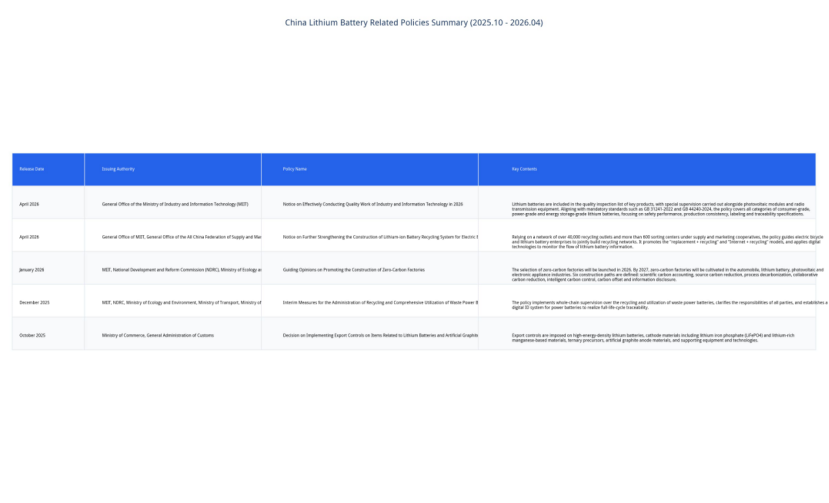
Key policies include the Notice on Effectively Conducting Quality Work of Industry and Information Technology in 2026, the Notice on Further Strengthening the Construction of Lithium-ion Battery Recycling System for Electric Bicycles, and the Guiding Opinions on Promoting the Construction of Zero-Carbon Factories. These policies jointly drive the standardized and high-quality development of the industry from the dimensions of production, end-of-life recycling and green manufacturing.
Summary of China's Policies Related to Lithium Battery Materials


3. Current Industry Development Status
3.1 Rapid Growth in Material Shipments
2025 marks a pivotal year for the lithium iron phosphate (LiFePO4) industry, defined by simultaneous explosive growth and structural adjustment. Driven by robust demand from downstream new energy vehicle and energy storage markets, the industry has accelerated capacity rollout, pushing the market out of the overcapacity trough and into a phase of supply-demand rebalancing.
According to industry statistics, China’s LiFePO4 cathode material shipments reached 3.944 million tons in 2025, with a year-on-year growth rate exceeding 60% — a three-year record high. Industry analysis projects that China’s LiFePO4 material shipments will climb to 4.4 million tons in 2026, maintaining a steady upward trajectory.

3.2 Sustained Expansion of Production Capacity
On the production capacity front, China’s annual lithium iron phosphate (LiFePO4) production capacity stood at around 6.88 million tons in 2025, with newly commissioned capacity accounting for roughly 46% of the total, and the industry’s average annual operating rate climbed to 54%.
The newly added capacity is mainly concentrated in China’s core lithium battery industry clusters, including Sichuan, Hubei, Guizhou and Hunan provinces. Industry forecasts indicate that China’s annual LiFePO4 production capacity will further expand to 7.8 million tons by 2026, driving continuous improvement of the industry’s overall supply capability.

3.3 Market Competition Landscape
In 2025, China’s lithium iron phosphate (LiFePO4) cathode material industry shows a clear echelon structure, with leading enterprises holding prominent advantages in shipment scale:
- Hunan Yuneng continues to top the industry with annual shipments exceeding 1 million tons, retaining its first-place ranking for consecutive years.
- Wanrun New Energy ranks second, followed by Defang Nano in third place.
- Jiangxi Shenghua, Youshan Technology, Guoxuan Hi-Tech, Longpan Technology, Taifeng Advanced, Anda Technology and Sichuan GCL take the 4th to 10th positions respectively.
Overall, the industry features high concentration among top players. Meanwhile, second-tier enterprises are accelerating capacity expansion, and market competition is gradually tilting toward technical strength and cost control capability.
3.4 Steady Growth in Power Battery Installation
With outstanding cost efficiency, long cycle life and high safety, LiFePO4 batteries have been widely adopted in the new energy vehicle and energy storage fields. As the global penetration rate of battery electric vehicles continues to rise, the installation volume of LiFePO4 power batteries maintains rapid growth.
Industry statistics show that the cumulative installation volume of LiFePO4 power batteries in China reached 625.3 GWh in 2025, accounting for 81.2% of the total power battery installation, with a year-on-year growth of 52.9%. It is projected that the installation volume of LiFePO4 power batteries will reach 660 GWh in 2026, continuing to dominate the market.

4. Analysis of Key Industry Players
4.1 Hunan Yuneng
Hunan Yuneng New Energy Battery Materials Co., Ltd. specializes in the R&D, production and sales of lithium-ion battery cathode materials, with phosphate cathode materials as its core products. According to public operating data, the company achieved an operating revenue of 14.965 billion yuan in Q1 2026, a year-on-year increase of 121.31%; its net profit attributable to the parent company reached 1.356 billion yuan, up 1342.55% year on year. In 2025, phosphate cathode materials accounted for 97.94% of the company’s total revenue, showing a high degree of business concentration.
4.2 Wanrun New Energy
Hubei Wanrun New Energy Technology Co., Ltd. focuses on the R&D, production and sales of lithium-ion battery materials, with lithium iron phosphate (LiFePO4) and iron phosphate as its core products. In Q1 2026, the company’s operating revenue reached 5.38 billion yuan, a year-on-year growth of 136.17%; its net profit attributable to the parent company stood at 401 million yuan, up 357.05% year on year. LiFePO4 business accounted for 97.06% of its total revenue in 2025.
4.3 Defang Nano
Shenzhen Defang Nano Technology Co., Ltd. focuses on the R&D and production of core lithium-ion battery materials. Its core product portfolio includes nano-sized lithium iron phosphate, lithium manganese iron phosphate, and lithium replenishment enhancers. In Q1 2026, the company recorded an operating revenue of 4.336 billion yuan, a year-on-year increase of 116.37%; its net profit attributable to the parent company reached 265 million yuan, up 258.68% year on year. Phosphate-based cathode materials contributed 97.39% of its total revenue in 2025.
4.4 Jiangxi Shenghua
As a core subsidiary of Fulin Seiko dedicated to lithium battery cathode materials, Jiangxi Shenghua is the pioneer of the ferrous oxalate technical route for LiFePO4 cathode materials in China, and also an industry leader in the new generation of high-compaction-density LiFePO4.
Its core product, high-compaction-density LiFePO4 cathode material, boasts a stable compaction density of 2.6 g/cm³, combined with advantages of high specific capacity and long cycle life, giving it outstanding competitiveness in the high-end power and energy storage sectors. Currently, the company has an annual capacity of 300,000 tons of high-compaction LiFePO4. It is also advancing a 350,000-ton new construction project in Sichuan, and planning a 500,000-ton high-end energy storage LiFePO4 project in Inner Mongolia, with supporting precursor capacity layout to secure upstream raw material supply.
4.5 Youshan Technology
Zhejiang Youshan New Materials Technology Co., Ltd. is a wholly-owned subsidiary of Huayou Holding Group, focusing on the R&D, production and sales of LiFePO4 cathode materials. It masters core technologies for high-compaction-density LiFePO4, with the product’s maximum compaction density reaching 2.712 g/cm³, a leading level in the industry.
Relying on its full industrial chain advantage of "mineral resources – precursors – cathode materials – recycling", the company has established six manufacturing bases across Guangxi, Inner Mongolia, Yunnan, Guizhou and other regions, and built in-depth cooperative partnerships with leading domestic battery enterprises.
5. Industry Development Prospects
5.1 Material Modification and Iteration Break Through Performance Bottlenecks
The industry continues to advance micro-engineering innovation around the crystal structure of LiFePO4. Through technical means such as element doping, carbon coating, primary particle morphology regulation and nano-dispersion, it optimizes electronic conductivity and lithium-ion diffusion kinetics. Meanwhile, it further improves processing consistency and cycle life by enhancing crystallinity and homogenizing particle size distribution.
The refined iteration on the material side will continuously raise the upper limit of LiFePO4’s energy density and fast-charging capability, make up for its traditional shortcomings in low-temperature performance and high-power scenarios, drive product upgrading from "cost-effective" to "high-performance + high-reliability", and support its long-term application in mid-to-high-end passenger vehicles and high-cycle energy storage scenarios.
5.2 Deep Coupling with Structural Innovation Amplifies Product Advantages
The high safety and thermal stability of LiFePO4 are highly compatible with cell structure innovation routes such as module-free design, large-format cells and blade batteries. By reconstructing thermal management design, mechanical support and electrical topology at the cell and pack levels, the industry converts the inherent safety redundancy of the material into system-level design simplification and space utilization improvement.
The integrated collaboration of material-structure-system will maximize the cost and reliability advantages of the LiFePO4 technical route. Under the same safety standards, it achieves higher volume utilization and lower unit cost, further broadening its penetration in scenarios such as medium-to-long range vehicles, commercial vehicles and stationary energy storage.
5.3 Closed-Loop Recycling System Reinforces Long-Term Competitiveness
Technologies for black powder recovery, selective lithium extraction and regenerative remediation of LiFePO4 cathode materials are growing mature. The industry is advancing full-lifecycle closed-loop design in parallel: end-of-life recyclability is factored into front-end material formulations and manufacturing processes, while high-quality recovery of valuable elements including lithium, iron and phosphorus is achieved at the back end via coupled hydrometallurgical-pyrometallurgical processes and strict impurity management.
The improvement of the circular economy system and the upgrade of green manufacturing will help the industry reduce reliance on primary mineral resources and cushion raw material price volatility. It will also satisfy the increasingly strict carbon footprint and supply chain compliance requirements from downstream automakers and energy storage operators, turning environmental compliance into a core competitive barrier for brand credibility and market access.
📞 Speak with Our Engineering Team – Get In Touch
🔗 Browse Our Custom Battery Solutions – View Products
Building 1, No. 2, Keji 9th Road, Songshan Lake, Dongguan, Guangdong, China
📞 +86 137 1383 1631 | ✉ info@aspowerbattery.com



How to Size a Home Battery Energy Storage System
Related Article


Get In Touch
Have questions about custom lithium batteries, energy storage solutions, or lead-to-lithium conversion? Our team is ready to help. Send us a message and we’ll respond within 24 hours.

Building 1, No. 2, Keji 9th Road, Songshan Lake, Dongguan, Guangdong, China
Office Address

info@aspowerbattery.com
Email Us

+86 137 1383 1631
Call Us

Sun - Fri (08AM - 10PM)
Office Open
