
China LiFePO4 & Energy Storage Market H1 2026 – Key Trends for B2B Buyers
Table of Contents
- Introduction: A Market at an Inflection Point
- 1. The Big Picture: H1 2026 in Numbers
- 2. LFP Dominance: The Chemistry That Won
- 3. The Energy Storage Growth Engine
- 4. Market Concentration and Supplier Landscape
- 5. Raw Material Demand Trends
- 6. What This Means for B2B Energy Storage Buyers
- Frequently Asked Questions
- Summary
Introduction: A Market at an Inflection Point
China‘s lithium battery industry reached a significant milestone in the first half of 2026. Total production of power and energy storage batteries exceeded 1,000 GWh for the first time in a six-month period—a figure that would have seemed unthinkable just three years ago.
For B2B buyers—system integrators, project developers, and distributors—these numbers are more than just statistics. They signal where the market is heading, which technologies are winning, and what supply chain trends will affect procurement decisions in the months ahead.
This report analyzes publicly released data from the China Automotive Battery Innovation Alliance (CABIA) , with additional context from industry sources including GGII, SMM, and SNE Research. All data is cited from publicly available industry reports and is presented for informational purposes.
Data source: China Automotive Battery Innovation Alliance (CABIA) and other publicly available industry reports, unless otherwise noted.
For a complete overview of LiFePO4 battery sourcing across all applications, see our B2B Sourcing Guide.
1. The Big Picture: H1 2026 in Numbers
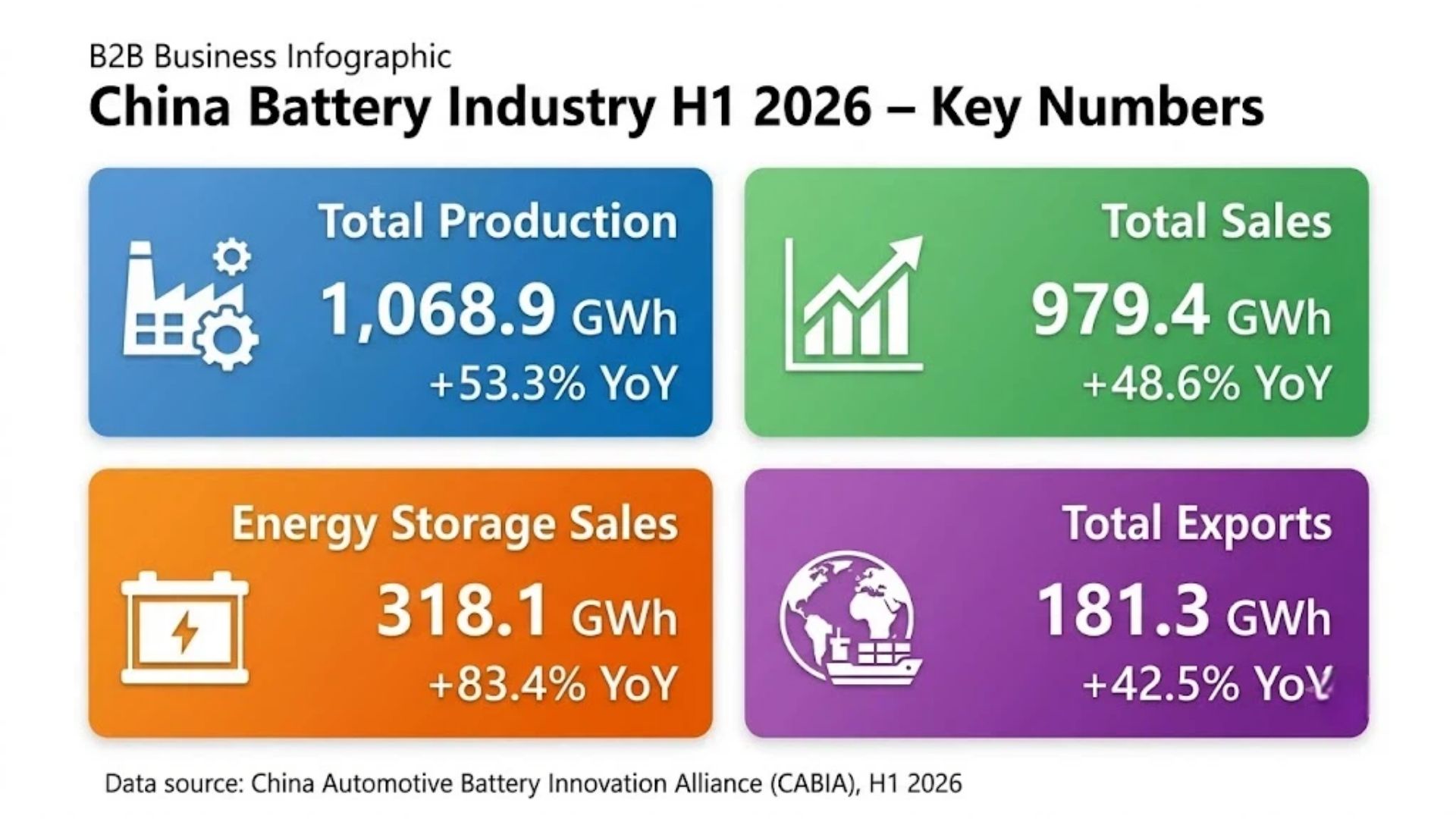
The first half of 2026 saw China‘s power and energy storage battery sector maintain strong growth across all major metrics:
| Metric | H1 2026 Volume | YoY Growth |
|---|---|---|
| Total Production | 1,068.9 GWh | +53.3% |
| Total Sales | 979.4 GWh | +48.6% |
| Power Battery Sales | 661.3 GWh | +36.2% |
| Energy Storage Battery Sales | 318.1 GWh | +83.4% |
| Total Exports | 181.3 GWh | +42.5% |
Source: CABIA
Key Takeaway for B2B Buyers: Energy storage battery sales grew more than twice as fast as power batteries (83.4% vs 36.2%). For buyers sourcing energy storage systems, this signals a market that is expanding rapidly—but also one where supply chain capacity may be tested as demand outpaces production.
2. LFP Dominance: The Chemistry That Won
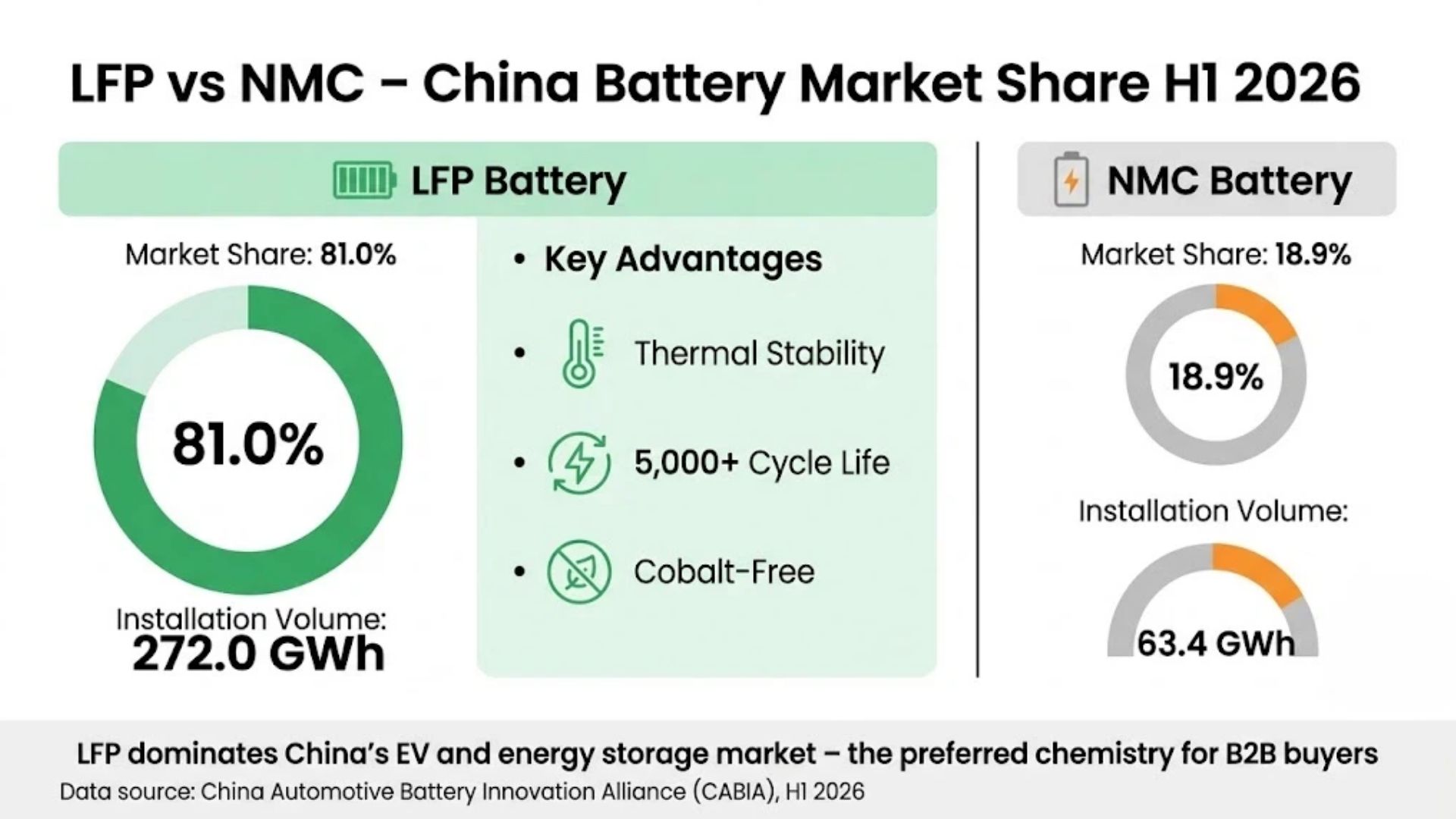
The most striking trend in the H1 2026 data is the continued dominance of Lithium Iron Phosphate (LFP) chemistry.
In June 2026 alone:
| Chemistry | Installation Volume | Market Share |
|---|---|---|
| LFP | 63.7 GWh | 83.3% |
| NMC | 12.7 GWh | 16.5% |
Source: CABIA
For the full first half of 2026:
-
LFP installation: 272.0 GWh (81.0% share)
-
NMC installation: 63.4 GWh (18.9% share)
-
LFP year-over-year growth: +11.5%
-
NMC year-over-year growth: +14.2%
Source: CABIA
Why This Matters for B2B Buyers:
LFP‘s dominance is not accidental. For stationary energy storage applications, LFP offers three critical advantages that align with B2B procurement priorities:
| Advantage | B2B Impact |
|---|---|
| Thermal Stability | Lower fire risk, easier permitting, reduced insurance costs |
| Cycle Life (5,000+) | 10+ year service life, better ROI |
| Cobalt-Free | ESG compliance, stable pricing, no supply chain concentration risk |
The trend is clear: For commercial and industrial energy storage projects, LFP is no longer an alternative—it‘s the default choice. Buyers sourcing battery systems should prioritize suppliers with proven LFP manufacturing capability and consistent cell quality.
For a complete overview of LiFePO4 battery sourcing across all applications, see our B2B Sourcing Guide.
3. The Energy Storage Growth Engine
Energy storage batteries are emerging as the fastest-growing segment of China‘s battery industry.
June 2026 Performance:
| Metric | June 2026 Volume | MoM Growth | YoY Growth |
|---|---|---|---|
| Power Battery Sales | 133.4 GWh | +5.0% | +41.8% |
| Energy Storage Battery Sales | 62.6 GWh | +13.4% | +67.5% |
Source: CABIA
H1 2026 Energy Storage Highlights:
-
Energy storage battery sales: 318.1 GWh
-
Year-over-year growth: +83.4%
-
Share of total sales: 32.5%
Source: CABIA
China‘s Energy Storage Export Surge
Exports tell an equally compelling story. In June 2026:
-
Total power + storage battery exports: 36.2 GWh (+23.7% MoM, +48.7% YoY)
-
Power battery exports: 25.5 GWh (+26.6% MoM, +60.8% YoY)
-
Energy storage battery exports: 10.7 GWh (+17.3% MoM, +26.1% YoY)
Notably, LFP battery overseas shipments achieved remarkable year-on-year growth of 105.0% in June—more than double the previous year‘s volume.
Source: CABIA
B2B Implication: For buyers outside China, this export surge means shorter lead times and more competitive pricing as Chinese manufacturers scale up production. However, it also means increased competition for high-quality cells—buyers should secure supply agreements early.
For a complete guide to battery energy storage systems (BESS), see our BESS Complete Guide.
4. Market Concentration and Supplier Landscape
The Chinese battery market remains highly concentrated, with the top 10 suppliers capturing 93.6% of domestic installation volume in June 2026.
Source: CABIA
Key Players (June 2026 Market Share):
| Manufacturer | Market Share |
|---|---|
| CATL | 42.70% |
| BYD | 18.49% |
Source: CABIA
B2B Takeaway: While CATL and BYD dominate, second-tier manufacturers including CALB, Gotion High-Tech, and EVE Energy are steadily expanding their market share. For B2B buyers, this creates opportunities to source from established second-tier suppliers who offer competitive pricing and flexible custom configurations—often with shorter lead times than the top two.
5. Raw Material Demand Trends
Strong downstream battery production continues to drive stable demand for lithium battery upstream materials.
June 2026 Material Demand:
| Material | June 2026 Volume |
|---|---|
| NMC Cathode | 73,000 tons |
| LFP Cathode | 423,000 tons |
| Anode Material | 288,000 tons |
| Separator | 4.12 billion sq.m |
| Electrolyte (NMC) | 33,000 tons |
| Electrolyte (LFP) | 254,000 tons |
Source: CABIA
H1 2026 Material Demand:
| Material | H1 2026 Volume |
|---|---|
| NMC Cathode | 387,000 tons |
| LFP Cathode | 2.187 million tons |
| Anode Material | 1.497 million tons |
| Separator | 21.38 billion sq.m |
| Electrolyte (NMC) | 174,000 tons |
| Electrolyte (LFP) | 1.312 million tons |
Source: CABIA
B2B Implication: The significant volume of LFP cathode materials (over 2 million tons in H1) confirms the scale of LFP production capacity. For buyers, this translates to supply stability and cost predictability for LFP cells compared to NMC alternatives.
6. What This Means for B2B Energy Storage Buyers
The H1 2026 data confirms several strategic directions for B2B buyers sourcing energy storage systems:
1. LFP is the winning chemistry for stationary storage.
With 81% domestic market share and accelerating export growth, LFP has clearly established itself as the preferred technology for commercial and industrial energy storage applications.
2. Energy storage is the fastest-growing segment.
The 83.4% year-over-year growth in energy storage battery sales signals strong and sustained demand. For B2B buyers, this means now is the time to secure reliable supply partnerships.
3. China remains the global manufacturing hub.
With the majority of global energy storage battery manufacturing capacity concentrated in China, buyers sourcing from Chinese manufacturers benefit from scale, cost advantages, and a mature supply chain. According to industry analysts at SNE Research, Chinese firms account for over 70% of the global battery market share.
4. Quality and certification matter more than ever.
As the market expands, the gap between high-quality and low-quality suppliers widens. Enerbe‘s commitment to UL, CE, IEC, and UN38.3 certification ensures that our customers receive batteries that meet international standards.
For solar energy battery storage solutions, see our Solar Storage Guide.
Frequently Asked Questions
Q1: Which battery segment grew fastest in China in H1 2026?
A1: Energy storage batteries, with sales growing 83.4% year-over-year—more than double the growth rate of power batteries.
(Source: CABIA)
Q2: What is the dominant battery chemistry for stationary storage in China?
A2: LFP (Lithium Iron Phosphate) holds over 80% of the domestic installation market, with 83.3% share in June 2026.
(Source: CABIA)
Q3: Are Chinese lithium battery exports still growing?
A3: Yes. H1 2026 total battery exports rose 42.5% year-over-year, with power battery exports up 50.3%. LFP overseas shipments grew 105% in June alone.
(Source: CABIA)
Q4: What does this data mean for B2B buyers outside China?
A4: Strong export growth means shorter lead times and competitive pricing. However, increased global demand also means buyers should secure supply agreements early to avoid capacity constraints.
For B2B buyers sourcing LiFePO4 batteries from China, understanding market trends is essential for procurement strategy. Enerbe, as a China-based LiFePO4 battery manufacturer, offers factory-direct pricing and custom solutions for commercial energy storage, RV, and marine applications.
Summary
The first half of 2026 data from China‘s battery industry tells a clear story: energy storage is the fastest-growing segment, LFP is the dominant chemistry, and Chinese manufacturers continue to lead global supply.
For B2B buyers—system integrators, project developers, and distributors—these trends reinforce the importance of sourcing from established manufacturers with proven quality, certification, and supply chain reliability.
Enerbe, as a LiFePO4 battery manufacturer serving global B2B clients, is positioned to meet this growing demand with factory-direct pricing, customizable configurations, and full certification compliance.
Data in this report is sourced from the China Automotive Battery Innovation Alliance (CABIA) and other publicly available industry reports including GGII, SMM, and SNE Research. All data is cited from publicly released industry reports and is presented for informational purposes.
📞 Speak with Our Engineering Team – Get In Touch
🔗 Browse Our Custom Battery Solutions – View Products
Building 1, No. 2, Keji 9th Road, Songshan Lake, Dongguan, Guangdong, China
📞 +86 137 1383 1631 | ✉ info@aspowerbattery.com



China LFP Battery & NEV Market H1 2026 – Key Insights for B2B Buyers
12V vs 24V vs 48V LiFePO4 Batteries: A Simple Guide to Choosing the Right Voltage for Your Project
Related Article


Get In Touch
Have questions about custom lithium batteries, energy storage solutions, or lead-to-lithium conversion? Our team is ready to help. Send us a message and we’ll respond within 24 hours.

Building 1, No. 2, Keji 9th Road, Songshan Lake, Dongguan, Guangdong, China
Office Address

info@aspowerbattery.com
Email Us

+86 137 1383 1631
Call Us

Sun - Fri (08AM - 10PM)
Office Open
