
LiFePO4 Battery Capacity Tester: How to Choose & Use (2026)
Table of Contents
- What Is a LiFePO4 Battery Capacity Tester?
- Capacity Tester vs Multimeter vs Load Tester
- Types of LiFePO4 Capacity Testers
- How to Choose: Key Specs & Parameters
- Match the Tester to Your Battery
- How to Use a Capacity Tester
- Calibration, Accuracy & Common Mistakes
- B2B Quality Control: Incoming Inspection & Batch Grading
- What to Ask Your Battery Supplier
- Frequently Asked Questions
- Related Resources
Last updated: November 2026 | Written by the Enerbe Engineering Team
What Is a LiFePO4 Battery Capacity Tester?
Quick Answer: A LiFePO4 battery capacity tester is an instrument that discharges a fully charged lithium iron phosphate battery through a precisely controlled constant-current load, measures the total amp-hours (Ah) and watt-hours (Wh) delivered down to the cut-off voltage, and reports the real capacity and state of health. A programmable DC electronic load, an integrating battery analyzer, or a multi-channel grading cabinet all perform this function automatically and far more accurately than a multimeter.
A battery's nameplate rating is a factory claim, not a permanent fact. Every LiFePO4 cell loses a small amount of capacity with each cycle, and packs assembled from mismatched or used cells can deliver far less than the printed Ah figure from day one. The only way to know what a battery actually holds is to measure the energy it delivers in a controlled full discharge, and that is the job of a battery capacity tester.
Instead of manually timing a load and doing the arithmetic, a dedicated tester integrates current over time continuously. It holds the discharge current steady, stops exactly when the battery reaches its programmed cut-off (for example 2.5 V per cell or 10.0 V for a 12 V/4S pack), and displays the measured Ah and Wh directly. The result is repeatable, logged, and acceptable as evidence for incoming inspection and warranty claims.
- Verify supplier claims — confirm the battery delivers the rated Ah and Wh you paid for.
- Measure state of health (SoH) — measured capacity divided by rated capacity; under 80% is end of life.
- Track degradation — schedule replacement before a failure rather than after one.
- Grade and match cells — group cells by real capacity for balanced packs.
- Document quality — produce logged reports for QC, warranty and compliance records.
Capacity Tester vs Multimeter vs Load Tester
Quick Answer: A multimeter measures instantaneous voltage and current but cannot read amp-hours, because capacity is energy delivered over time; its resting-voltage reading gives only a rough state of charge. A load tester applies a high current briefly to check cranking ability, while a capacity tester performs a full, controlled constant-current discharge and integrates the total Ah and Wh. Only an integrating tester or a timed load test gives a true capacity figure.
These three tools are often confused, but they answer different questions. A plain multimeter is the most common source of misunderstanding. Because LiFePO4 has a flat voltage curve — it sits near 3.2–3.3 V per cell across most of its working range — voltage cannot distinguish a half-full pack from an 80% full one. A multimeter tells you state of charge near the extremes, never capacity.
| Instrument | What it measures | Output | Best for |
|---|---|---|---|
| Multimeter / voltmeter | Instant voltage and current | V and A readings | Field checks, rough SoC, wiring |
| Clamp meter | Current through a cable | Amps (live) | Monitoring discharge current in a manual test |
| Load tester | Voltage under a short high-current load | Pass/fail cranking check | Starter batteries, quick stress test |
| Capacity tester / electronic load | Full controlled discharge, current integrated over time | Ah, Wh, time, SoH | True capacity, grading, QC, warranty |
| Battery analyzer | Charge + discharge cycling, logging | SoH, cycles, reports | Service, research, repeated testing |
For the step-by-step calculation behind a manual multimeter-plus-clamp test, see our companion guide on how to test LiFePO4 battery capacity; this article focuses on choosing and using the equipment that automates it.
Types of LiFePO4 Capacity Testers
Quick Answer: The four common types are programmable DC electronic loads for technicians and dealers, integrating battery capacity analyzers that add charge-discharge cycling and PC reporting, multi-channel aging and grading cabinets for production lines, and small handheld portable testers for field and service work. They range from single-channel bench units to factory cabinets grading hundreds of cells at once.
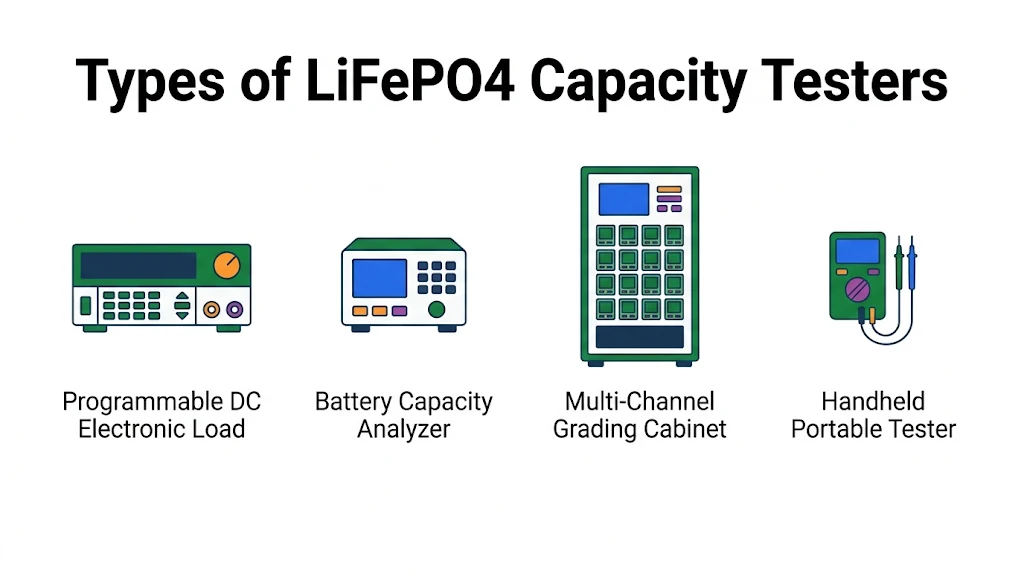
Programmable DC electronic load
A bench electronic load presents a controllable constant-current (CC), constant-voltage (CV) or constant-power (CP) load to the battery. Models with an Ah/Wh integrator and adjustable cut-off work as a complete capacity tester. They are the most cost-effective choice for technicians, distributors and low-to-mid volume testing.
Battery capacity analyzer
An analyzer combines an electronic load with a charging channel, so it can run repeated charge-discharge cycles, calculate SoH and internal resistance, and export logs to a PC. It suits service centers, laboratories and anyone who needs documented, repeatable reports rather than a single reading.
Aging / grading cabinet
A multi-channel cabinet connects dozens or hundreds of cells or packs simultaneously, charging and discharging each on its own channel and recording per-channel capacity. This is the equipment used by manufacturers for cell grading, pack aging and end-of-line QC. Channel count, current per channel and data software are the key specifications.
Handheld portable tester
Compact handheld units run quick capacity and internal-resistance checks in the field or on installed systems. They sacrifice the high current and precision of a bench load but are convenient for maintenance, warranty calls and spot checks.
How to Choose: Key Specs & Parameters
Quick Answer: Match the tester's voltage range, current and power rating to your largest battery, then check measurement accuracy and resolution, an adjustable cut-off, an Ah/Wh integrator, charge and discharge modes, channel count and PC software with report export. Always leave headroom: a load rated at or below its limit runs hot and drifts, so rate it roughly 20-30% above your maximum calculated current and watts.
| Specification | Why it matters | Typical guidance |
|---|---|---|
| Voltage range | Must cover the full battery, including peak charge voltage | Up to 15 V for 12 V, 60 V for 48 V/51.2 V packs |
| Max current | Sets the highest discharge (C-rate) you can apply | ≥ 0.5C of your largest pack, with headroom |
| Max power (W) | Current and voltage together determine real load | W = A × V; size above the peak, not nominal |
| Accuracy | Difference between measured and true capacity | Current accuracy around ±(0.1-0.5%) + resolution |
| Cut-off voltage | Stops the test to protect the battery | Adjustable, e.g. 2.5 V/cell or 10.0 V for 12 V |
| Ah / Wh integration | Replaces manual timing and math | Essential for direct capacity readout |
| Charge + discharge | Enables cycling and SoH routines | Needed on analyzers; bench loads may be discharge-only |
| Channels | How many cells/packs test at once | 1 for bench work; many for grading cabinets |
| PC software / logging | Export reports for QC and warranty | Look for CSV/PC link and per-channel data |
A common mistake is selecting a load on current alone while ignoring power. A 50 A load may be unable to dissipate 50 A at 51.2 V if its wattage ceiling is too low, so it will reduce current to protect itself. Check both the amp and watt ratings against your specific battery.
Match the Tester to Your Battery
Quick Answer: First pick a test C-rate, commonly 0.2C for a gentle, accurate run or 0.5C for faster QC, then multiply capacity in Ah by the C-rate for current, and multiply current by the battery's peak voltage for power. A 12 V 100 Ah pack at 0.5C needs about 50 A and roughly 730 W; a 48 V 100 Ah pack at 0.5C needs 50 A but about 2,560 W, which is why high-voltage packs need higher-wattage loads.
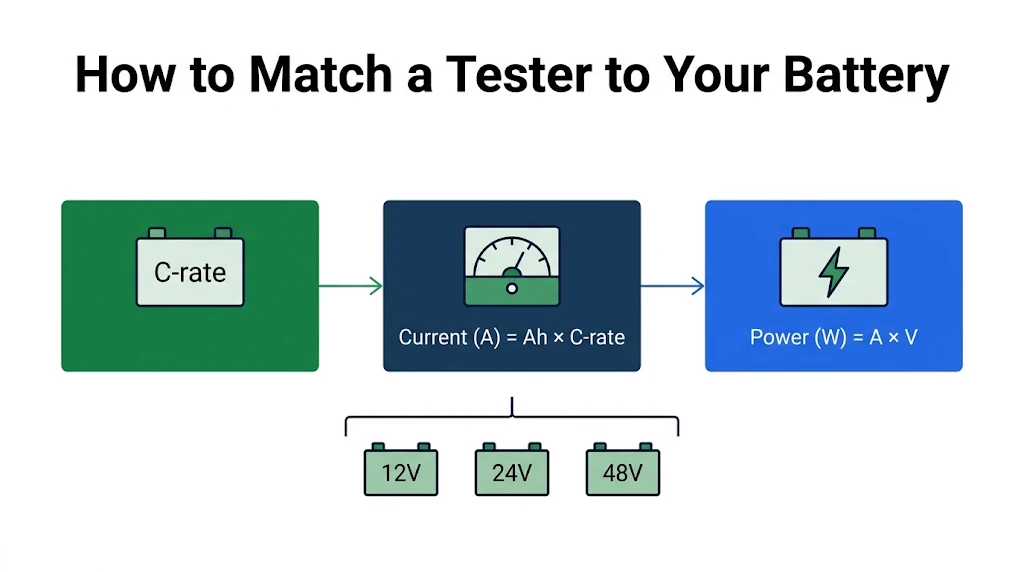
The discharge current is set by the C-rate and the capacity. The power the tester must dissipate is that current multiplied by voltage — use the peak charge voltage rather than nominal to leave realistic headroom. The table below works through common packs at 0.5C.
| Battery | Current at 0.5C | Approx. peak power | Suggested load rating |
|---|---|---|---|
| 12 V 100 Ah | 50 A | 50 A × 14.6 V ≈ 730 W | 60 A / 1,000 W |
| 24 V 100 Ah | 50 A | 50 A × 29.2 V ≈ 1,460 W | 60 A / 1,800 W |
| 48 V 100 Ah | 50 A | 50 A × 58.4 V ≈ 2,920 W | 60 A / 3,500 W |
| 12 V 100 Ah at 0.2C | 20 A | 20 A × 14.6 V ≈ 292 W | 30 A / 500 W |
| 48 V 200 Ah at 0.5C | 100 A | 100 A × 58.4 V ≈ 5,840 W | 120 A / 7,000 W |
For a multi-module rack, test each module separately rather than the whole string, so a single weak module is not hidden by the average. Lower C-rates (0.2C) give a slightly more accurate capacity number and generate less heat; 0.5C is standard for routine QC where speed matters.
How to Use a Capacity Tester
Quick Answer: Fully charge the battery and let it rest, connect the tester positive-to-positive and negative-to-negative, set the discharge current and the cut-off voltage, start the test, and let the load run until it stops automatically at the cut-off. The tester then displays the integrated Ah and Wh; divide measured Ah by rated Ah for state of health. Keep the load and battery within their temperature limits throughout.
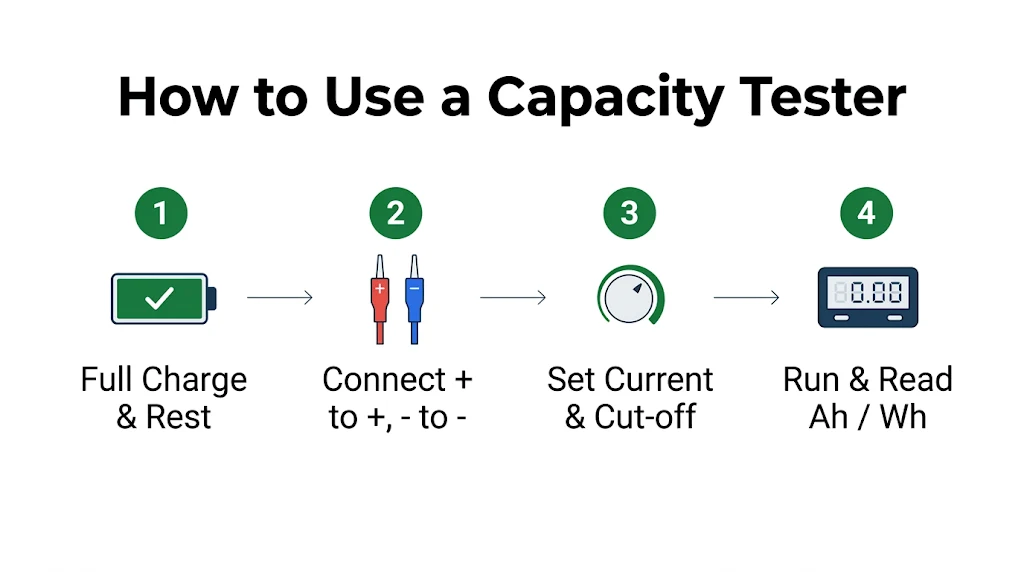
Step-by-step procedure
- Full charge: charge to 100% with the correct LiFePO4 profile (14.6 V for 12 V), then rest about 30 minutes.
- Connect safely: with the load off, attach positive to positive and negative to negative; confirm cables can carry the current.
- Set parameters: enter the constant-current value and the cut-off voltage (10.0 V for 12 V/4S, 2.5 V/cell).
- Run the test: start the discharge and monitor temperature; the load holds current and logs Ah and Wh.
- Read and record: the tester stops at cut-off and shows capacity; save the log for the QC or warranty file.
- Calculate SoH: SoH (%) = measured Ah ÷ rated Ah × 100; below 80% means replacement.
Never reverse the polarity or connect a running load under load, and ensure the tester's voltage window covers the pack. For the underlying math and the no-specialist-equipment method, refer to the capacity testing methods guide.
Calibration, Accuracy & Common Mistakes
Quick Answer: Have the tester calibrated against a reference meter on a schedule, warm it up before testing, and use cables thick enough to avoid voltage drop. The most frequent errors are testing at too high a C-rate, using the nominal instead of peak voltage for power sizing, stopping above the true cut-off, testing a pack that was not fully charged, and trusting a multimeter's resting voltage as a capacity reading.
| Common mistake | Result | Correct practice |
|---|---|---|
| Trusting resting voltage | Flat LiFePO4 curve hides capacity | Run a full integrated discharge |
| Ignoring wattage rating | Load throttles current to protect itself | Size both A and W with headroom |
| Test current too high | Heating and voltage sag skew result | Use 0.2-0.5C and monitor temperature |
| Pack not fully charged | Capacity understated | Charge to 100%, rest 30 minutes first |
| Cut-off set too high | Test ends early, low Ah | Use 2.5 V/cell or the pack specification |
| Thin / long cables | Voltage drop and error | Use short, appropriately rated conductors |
| No calibration | Readings drift over time | Periodic calibration against a reference |
Even an accurate instrument drifts as components age. A documented calibration routine and consistent test conditions make period-over-period comparisons meaningful and keep reports defensible.
B2B Quality Control: Incoming Inspection & Batch Grading
Quick Answer: On the first order, run a sample batch on your own tester to confirm the factory capacity, then shift to periodic spot checks once the supplier is proven. Use a multi-channel grading cabinet or independent electronic load to verify Ah and Wh, compare results with the supplier's grading report, and reject cells below the agreed tolerance. Logged per-unit data support traceability and warranty claims.
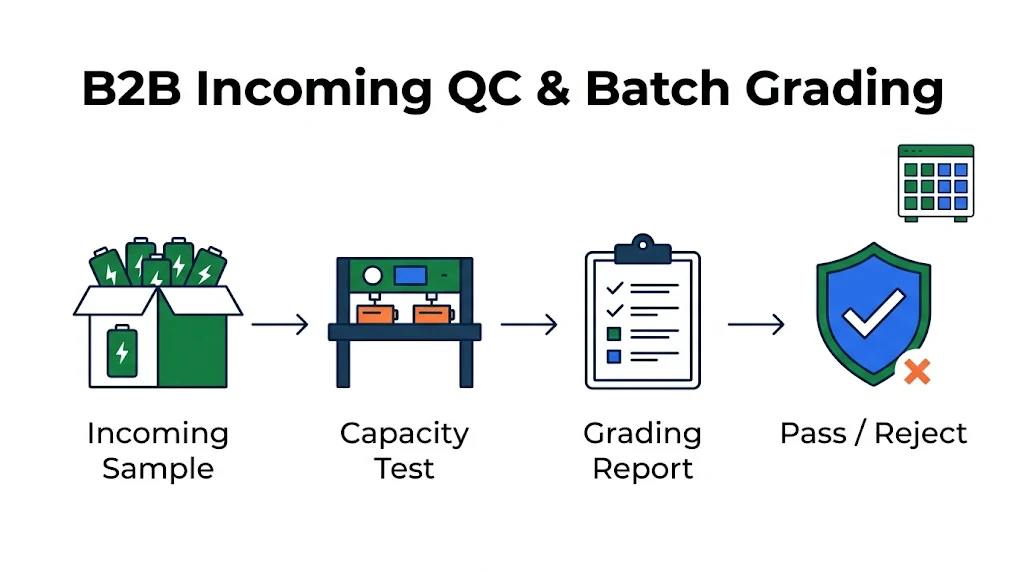
Distributors, integrators and EPC teams cannot rely on a nameplate alone. A practical incoming-QC program combines documentation review with measured verification and scales the sampling rate to risk.
| QC stage | Action | Pass criterion |
|---|---|---|
| Documentation | Review factory grading report and certificates | Complete, model-specific, verifiable |
| Incoming sampling | Capacity-test a sample of the first batch | Measured Ah within agreed tolerance |
| Batch grading | Multi-channel charge-discharge per cell | Capacity bins match the specification |
| Periodic spot check | Test random units on later orders | Consistent SoH, no downward trend |
| Warranty evidence | Archive logged Ah/Wh reports | Traceable to serial and batch number |
What to Ask Your Battery Supplier
Quick Answer: Ask for the factory capacity-grading report for each batch, the test C-rate and cut-off used, per-cell or per-pack Ah and Wh data, the calibration status of the test equipment, and the tolerance guaranteed against rated capacity. A manufacturer that runs 100% end-of-line testing and shares the records is far lower risk than one that only quotes a nameplate figure.
- Can you provide the capacity-grading report for my specific batch, with per-unit Ah and Wh?
- What C-rate and cut-off voltage do you use for the rating, and at what temperature?
- Is your test equipment calibrated, and on what schedule?
- What capacity tolerance do you guarantee against the rated figure?
- Do you perform 100% end-of-line testing, and can I audit or inspect the line?
- On the first order, may I run a sample batch on my own tester to confirm?
Enerbe runs 100% incoming cell inspection and final testing, uses A-grade LiFePO4 cells, and provides factory capacity-grading reports and full traceability on request. For the broader buying process, see the B2B sourcing guide.
Frequently Asked Questions
Quick Answer: This FAQ covers how a capacity tester differs from a multimeter, sizing a tester for 12 V to 48 V packs, charge versus discharge capability, accuracy and calibration, grading cabinets, test frequency and whether LiFePO4 needs different equipment from lead-acid.
What is the difference between a battery capacity tester and a multimeter?
A multimeter measures instantaneous voltage and current and can only estimate state of charge from resting voltage, which is unreliable for LiFePO4 because of its flat voltage curve. A capacity tester performs a full controlled constant-current discharge and integrates the current over time to report total amp-hours and watt-hours, giving a true capacity and state of health.
What size tester do I need for a 12 V, 24 V or 48 V LiFePO4 battery?
Choose a test C-rate, usually 0.2C to 0.5C, multiply capacity in Ah by the C-rate for current, and multiply that current by the peak voltage for power. A 12 V 100 Ah pack at 0.5C needs about 50 A and 730 W, while a 48 V 100 Ah pack needs the same 50 A but about 2,920 W, so select a load rated for both current and watts with headroom.
Can a battery tester both charge and discharge a battery?
A programmable DC electronic load typically only discharges. A battery capacity analyzer adds a charging channel so it can run complete charge-discharge cycles, calculate state of health and internal resistance, and export repeatable reports.
How accurate are LiFePO4 capacity testers?
Quality bench loads and analyzers offer current accuracy of roughly plus or minus 0.1 to 0.5 percent when calibrated and used within rating. Accuracy depends on calibration, cable thickness, temperature and using an appropriate C-rate; periodic calibration against a reference keeps readings trustworthy.
What is a battery aging or grading cabinet?
It is a multi-channel instrument that charges and discharges many cells or packs at once, recording per-channel capacity so units can be graded and matched. Manufacturers use it for cell grading, pack aging and end-of-line quality control.
How often should I test LiFePO4 capacity?
Run a capacity test on incoming first orders, then on periodic spot checks for established suppliers, and whenever a battery shows reduced runtime or is used for a warranty claim. Routine maintenance testing at defined intervals lets you track degradation and plan replacement.
Do I need a different tester for LiFePO4 versus lead-acid?
The same electronic load or analyzer can test both if its voltage range and cut-off settings cover the battery. LiFePO4 uses a higher and differently shaped voltage profile and a cut-off around 2.5 V per cell, so confirm the tester supports the LiFePO4 range and adjustable cut-off.
Related Resources
Quick Answer: These resources connect the equipment guide to the capacity testing method, B2B sourcing, rack-mounted systems and LiFePO4 safety and charging references, followed by contact details and product links.
| Topic | Resource |
|---|---|
| Step-by-step capacity testing methods and math | How to Test LiFePO4 Battery Capacity |
| B2B sourcing and supplier qualification | BESS Sourcing Guide |
| 48 V rack-mounted systems | 48 V Rack Battery Guide |
| LiFePO4 safety and fire risk | LiFePO4 Safety Guide |
| Full product lineup | View Products |
Get In Touch
Need help selecting a LiFePO4 capacity tester or test documentation? Contact Enerbe today.
📄 Request a Technical Datasheet
Contact Us →📞 Speak with Our Engineering Team
Get In Touch →🔗 Browse Our Custom Battery Solutions
View Products →Dongguan A&S Power Technology Co., Limited.
Building 1, No. 2, Keji 9th Road,
Songshan Lake, Dongguan, Guangdong, China
📞 +86 137 1383 1631
✉ info@aspowerbattery.com
Stay Charged. Stay Connected.




BESS Sourcing & Procurement Guide for B2B Buyers (2026)
Related Article

Get In Touch
Have questions about custom lithium batteries, energy storage solutions, or lead-to-lithium conversion? Our team is ready to help. Send us a message and we’ll respond within 24 hours.

Building 1, No. 2, Keji 9th Road, Songshan Lake, Dongguan, Guangdong, China
Office Address

info@aspowerbattery.com
Email Us

+86 137 1383 1631
Call Us

Sun - Fri (08AM - 10PM)
Office Open
