
12V 54Ah LiFePO4 Battery: Deep Cycle Lithium Buying Guide for Marine & Trolling

Table of Contents
- Introduction: Why 54Ah Is the Sweet Spot for Trolling Motors
- What Is a 12V 54Ah LiFePO4 Battery?
- 12V 54Ah Specs Explained: Voltage, Capacity, CCA & More
- LiFePO4 vs Lead-Acid 54Ah: The Real-World Difference
- The 54Ah Market: Dakota Lithium & Other Options
- Key Applications: Where 54Ah Shines
- Buying Guide: What to Look For in a 54Ah LiFePO4 Battery
- B2B Sourcing: Advice for Dealers & Distributors
- Frequently Asked Questions
- Summary
Introduction: Why 54Ah Is the Sweet Spot for Trolling Motors
If you've ever spent a day on the water with a trolling motor, you know the anxiety: is my battery going to last until the end of the day? Nothing kills a fishing trip faster than a dead trolling motor battery at 2 PM with the wind picking up and the fish finally biting.
That's why the 12V 54Ah size has become one of the most popular lithium battery formats for freshwater and inshore saltwater anglers. It's the capacity sweet spot — big enough to run a 55-lb thrust trolling motor for a full day of typical mixed-speed trolling (6-10 hours), yet small and light enough to fit in most boat battery trays and lift with one hand.
For years, anglers had two choices: a heavy Group 24 or Group 27 lead-acid battery that weighed 45-60 lbs and lasted 2-3 years, or an expensive lithium battery that cost $400+ but weighed 15 lbs and lasted a decade. Today, LiFePO4 (Lithium Iron Phosphate) batteries in the 12V 54Ah size have come down in price significantly, making them accessible to everyday anglers — and the total cost of ownership is actually lower than lead-acid when you factor in lifespan and performance.
This guide covers everything you need to know about 12V 54Ah LiFePO4 batteries: what the specs mean, how they compare to lead-acid, what the market looks like (including well-known brands like Dakota Lithium), where 54Ah makes the most sense, what to look for when buying, and advice for dealers and distributors sourcing in volume.
For a broader overview of LiFePO4 battery chemistry and why it's the preferred choice for deep cycle applications, see our What Is a LiFePO4 Battery? guide. For charging best practices, see our LiFePO4 Charging Guide.
What Is a 12V 54Ah LiFePO4 Battery?
A 12V 54Ah LiFePO4 battery is a deep cycle battery that uses Lithium Iron Phosphate (LiFePO4) cells and delivers 12 volts nominal with a capacity of 54 amp-hours. Inside the case, you'll typically find four LiFePO4 cells wired in series (4S configuration), a built-in BMS (Battery Management System), and the terminals that connect to your equipment.
The "12V" is nominal — a 4S LiFePO4 battery actually has a nominal voltage of 12.8V (3.2V per cell), a fully charged resting voltage of 13.2V-13.6V, and a charging voltage of 14.2V-14.6V. This is slightly higher than a lead-acid battery's 12.6V fully charged resting voltage, but it's compatible with virtually all 12V trolling motors, fish finders, and other marine electronics.
The "54Ah" means the battery can theoretically deliver 54 amps for 1 hour, or 27 amps for 2 hours, or 5.4 amps for 10 hours, before reaching the cut-off voltage. In real-world trolling motor use, you rarely draw a constant current — you might run at speed 5 for 10 minutes (drawing 30-40A), then troll at speed 2 for an hour (drawing 8-12A), then drift with the motor off. This mixed-use pattern is why a 54Ah battery can last a full day even though a single hour at full speed would drain it.
Key point: 54Ah is not a standard lead-acid size — most lead-acid marine batteries come in 50Ah, 55Ah, 65Ah, or 75Ah. The 54Ah size is specific to the lithium market, and it's designed to be a direct drop-in replacement for Group 24 (typically 50-65Ah) lead-acid batteries. The physical dimensions of a 12V 54Ah LiFePO4 battery are usually very close to a Group 24 lead-acid battery, so it fits in the same battery tray.
12V 54Ah Specs Explained: Voltage, Capacity, CCA & More
When you're comparing 12V 54Ah LiFePO4 batteries, you'll see a lot of numbers on the spec sheet. Here's what each one actually means and what to look for:
Nominal Voltage: 12V (12.8V actual)
As mentioned, a 4S LiFePO4 battery has a nominal voltage of 12.8V. This is compatible with all standard 12V equipment. The important thing to check is the charging voltage range — the battery should accept 14.2V-14.6V charging and have a float voltage of 13.5V-13.8V. If the battery's BMS has a lower overcharge cutoff (below 14.2V), it may not fully charge with some chargers.
Capacity: 54Ah
This is the most important spec, and unfortunately the one that's most often exaggerated. A true 54Ah battery should deliver 54Ah at the standard discharge rate (usually 0.2C, or 10.8A for a 54Ah battery) down to the cut-off voltage (typically 10.0V-11.0V for a 12V battery). Some cheaper batteries label themselves as 54Ah but only deliver 45Ah-50Ah in real testing. Always verify capacity with a discharge test or ask the supplier for independent capacity test data.
CCA (Cold Cranking Amps)
CCA measures the maximum current the battery can deliver for 30 seconds at -18°C (0°F) without dropping below 7.2V. For trolling motor and deep cycle use, CCA is less important than capacity — but it matters if you also use the battery for starting an outboard motor, or if you fish in very cold weather. A typical 12V 54Ah LiFePO4 battery delivers 400-800 CCA, which is more than enough for most 12V outboard motors up to 50-60 hp. If the battery is marketed as "deep cycle only" with no CCA rating, it may not be suitable for engine starting — verify before buying if you need it for starting.
Cycle Life: 2,000-5,000+ cycles
Cycle life is the number of full charge/discharge cycles the battery can perform before its capacity drops below 80% of the original rating. A quality A-grade LiFePO4 battery should deliver 2,000-5,000 cycles at 80% depth of discharge (DoD). At shallower discharges (50% DoD), cycle life can exceed 5,000-7,000 cycles. Be skeptical of batteries claiming 10,000+ cycles — that's usually measured at very shallow discharge (10-20% DoD) and doesn't reflect real-world deep cycle use.
Weight: 13-16 lbs (5.9-7.3 kg)
A 12V 54Ah LiFePO4 battery typically weighs 13-16 lbs, depending on the case material (ABS plastic vs. metal), BMS size, and build quality. By comparison, a Group 24 lead-acid marine battery weighs 45-55 lbs. The weight savings is one of the biggest advantages for boat owners — less weight means better fuel efficiency, faster hole shot, and easier handling.
Dimensions: Group 24 compatible
Most 12V 54Ah LiFePO4 batteries are designed to match Group 24 lead-acid battery dimensions: approximately 10.25" L x 6.75" W x 8.5" H (260mm x 171mm x 216mm). However, dimensions vary by manufacturer — some are slightly smaller (which is fine, they'll still fit in a Group 24 tray with a spacer), and some are larger. Always verify the exact dimensions against your battery tray before buying, especially if you have a tight-fitting battery compartment.
BMS (Battery Management System)
Every quality LiFePO4 battery includes a built-in BMS that protects the cells. For a 54Ah deep cycle battery, the BMS should have:
-
Overcharge protection: Cuts off charging when any cell reaches 3.65V-3.8V
-
Over-discharge protection: Cuts off output when any cell drops below 2.5V-2.8V
-
Over-current protection: Cuts off output if discharge current exceeds the safe limit (typically 50-100A for a 54Ah battery)
-
Short circuit protection: Instant cutoff in case of a short
-
Temperature protection: Premium BMS units include temperature sensors that cut off charging below 0°C (32°F) to prevent lithium plating
-
Cell balancing: Passive or active balancing to keep all 4 cells at the same voltage, maximizing capacity and lifespan
LiFePO4 vs Lead-Acid 54Ah: The Real-World Difference
The comparison between LiFePO4 and lead-acid for a 54Ah-class deep cycle marine battery comes down to real-world performance that anglers actually notice. Here's how they stack up:
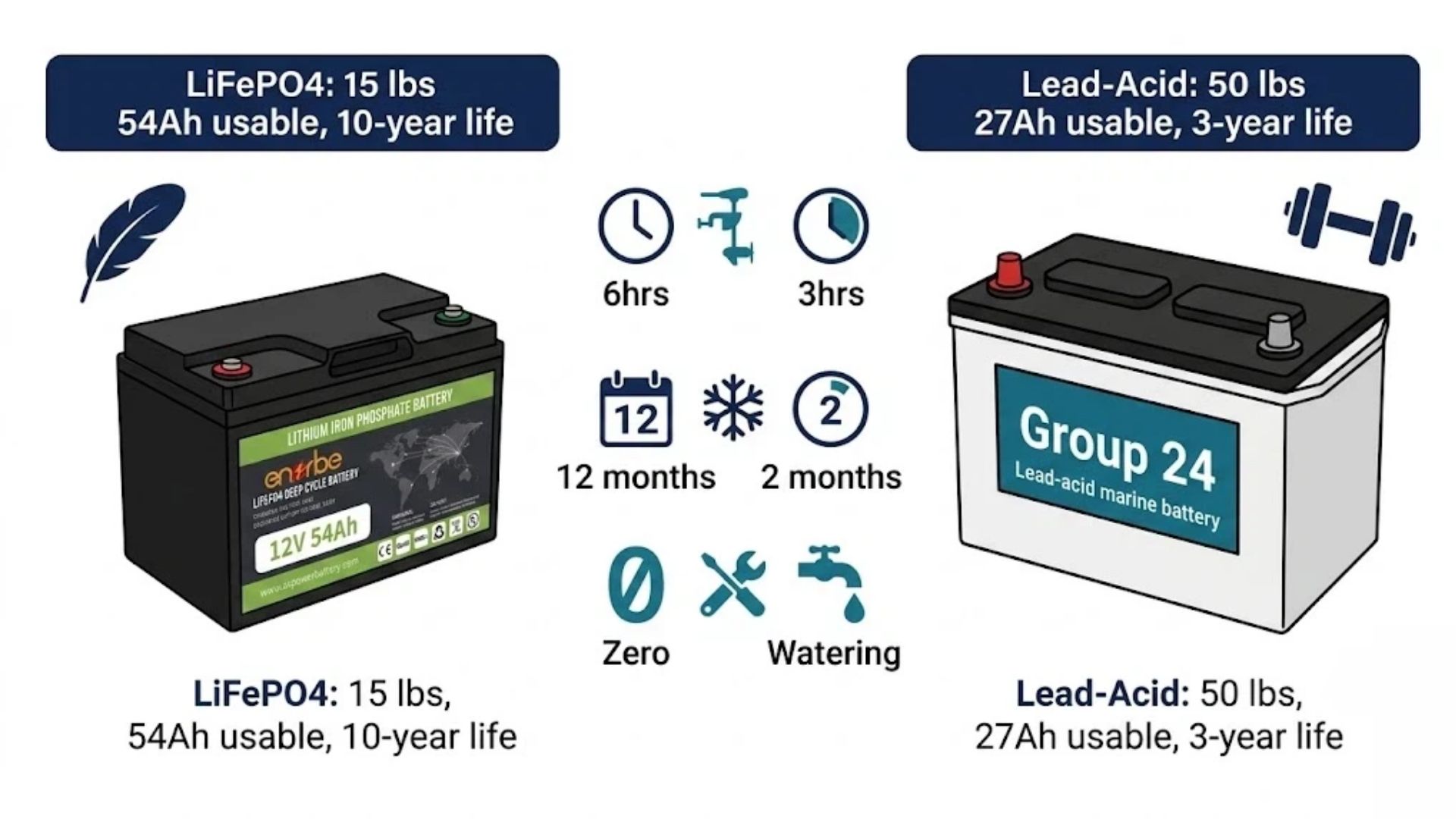
| Metric | LiFePO4 (12V 54Ah) | Lead-Acid (Group 24, ~55Ah) | Real-World Impact |
|---|---|---|---|
| Weight | 13-16 lbs (6-7 kg) | 45-55 lbs (20-25 kg) | 30-40 lbs lighter — easier to lift, better boat performance |
| Usable Capacity | 80-100% (43-54Ah usable) | 50% max (~27Ah usable) | LiFePO4 delivers ~2x more usable energy at the same Ah rating |
| Trolling Motor Runtime | 6-10 hours (mixed speed) | 3-5 hours (mixed speed) | LiFePO4 lasts nearly twice as long on the water |
| Cycle Life | 2,000-5,000 cycles | 300-800 cycles | LiFePO4 lasts 3-10x longer |
| Calendar Life | 8-12 years | 3-5 years | One LiFePO4 = 2-3 lead-acid batteries over time |
| Winter Storage | 6-12 months self-discharge, no trickle needed | 1-3 months, needs trickle charger or it sulfates | No more dead batteries after winter storage |
| Maintenance | None (sealed, no water, no corrosion) | May need watering (flooded), terminal corrosion | Install and forget — no maintenance |
| Price (retail) | $250-$500 | $100-$200 | Higher upfront, but lower cost per year |
The bottom line for anglers: A 12V 54Ah LiFePO4 battery costs about 2-3x more upfront than a comparable lead-acid battery, but it delivers nearly twice the runtime on the water, weighs 30-40 lbs less, lasts 2-3 times longer, requires zero maintenance, and won't die during winter storage. Over the lifespan of the battery, the cost per year is actually lower for LiFePO4 — and you avoid the frustration of dead batteries mid-trip.
The "usable capacity" row is the most important one that most people miss. A 55Ah lead-acid battery should only be discharged to 50% (about 27Ah usable) to avoid damaging the battery and shortening its life. A 54Ah LiFePO4 battery can be safely discharged to 80-100% (43-54Ah usable) without damage. So even though the Ah ratings look similar, the LiFePO4 battery actually delivers almost twice as much usable energy — which directly translates to more hours on the water.
The 54Ah Market: Dakota Lithium & Other Options
If you've shopped for a 12V 54Ah lithium battery, you've almost certainly come across Dakota Lithium. They are one of the most recognized brands in this category, particularly among anglers and outdoor enthusiasts in the North American market. Their 12V 54Ah model is one of their flagship products, and they've built a reputation around strong warranty coverage, cold-weather performance, and US-based customer service.
Dakota Lithium's success has helped grow the entire 54Ah category — as more anglers learned about the benefits of lithium trolling motor batteries, more manufacturers entered the market with 54Ah options at various price points. Today, you can find 12V 54Ah LiFePO4 batteries from well-known marine brands, direct-from-China manufacturers, private label brands, and everything in between.
What to Compare Across Brands
When evaluating any 12V 54Ah LiFePO4 battery — whether it's a well-known brand or a lesser-known supplier — compare these factors:
-
Cell grade: A-grade cells from reputable manufacturers (CATL, EVE, BYD, Lishen) are essential. B-grade or recycled cells may have lower capacity, shorter life, and safety risks.
-
Actual capacity: Don't trust the label — verify with a discharge test or ask for independent test data. A battery labeled 54Ah should deliver at least 52Ah at the standard discharge rate. Some suppliers overstate capacity by 10-20%.
-
BMS features: Check for overcharge, over-discharge, over-current, short circuit, and temperature protection. Cell balancing is important for maintaining capacity over time. The BMS current rating should be high enough for your application (at least 50A continuous for trolling motor use).
-
Cycle life rating: Look for 2,000+ cycles at 80% DoD. Be skeptical of 10,000+ cycle claims — they're usually measured at very shallow discharge.
-
Warranty: A reputable brand should offer at least 2-3 years. Some premium brands offer 5-11 years. Read the warranty terms carefully — some warranties are pro-rated, some require registration, and some only cover manufacturing defects (not normal wear).
-
Certifications: UN38.3 is required for shipping. CE and RoHS for EU sales. IEC 62133 is a good safety indicator. IP65/IP67 waterproof rating is important for marine use.
-
Customer service & support: If you have a problem, can you reach someone? US-based support is a big plus for North American customers. Check reviews and return policies.
-
Price: For retail buyers, price is obviously a factor — but don't choose based on price alone. A $200 battery with B-grade cells and a 1-year warranty is a worse deal than a $400 battery with A-grade cells and a 5-year warranty.
For B2B buyers: If you're sourcing for resale, OEM, or fleet use, you don't necessarily need to buy a retail brand like Dakota Lithium. You can source directly from manufacturers like Enerbe that offer A-grade cells, full certifications, private label options, and competitive wholesale pricing — often at 40-60% below retail brand prices. The key is to verify quality through sample testing and independent reports before committing to volume.
Key Applications: Where 54Ah Shines
The 12V 54Ah size is versatile, but it's particularly well-suited for these applications:
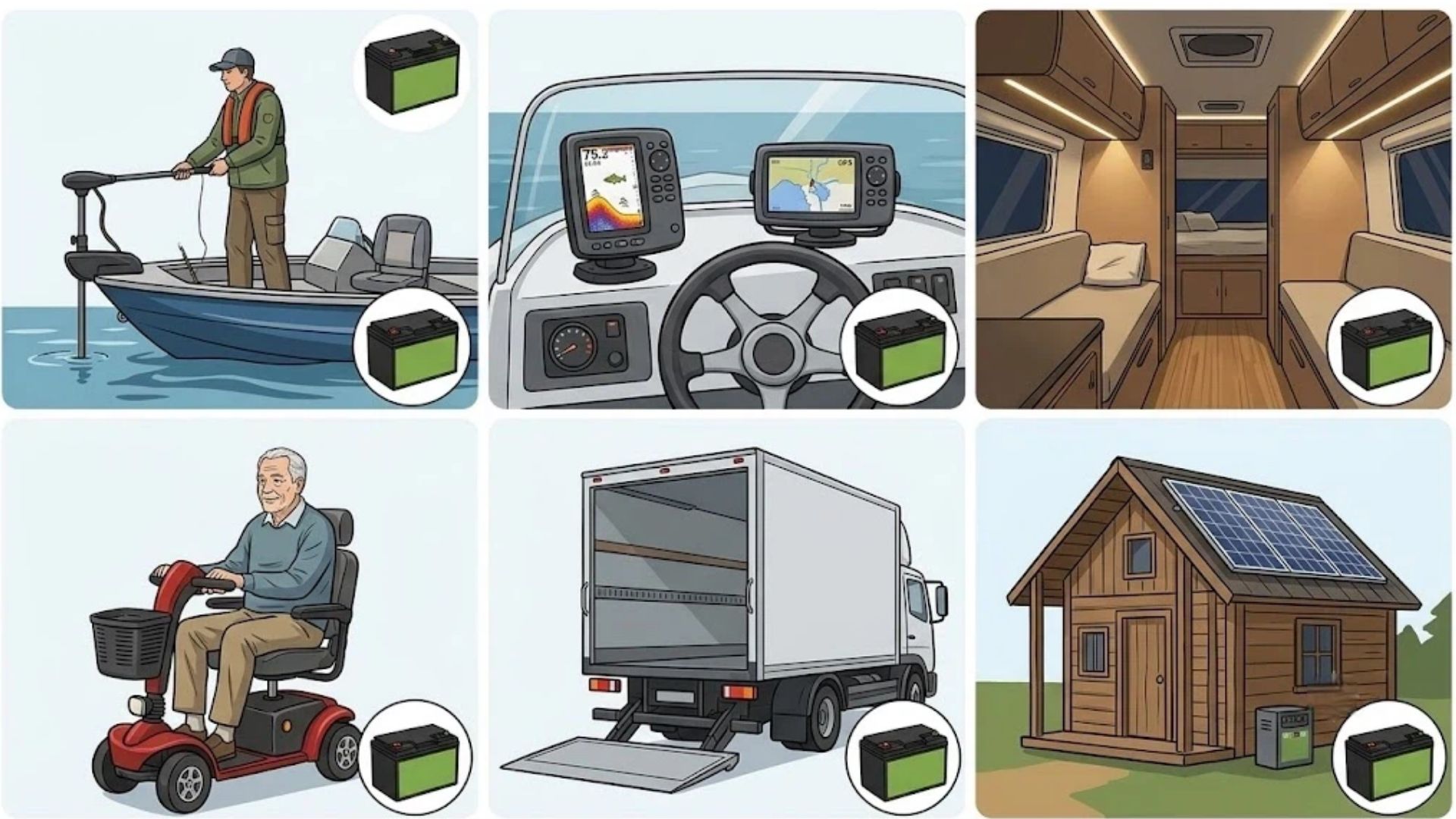
1. Trolling Motors (Primary Use)
This is the #1 application for 12V 54Ah LiFePO4 batteries. A 54Ah battery can power a 30-55 lb thrust 12V trolling motor for 6-10 hours of typical mixed-speed use, which covers a full day of fishing for most anglers. It fits in the standard battery trays on bass boats, pontoons, aluminum fishing boats, and kayaks with motor mounts. The light weight (13-16 lbs) is a huge advantage for kayak anglers and small boat owners who need to move the battery around.
2. Marine Electronics
Fish finders, GPS chartplotters, VHF radios, livewell pumps, and LED lighting all draw relatively low current (1-10A), and a 54Ah battery can power these for days. Many anglers use a separate 54Ah LiFePO4 battery dedicated to electronics, so the trolling motor battery doesn't cause voltage drops that can reset fish finders or GPS units. The stable voltage output of LiFePO4 (it holds near-constant voltage until nearly depleted) is ideal for sensitive electronics.
3. RV & Camper House Batteries
A single 12V 54Ah LiFePO4 battery works well as a house battery for small campers, van conversions, and truck campers. It can power LED lights, a water pump, a phone/laptop charger, and a small fridge for 1-2 days. For larger RVs, multiple 54Ah batteries can be wired in parallel for more capacity. The light weight and zero maintenance make LiFePO4 ideal for RV use.
4. Mobility Scooters & Wheelchairs
Many mobility scooters and power wheelchairs use 12V deep cycle batteries, and 54Ah is a common size. LiFePO4 batteries offer longer range per charge, faster charging, lighter weight (easier to transport for travel), and much longer lifespan than the lead-acid batteries that come stock with most mobility devices.
5. Lift Gates & Material Handling
Hydraulic lift gates on trucks and trailers, pallet jacks, and small material handling equipment often use 12V deep cycle batteries. The 54Ah size provides enough capacity for dozens of lift cycles, and the high discharge capability of LiFePO4 handles the high current draw of hydraulic pumps well. The long cycle life reduces replacement frequency for commercial fleets.
6. Small Off-Grid Solar Systems
A 12V 54Ah LiFePO4 battery (54Ah × 12.8V = ~691 Wh) is a good size for small off-grid solar systems — cabins, sheds, remote monitoring stations, or backup power for a few essential circuits. It can be charged with a 100W-200W solar panel and a LiFePO4-compatible charge controller in 4-8 hours of full sun.
Buying Guide: What to Look For in a 54Ah LiFePO4 Battery
Whether you're buying one battery for your fishing boat or sourcing for a retail store, these are the critical factors to evaluate:
1. Verify Actual Capacity (Don't Trust the Label)
This is the #1 mistake buyers make. Some manufacturers label a 45Ah or 50Ah battery as "54Ah" because it sounds better. Always ask for a capacity test report, or test the battery yourself with a battery capacity tester. A true 54Ah battery should deliver at least 52Ah when discharged at 0.2C (10.8A) down to 10.0V. If a supplier can't or won't provide capacity test data, that's a red flag.
2. Insist on A-Grade Cells
The cells are the heart of the battery, and cell quality determines everything — capacity, cycle life, safety, and consistency. A-grade cells from reputable manufacturers (CATL, EVE, BYD, Lishen, Coslight) have tight capacity tolerances (±2%), low internal resistance, and full cycle life. B-grade cells are typically rejects from EV production with minor defects — they may have 5-15% less capacity, higher internal resistance, and shorter life. C-grade or recycled cells are even worse and can be a safety risk. Always ask: who makes the cells? What grade? Can I see the cell test report?
3. Check the BMS
A cheap BMS can turn A-grade cells into a mediocre battery. Look for:
-
Continuous discharge current rating of at least 50A (100A is better for trolling motor starting surges)
-
Overcharge, over-discharge, over-current, and short circuit protection (minimum)
-
Temperature protection (low-temp charging cutoff is important for cold climates)
-
Cell balancing (passive is fine for 4S, active is better but more expensive)
-
Reputable BMS IC (TI, Analog Devices, or well-known Chinese BMS IC manufacturers)
4. Verify Certifications
-
UN38.3: Required for shipping lithium batteries by air or sea. Without it, you can't legally ship the battery.
-
CE: Required for sale in the European Union.
-
RoHS: Restriction of Hazardous Substances — required for EU and many other markets.
-
IP65/IP67: Waterproof rating — important for marine use. IP65 = dust-tight + water jet protection. IP67 = dust-tight + temporary immersion (up to 1m for 30 min).
-
IEC 62133: International safety standard for portable lithium cells/batteries — optional but a good indicator of quality.
5. Check the Warranty & Return Policy
A 2-3 year warranty is the minimum for a quality LiFePO4 deep cycle battery. Premium brands offer 5-11 years. Read the fine print: is it a full replacement warranty or pro-rated? Does it cover shipping? Do you need to register the battery? What's the return window if it's defective? For B2B buyers, also ask about the warranty claim process and turnaround time for replacements — if a customer has a dead battery in the middle of fishing season, they can't wait 4 weeks for a replacement.
6. Consider the Case & Terminals
-
Case material: ABS plastic is standard and lightweight. Some premium batteries use metal-reinforced cases for extra durability.
-
Terminal type: Common types include 5/16" threaded inserts (most common for marine), M6 bolt terminals, and wingnut-style. Make sure the terminal type matches your battery cables and trolling motor connectors.
-
Handle: A built-in carry handle is a nice feature for a battery you'll be moving in and out of a boat. Many LiFePO4 batteries are light enough that you don't strictly need a handle, but it's still convenient.
-
Venting: LiFePO4 batteries don't emit gas during normal operation (unlike lead-acid), so they don't require vented battery boxes. However, in the event of a severe failure, some batteries have a pressure relief vent — this is a safety feature, not a concern for normal use.
Red flags to avoid:
- No capacity test data available
- Refuses to disclose cell manufacturer or grade
- Claims 10,000+ cycles (unrealistic for deep cycle use)
- No UN38.3 certification (can't ship legally)
- Warranty less than 1 year
- Price significantly below market average (usually means B-grade cells or fake capacity)
- No customer support contact or only a generic email
B2B Sourcing: Advice for Dealers & Distributors
If you're a marine dealer, RV dealer, battery distributor, or retailer looking to add 12V 54Ah LiFePO4 batteries to your product lineup, the sourcing strategy is different from a retail buyer. Here's what you need to know:
1. Retail Brand vs. Private Label vs. Direct Manufacturer
You have three basic sourcing options:
-
Retail brand (Dakota Lithium, etc.): You buy from an established brand at wholesale/distributor pricing. Pros: brand recognition, marketing support, established warranty. Cons: higher cost, lower margins, less control over specifications.
-
Private label / OEM: You work with a manufacturer to produce batteries under your own brand name. Pros: higher margins, brand building, control over specs and pricing. Cons: requires minimum order quantities (MOQ), you handle warranty and customer support, need to invest in marketing.
-
Direct manufacturer (white label): You buy directly from a Chinese manufacturer at the lowest possible cost, with their branding or no branding. Pros: lowest cost, highest margins, flexible specifications. Cons: no brand recognition, you handle all support and warranty, need to verify quality yourself, language and time zone barriers.
For most dealers and small distributors, starting with a mix — a retail brand for customers who want a known name, and a private label or direct-manufacturer option for price-sensitive customers and higher-margin sales — is a good strategy.
2. Sample Testing Is Non-Negotiable
Before placing any volume order, order 3-5 samples from each supplier you're considering and test them thoroughly:
-
Capacity test: Discharge at 0.2C (10.8A for 54Ah) to 10.0V and measure actual Ah. Should be ≥52Ah.
-
High-current discharge: Discharge at 50A for 5 minutes and monitor voltage. Voltage should stay above 11.0V and the battery should not overheat.
-
Charge test: Charge with a standard LiFePO4 charger and verify it reaches full charge (13.2V+ resting) without BMS errors.
-
Cycle test (if time permits): Run 20-50 charge/discharge cycles and check for capacity fade. A-grade cells should show less than 2% fade after 50 cycles.
-
Real-world test: Install the battery in an actual trolling motor or RV and use it for a week. Check runtime, charging behavior, and any issues.
3. Understand the MOQ & Pricing Structure
For private label and direct manufacturer sourcing, ask about:
-
MOQ (Minimum Order Quantity): Typical MOQ for private label 12V 54Ah batteries is 50-200 pieces. Some manufacturers offer lower MOQs (10-50) for first orders to build a relationship.
-
Pricing tiers: Get quotes for 10, 50, 100, 500, and 1000 pieces. Unit price drops significantly at higher volumes. Typical wholesale pricing for A-grade 12V 54Ah LiFePO4 batteries ranges from $120-$200/unit depending on volume and specs.
-
Customization costs: Custom branding (logo printing on the case), custom packaging, custom spec changes (different BMS, terminals, etc.) may have one-time tooling fees or per-unit surcharges.
-
Shipping: Get quotes for sea freight (cheaper, 4-6 weeks) and air freight (faster, 5-10 days, more expensive). Verify that the supplier handles UN38.3 documentation and dangerous goods shipping.
4. Warranty & After-Sales Support
For B2B sourcing, the warranty arrangement with your supplier directly affects your profitability and customer satisfaction. Ask:
-
What's the warranty period? (2-3 years minimum for A-grade)
-
How are warranty claims handled? Do you ship defective units back to China, or does the supplier send replacements in advance?
-
What's the expected failure rate? A reputable supplier should have a failure rate below 1-2%.
-
Do they provide spare BMS boards or parts for in-warranty repairs?
-
Is there a dedicated account manager or support contact for B2B clients?
5. Marketing & Sales Support
If you're selling these batteries retail, ask your supplier for:
-
Product images (high-resolution, white background, lifestyle shots)
-
Spec sheets and datasheets (PDF)
-
Product descriptions and marketing copy
-
Comparison charts (LiFePO4 vs lead-acid)
-
Retail packaging design (if private label)
-
Training materials for your sales staff
Enerbe offers: A-grade CATL/EVE LiFePO4 cells, full UN38.3/CE/RoHS certification, IP65 waterproof cases, 2-3 year warranty (extendable), private label OEM with MOQ as low as 50 pieces, complete marketing materials (images, spec sheets, copy), and dedicated B2B account support. Wholesale pricing for 12V 54Ah LiFePO4 batteries starts at $120-$160/unit depending on volume and specifications. For a quote, sample request, or custom spec discussion, contact our B2B team.
Frequently Asked Questions
Q1: What is a 12V 54Ah LiFePO4 battery used for?
A 12V 54Ah LiFePO4 battery is most commonly used for marine trolling motors, fishing boat electronics (fish finders, GPS, radios), RV house batteries, mobility scooters, lift gates, and small off-grid solar systems. The 54Ah capacity is particularly popular for freshwater and inshore saltwater fishing because it can typically power a 55-lb thrust trolling motor for 6-10 hours on a single charge, depending on speed and wind conditions. This makes it the ideal size for a full day of fishing without needing to recharge on the water.
Q2: How long will a 12V 54Ah lithium battery run a trolling motor?
A 12V 54Ah LiFePO4 battery will typically run a trolling motor for 6-10 hours, depending on several factors: (1) Motor thrust — a 30-lb motor draws less current than an 80-lb motor, so it runs longer. (2) Speed setting — running at full speed (highest setting) draws 40-50A and will drain the battery in about 1 hour, while trolling at speed 2-3 draws 8-15A and can run 4-7 hours. (3) Wind and current — fighting wind or current means the motor works harder and draws more current. (4) Battery condition — a new, fully charged A-grade LiFePO4 battery will deliver closer to its rated capacity, while an older or degraded battery may deliver less. Most anglers report that a 54Ah LiFePO4 battery easily lasts a full 6-8 hour fishing day with typical mixed-speed trolling, which is why this size is so popular.
Q3: How much does a 12V 54Ah LiFePO4 battery weigh?
A typical 12V 54Ah LiFePO4 battery weighs approximately 13-16 lbs (5.9-7.3 kg), depending on the case material, BMS, and build quality. By comparison, a comparable 12V 55Ah group 24 deep cycle lead-acid battery (such as a Group 24 marine battery) typically weighs 45-55 lbs (20-25 kg). That's a weight savings of roughly 30-40 lbs (14-18 kg), or about 70% lighter. For boat owners, this weight savings is significant — it reduces the overall weight of the boat, improves fuel efficiency, and makes the battery much easier to lift and install. Many anglers can lift a 54Ah LiFePO4 battery with one hand, while a lead-acid battery of the same capacity requires two hands or a battery carrier.
Q4: Is Dakota Lithium a good brand, and are there alternatives?
Dakota Lithium is one of the most recognized brands in the 12V 54Ah LiFePO4 battery category, particularly among anglers and outdoor enthusiasts. They are known for their strong warranty coverage, focus on cold-weather performance, and dedicated US-based customer service. Their 12V 54Ah model is one of their most popular products for trolling motor applications. However, Dakota Lithium is not the only option — there are many other manufacturers offering 12V 54Ah LiFePO4 batteries with comparable specifications, often at lower price points, especially for B2B and wholesale buyers. When comparing brands, evaluate: cell grade (A-grade is essential), BMS quality and protection features, cycle life rating, actual capacity (not just marketing numbers), certifications (UN38.3 for shipping, CE, RoHS), warranty terms, and customer support. The best choice depends on your budget, volume needs, and whether you need retail branding or are sourcing for resale/OEM. Always request test reports and sample units before committing to a large order, regardless of brand.
Q5: Can I charge a 12V 54Ah LiFePO4 battery with a regular charger?
It depends on the charger. A 12V LiFePO4 battery requires a charging voltage of 14.2V-14.6V (bulk/constant current stage) followed by a float/maintenance voltage of 13.5V-13.8V. Many modern multi-stage battery chargers have a 'lithium' or 'LiFePO4' mode that uses the correct voltage profile — these are safe to use. However, standard lead-acid chargers may have issues: (1) Some lead-acid chargers use a desulfation mode that sends high-voltage pulses, which can damage LiFePO4 cells or trigger the BMS overcharge protection. (2) Some lead-acid chargers have a float voltage of 13.8V-14.4V, which may be too high for long-term float charging of LiFePO4. (3) Some older 'dumb' chargers don't shut off automatically and can overcharge the battery. For best results and longest battery life, use a charger specifically designed for LiFePO4 or a multi-chemistry charger with a selectable lithium mode. If you must use a lead-acid charger, verify that its float voltage is below 14.0V and don't leave it connected indefinitely. For on-board marine charging, many modern onboard chargers (like Minn Kota, ProMariner, or NOCO) have lithium-compatible modes.
Q6: How many years does a 12V 54Ah LiFePO4 battery last?
A high-quality 12V 54Ah LiFePO4 battery with A-grade cells typically lasts 8-12 years, or 2,000-5,000 charge/discharge cycles at 80% depth of discharge (DoD). By comparison, a deep cycle lead-acid marine battery typically lasts 3-5 years, or 300-800 cycles. For a typical angler who uses the battery 50-100 times per year (weekends and fishing season), a LiFePO4 battery can easily last 8-10 years or more. The actual lifespan depends on: depth of discharge (shallower discharges = longer life), charging habits (using the correct charger, avoiding overcharge/over-discharge), temperature exposure (extreme heat or cold reduces life), and cell/BMS quality. One of the biggest advantages of LiFePO4 for marine use is that it holds its charge extremely well during storage — it can sit for 6-12 months over the winter without needing a trickle charger, while a lead-acid battery may sulfate and go dead in 1-3 months. This storage performance alone extends the practical lifespan significantly for seasonal users.
Q7: What size charger do I need for a 12V 54Ah LiFePO4 battery?
For a 12V 54Ah LiFePO4 battery, the recommended charger size depends on how fast you want to charge: (1) Standard/overnight charging — a 5A-10A charger is ideal. A 10A charger will fully charge a depleted 54Ah battery in about 6-7 hours (54Ah ÷ 10A = 5.4 hours, plus some overhead for the absorption stage). A 5A charger takes about 12 hours. (2) Faster charging — a 15A-20A charger can charge the battery in 3-4 hours. Most 54Ah LiFePO4 batteries can accept a charge rate of up to 0.5C (27A) or even 1C (54A), but faster charging generates more heat and may slightly reduce long-term cycle life. For most marine and RV applications, a 10A-15A onboard charger or portable charger is the sweet spot between charging speed and battery longevity. Always use a LiFePO4-compatible charger, and verify that the charger's maximum current is within the battery's recommended charging current range (check the battery's spec sheet or label). For dual-bank or triple-bank onboard marine chargers, make sure each bank is rated for at least 10A if you want reasonable charging times.
Q8: What should dealers look for when sourcing 12V 54Ah LiFePO4 batteries for resale?
For dealers, distributors, and marine/RV retailers sourcing 12V 54Ah LiFePO4 batteries in volume, evaluate these key factors: (1) Cell grade — insist on A-grade LiFePO4 cells from reputable manufacturers (CATL, EVE, BYD, Lishen); B-grade or recycled cells have higher failure rates and shorter life, which leads to warranty claims and damaged reputation. (2) BMS quality — look for a BMS with overcharge, over-discharge, over-current, short circuit, and temperature protection; cell balancing is important for maintaining capacity over time. (3) Capacity verification — test samples with a capacity tester to confirm the battery actually delivers 54Ah (not 45Ah or 50Ah labeled as 54Ah). Some suppliers overstate capacity. (4) Certifications — UN38.3 is required for shipping lithium batteries by air or sea; CE and RoHS are required for EU sales; IEC 62133 is an optional but good indicator of cell safety. (5) Waterproof rating — for marine use, look for IP65 or IP67 rated cases to protect against water spray and temporary immersion. (6) Terminal type — common types include 5/16" threaded inserts, M6 bolt terminals, or wingnut-style marine terminals; make sure they match what your customers expect. (7) Warranty — a reputable supplier should offer at least 2-3 years warranty for deep cycle batteries; some premium suppliers offer 5+ years. (8) Private label/OEM — if you want your own brand, verify MOQ, custom branding options, and packaging capabilities. Always order 3-5 samples first, test them thoroughly (capacity, cycle life, charging, cold cranking if applicable), and verify real-world performance in actual trolling motor or RV applications before committing to a volume order.
Summary
The 12V 54Ah LiFePO4 battery has earned its place as the go-to choice for trolling motor anglers and anyone needing a compact, lightweight, long-lasting 12V deep cycle battery. Here's what you need to remember:
-
54Ah is the sweet spot for trolling motors: It powers a 30-55 lb thrust motor for 6-10 hours of typical mixed-speed use — enough for a full day on the water — while remaining light enough (13-16 lbs) to handle easily and fitting in standard Group 24 battery trays.
-
LiFePO4 beats lead-acid on every metric that matters: Nearly twice the usable capacity (80-100% vs 50%), 2-3x the lifespan, 70% less weight, zero maintenance, and superior winter storage performance. The higher upfront cost is offset by lower total cost of ownership over the battery's life.
-
Dakota Lithium is a well-known brand, but not the only option: They've built a strong reputation in the 54Ah category, but there are many quality manufacturers offering comparable A-grade LiFePO4 batteries at lower prices — especially for B2B and wholesale buyers. Compare cell grade, capacity, BMS features, certifications, warranty, and support across all options, not just brand name.
-
Verify capacity and cell quality before buying: Don't trust the label — ask for independent capacity test data and cell grade certificates. A true 54Ah A-grade battery should deliver ≥52Ah at 0.2C discharge. Red flags include no test data, undisclosed cell manufacturer, unrealistic cycle life claims, and prices significantly below market average.
-
Use a LiFePO4-compatible charger: Standard lead-acid chargers may damage the battery or trigger BMS protection. Use a charger with a lithium/LiFePO4 mode, or a dedicated LiFePO4 charger with 14.2V-14.6V bulk charging and 13.5V-13.8V float. A 10A charger is the sweet spot for 54Ah batteries — full charge in 6-7 hours.
-
For B2B buyers: sample test, then volume order: Always order 3-5 samples first, test capacity and cycle life, verify real-world performance, and confirm quality before placing a volume order. Private label and direct-manufacturer sourcing can offer 40-60% savings vs. retail brands, with full control over specs and branding.
Enerbe manufactures high-quality 12V 54Ah LiFePO4 deep cycle batteries using A-grade CATL/EVE cells, with full UN38.3/CE/RoHS certification, IP65 waterproof cases, 2-3 year warranty (extendable), and private label OEM options with low MOQ. For wholesale pricing, sample requests, custom specifications, or private label discussion, contact our B2B team.
Get In Touch
Ready to source LiFePO4 batteries for your project? Contact Enerbe today.
📄 Request a Technical Datasheet
Contact Us →📞 Speak with Our Engineering Team
Get In Touch →🔗 Browse Our Custom Battery Solutions
View Products →Dongguan A&S Power Technology Co., Limited.
Building 1, No. 2, Keji 9th Road,
Songshan Lake, Dongguan, Guangdong, China
📞 +86 137 1383 1631
✉ info@aspowerbattery.com
Stay Charged. Stay Connected.



24V Lithium Trolling Motor Battery: Complete Guide for Buyers
LiFePO4 Motorcycle Battery: 12V 6Ah Lithium Upgrade Complete Guide
Related Article



Get In Touch
Have questions about custom lithium batteries, energy storage solutions, or lead-to-lithium conversion? Our team is ready to help. Send us a message and we’ll respond within 24 hours.

Building 1, No. 2, Keji 9th Road, Songshan Lake, Dongguan, Guangdong, China
Office Address

info@aspowerbattery.com
Email Us

+86 137 1383 1631
Call Us

Sun - Fri (08AM - 10PM)
Office Open
