
China LFP Battery & NEV Market H1 2026 – Key Insights for B2B Buyers
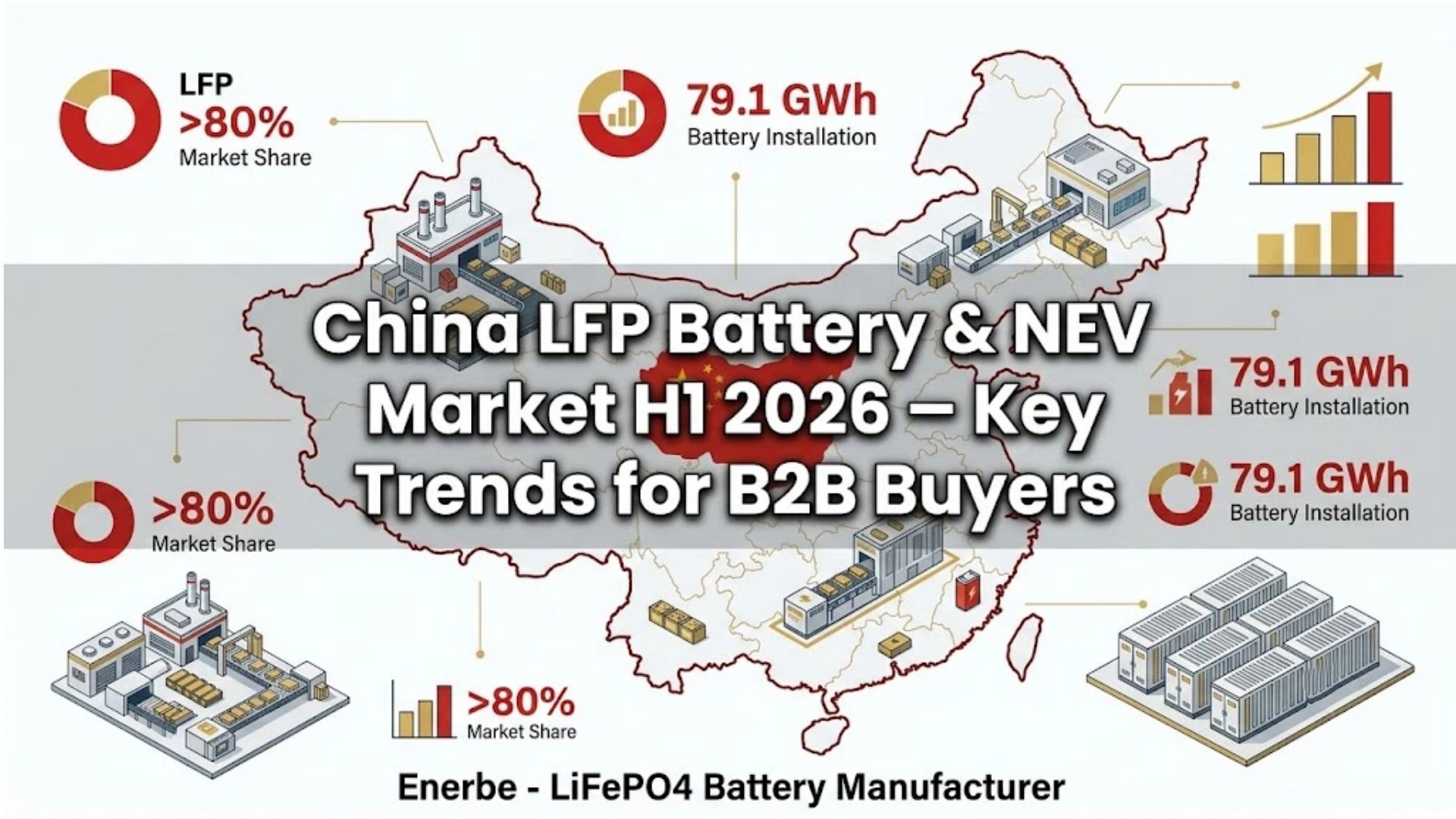
Table of Contents
Introduction
For B2B buyers sourcing LiFePO4 batteries for energy storage projects, understanding China‘s NEV battery market is not optional—it’s essential. China‘s battery supply chain directly impacts global pricing, lead times, and cell availability for commercial and industrial energy storage systems.
This report analyzes publicly available data from CPCA and Kerui Consulting. All statistics are cited from their published research. All market analysis, B2B procurement insights, and strategic recommendations in this article are the independent analysis of Enerbe. We do not claim ownership of the underlying data, and our interpretation does not represent the views of the data providers. Readers are encouraged to verify all data through original sources for business-critical decisions.
For a complete guide to battery energy storage systems, see our BESS Complete Guide. For the latest China battery industry market data, see our H1 2026 Market Report.
Why B2B Energy Storage Buyers Should Watch China‘s NEV Market

China’s NEV and battery market is the world‘s largest, accounting for over 60% of global lithium battery production. For B2B buyers outside China, this matters for three reasons:
1. Supply Chain Scale
China’s battery supply chain delivers scale-driven cost advantages. When EV production ramps up, battery prices drop—and those same cells power your energy storage systems.
2. Technology Validation
LFP chemistry has been proven through millions of EV installations. The chemistry that works reliably in EVs works just as reliably in stationary storage, with the added benefit of more forgiving operating conditions.
3. Supplier Diversity
Second-tier battery suppliers are gaining share, creating procurement opportunities for buyers willing to work with established manufacturers beyond the top two.
In H1 2026, China produced 7.399 million new energy vehicles, up 6.0% year-over-year. The NEV penetration rate reached 49.0%, approaching the 50% critical mark. For B2B buyers, this scale means stable supply, competitive pricing, and a mature ecosystem for LiFePO4 cell procurement.
Source: CPCA, Kerui Consulting
LFP Dominance: The Chemistry That Wins

In H1 2026, LFP batteries accounted for over 80% of China‘s NEV battery installations, while NMC held 18.7%.
Source: CPCA, Kerui Consulting
Why This Matters for B2B Buyers:
The dominance of LFP is not just an EV trend—it’s a signal for energy storage procurement. LFP‘s advantages align directly with commercial and industrial storage requirements:
| Advantage | Impact on Energy Storage Procurement |
|---|---|
| Thermal Stability | Lower fire risk, easier permitting, reduced insurance costs |
| 5,000+ Cycle Life | 10+ year service life, better ROI for commercial projects |
| Cobalt-Free | ESG compliance, stable pricing, no supply chain concentration risk |
With LFP production scaling to meet EV demand, the supply chain is mature enough to support stable pricing and reliable availability for energy storage buyers. Cell form factors are also standardizing—square cells dominate China‘s market with 97.7% share, ensuring consistency and quality control.
Source: CPCA, Kerui Consulting
The trend is clear: LFP is not just an EV chemistry—it is the dominant chemistry for stationary energy storage as well. B2B buyers sourcing LiFePO4 batteries benefit from a mature, scalable supply chain and proven technology.
Battery Supplier Landscape: Concentration and Opportunity
Power Battery Suppliers
The top two suppliers—CATL and BYD (FinDreams)—capture over 64% of the market, while second-tier manufacturers including CALB, Gotion High-Tech, and EVE Energy are steadily expanding their share.
Source: CPCA, Kerui Consulting
What This Means for B2B Buyers:
While CATL and BYD dominate, second-tier suppliers are gaining market share through commercial vehicle customers and overseas orders. For B2B buyers, this creates opportunities:
| Supplier Type | Advantages | Considerations |
|---|---|---|
| Tier 1 (CATL, BYD) | Proven quality, massive scale | Longer lead times, premium pricing |
| Tier 2 (CALB, Gotion, EVE) | Competitive pricing, flexible configurations, shorter lead times | Growing but less established track record |
B2B buyers should evaluate both tiers based on project requirements. For large-scale commercial projects with long lead times, Tier 1 suppliers offer reliability. For custom configurations and competitive pricing, Tier 2 suppliers present a strong alternative.
Drive Motor & Controller Market
The electric drive system market shows a similar concentration pattern:
| Component | Top 10 Supplier Market Share | Key Players |
|---|---|---|
| Drive Motor | 61.3% | FinDreams, Tesla, Huawei, NIO Drive |
| Motor Controller | 53.5% | FinDreams, Inovance, Tesla |
Source: CPCA, Kerui Consulting
B2B Takeaway: While the power battery market is more concentrated than drive systems, both markets show strong brand-vehicle matching relationships. For energy storage buyers, this means battery procurement should prioritize suppliers with proven track records in both quality and supply chain reliability.
Hydrogen Fuel Cell Outlook
Proton Exchange Membrane Fuel Cells (PEMFC) continue to develop as a complementary technology, particularly suited for heavy trucks and cold-chain logistics.
Key PEMFC Advantages:
-
High power density and quick startup
-
Over 90% output capacity at -30°C
-
Multiple storage technologies advancing (gaseous, liquid, solid-state)
-
Green hydrogen production accelerating capacity expansion
Source: CPCA, Kerui Consulting
B2B Takeaway: While hydrogen fuel cells are not yet a mainstream energy storage solution for commercial and industrial applications, they represent a complementary technology pathway worth monitoring for long-term procurement planning. Domestic substitution for core materials is making progress, which could improve cost competitiveness over time.
Key Takeaways for B2B Energy Storage Buyers
The H1 2026 data confirms several strategic directions for B2B buyers sourcing LiFePO4 energy storage systems:
| Insight | Implication |
|---|---|
| LFP dominates China‘s battery market (80%+ share) | LFP is the proven, scalable chemistry for stationary storage—no need to risk NMC for safety-critical ESS applications |
| Average battery capacity per vehicle continues to rise | Total battery demand is growing—secure supply agreements early with certified manufacturers |
| Second-tier battery suppliers are gaining share | More supplier options for buyers seeking competitive pricing and flexible configurations |
| Square cells dominate production (97.7%) | Standardization supports supply stability and pricing predictability |
| NEV penetration at 49% and rising | Battery production will continue scaling, pressuring prices downward—procurement timing matters |
For a complete overview of LiFePO4 battery sourcing across all applications, see our B2B Sourcing Guide.
Frequently Asked Questions
Q1: Which battery chemistry dominates China‘s NEV market?
LFP holds over 80% of the domestic installation market, according to CPCA data. For B2B buyers, this confirms LFP‘s position as the proven, scalable chemistry for stationary energy storage applications—combining safety, longevity, and cost-effectiveness.
Q2: How concentrated is the battery supplier market?
The top two suppliers (CATL and BYD) capture over 64% of installations, while second-tier suppliers like CALB, Gotion, and EVE are steadily gaining share. This creates procurement flexibility for buyers willing to work with established second-tier manufacturers.
Q3: What is the average battery capacity per EV?
The average single-vehicle battery capacity reached 65.4 kWh in H1 2026, up 29.3% YoY. Growing battery demand per vehicle tightens the global supply chain—buyers should secure supply agreements early with certified manufacturers.
Q4: What does this data mean for energy storage buyers?
The dominance of LFP and the scale of China‘s battery supply chain ensure stable availability and competitive pricing for LiFePO4 energy storage systems. Buyers should prioritize suppliers with proven quality, certification, and supply chain reliability—ideally those with established track records and transparent manufacturing practices.
Q5: Should I consider Tier 2 battery suppliers for my projects?
Yes, for projects where cost and flexibility outweigh brand premium. Tier 2 suppliers are gaining market share and often offer shorter lead times and more custom configurations. However, buyers should verify certification, quality control, and references before committing.
Summary
China‘s NEV and battery market in H1 2026 shows several clear trends relevant to B2B energy storage buyers:
LFP dominates with over 80% market share—confirming the chemistry‘s position as the proven, scalable solution for stationary storage applications. Battery demand continues to rise as average capacity per vehicle increases, tightening the supply chain. Second-tier suppliers are gaining share, creating procurement flexibility for buyers willing to work with established alternatives. Hydrogen fuel cells are developing as a complementary technology worth monitoring.
For B2B buyers sourcing LiFePO4 energy storage systems, these trends reinforce the importance of working with established manufacturers who have proven quality, certification, and supply chain reliability.
Enerbe provides high-quality LiFePO4 batteries for commercial, industrial, and lead-acid replacement applications, with full UL, CE, IEC, and UN38.3 certification. For wholesale pricing or custom configurations, contact our team.
Data in this report is sourced from CPCA, Kerui Consulting, and other publicly available industry reports. All data is cited from publicly released industry reports and presented for informational purposes.
📞 Speak with Our Engineering Team – Get In Touch
🔗 Browse Our Custom Battery Solutions – View Products
Building 1, No. 2, Keji 9th Road, Songshan Lake, Dongguan, Guangdong, China
📞 +86 137 1383 1631 | ✉ info@aspowerbattery.com



Are LiFePO4 Batteries Safe? – A Complete B2B Safety Guide
How Long Do Solar Batteries Last? Lifespan by Chemistry & Use Case (2026)
Related Article



Get In Touch
Have questions about custom lithium batteries, energy storage solutions, or lead-to-lithium conversion? Our team is ready to help. Send us a message and we’ll respond within 24 hours.

Building 1, No. 2, Keji 9th Road, Songshan Lake, Dongguan, Guangdong, China
Office Address

info@aspowerbattery.com
Email Us

+86 137 1383 1631
Call Us

Sun - Fri (08AM - 10PM)
Office Open
