
Telecom Battery Guide: 48V LiFePO4 Backup for Cell Towers & B2B Buyers (2026)

Table of Contents
- Introduction: What Is a Telecom Battery?
- Why Cell Sites Need Battery Backup
- What Is a Battery Bank in a -48V Telecom System?
- Are Telecom Batteries Lead Acid? Battery Types
- VRLA vs LiFePO4 Telecom Batteries
- How a 48V LiFePO4 Telecom Battery Works
- Key Specs: Voltage, Ah, kWh & Rack Dimensions
- How Long Do Cell Towers Last Without Power?
- How to Size a Telecom Battery Backup
- Replacing VRLA With LiFePO4: Rectifier Compatibility
- Telecom Battery Monitoring & Communication
- Certifications & Standards to Require
- B2B Buyer's Checklist
- Frequently Asked Questions
- Related Resources
- Summary
Telecom Battery Guide: 48V LiFePO4 Backup for Cell Towers & B2B Buyers (2026)
Last updated: September 2026 | Written by the Enerbe Engineering Team
Introduction: What Is a Telecom Battery?
Quick Answer: A telecom battery is a stationary rechargeable battery permanently connected to a cell site's -48V DC power system. It floats on the DC bus while grid power is present and discharges instantly the moment the grid fails, keeping radios, routers and transport equipment online. Most legacy sites use VRLA (valve-regulated lead-acid) strings; new and upgraded sites increasingly use 48V/51.2V LiFePO4 rack modules (50-200Ah, 19-inch, 3U-4U) that last 3,000-6,000 cycles, require almost no maintenance, and tolerate heat far better. It is not an automatic drop-in: the rectifier voltage, current and temperature-compensation settings must be adjusted and monitoring integrated.
A telecom battery (also called a telecommunication battery or cell tower battery) is the energy reserve inside a base station, central office, data room, OLT room or ISP POP. Unlike a portable generator, the battery is hardwired in parallel with the load, so backup is instantaneous and seamless—there is no transfer switch and no startup delay. For mobile network operators (MNOs), tower companies (towercos), telecom contractors and system integrators, these batteries directly determine network uptime, field-maintenance cost and subscriber experience.
For buyers already familiar with stationary lithium storage, our 48V Rack-Mounted Lithium Battery Guide for Project Buyers covers rack architecture in depth. This guide focuses specifically on telecom duty: the -48V power plant, battery-bank design, VRLA-to-LiFePO4 conversion, sizing, monitoring, certifications and B2B procurement.
Why Cell Sites Need Battery Backup
Cell towers are almost always grid-connected, but grid power is not perfectly reliable—especially at remote macro sites, in regions with weak grids, and during storms, heatwaves or construction damage. When the grid drops, the site must continue to carry calls, data, emergency services and backhaul until power returns or a generator starts.
| Site Type | Typical Load | Why Backup Matters |
|---|---|---|
| Macro cell tower | 600-2,000W (RRUs, baseband, microwave) | Covers large coverage area; outage affects many subscribers and emergency calls |
| Small cell / 5G densification | 200-600W | Pole- or street-mounted; space and weight constraints favor compact lithium |
| Central office / data room | Several kW+ | Aggregates traffic for many sites; downtime has network-wide impact |
| OLT / ISP POP | 300-1,500W | Keeps fiber and broadband customers online during outages |
| Off-grid / weak-grid site | Variable; often solar-assisted | Battery is the primary power source, not just backup; cycling duty is heavy |
Regulators and operator SLAs commonly require a defined reserve—frequently 1-3 hours of autonomous operation for macro sites—plus alarms that report mains loss and low battery to the network operations center (NOC). This is one of the questions behind queries such as "do cell towers have backup power" and "do cell phone towers need electricity": yes, they need continuous DC power, and the battery is what bridges every interruption.
What Is a Battery Bank in a -48V Telecom Power System?
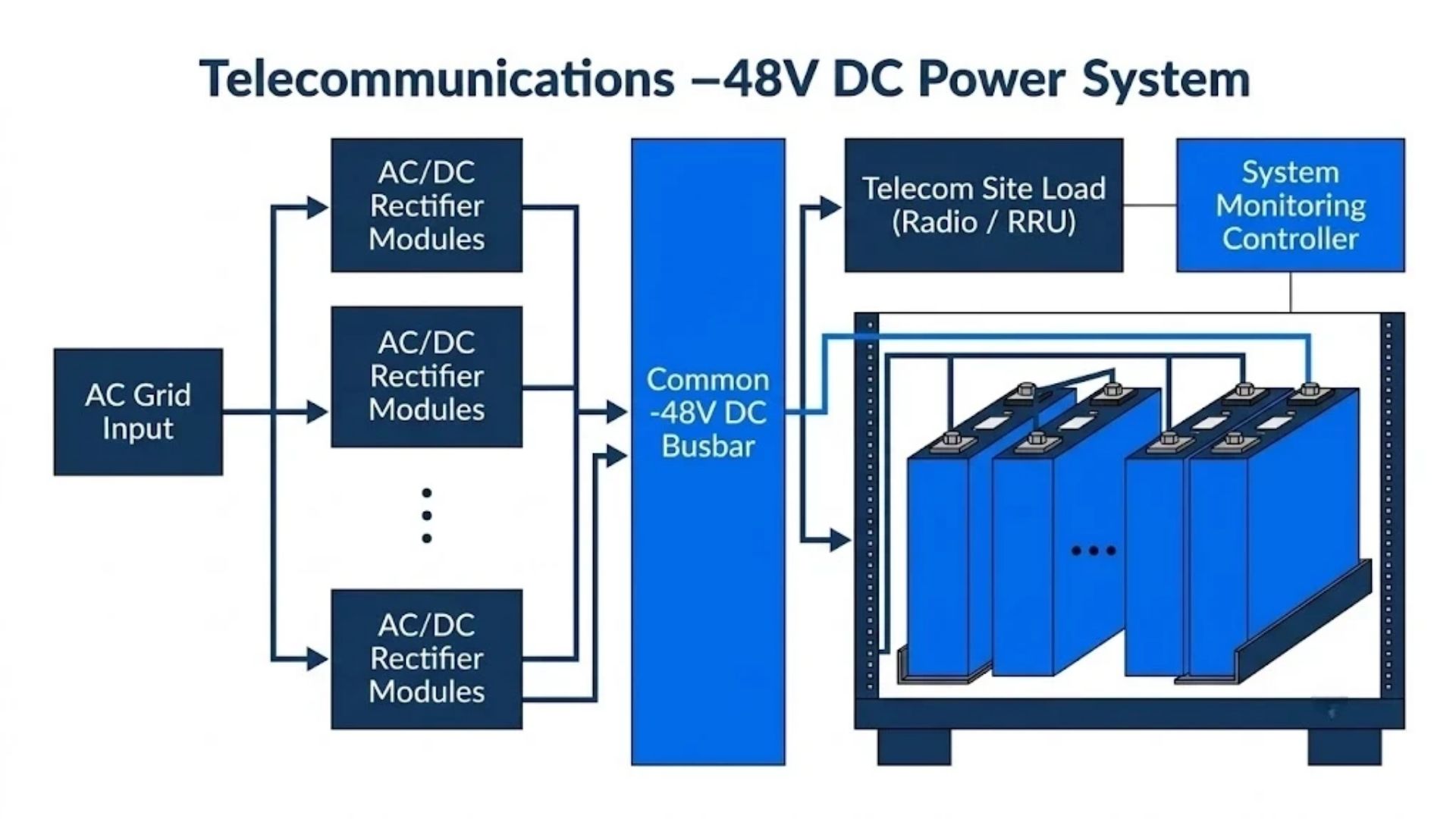
Telecom sites standardize on a nominal -48V DC plant (the negative conductor is grounded, hence the minus sign). A battery bank in telecom is a string—or several parallel strings—of cells sized to that voltage, connected directly across the common DC bus. Three elements work together:
-
Rectifiers (AC/DC power system): convert grid AC to regulated DC, power the load and recharge/float the battery. Multiple rectifier modules share the load and provide redundancy (N+1).
-
Battery bank: sits on the same bus at a voltage slightly below the rectifier output under normal conditions, so it carries no load but is fully charged and ready. The instant bus voltage collapses (mains loss), the battery supplies the load with zero interruption.
-
System controller / monitor: manages rectifier voltage and current limits, reports battery voltage, current, temperature, state of charge and alarms (mains fail, low battery, breaker open) to the NOC.
Key Point: Because the battery is permanently paralleled with the load, the rectifier's voltage settings are effectively the battery's charge settings. This is why correct rectifier programming—not the battery alone—determines float life, charge completeness and whether a LiFePO4 conversion succeeds.
For lead-acid, a 48V string is 24 cells; for LiFePO4 it is typically 15 or 16 cells in series (15S/16S). Capacity is extended by adding parallel strings or parallel rack modules rather than more series cells, keeping the bus voltage fixed. The wiring, busbars, breakers and sense leads must be rated for the fault current and installed to recognized practice; see our How to Install a LiFePO4 Battery Guide for series/parallel and protection basics.
Are Telecom Batteries Lead Acid? Battery Types
Historically, yes—the large majority of installed telecom batteries are VRLA (valve-regulated lead-acid), in either absorbed glass mat (AGM) or gel form, housed in cabinets, racks or on stands. That installed base is now shifting. Today a telecom battery can be any of the following:
| Type | Typical Use in Telecom | Notes |
|---|---|---|
| VRLA AGM | Legacy macro sites, offices (front-terminal/top-terminal) | Low upfront cost, mature; heat-sensitive, needs maintenance and periodic replacement |
| VRLA Gel | Hot/cycling environments, solar-hybrid sites | Better cycling and heat tolerance than AGM; still heavy and shorter-lived |
| LiFePO4 (LFP) | New builds, upgrades, small cells, weak-grid/off-grid | Long cycle life, near-zero maintenance, heat-tolerant, lighter; higher upfront cost |
| Vented / flooded (rare) | Older central offices | Requires watering rooms and ventilation; largely legacy |
So the answer to "are telecom batteries lead acid" is: most of the installed base is VRLA, but LiFePO4 is the fastest-growing choice for new and refurbished sites. The chemistry decision is essentially a comparison between VRLA and LiFePO4, which the next section addresses. For a cross-application view of that transition, see our Lead-Acid to LiFePO4 Conversion Guide.
VRLA vs LiFePO4 Telecom Batteries
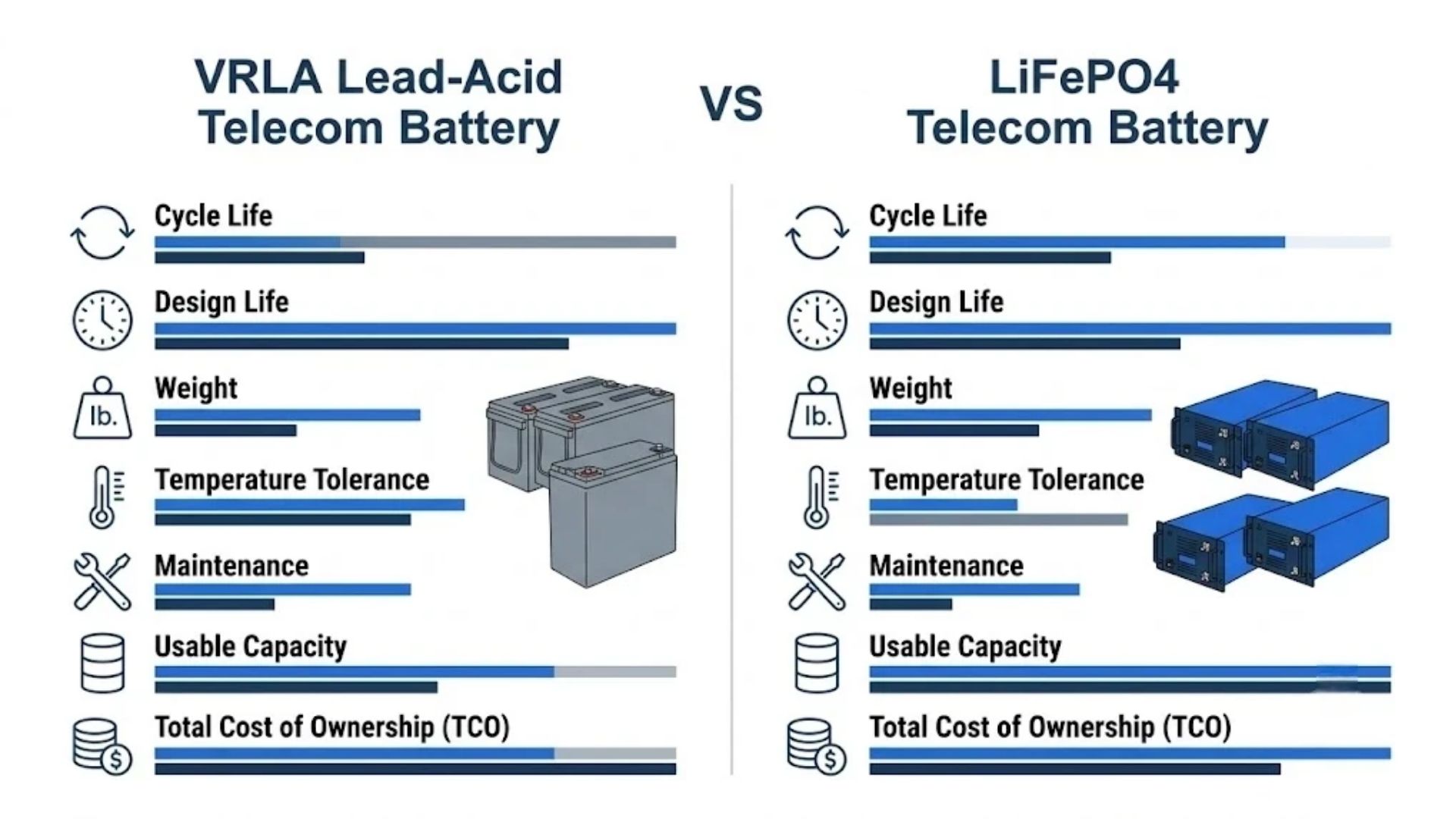
Stationary telecom duty is a float-and-occasional-discharge application, but sites increasingly cycle (outages, weak grids, solar hybrid). The two chemistries differ sharply under exactly these conditions.
| Attribute | VRLA (AGM/Gel) | LiFePO4 |
|---|---|---|
| Cycle life (80% DoD) | Roughly 500-1,500 cycles | Roughly 3,000-6,000 cycles |
| Design / float life | Typically 3-5 years; shorter when hot | Around 10 years under proper settings |
| Maintenance | Inspections, conductance tests, discharge tests, cleaning | Near-zero; BMS self-monitors and reports |
| Heat tolerance | Poor; high ambient accelerates corrosion and dry-out | Good; discharge to about 60°C, far less degradation |
| Weight / footprint | Heavy and bulky | About half the weight; more capacity per rack unit |
| Usable capacity | Often limited to 50-80% to protect life | About 90-100% usable routinely |
| Monitoring | External probes/testers; state inferred | BMS reports voltage, current, temperature, SOC per module |
| Upfront cost | Lower | Higher; offset by fewer replacements and site visits |
Fair TCO note: Two factors often overlooked when comparing cost: (1) lead-acid batteries have a scrap/recycling credit from their lead content, while LiFePO4 generally has little end-of-life residual value; (2) the dominant cost at many sites is the truck roll—technician travel, access and labor—not the battery. LiFePO4's financial advantage is therefore largest at remote, hot, hard-to-access or frequently-cycling sites, and may be smaller at easily-accessed, temperature-controlled sites where cheap VRLA is replaced on a routine cycle.
For the engineering detail behind the cycle-life figures—depth of discharge, state of health and the 80% end-of-life rule—see our LiFePO4 Cycle Life Guide (DoD, SOH & Cycle Count) and the user-facing LiFePO4 Battery Lifespan Guide.
How a 48V LiFePO4 Telecom Battery Works
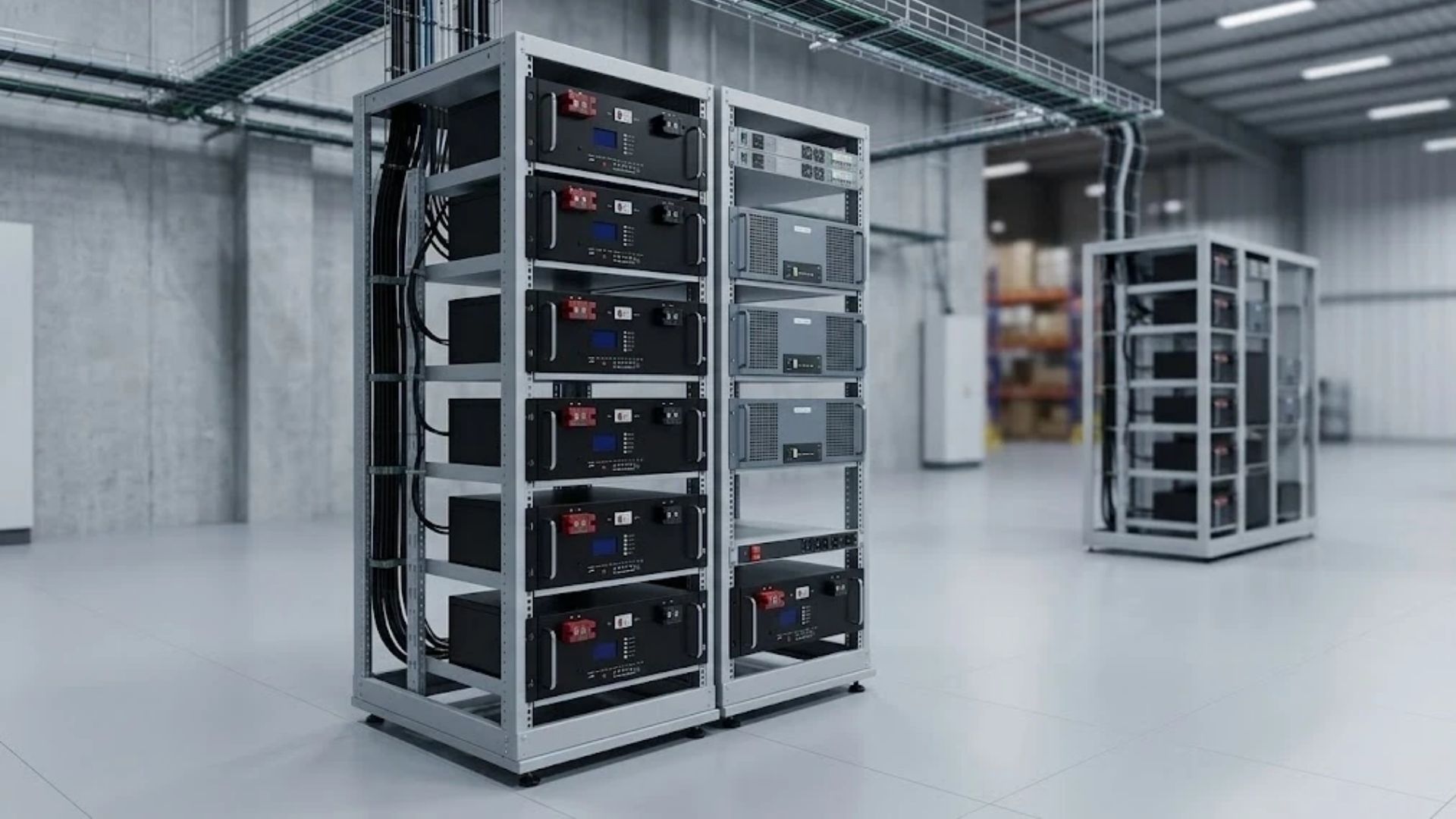
A modern 48V telecom lithium battery is built from large prismatic LiFePO4 cells (rectangular metal-cased cells—not small cylindrical cells) arranged in a 19-inch rack or cabinet module, with an integrated battery management system (BMS). The BMS is the module's brain; for a full description of its functions and how to specify one, see our companion page What Is a LiFePO4 BMS: Functions & Selection Guide.
In telecom service the BMS performs four jobs:
-
Monitors every series cell's voltage, plus pack current and temperature, and computes state of charge and state of health.
-
Protects against over/under-voltage, over-current, short circuit and over/under-temperature, opening contactors if a limit is breached.
-
Balances cells (typically passive balancing during charge) so capacity is not lost to weak cells—see How to Balance LiFePO4 Batteries.
-
Communicates with the site controller/NOC over CAN, RS485/Modbus or dry-contact alarms, and often Bluetooth for local commissioning.
During normal operation the module floats at the bus voltage set by the rectifier; during an outage it discharges to the load; when the grid returns, the rectifier recharges it (constant-current then constant-voltage) and the BMS resumes standby. Because LiFePO4 has a very flat voltage plateau, voltage alone is a poor fuel gauge—the BMS uses current integration (coulomb counting) to report an accurate SOC, which is why monitoring integration matters.
Key Specs: Voltage, Ah, kWh & Rack Dimensions
Telecom LiFePO4 modules are offered in standardized capacities and rack formats. Typical parameters for 19-inch rack modules are summarized below (exact values vary by manufacturer and configuration).
| Parameter | Typical Value |
|---|---|
| Nominal voltage | 48V (15S) or 51.2V (16S) |
| Charge voltage limit | About 54.75V (matched to the -48V plant) |
| Discharge cut-off | About 37.5-40V |
| Capacities | 50 / 100 / 150 / 200Ah per module; parallel for more |
| Energy (51.2V) | 2.56 / 5.12 / 7.68 / 10.24 kWh |
| Form factor | 19-inch rack, about 3U-4U per module (e.g., 50Ah near 3U, ~482×440×134mm) |
| Discharge temperature | About -20°C to +60°C |
| Charge temperature | About 0°C to +45°C |
| Communication | CAN, RS485/Modbus, dry-contact alarms; Bluetooth for service |
Note the two voltage conventions: a 15S module (nominal 48V) reaches about 54.75V at full charge and aligns almost exactly with the traditional -48V envelope, while a 16S module (nominal 51.2V) is charge-limited to roughly the same 54.75V to stay compatible with the existing rectifier and bus. Both work; the key procurement point is that the module's charge and discharge envelope matches the specific rectifier and load. For broader stationary sizing, see the 48V Solar Battery Storage Guide.
How Long Do Cell Towers Last Without Power?
The honest answer to "how long do cell towers last without power" is: it depends entirely on the battery's usable energy versus the site load—commonly 1-4 hours, but ranging from under an hour at a poorly-maintained site to 8-12 hours (or more) at sites with large banks, extended-reserve requirements, or solar assistance. Once the battery is exhausted, a site with a generator may continue; one without goes dark until the grid returns.
| Configuration (51.2V) | Usable Energy (approx, with conversion margin) | Runtime at 800W | Runtime at 1,200W |
|---|---|---|---|
| 100Ah (5.12kWh) | ~4.6kWh | ~5.8 hours | ~3.8 hours |
| 200Ah (10.24kWh) | ~9.2kWh | ~11.5 hours | ~7.7 hours |
These figures assume the DC load is fed directly (or through a highly efficient conversion) and include a realistic margin; actual runtime also falls with low temperature, battery age and the cut-off voltage. This is why operators size to a target reserve rather than rely on a generic number, and why a healthy, accurately-monitored battery matters more than a large nominal Ah rating that has quietly faded.
How to Size a Telecom Battery Backup
Sizing a telecom battery backup system follows a simple energy balance, then adds margin for efficiency, temperature and ageing.
Required Ah = (Load in W × Backup hours) ÷ (Nominal DC voltage × derate factor)
Use a derate factor of roughly 0.75-0.85 to account for conversion efficiency, the usable depth of discharge, low-temperature capacity loss and future fade; then select the next standard size up. Worked examples:
| Example | Calculation (51.2V, factor 0.8) | Select |
|---|---|---|
| 800W, 3h reserve | (800×3)/(51.2×0.8) ≈ 58.6Ah | 100Ah |
| 1,000W, 3h reserve | (1,000×3)/(51.2×0.8) ≈ 73.2Ah | 100Ah |
| 1,200W, 6h reserve | (1,200×6)/(51.2×0.8) ≈ 175.8Ah | 200Ah (or two 100Ah parallel) |
Add parallel modules for capacity or redundancy, but only combine identical modules at the same voltage and from—where possible—the same batch. At weak-grid or off-grid sites where the battery cycles daily, treat it as a cycling application and size for depth of discharge and cycle life rather than just reserve; our Solar Energy Battery Storage Guide covers PV-hybrid sizing.
Replacing VRLA With LiFePO4: Rectifier Compatibility
Not an automatic drop-in. A LiFePO4 module will physically connect to a -48V plant, but if the rectifier is left at VRLA settings it can undercharge, fail to balance, or apply voltage temperature compensation that lithium does not need. Always commission the conversion; never simply swap the battery and walk away.
When converting a site, verify and adjust the following:
| Setting / Check | VRLA (typical) | LiFePO4 |
|---|---|---|
| Float / charge voltage | ~54.0-54.4V (plus equalize ~56V) | Limit to ~53-54.75V; no high equalize cycle |
| Temperature compensation | Enabled (slope per cell) | Disable; LiFePO4 charge voltage barely changes with heat; only limit charging below 0°C |
| Current limit | Per battery spec | Set within module charge current; ensure rectifier can supply load + recharge |
| Low-voltage disconnect | Plant LVBD/battery LVD | Coordinate BMS cut-off (~37.5-40V) with plant LVBD to avoid deep discharge |
| Alarms / telemetry | Mains fail, low battery, breaker | Map BMS CAN/RS485/dry contacts to the controller and NOC |
| Cabinet / thermal | Existing cooling | Confirm airflow and clearance; lithium tolerates heat but electronics have limits |
After commissioning, perform a controlled discharge/recharge to verify alarms, runtime reporting and recharge behavior. If a module will not charge after installation, work through the causes in LiFePO4 Battery Not Charging: Troubleshooting Guide; if the BMS has latched off, How to Reset BMS on LiFePO4 and How to Wake Up a LiFePO4 Battery cover recovery.
Telecom Battery Monitoring & Communication
Telecom battery monitoring is what turns a battery from an unknown asset into a managed one. Modern LiFePO4 modules expose the data that VRLA only reveals through manual testing: per-cell and pack voltage, charge/discharge current, temperature, SOC, SOH, cycle count and fault status.
| Interface | Typical Use |
|---|---|
| CAN bus | Native BMS data to modern power-system controllers and site management |
| RS485 / Modbus | Integration with SCADA, site controllers and legacy monitoring; long cable runs |
| Dry-contact / relay alarms | Simple, universal mains-fail/low-battery/fault indication to the NOC |
| Bluetooth | Local commissioning and service via phone/tablet, no wiring |
| SNMP / network | At data rooms and managed sites, aggregated into NOC dashboards |
Specify the protocol your controller actually supports and request the protocol/register documentation up front. Remote SOC and fault visibility lets teams dispatch a service visit before a failed outage—converting unplanned emergency truck rolls into scheduled maintenance, which is usually the largest operational saving. For ongoing care and storage practices, see the LiFePO4 Battery Storage & Maintenance Guide.
Certifications & Standards to Require
Telecom batteries sit in unattended, often densely-equipped cabinets, so buyers should require a documented compliance package. The relevant standards depend on region and whether the battery is a cell, a module or an installed system.
| Area | Standards / Certifications |
|---|---|
| Battery safety (industrial/stationary) | IEC 62619; UL 1973 for stationary packs (North America); UL 1642 cells |
| EMC | EN 61000 series; EN 300 386 (telecom network equipment) |
| Environment / DC interface | ETSI EN 300 019 (environmental classes); EN 300 132 (DC power interface); ETSI TS 103 553 (innovative stationary storage) |
| Transport | UN 38.3, test summary and MSDS for shipping lithium |
| General | CE marking, RoHS; regional type approvals per operator |
Many MNOs and towercos add their own qualified-product/type-approval process and may reference additional regional requirements, so treat the table as the baseline, not the full list. Verify certificates against the actual model number and configuration, and request them before volume shipment. Our BESS Certification Guide explains stationary battery compliance in more detail, and the GB 38031 Safety Standard Guide covers a major Chinese benchmark. For shipping documentation, see the LiFePO4 Battery Shipping Certifications Guide.
B2B Buyer's Checklist
Whether you are an operator qualifying a fleet standard, a towerco upgrading a portfolio, or a contractor/integrator sourcing for a rollout, require the following:
-
Cells: large prismatic LiFePO4 from a traceable, consistent source—not small cylindrical cells; request cell origin and grade.
-
Voltage envelope: confirm nominal (48V/51.2V), charge limit (~54.75V) and cut-off (~37.5-40V) match the rectifier and load.
-
Capacity & runtime: verify Ah and kWh against your target reserve using the sizing formula, with derate and ageing margin.
-
BMS: per-cell monitoring, protection, balancing and an accurate SOC gauge; confirm fault behavior and recovery.
-
Communication: the exact protocol your controller supports (CAN/RS485/Modbus/dry contacts), with documentation.
-
Form factor: 19-inch/ETSI rack compatibility, module height (3U-4U), weight, airflow and clearance.
-
Temperature range: charge and discharge limits suited to the site climate; low-temperature charge protection.
-
Certifications: IEC 62619, UL 1973 (as required), EN 61000/EN 300 386, UN 38.3, CE/RoHS, matched to the model.
-
Conversion support: supplier guidance on rectifier settings, disabling temperature compensation, alarm mapping and commissioning.
-
Warranty & terms: years/throughput clauses, replacement policy, lead time, MOQ, spare modules and documentation package.
For the broader qualification of a battery factory, our How to Choose a LiFePO4 Battery Supplier Guide, China LiFePO4 Battery Manufacturer Sourcing Guide and Reliable Bulk Battery Suppliers Guide define the audit process; the Battery System Guidance Supplier Guide clarifies who does what on a project.
Frequently Asked Questions
Are telecom batteries lead acid?
Most of the installed base is VRLA (AGM or gel), but the choice for new and upgraded sites is increasingly LiFePO4. VRLA remains attractive on upfront cost for easy-access, temperature-controlled sites; LiFePO4 is favored where sites cycle, run hot, are hard to access, or where long life and minimal maintenance matter. The decision should be made on total cost and site conditions, not chemistry habit.
Do cell towers have backup power?
Yes. Cell sites are designed with a battery bank permanently connected to the -48V DC bus, which supplies the load immediately on mains loss; many sites also add a generator for longer outages. The reserve duration and alarms are typically set by regulation and operator SLAs—commonly 1-3 hours for macro sites, sometimes more.
How long do cell towers last without power?
It depends on usable battery energy versus site load: commonly 1-4 hours, but well-configured or solar-assisted sites can run 8-12 hours or longer, while neglected sites may last under an hour. A 51.2V 100Ah module can feed an 800W load for roughly 5-6 hours; a 200Ah module roughly doubles that. Age, temperature and cut-off settings reduce real runtime.
Do cell phone towers need electricity?
Yes—the radios, baseband units, backhaul and cooling all require continuous power, delivered as regulated -48V DC by rectifiers when the grid is present and by the battery (and sometimes a generator) when it is not. Without any of these sources, a site stops serving the network.
What is a battery bank in telecom?
It is the series string (or parallel strings) of rechargeable cells connected across the site's common DC bus, sized to the -48V nominal system. It floats fully charged during normal operation and instantly discharges to carry the load during a mains failure. Capacity is expanded with parallel strings/modules while voltage stays fixed.
What voltage is a telecom battery?
Telecom power systems are nominally -48V DC. A LiFePO4 bank is typically 15S (nominal 48V) or 16S (nominal 51.2V), charge-limited to about 54.75V and with a discharge cut-off around 37.5-40V, matching the traditional -48V envelope. The minus sign reflects the telecom convention of grounding the positive/negative rail (negative supply).
Can LiFePO4 directly replace VRLA telecom batteries?
Physically yes, but it is not a set-and-forget drop-in. The rectifier must be set to the lithium charge voltage (~53-54.75V), the high equalize cycle and VRLA temperature compensation disabled, current limits confirmed, and BMS alarms/telemetry integrated. After commissioning, verify runtime and recharge with a controlled test.
How long does a telecom LiFePO4 battery last?
Properly configured, LiFePO4 provides roughly 3,000-6,000 cycles to 80% depth of discharge and a design life around 10 years—several times the cycle life of VRLA. Actual life depends on depth of discharge, temperature, charge settings and whether the BMS and monitoring are correctly integrated.
How do you size a telecom battery backup?
Use Required Ah = (load W × backup hours) / (DC voltage × derate factor), with a factor around 0.75-0.85 for efficiency, usable depth, temperature and ageing, then choose the next standard size. For example, a 1,000W site needing 3 hours at 51.2V requires about 73Ah, so a 100Ah module is selected.
Are lithium telecom batteries safe?
LiFePO4 is inherently thermally stable with no cobalt and a high decomposition temperature, and the BMS adds per-cell voltage, current and temperature protection. For unattended sites, require IEC 62619 and (in North America) UL 1973, plus correct installation and ventilation. More on safety is in our LiFePO4 Battery Safety Guide and Are LiFePO4 Batteries Safe? Guide.
Related Resources
-
48V Rack-Mounted Lithium Battery Guide for Project Buyers — rack architecture, modules and procurement
-
What Is a LiFePO4 BMS: Functions & Selection Guide — BMS functions, parameters and matching
-
How to Reset BMS on LiFePO4 — recovering a latched BMS
-
Lead-Acid to LiFePO4 Conversion Guide — the chemistry transition across applications
-
How to Charge LiFePO4 Batteries Guide — charge voltage, current and stages
-
How to Balance LiFePO4 Batteries Guide — cell balancing and BMS behavior
-
BESS Certification Guide — stationary battery compliance
-
Complete B2B Sourcing Guide for LiFePO4 Batteries — applications and sourcing overview
Summary
A telecom battery is the stationary reserve that keeps a cell site's -48V DC plant running through every mains interruption—instantly, because it is permanently paralleled with the load.
-
System: rectifiers, a common DC bus, the battery bank and a monitoring controller; the battery floats ready and discharges on outage.
-
Types: the installed base is mostly VRLA (AGM/gel); LiFePO4 is the growth choice for new and upgraded sites.
-
Why LiFePO4: ~3,000-6,000 cycles, ~10-year life, near-zero maintenance, heat tolerance and lighter weight; higher upfront cost.
-
Specs: 48V/51.2V (15S/16S), ~54.75V charge limit, ~37.5-40V cut-off, 50-200Ah modules in 19-inch 3U-4U formats.
-
Runtime: commonly 1-4 hours, longer with large/solar-assisted banks; size from load × hours with a derate factor.
-
Conversion: not an automatic drop-in—set charge voltage, disable equalize and VRLA temperature compensation, integrate alarms.
-
Procurement: require prismatic cells, a capable BMS, the right communication protocol and IEC 62619 / UL 1973 / UN 38.3 documentation.
The cost of getting a telecom battery specification wrong is paid in network downtime and emergency truck rolls; the value of getting it right is measured in years of unattended, monitored reliability. Enerbe supplies 48V/51.2V prismatic LiFePO4 telecom battery modules with integrated BMS, CAN/RS485 monitoring and the required certification package, with support for VRLA-to-LiFePO4 commissioning. For wholesale pricing, custom configurations or a sample for qualification, contact our team.
Get In Touch
Ready to source LiFePO4 batteries for your project? Contact Enerbe today.
📄 Request a Technical Datasheet
Contact Us →📞 Speak with Our Engineering Team
Get In Touch →🔗 Browse Our Custom Battery Solutions
View Products →Dongguan A&S Power Technology Co., Limited.
Building 1, No. 2, Keji 9th Road,
Songshan Lake, Dongguan, Guangdong, China
📞 +86 137 1383 1631
✉ info@aspowerbattery.com
Stay Charged. Stay Connected.



LFP Battery Chemistry: LiFePO4 Crystal Structure & Charging Reaction Explained (2026)
Related Article


Get In Touch
Have questions about custom lithium batteries, energy storage solutions, or lead-to-lithium conversion? Our team is ready to help. Send us a message and we’ll respond within 24 hours.

Building 1, No. 2, Keji 9th Road, Songshan Lake, Dongguan, Guangdong, China
Office Address

info@aspowerbattery.com
Email Us

+86 137 1383 1631
Call Us

Sun - Fri (08AM - 10PM)
Office Open
